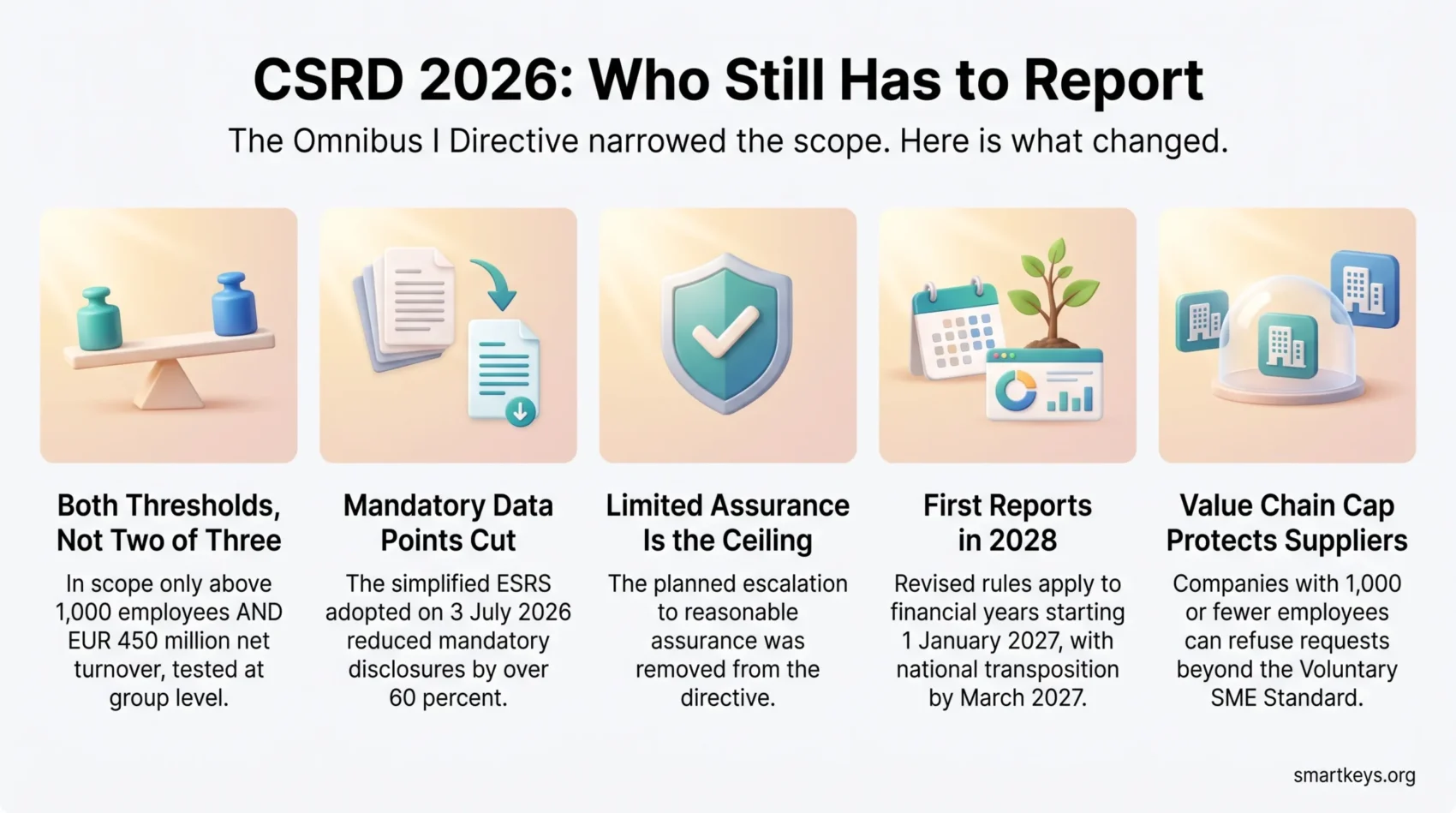
The Corporate Sustainability Reporting Directive (CSRD) is the European Union law that makes large companies publish audited information about their environmental and social performance. It entered into force on January 5, 2023. Three years later the rules look very different. The Omnibus I Directive (EU) 2026/470, in force since March 18, 2026, cut the number of companies covered and simplified what they must publish.
If your business has European operations, the first question is no longer “how do we report everything?” It is “are we still in scope, and for which financial year?”
The larger opportunity is better decision-making. Reliable sustainability data guides investors, managers, and operational teams toward stronger choices, whether or not you file a statement in Brussels. This guide covers the current rules, the simplified standards adopted in July 2026, and how to turn reporting into lasting business value.
Key Takeaways
- The CSRD took effect on January 5, 2023; the Omnibus I Directive (EU) 2026/470 reshaped it on March 18, 2026.
- Scope now depends on two thresholds: more than 1,000 employees and more than €450 million in net turnover.
- The revised rules apply to financial years beginning on or after January 1, 2027, and member states must write them into national law by March 19, 2027.
- The simplified ESRS adopted on July 3, 2026 cut mandatory data points by more than 60%.
- Only limited assurance is required; the planned step up to a full audit was removed, and sector-specific standards were dropped.
- Disclosures still belong in the annual or management report, in XHTML with iXBRL tagging.
What Is CSRD Reporting and Why Does It Matter?
CSRD reporting means publishing audited sustainability information inside your annual or management report, following a common EU standard. It is not a separate glossy brochure. It sits in the same document your investors and lenders already read, and an external assurance provider checks it before it goes out.
That changes how you collect the information. A number such as annual energy use can no longer come from a spreadsheet nobody owns. It needs a source, a method, and an owner. In return, investors and managers get a clearer view of environmental performance, social impacts, and financial risk.
From the 2014 NFRD to a Broader Framework
The European Union adopted the Non-Financial Reporting Directive (NFRD) in 2014. It asked large listed companies for a short narrative on environmental and social matters, with little prescription about content. Reviews of that regime, including a 2021 European Parliamentary Research Service briefing, found that the resulting data often lacked consistency and comparability.
The CSRD responded in two ways. It extended disclosure beyond listed public-interest entities, and it replaced loose narrative with a regulated process: common standards, independent assurance, and digital filing. The Omnibus I Directive later pulled the perimeter back toward the largest groups, but kept that architecture intact.
Why Better Data Supports Better Decisions
Comparable data helps investors, analysts, and customers assess a company’s progress and exposure. You can also use it to spot waste, prepare for climate risks, and guide capital toward stronger projects. That is why many companies outside the legal perimeter still run the process, much as they treat digital transformation as an operating decision rather than a compliance exercise. If you are choosing standards rather than applying a mandate, start with a broader ESG framework comparison.
This approach supports the European Green Deal and the European Union’s goal of climate neutrality by 2050. Clear disclosure turns sustainability from a flexible narrative into useful business intelligence.
Who Must Comply With the CSRD Under the Current Rules?
The Omnibus I Directive (EU) 2026/470 took effect on March 18, 2026 and sharply narrowed the scope of the reporting directive. Member states must transpose it by March 19, 2027, which means writing it into their own national law. The revised rules then apply to financial years that begin on or after January 1, 2027. Many mid-sized businesses that spent 2024 and 2025 preparing are now outside the perimeter.

Updated Employee and Net Turnover Thresholds for EU Companies
Under the new test, an EU company falls within scope only when it exceeds both thresholds: more than 1,000 average employees and more than €450 million in annual net turnover, meaning total sales after discounts and sales taxes. The earlier two-out-of-three size test no longer applies, so a company with 1,200 staff and €300 million in turnover is out.
Review group data, workforce records, and turnover every year, because an acquisition can push headcount back over 1,000.
- Employee threshold: more than 1,000 average employees
- Turnover threshold: more than €450 million in net turnover
- Effective period: financial years starting on or after January 1, 2027
Requirements for Non-EU Parent Companies
A parent company based outside the EU may still need to comply. Two conditions apply together. Its EU net turnover must exceed €450 million in each of the last two consecutive financial years. It must also have an EU subsidiary or branch generating more than €200 million in net turnover.
When the European Commission proposed the 1,000-employee threshold, it estimated the change would take roughly 80% of previously covered companies out of CSRD scope. The obligation now concentrates on the largest groups.
Out of Scope Is Not the End of the Question
If you have just fallen outside the perimeter, two things are worth knowing before you dismantle the programme.
The scope was recalibrated rather than closed. Both the CSRD and the CSDDD contain formal review clauses, and the EU left the door open to adjusting thresholds again. A data collection process torn down this year may have to be rebuilt in three.
The second point is commercial rather than legal. Institutional investors, lenders and large corporate customers continue to ask for emissions and supply chain data as a condition of capital and contracts, and the Omnibus did nothing to change that. It lowered the regulatory floor, not the market expectation. For many mid-sized companies the practical shift is that sustainability data stops being a filing obligation and becomes a sales and financing requirement, which is a different owner and a different deadline but the same underlying numbers.
When Do CSRD Reporting Requirements Apply?
Your compliance date depends on company size, group structure, and financial year. The original law phased companies in through three waves, and the Omnibus rewrote that timetable. Confirm your position before building a long-term process.
If You Are Already Reporting Under the CSRD
Companies that were already reporting continue to do so until FY2027 unless their member state grants relief. The directive lets member states exempt companies that fall below the new thresholds for financial years beginning between January 1, 2025 and December 31, 2026. That relief is optional, so check your national transposition law before you stop reporting.
Large EU Companies and Non-EU Issuers: FY2027
Large EU companies and non-EU issuers that meet the new thresholds report for FY2027 and publish their first statements in 2028. They apply the simplified ESRS adopted in 2026. Review employee counts, group turnover, and legal entity structures early, because the thresholds are tested on consolidated group figures rather than on each entity alone.
Non-EU Parent Groups: FY2028
Qualifying non-EU parent groups report for FY2028, with statements published in 2029. If you operate across several EU countries, review national enforcement practices too, because member states set their own penalty regimes.
How the European Sustainability Reporting Standards Shape Disclosure
EFRAG, the technical advisory body that writes the detail for the European Commission, develops the European Sustainability Reporting Standards (ESRS). They turn broad legal duties into practical requirements for collecting and presenting information.
The original set of 12 ESRS covered cross-cutting principles, environmental matters, social topics, and governance including business conduct. They became legally binding after publication in the EU Official Journal in December 2023, giving investors a consistent basis for comparing companies and industries.
“A clear standard turns complex sustainability information into useful business insight.”
On July 3, 2026, the European Commission adopted a revised, simplified set. Mandatory data points fell by more than 60%, and the total number of data points by more than 70%. The Commission also discontinued work on sector-specific ESRS, so the industry-tailored standards many companies were waiting for will not arrive. They are expected to enter into force in November 2026, once the European Parliament and Council scrutiny period closes without objection. They apply to financial years beginning on or after January 1, 2027.
Two reliefs bite earlier. From FY2026, companies may use a top-down materiality approach. You start from your business model and the places where impacts and risks are likely to arise, instead of screening every topic from the bottom up. Also from FY2026, a value chain cap limits what you may demand from smaller suppliers. A supplier with 1,000 or fewer employees may decline anything beyond the voluntary standard. If you ask for more, you must flag the extra request and say the supplier can refuse it.
Review your data systems early. A simpler framework still requires accurate evidence, clear ownership, and consistent methods.
How Double Materiality Determines What You Report
A focused materiality review decides which sustainability topics deserve attention. In reporting, a topic is material when leaving it out would change how a reader judges the company. Double materiality applies that test twice: once for your company’s effect on people and nature, and once for the way sustainability issues affect your finances. The Omnibus kept both perspectives, and EFRAG publishes guidance to support the process.

Impact Materiality for People and the Planet
Impact materiality examines how your operations affect stakeholders. Carbon emissions, workforce composition, and human rights can reveal positive or harmful effects. Your assessment should use reliable data, measured results, and clear information from across the value chain. That is where blockchain in logistics and similar traceability tools earn their keep.
Financial Materiality for Business Performance and Risk
Financial materiality looks at how sustainability matters influence cash flows, access to funding, business risks, and financial performance. Take a plant that runs on cheap gas. Its energy use shows today’s impact, its reduction target shows tomorrow’s obligation, and the retrofit budget shows the cost. A structured risk management framework makes those links explicit rather than anecdotal.
Use double materiality to filter the relevant ESRS topics. The process should capture measured impacts as well as targets, strategies, and risk assessments.
- Map impacts on people, communities, and ecosystems.
- Assess financial risks and opportunities.
- Document evidence, methods, and stakeholder input.
- Review materiality decisions as conditions change.
What Sustainability Information Must Your Company Disclose?
Your disclosure should show how sustainability issues affect operations, people, and financial plans. The standards set the framework; each company gathers the evidence from its own systems and partners.
Environmental Metrics, Climate Risks, and Transition Plans
The climate standard covers Scope 1, Scope 2, and material Scope 3 emissions. Scope 1 is what you burn yourself, such as fuel in company vehicles. Scope 2 is the electricity and heat you buy. Scope 3 is everything else in the chain: suppliers, transport, distribution, and customer use of the product. It is the hard one, which is why most reporters lean on dedicated carbon accounting software rather than spreadsheets. Companies also explain energy, water, waste, pollution, biodiversity, climate risks, and progress against their carbon neutrality goals.
Transition plans are where disclosure meets capital planning. If your roadmap depends on climate tech or wider green technology investment, show the assumptions and the funding behind them.
Employees, Human Rights, and Value Chain Impacts
Social disclosures cover workforce composition, pay equity, working conditions, social protection, and human rights due diligence. Companies already moving toward pay transparency find this section easier, because the data already exists. A value chain review should identify risks linked to suppliers, communities, consumers, and end users.
Governance, Ethics, and Sustainability Oversight
Governance disclosures address board oversight, risk management, business conduct, and anti-corruption controls. Someone must own each figure, one reason sustainability duties keep appearing among emerging C-suite roles.
How CSRD Reports Must Be Presented and Tagged
Format matters as much as content. Your sustainability statement sits inside the annual or management report, which helps readers connect it with strategy, results, and risk.
Connecting Sustainability Information With Business Results
ESRS 2, the cross-cutting standard on general disclosures, expects you to explain how sustainability matters relate to financial results and risk management. Use narrative links and cross-references between sections. Placing ESG content beside financial pages does not prove integration. Good data storytelling is what turns a compliance annex into something the board actually reads.
Your report should show the business connection. Link energy costs to operating performance, or workforce risks to talent plans. That gives investors context and helps internal teams decide better.
Making Reports Machine-Readable
The annual report is filed in ESEF/XHTML, the web-page format the EU already uses for financial statements. iXBRL tags then sit inside that file and label each figure, so software can read “Scope 1 emissions” as data rather than as text. The European Single Access Point, the EU’s public database of filings, can then index and compare those figures.
The Omnibus left this mandate untouched. Tagging only becomes operational once the Commission adopts the technical standard that defines the sustainability taxonomy, the official list of tag names. The EU securities regulator ESMA is preparing it.
- Place disclosures within the annual or management report.
- Use cross-references to connect sustainability, financial, and risk information.
- Track the ESMA digital taxonomy so tagging does not arrive as a surprise.
What Assurance and Compliance Controls Does the CSRD Require?
Trust depends on more than a polished report. Every sustainability statement must receive independent external assurance before publication, which is stricter than the largely optional review under the NFRD.
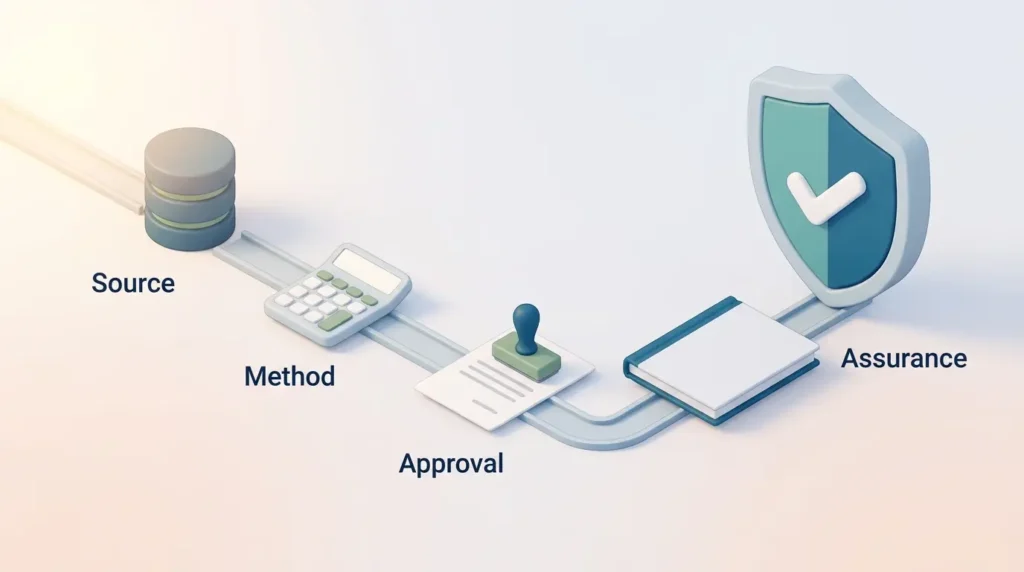
The required level is limited assurance. The auditor asks questions and runs targeted checks, then states that nothing came to their attention suggesting the report is wrong. Reasonable assurance, the level used for financial statements, demands far more testing. The Omnibus I Directive removed the Commission’s option to escalate to that higher level, so the deeper audit companies were bracing for is off the table. Clear evidence trails still pay for themselves at limited assurance.
Preparing Sustainability Data for External Assurance
Auditors need to connect each number with its source, calculation method, data owner, approval, and published disclosure. Good controls make that review faster and let you correct gaps before filing rather than during fieldwork. The discipline mirrors what finance automation brought to the financial close: fewer manual handoffs, more traceability.
Building Traceable and Audit-Ready Processes
- Document Scope 3 estimates and supplier submissions.
- Review manual adjustments and preserve version histories.
- Capture management sign-offs and cross-report checks.
Member states set penalties under national law, and officials may weigh the gravity of a breach, its duration, and a company’s financial standing. Strong CSRD compliance reduces that exposure. Treat assurance as an ongoing control, not a final hurdle. RegTech tools can automate parts of the evidence trail, though they do not replace ownership.
How to Prepare Your Data and Teams for CSRD Compliance
Build one process across the organization. Finance, sustainability, internal audit, risk, HR, procurement, suppliers, and assurance providers all need clear roles. That teamwork keeps the information reliable when the rules shift again.
Start with a double materiality assessment and an ESRS gap analysis, a side-by-side check of what each standard asks for against what you can already evidence. Early planning makes compliance manageable.
- Create data governance rules with named owners, approval steps, and audit trails.
- Connect finance, HR, digital procurement, business units, and suppliers through common controls.
- Engage stakeholders early, including assurance providers, to validate complex estimates.
- Consolidate source data where it can be queried, whether in a warehouse or in data lakes, and map each field to an ESRS requirement.
- Check where sustainability data may be stored and transferred, since data localization laws can constrain group-wide systems.
- Align your model with the GRI standards, the SFDR, and the ISSB standards IFRS S1 and S2, so one data set feeds every framework instead of three parallel reporting stacks.
A shared data foundation reduces duplicate work and improves quality. Pairing it with self-service analytics lets the teams closest to the numbers check them before an auditor does. That is how compliance becomes a byproduct of good management rather than a project.
How to Turn CSRD Reporting Into Business Value
Good disclosure does more than satisfy regulators. It helps you find waste, manage risk, and guide stronger decisions. Corporate sustainability becomes useful when leaders connect it to daily operations.

Reducing Costs and Improving Operational Performance
Use the collection process to review energy, waste, freight, and resource use. The data usually reveals inefficiencies that quietly raise costs: a compressor running overnight, a half-empty weekly truck, packaging heavier than the product needs.
Platforms that track figures continuously rather than once a year turn this into a management tool. Feeding them into real-time data dashboards lets teams act on a trend in March instead of finding it in next year’s report.
Strengthening Supply Chain Visibility and Resilience
Scope 3 analysis exposes concentration and risk across suppliers, logistics partners, and downstream activities. Companies use those findings to improve product design, pricing, and demand planning. The same evidence backs customer-facing claims, which matters because buyers increasingly check them.
- Give procurement teams clearer supplier performance insights.
- Anticipate disruptions and improve supplier engagement.
- Link sustainability targets with investment and operating priorities.
- Use credible disclosure to build trust with customers and lenders.
Stronger visibility helps businesses respond faster and sets them apart in a climate-conscious market. When sustainability supports strategy, reporting creates lasting value.
How CSRD Connects With the EU Taxonomy and SFDR
Three EU rules overlap here, and it helps to keep their jobs apart. The CSRD governs what companies disclose. The EU Taxonomy classifies which activities count as environmentally sustainable; its Regulation (EU) 2020/852 entered into force on July 12, 2020. The SFDR, the Sustainable Finance Disclosure Regulation, governs how investment products describe their sustainability features.
Where applicable, EU Taxonomy alignment data becomes part of the sustainability information you publish. You may need to show whether activities are eligible and whether they meet the Taxonomy’s technical screening criteria, the tests that decide when an activity really qualifies.
The SFDR applies mainly to financial-market participants, asset managers, and banks. Consistent CSRD information flows into their reporting, which is one reason green finance teams watch corporate disclosure so closely.
“One clear data trail can serve several regulatory needs.”
The Commission’s simplification effort aims to reduce duplication across the CSRD, EU Taxonomy, and SFDR. EFRAG is also aligning the simplified ESRS financial materiality requirements with the ISSB standards, the global baseline used by many non-EU markets. That narrows the gap for groups already reporting under IFRS S1 and S2, and turns one directive’s data into information several markets can use.
Conclusion
Sustainability reporting now sits in the annual report, supported by the ESRS, digital tags, and independent assurance. The Omnibus made the perimeter smaller, not the discipline softer.
Begin by checking your position for FY2027 against the 1,000-employee and €450 million thresholds, the transition rules for companies already reporting, and the non-EU parent criteria. Getting this right first prevents months of wasted preparation.
Next, use double materiality to focus disclosures on the issues that genuinely affect people, the planet, and financial performance. The simplified ESRS reward that focus with far fewer mandatory data points.
With clear ownership, the process supports stronger decisions, resilient operations, and long-term value. Treat the CSRD as a foundation rather than a yearly burden, and the work keeps paying off long after filing.
Found this useful?
Make SmartKeys a preferred source on Google, and our articles will surface more often in your Top Stories, AI Overviews, and AI Mode.
Add as Preferred Source