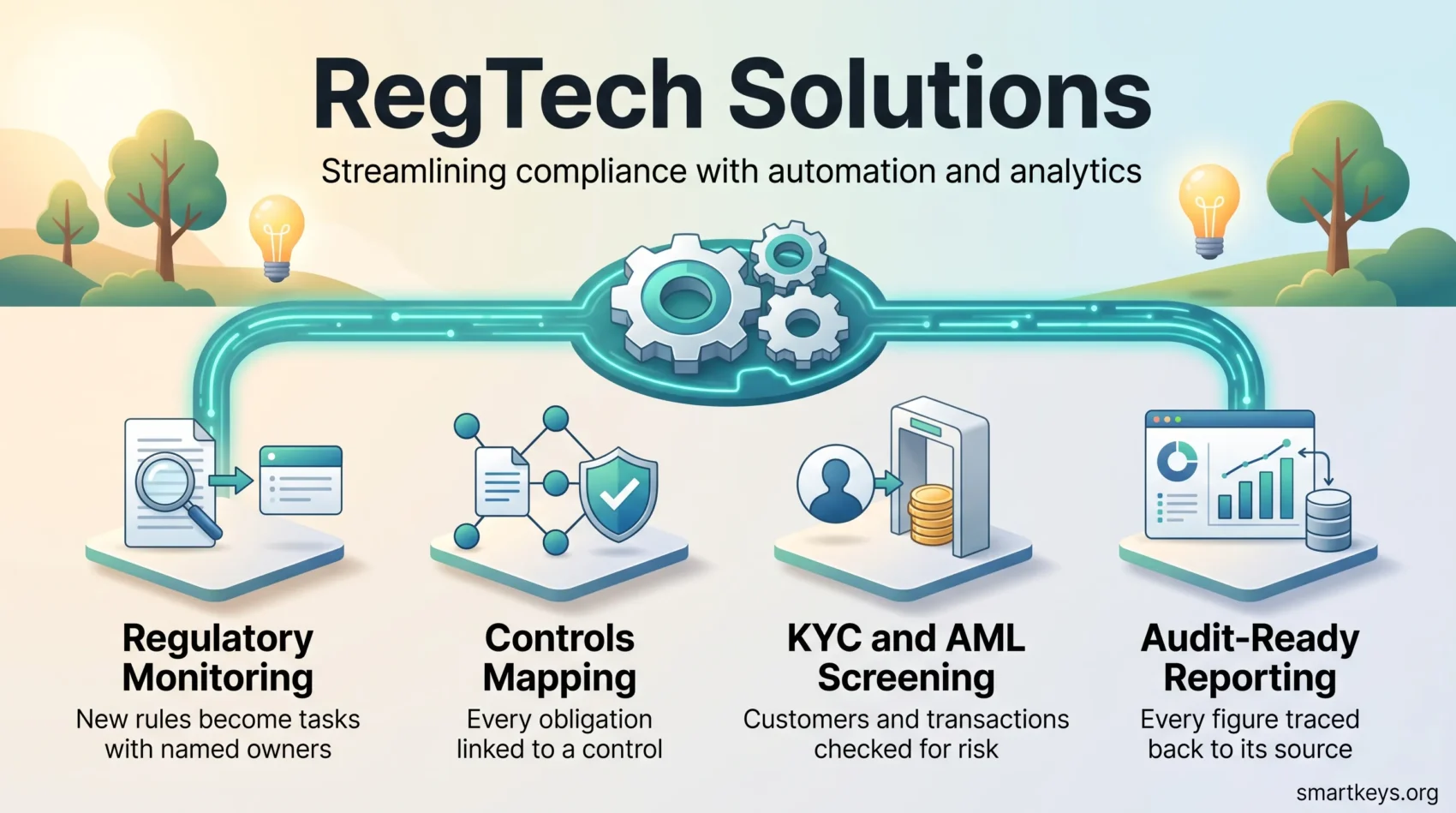
RegTech is short for regulatory technology: software that automates the work of proving your company follows the rules it is subject to. Instead of an analyst reading new regulations and copying obligations into a spreadsheet, the software reads the rule, flags what changed, and assigns the task to a named owner.
That sounds small. In practice it is the difference between a compliance team that spends its week on clerical work and one that spends it on judgement calls.
This guide is written for people who run compliance, risk or operations at a bank, insurer, fintech or investment firm. It covers what these tools actually do, which vendors do what, how to connect them to systems you already own, and how to prove the investment paid off.
Key Takeaways
- RegTech automates regulatory monitoring, evidence capture and reporting, which cuts cycle time and manual error.
- Capture your data once, then reuse it across monitoring, attestations and board reporting.
- Choose a platform that matches your actual risk profile, not the longest feature list.
- Build the business case on measurable baselines: cycle time, rework, and evidence completeness.
- Keep humans in the loop. Automated interpretations of a rule still need a reviewer who owns the decision.
- The market is split between broad platforms and specialists. Many firms end up running both.
What RegTech is and why financial firms adopted it
RegTech is a branch of fintech, the wider field of technology applied to financial services. Where most fintech aims at customers, RegTech aims at the back office: the monitoring, screening, recordkeeping and reporting that regulators require.
The market reflects that demand. Grand View Research valued regulatory technology at $24.3 billion in 2025 and expects it to reach roughly $29.3 billion in 2026, growing at about 21% a year through 2033.
What that looks like on a normal Tuesday
Take a mid-sized bank that must track rule changes from several regulators. Before automation, an analyst scans regulator websites, reads what is new, decides which business line it touches, and emails the owner. Nothing is logged. When an examiner asks what the bank monitored in March, someone reconstructs it from an inbox.
With a regulatory change engine, the same flow is automatic. The tool ingests the publication, extracts the obligations inside it, tags the affected business line, and opens a task with a due date. The audit trail writes itself.
Why adoption accelerated
Three pressures pushed firms to automate rather than hire.
First, rule volume kept rising while compliance budgets did not. Second, fraud and cyber threats moved faster than manual review cycles could follow. Third, examiners started expecting evidence that was traceable to source data, not a summary memo.
Machine learning helps with the reading. Models classify documents and extract obligations far faster than people can. They also make mistakes, which is why every serious deployment keeps a human reviewer on anything consequential. For a wider view of where the sector is heading, see our overview of business trends shaping fintech.
The regulatory picture heading into 2026
Two things shape how much monitoring you need: how actively your regulators enforce, and how many new rules are landing.
What US enforcement actually looked like
The SEC filed 456 enforcement actions in fiscal year 2025 and obtained orders for $17.9 billion in monetary relief, according to its own published results. That headline number needs a caveat the SEC itself supplies: most of it comes from a single Ponzi scheme judgment and from amounts deemed already satisfied. Stripping those out leaves roughly $2.7 billion in disgorgement and penalties.
The useful signal is not the dollar figure. It is that roughly two thirds of standalone actions charged individuals, a 27% increase year over year. Personal exposure changes how seriously control owners treat attestations.
Two European rules that now reach US firms
The EU’s Digital Operational Resilience Act, usually shortened to DORA, has applied since 17 January 2025. It sets requirements for how financial entities manage technology risk, report IT incidents, and oversee their IT vendors. If you serve EU clients or run an EU entity, it applies to you.
The EU AI Act phases in on a published schedule. Prohibitions on certain AI uses applied from 2 February 2025. Obligations for providers of general-purpose AI models applied from 2 August 2025. Transparency rules and enforcement began on 2 August 2026, and the rules for high-risk systems listed in Annex III now apply from 2 December 2027 after the Digital Omnibus revisions. Our guide to EU AI Act compliance breaks the risk tiers down, and our piece on preparing your business for new AI rules covers the wider picture.
How to turn that into a monitoring cadence
- Subscribe to feeds for the regulators that actually govern you, then route alerts to named owners automatically.
- Use a dashboard to show open obligations, due dates and overdue items in one view.
- Prioritize by enforcement exposure. Where regulators are active and your controls are weakest, test first.
Core capabilities: what these tools actually do
Vendors describe their products differently, but the useful capabilities fall into four groups.
Regulatory monitoring and change management
The tool ingests regulatory publications, classifies them, extracts the obligations inside, and routes each one to an owner. Compliance.ai is a well-known example of the model that pairs machine classification with human review.
Policy management and controls mapping
Controls mapping means linking each obligation to the specific control that satisfies it, and to the person responsible. Once that map exists, a rule change immediately shows you which controls and which policy paragraphs need updating. Workflow automation then replaces the email chain: tasks, approvals and version history live in one place.
KYC, AML screening and transaction monitoring
KYC stands for know your customer, the checks that confirm who you are doing business with. AML stands for anti money laundering, the monitoring that flags suspicious transactions. These systems screen customers against sanctions lists, watch transactions for unusual patterns, and open cases for review.
The practical problem is false positives. A poorly tuned system buries analysts in alerts that turn out to be nothing. Tuning thresholds and scenarios is ongoing work, not a setup step.
Reporting with data lineage
Data lineage means you can trace any number in a report back to where it came from. An examiner asks how a figure was produced, and you show the source system, the transformation, and the approval. Reports without lineage force you to rebuild the answer under time pressure. Our data governance strategy guide covers how to build that foundation.
Mapping obligations to your actual processes
Software does not fix a process you have not defined. Start with intake.
Capture every regulatory change in one standard form. Tag its priority and the business line it touches. Route it to an owner automatically rather than deciding case by case.
Then map each requirement to a control, an owner and a due date. This mapping is the piece most firms skip, and it is the piece that makes everything downstream possible. Without it, you cannot answer the question examiners ask most often: which control covers this obligation, and who signed off?
Closing the loop with evidence
An attestation is a periodic sign-off in which a control owner confirms the control is working. Keep them short. Three clear questions with links to supporting documents beat a long form nobody reads carefully.
Build reports that roll up control status, exceptions and remediation, with a drilldown to the underlying evidence. Then set a rhythm: weekly for open tasks, monthly for exceptions, quarterly for the full control review.
- Use one taxonomy for obligations, controls and evidence so teams can compare across business lines.
- Automate task creation so nothing waits for a person to notice it.
- Store evidence where it was produced, not in a separate audit folder someone updates before an exam.
Who benefits inside the organization
Risk and compliance teams
They get visibility first. Dashboards show what is open, who owns it and what is late. The automation removes the copying and chasing that fills most of a compliance analyst’s week.
Product and operations
They get context. When a rule changes, the relevant teams see what it means for their process rather than receiving a forwarded PDF. Approvals move faster because the reviewers already have the background.
Executives and boards
They get prioritized exposure rather than a status update. Clear reporting on where risk is concentrated lets them direct people and budget before an issue becomes an enforcement matter. Our risk management framework guide covers how to structure that oversight.
The vendor landscape
The market splits into broad platforms and specialists. Compare them on integration readiness, coverage of the rules you actually face, and how much administration they need.
Regulatory change and policy management
Ascent, CUBE and Corlytics track rule changes and keep policy text aligned with obligations. Clausematch, long a standalone name in policy management, was acquired by Corlytics and now ships as part of that platform.
KYC, AML and sanctions screening
ComplyAdvantage, Fenergo, Castellum.AI and AML Partners cover customer screening, watchlists and case workflows. Fenergo is the usual choice where client onboarding is complex and ongoing due diligence is heavy.
Third-party risk, surveillance and governance
Aravo Solutions and Albany Group focus on vendor oversight and due diligence, which DORA made considerably more important for EU-facing firms. For communications surveillance and behavioral detection, Behavox and Darktrace are the established names.
Data quality, recording and consent
Datactics handles data quality and lineage, the unglamorous work that determines whether your reports are trustworthy. ASC Technology records and analyzes regulated communications for trading desks. For cloud security posture, Check Point’s CloudGuard (formerly Dome9) is widely deployed, and consent management tools such as Cookiebot handle cookie and tracking consent.
- Check integration depth before features. A tool that cannot read your core system will not save anyone time.
- Ask for audit trails and data lineage in the demo, using your own data.
- Match the vendor to your team’s skills. A powerful platform nobody can configure is shelfware.
Connecting RegTech to your existing systems
Most firms already run a GRC stack: the governance, risk and compliance tools that hold policies, risk registers and audit records. A new platform that does not talk to those systems creates a second version of the truth, which is worse than no platform at all.

APIs, connectors and orchestration
An API is simply an agreed way for two systems to exchange data automatically. Connectors let the compliance platform pull customer records from your core banking system and push task status back to your GRC tool, so owners see updates where they already work.
Orchestration is the layer above that. It ties alerts, tasks and approvals into one flow: an alert fires, the platform assigns the owner, triggers the review, and files the evidence. Nobody maintains a spreadsheet to track it. Tools in this space overlap heavily with general integration platforms.
Bridging older processes
Do not migrate everything at once. Pick one high-value workflow, move it, validate that the data arriving matches the data leaving, then expand.
“Preserve institutional knowledge while you modernize. Migrate history, secure the pipelines, and keep controls traceable.”
- Secure the pipelines and restrict access. Compliance data is some of the most sensitive you hold.
- Migrate historical records so your audit trail does not start on go-live day.
- Embed checks in daily work rather than adding a separate compliance step at the end.
- Measure success by cycle time, error rate and reporting speed, not by features enabled.
Data quality and model governance
An automated interpretation of a rule is only defensible if you can show how it was produced. That starts with the data underneath it.
Quality, lineage and auditability
Define your schemas, version your data, and set retention rules. Keep change logs, model versions and test sets together so you can produce evidence quickly rather than assembling it during an exam.
The practical test is simple. If a regulator asks why a transaction was not flagged in March, can you show which model version ran, what data it saw, and who reviewed the output? Our guide to explainable AI in business decisions covers how to make model behavior legible to non-specialists.
Human oversight is not optional
Machine learning is good at classification and extraction. It is unreliable at judgement, especially where a rule is ambiguous or newly published.
Build explicit review steps. Set thresholds above which a human must sign off. Define escalation paths for high-impact items. Monitor for model drift, which is the gradual decline in accuracy as the real world moves away from the training data, and recalibrate on a schedule rather than after a failure.
Designing workflows people will actually use
The most common failure is not technical. It is that the new platform sits beside the old email habit instead of replacing it.
Convert recurring email threads into tasks with owners and deadlines. Set service levels and automatic reminders so time-sensitive items surface before they are late, not after. Standardize intake forms so management can compare progress across teams without translating three different formats.
- Embed controls testing into normal work rather than running it as a separate annual exercise.
- Keep change logs and version history so the audit trail runs from assessment to published policy.
- Pilot with one team, train them properly in a short session, then expand once the workflow holds up.
From business case to go-live
Tie the business case to specific tasks and measurable outcomes. “Improve compliance” is not a business case. “Cut the time from rule publication to assigned owner from nine days to one” is.
Running the vendor selection
An RFI is a request for information, a short questionnaire that narrows the field. An RFP is a request for proposal, the detailed round where shortlisted vendors price the work. Structure both around your risk appetite, your data sources, the integrations you need, and the workflows you want covered.
Score vendors on platform fit, quality of evidence generated, and total cost to serve your processes, including the internal effort to run the thing.
Pilot and change management
Design the pilot with success criteria written down before it starts. Include model validation with human review in the scope. Assign stakeholder roles and plan the change management, because adoption is where most of these projects quietly fail.
“Measure early wins such as reduced cycle time and fewer manual steps, then publish them to keep momentum.”
- Agree governance and approval paths with business owners before go-live, not during it.
- Budget realistic time for integration, data migration and training. These always take longer than the demo suggests.
- Negotiate support terms that match your team’s capacity to self-serve.
Before go-live, confirm migrated history is complete, validate every integration, test an attestation end to end, and set your reporting rhythms.
Measuring return on a RegTech investment
You can show value quickly if you record a baseline first. Measure cycle times and error rates before anything changes, or you will have nothing to compare against.
The metrics that persuade a board
Time saved is the easiest to prove. Compare how long intake, review and attestation took before and after. Track defects and rework to quantify error reduction.
Then connect speed to risk. Count issues closed within their service level window, and show how monitoring coverage improved. Faster closure of known gaps is a defensible proxy for reduced enforcement exposure.
Cost against the old way
Calculate savings from retiring legacy tools and from the analyst hours no longer spent on manual work. Present it with the same figures every quarter so the trend is readable. Our guide to finance automation covers similar measurement approaches on the accounting side.
- Baseline: cycle time, defect rate, evidence completeness.
- Dashboards: data quality, reporting completeness, approval status.
- Business outcomes: faster product changes, smoother examinations.
- Attribution: savings from consolidating tools onto one platform.
Continuous monitoring and audit readiness
Regulatory text arrives continuously. The job is turning it into tasks that someone owns before the deadline, rather than after.
Dashboards that earn their place
Configure the dashboard so you see updates, owners, due dates and open obligations in one view. Use filters to surface high-risk and overdue items. Set alert thresholds deliberately, because a dashboard that flags everything is a dashboard nobody reads.
The drilldown matters more than the summary. A board member should be able to click from a green status tile to the underlying control test and its evidence.
Evidence and exam bundles
Link policies, procedures, test results and approvals automatically so audits move faster. Run attestations on a fixed schedule and keep sign-offs versioned and searchable.
Package obligations, artifacts and timelines into exam bundles ahead of time. The firms that handle examinations calmly are the ones that assembled the bundle over the year rather than in the three weeks before the examiner arrived.
How this differs by sector
Banking, securities and investment management
Banks and investment firms live or die on client lifecycle controls and transaction records. Onboarding tools such as Fenergo earn their keep where ongoing due diligence is genuinely complex.
Trading desks have an additional burden: they must capture communications. Recording and surveillance platforms exist specifically for that, and market abuse, suitability and liquidity scenarios should be your first monitoring priorities. Firms operating under open banking rules face a further layer, which our open banking guide covers in detail. Insurers face their own distinct set, discussed in our look at digital transformation in insurance.
Privacy, data protection and consent
Privacy law drives how you handle consent, and consent status has to reach the systems that act on it. If someone withdraws marketing consent, your marketing platform needs to know within minutes, not at the next data sync.
Design controls that tie consent to downstream processes: marketing, onboarding and reporting. Our guides to the privacy rules that actually apply, building a privacy compliance framework and data localization laws cover the obligations in more depth.
Security obligations that travel with the data
Compliance and security overlap constantly. DORA made vendor security an explicit regulatory matter for financial entities, and encryption standards are shifting under the post-quantum migration timelines. See our guides to current cybersecurity trends, zero-trust adoption, cybersecurity mesh architecture and quantum-safe encryption deadlines.
Sequencing when you cannot do everything
Start where enforcement is most active and your controls are weakest. For most firms that means transactions and communications first, then customer onboarding, then privacy and broader data hygiene. Sustainability reporting increasingly belongs on the same roadmap, as our ESG framework guide and our piece on ESG compliance in SaaS explain.
Conclusion
RegTech is not a category you buy once. It is a set of capabilities you assemble around the obligations you actually have.
The sequence that works is consistent: define your use cases, run a structured selection, pilot with real data, validate the models, and scale with genuine change management. Underneath all of it sits data quality, because every automated interpretation rests on the data feeding it.
When you present the plan to your board, lead with the numbers that changed: hours saved, errors avoided, gaps closed inside their deadline. Those are the figures that justify the next phase.
Found this useful?
Make SmartKeys a preferred source on Google, and our articles will surface more often in your Top Stories, AI Overviews, and AI Mode.
Add as Preferred Source