ESG in SaaS looks different in 2026, and not in the direction most people expected. Europe sharply cut the number of companies that must report, the US federal rule is being unwound, and California quietly became the deadline large software vendors actually plan around. Meanwhile the environmental picture got harder, because AI infrastructure is pushing cloud emissions up.
That combination of lighter mandatory reporting and a heavier real footprint is what makes ESG SaaS trends a commercial question rather than a compliance checkbox. This guide is written for people who build, run or buy software. It covers what the rules now require of SaaS companies, which numbers hold up, and how to build sustainable software solutions that customers can verify.
Key Takeaways
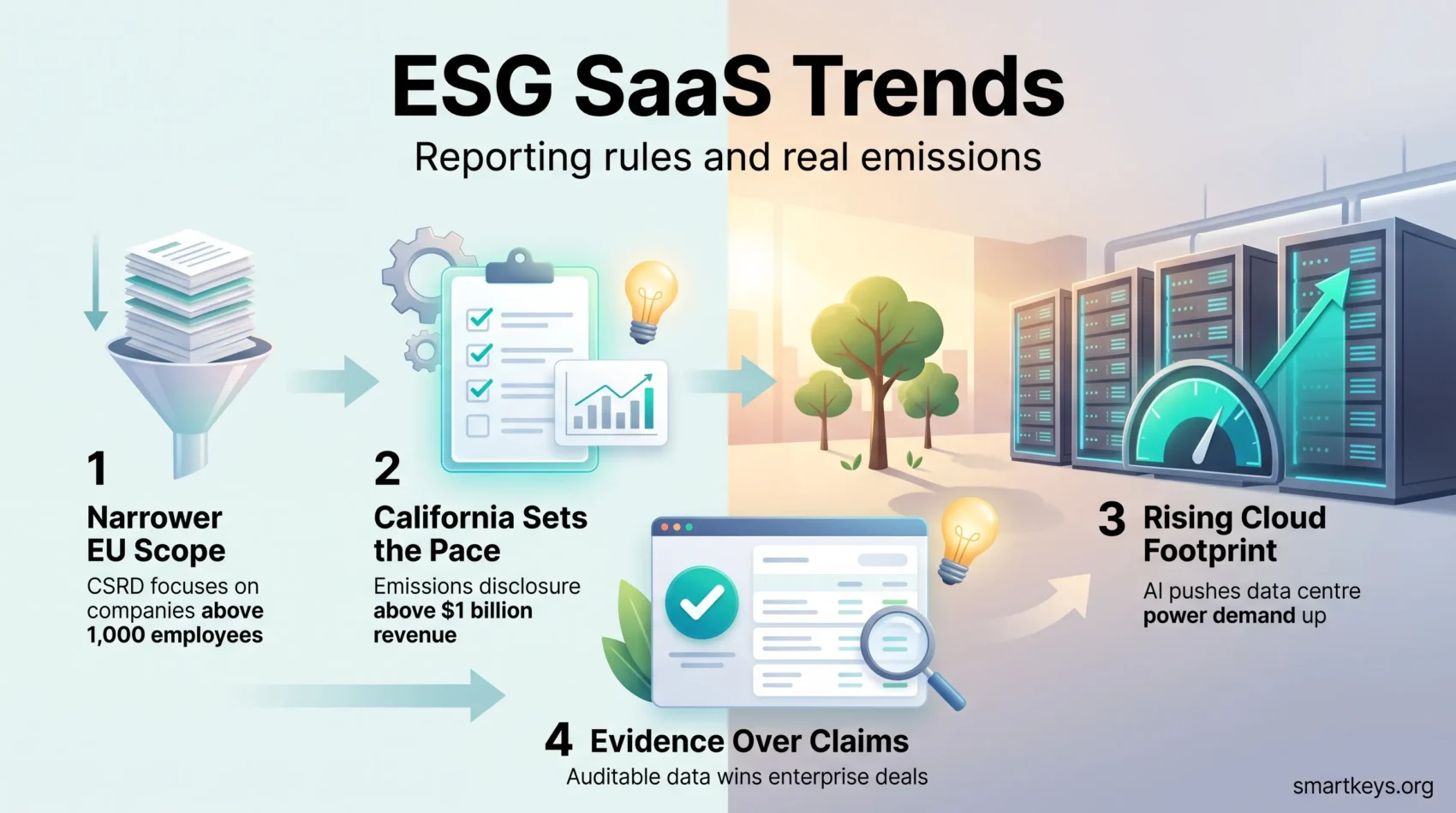
- The EU’s Omnibus I directive, approved by the Council on 24 February 2026, narrows CSRD to companies with more than 1,000 employees and over €450 million net turnover, applying to financial years from 1 January 2027.
- California set the nearer deadline: under SB 253, companies above $1 billion in global revenue had to disclose Scope 1 and Scope 2 emissions by 10 August 2026.
- The SEC proposed rescinding its 2024 climate disclosure rule on 29 May 2026, leaving the US federal baseline effectively voluntary.
- Data centres consumed roughly 415 TWh of electricity in 2024, about 1.5% of global demand, rising to around 945 TWh by 2030 on the IEA’s projection.
- Microsoft’s reported emissions rose 25% in its 2025 financial year to 20.29 million tonnes of CO₂ equivalent, driven by data centre expansion.
- ESG reporting software is a real but modest market: Verdantix put global spend above $1.3 billion in 2023, growing towards $5.6 billion by 2029.
Understanding ESG in the SaaS Landscape
ESG covers three separate things that get bundled into one word. For a software company the environmental question is overwhelmingly about the electricity behind its compute; the social question is about hiring, accessibility and how the product affects users; the governance question is about who is accountable, what gets disclosed, and whether the disclosure survives an auditor.
Those three carry very different weight in SaaS. A vendor has almost no direct emissions of its own; the footprint sits in purchased electricity and in the cloud provider’s infrastructure. That makes Scope 2 and Scope 3 the whole story, and it makes supplier data the hardest part of any credible ESG framework.

Reporting itself has become a product category. ESG platforms collect activity data, convert it into emissions using published factors, and generate disclosures mapped to a chosen standard. The useful ones expose their assumptions, because a number produced by a black box is worth little once assurance enters the picture. Treat data lineage as the buying criterion, as you would for any data governance strategy.
ESG SaaS Trends Shaping the Industry
Three shifts define 2026: the regulatory perimeter shrank, the emissions story got worse, and buyers began asking for evidence rather than statements.

The Regulatory Perimeter Narrowed
The EU’s Omnibus I package is the biggest change. The Council approved the directive on 24 February 2026, cutting CSRD’s scope to undertakings with more than 1,000 employees and more than €450 million in net turnover. The consultancy ERM put the reduction at roughly 85% of the companies originally covered. Member states have until 26 July 2028 to transpose it, and the revised requirements bite for financial years beginning on or after 1 January 2027. A value-chain cap also limits what in-scope companies can demand from smaller suppliers, which matters for any SaaS vendor sitting in a large customer’s supply chain.
In the US the federal rule is going the other way. The SEC formally proposed rescinding its March 2024 climate disclosure rule on 29 May 2026, so federal rulemaking is no longer the binding constraint for US-listed software firms. For the full rule-by-rule picture, including how GRI, SASB and ISSB fit together, see our guide to ESG frameworks and reporting standards.
California Became the Real Deadline
State law filled the gap. The California Air Resources Board adopted its initial implementing regulations on 26 February 2026. Under SB 253, companies doing business in California with more than $1 billion in global annual revenue had to report Scope 1 and Scope 2 emissions by 10 August 2026. SB 261 applies a lower threshold of $500 million in global revenue and requires a climate-related financial risk report rather than an emissions inventory.
For most mid-sized and large SaaS companies with US customers, that is the obligation that actually landed in 2026, well before anything in Brussels applies.
The Importance of Sustainable Practices in SaaS
The uncomfortable part of the 2026 picture is that the sector’s footprint is growing: efficiency gains are real, but demand is outrunning them.
Where the Emissions Actually Are
The International Energy Agency estimates data centres used about 415 TWh of electricity in 2024, roughly 1.5% of global consumption, and projects around 945 TWh by 2030, just under 3% of the global total. Growth on that scale is why cloud-hosted software can no longer be described as inherently low-impact.
Individual vendors show the same pattern. Microsoft reported 20.29 million tonnes of CO₂ equivalent for its 2025 financial year, up 25% from 16.21 million tonnes the year before, with data centre construction and a change in how it accounts for renewable energy certificates driving the increase. The company still targets carbon negative by 2030, and says emissions would have been far higher without efficiency and procurement measures. Still, the reported number went up, not down.
There is a governance lesson in that. A vendor that publishes a rising figure and explains it is more credible than one that publishes nothing. It is also more useful to a customer building its own Scope 3 inventory, the count of emissions that sit in its suppliers and products.
Practical Levers for a Software Company
The levers that move the number are unglamorous and overlap with cost control:
- Region and workload placement, since grid carbon intensity varies enormously by location and time of day.
- Right-sizing and shutting down idle infrastructure, the same discipline as cloud cost optimization and FinOps practice.
- Efficient architecture: caching, batching and model choice, which now matter more than they did before AI features became standard.
- Contracted clean power rather than unbundled certificates, which is precisely the distinction that pushed Microsoft’s reported Scope 2 figure up.
The EU also imposes a hard obligation on infrastructure. Under the Energy Efficiency Directive, data centres with at least 500 kW of installed IT power demand must report energy performance indicators to a European database. If you self-host at scale, that applies to you, not just to your provider.
Social Responsibility and Inclusion in Software Development
The social pillar is where SaaS companies have the most direct control and the least excuse. Accessibility is the clearest example: a product that fails WCAG criteria excludes users regardless of what the sustainability report says. Hiring, pay transparency and workforce data sit here too, increasingly covered by disclosure rules of their own, as our overview of diversity and inclusion trends sets out. Community programmes and employee volunteering belong here too, but they only count if you measure them: record hours, the groups reached and what changed, not just how many people took part.

What ESG Actually Buys a SaaS Business
The honest case for ESG work in software is narrower than the marketing version, and stronger for being narrower.
The most reliable benefit is commercial access. Enterprise and public sector procurement increasingly asks for emissions data, a privacy posture and evidence of governance. A vendor that cannot answer gets filtered out before pricing is discussed. That is a revenue effect, not a reputational one. Large buyers ask because they report themselves: G&A Institute found that 99% of S&P 500 companies published a sustainability report covering 2024, and much of their footprint sits with suppliers.
The second is cost. Most environmental levers in SaaS reduce infrastructure spend at the same time.
The third is risk. Overstated environmental claims now carry legal exposure in several markets, which is why “greenhushing” (saying less rather than risking a challenge) has become common. The safer path is fewer claims, each documented, an approach covered further in corporate social responsibility trends and business sustainability trends.
What ESG does not reliably buy is a premium price or a measurable brand lift. Claims of that kind circulate widely and rarely survive scrutiny. Build the case on procurement access, infrastructure cost and legal risk instead.
Challenges in Implementing ESG Solutions
Two problems account for most failed programmes, and neither is technical.
Regulatory Uncertainty
The rules changed direction mid-cycle. Companies that built CSRD programmes in 2024 found the scope cut in 2026; companies that prepared for the SEC rule watched it head for rescission. The result is genuine planning difficulty, and a temptation to stop altogether.
That would be the wrong read. California’s deadlines are live, EU obligations arrive for financial years from 2027, and customer questionnaires do not wait for legislation. Build the underlying data capability first: activity data, supplier data and a defensible method. Then treat the disclosure format as interchangeable. A compliance framework that survives a change of regulation beats one tuned to a single standard.

Data Quality and Assurance
The second problem is that most ESG data would not survive an audit. Emissions numbers depend on activity data that often lives in procurement systems, cloud bills and supplier spreadsheets, none of which were designed for the purpose. Estimates get layered on estimates, and the further into Scope 3 you go, the weaker the evidence becomes.
As assurance requirements tighten, that gap becomes expensive. The fix is ordinary data engineering: identify the sources, automate collection, version the emission factors, and record who signed off on what. Companies that already invest in data literacy find this considerably easier.
Effective Strategies for ESG Integration in SaaS
Integration works when ESG is owned by the functions that already hold the data, rather than parked in a separate sustainability team.
Building Transparent Governance Practices
- Assign ownership: name the executive accountable for disclosure, and the teams that own each data source.
- Document the method: record boundaries, emission factors and estimation rules so a third party can reproduce the number.
- Report on a fixed cadence: an annual figure published on time beats a perfect figure published late.
- Say what you do not know: flagging weak Scope 3 categories is more defensible than a confident total, and supports a wider culture of transparency.
Aligning ESG With AI Governance
The newest overlap is with AI. Energy use, model choice and transparency obligations under EU AI Act compliance increasingly land on one governance agenda rather than two. Vertical software vendors feel this first, since their customers pass regulatory pressure straight through. The same dynamic is visible across the vertical SaaS landscape.
Choosing ESG and Sustainability Software
The tooling market is real but smaller than the marketing suggests. Verdantix put global ESG reporting software spend above $1.3 billion in 2023, forecasting growth towards $5.6 billion by 2029 at around 26% a year. That is strong growth from a modest base, not a category on the scale of CRM or security.
SaaS vendors also sit on both sides of this market. Salesforce, for example, sells its own ESG platform, Net Zero Cloud, and in 2025 added AI agents designed to draft disclosure answers and analyse emissions data. A vendor that reports on its own footprint with its own tool has a strong incentive to make that tool auditable.
The questions that separate useful platforms from decorative ones are consistent:
- Which standards and frameworks does it map to, and how quickly does it update when they change?
- Can it ingest cloud billing and procurement data automatically, or does it depend on manual entry?
- Are emission factors versioned and auditable?
- What does assurance support look like in practice?
- Does the pricing model survive scope changes, or does it punish you for adding entities?
Where the obligation is limited to emissions, dedicated carbon accounting software often beats a broad ESG suite. And as with the wider consolidation across SaaS, one adequate platform beats three specialised ones.
Green Tech in the SaaS Sector
Green technology adjacent to software is developing along two lines. The first is efficiency: better silicon, cooling and workload scheduling that follows clean power. The second is the software layer used to run climate-related businesses at all, from grid management to carbon markets. Both are covered in more depth in climate tech trends and green technology trends, with the capital side in green finance trends and the circular economy in business. Treat vendor claims about market growth sceptically: check who produced the number, when, and what they were selling.
Where to Start in 2026
If you sell software, start with the closest obligation. Check the California thresholds against your revenue, then work back from your largest customers’ questionnaires, because those arrive whether or not a law applies to you. Build the emissions data pipeline once, properly, and let the disclosure format follow.
If you buy software, ask vendors for reported emissions and the method behind them, not for a sustainability page. The ones who answer without hesitation are the ones whose data you can safely put in your own report. Anchor all of it in a written sustainability strategy, and it stays useful as the rules keep moving.
Found this useful?
Make SmartKeys a preferred source on Google, and our articles will surface more often in your Top Stories, AI Overviews, and AI Mode.
Add as Preferred Source