Diversity and inclusion in business look different in 2026 than they did five years ago. Federal DEI programs were dismantled in early 2025, dozens of large employers scaled back public commitments, and the acronym itself is being rewritten across the industry. What has not changed is the underlying business question: do teams that draw on a wider range of people and perspectives make better decisions, keep employees longer, and reach more customers? The independent evidence still says yes, but only when the work is done seriously rather than announced.
This guide covers what has actually shifted since 2024, what current research supports about diverse teams, the role leaders and hiring play, which reporting rules now apply, and how to run an inclusion program that survives both political scrutiny and a slower economy.
Key Takeaways
- Federal DEI programs ended in January 2025; corporate approaches are now more measured and legally cautious.
- McKinsey’s most recent data still links top-quartile ethnic and gender diversity in leadership with a higher likelihood of outperforming peers.
- Inclusion, not headcount targets, drives the retention and engagement gains that show up in the data.
- Programs framed as universal opportunity (accessibility, mentorship, skills) are more defensible than identity-based quotas under current US case law, and dovetail more cleanly with corporate responsibility reporting.
- Leaders and hiring processes decide most inclusion outcomes; both are where programs succeed or stall.
- In the EU, disclosure duties are growing: pay gap reporting starts in 2027, and the AI Act’s hiring rules apply from December 2027.
- Meaningful measurement means engagement, promotion and pay-equity data, not press releases.
Understanding Diversity and Inclusion in 2026
Diversity describes who is on the team: the mix of race, gender, age, national origin, disability status, sexual orientation, socioeconomic background, education and cognitive style. Inclusion is the practice that decides whether those people can actually contribute. A team can be diverse on paper and still exclusionary in the room if certain voices dominate meetings, if promotion decisions favour one profile, or if the “way we do things here” was designed for one type of worker.
The vocabulary is shifting too, alongside a broader rethink of how multigenerational teams work. SHRM, the largest US HR association, dropped the “E” from DEI in July 2024 and now uses “I&D” (inclusion and diversity), arguing that inclusion has to come first for diversity to work. Other organisations still use DEI, DEIB (adding “belonging”) or JEDI (adding “justice”). The label matters less than what the program actually does.
Where public opinion sits
Pew Research found in late 2024 that 52% of US workers said focusing on DEI at work was mainly “a good thing”, down from 56% in early 2023, while the share calling it a bad thing rose from 16% to 21%. Women and Black, Hispanic and Asian workers remain the most supportive groups, although support among Asian workers fell sharply, from 72% to 57%.
Companies read this split differently, and the broader HR trends of 2026 reflect both interpretations. Some interpret falling headline numbers as a signal to retreat. Others focus on the fact that most workers still want fair hiring, transparent pay and career paths that do not depend on informal networks, whether or not those are branded as DEI.
The Business Case for Inclusion
The claim that diverse teams outperform their peers rests on a handful of large studies, and it is worth being precise about what they show.
McKinsey’s “Diversity Matters Even More” report (2023, its fourth in the series) found that companies in the top quartile for gender diversity on executive teams were 39% more likely to financially outperform those in the bottom quartile. The figure for ethnic diversity was also 39%. These are correlations, not proof that hiring for diversity causes profits, and academic replications have debated the effect size. What holds up across studies is a consistent positive association, not a negative one.
Boston Consulting Group’s 2018 study linked diverse management teams to 19 percentage points higher innovation revenue, meaning a bigger share of revenue from products launched in the previous three years. That figure comes from survey data, so treat it as directional rather than exact.
What the evidence more clearly supports:
- Better decisions under complexity. Teams with diverse thinking styles catch more errors in scenario planning studies.
- Wider talent pool. Companies that only recruit from familiar networks miss most of the market.
- Customer fit. Product teams that reflect their user base tend to spot usability failures that homogeneous teams miss.
- Retention through belonging. Employees who feel they belong stay longer, refer other candidates, and factor into wider talent retention outcomes.
The weaker claims (exact percentage lifts in profit, ROI multiples on training spend, “X times higher retention”) rarely survive scrutiny. Skip them and focus on what your own data tells you.
What Changed Since 2024
Three shifts define the current environment.
US federal rollback. Executive Orders 14151 and 14173, signed in January 2025, ended federal DEI offices, revoked the affirmative action requirements for federal contractors under Executive Order 11246 (in place since 1965), and directed agencies to identify private-sector DEI programs for potential enforcement action. The Supreme Court’s 2023 decision in Students for Fair Admissions v. Harvard also raised the legal risk of race-conscious admissions and, by extension, workplace programs that use protected characteristics as a factor.
Corporate pullback. Meta, McDonald’s, Walmart, Ford, John Deere, Harley-Davidson, Lowe’s, Boeing, Molson Coors and others publicly scaled back DEI programs between mid-2024 and late 2025. Some dissolved dedicated DEI teams, others rebranded them as “belonging” or “opportunity” groups. Costco was a notable exception, with shareholders voting overwhelmingly in January 2025 to keep its DEI policies.
Regulatory divergence. Outside the US, the direction of travel is toward more disclosure, not less. The next section covers the rules that matter most. Separate employee data privacy rules also limit how you can collect and use demographic data in the first place.
The practical result: companies operating across jurisdictions are running two programs in parallel, one designed for US legal defensibility and one meeting EU transparency requirements.
Reporting Duties and Upcoming Regulation
Diversity work is moving from voluntary statements to data that regulators can check. Four sets of rules are worth knowing.
- EU Pay Transparency Directive. Member states had to turn it into national law by 7 June 2026, although only a handful met that deadline. It bans questions about a candidate’s salary history and requires pay information before the interview. Employers with 150 or more staff file their first gender pay gap report by June 2027. A gap of 5% or more that cannot be explained by gender-neutral factors triggers a joint pay assessment with worker representatives.
- CSRD workforce reporting. The EU sustainability reporting rules include a standard on a company’s own workforce (ESRS S1), covering diversity and pay metrics. The Omnibus I package adopted in late 2025 narrowed the scope to companies with more than 1,000 employees and more than €450 million in turnover.
- EU AI Act. AI used in recruitment, promotion or performance decisions is classed as high-risk. After the 2026 “digital omnibus” agreement, those high-risk duties apply from 2 December 2027 instead of August 2026. Read our EU AI Act compliance guide for the details.
- Existing national reporting. UK employers with 250 or more staff have published gender pay gap figures since 2017, and US employers with 100 or more employees still file annual EEO-1 workforce demographic reports with the EEOC.
How to prepare without waiting for the deadlines: know which rules apply in each country you operate in, clean up job architecture so roles of equal value can be compared, run a pay-equity audit now rather than in the year you must publish, and decide who owns the numbers. A gap you find yourself is far cheaper to fix than one a regulator or journalist finds first.
The Role of Leadership in Diversity and Inclusion
Leaders set the tone for inclusion in ways no policy can. If senior people interrupt the same colleagues in every meeting, promote only people who remind them of themselves, or treat inclusion as an HR side project, employees notice fast. The reverse also holds: visible, consistent behaviour from leaders gives everyone else permission to act.
What committed leadership looks like in practice:
- Owning the numbers. Leaders review hiring, promotion and pay data for their own area, not just a company-wide dashboard.
- Accountability in reviews. Managers are assessed on how they build and develop their teams, not only on output.
- Sponsorship. Senior people actively put forward high-potential employees from under-represented groups for stretch roles and promotions.
- Everyday behaviour. Asking quieter people for input, sharing credit, and responding to mistakes without blame. These habits build the psychological safety that diverse teams need to speak up.
Leadership commitment also has limits worth naming. A strong statement from the CEO does little if middle managers are not trained or measured on inclusion. For the values side of this work, see our guide to ethical leadership for managers, and for wider shifts in management style, the leadership approaches that hold up in 2026.
Inclusive Hiring Practices
Hiring is where most diversity strategies either work or fail. You can only include people you actually hire, and small design choices in the process decide who gets through. None of the practices below require quotas or decisions based on protected characteristics.
- Write inclusive job ads. List only the requirements the role truly needs. Long wish lists and jargon discourage qualified people who do not tick every box.
- Widen your sources. Post beyond the usual networks: different universities, community organisations, return-to-work programs and referrals from a broader set of employees.
- Structure the interview. Fixed questions and a scoring rubric reduce the influence of gut feeling. Mixed interview panels, drawing on different teams and roles, add perspectives.
- Screen blind at the first stage. Removing names, photos and school names from early resume review limits signals that trigger unconscious bias.
- Test the work, not the pedigree. A short, paid work sample often predicts performance better than a resume.
- Offer adjustments. Tell every candidate how to request changes to the process, such as extra time or a different interview format.
Shortlist rules are the most debated tool. The Rooney Rule in American football and the Mansfield certification in US law firms ask organisations to consider a minimum share of candidates from under-represented groups for senior roles. Under current US law, such rules carry more legal risk than they did a few years ago, so check them with an employment lawyer before you adopt or keep one.
Structured hiring also reduces the surface area for AI hiring bias once you introduce automated screening, because the criteria are written down and can be audited.
Where Technology Helps, and Where It Adds Risk
Software can support inclusion at several points: checking job ad language, anonymising applications, running structured interviews, and analysing pay and promotion data by group. The benefit is consistency and measurement at a scale no HR team can manage by hand. The risk is that a tool trained on past decisions repeats past bias, only faster. New York City has required independent bias audits of automated hiring tools since 2023, and the EU AI Act adds similar duties from December 2027. For a tool-by-tool look at the options and the legal duties that come with them, see our guide to DEI software for bias-free hiring and pay analysis.
Building an Inclusion Program That Works
Programs that last share four features.
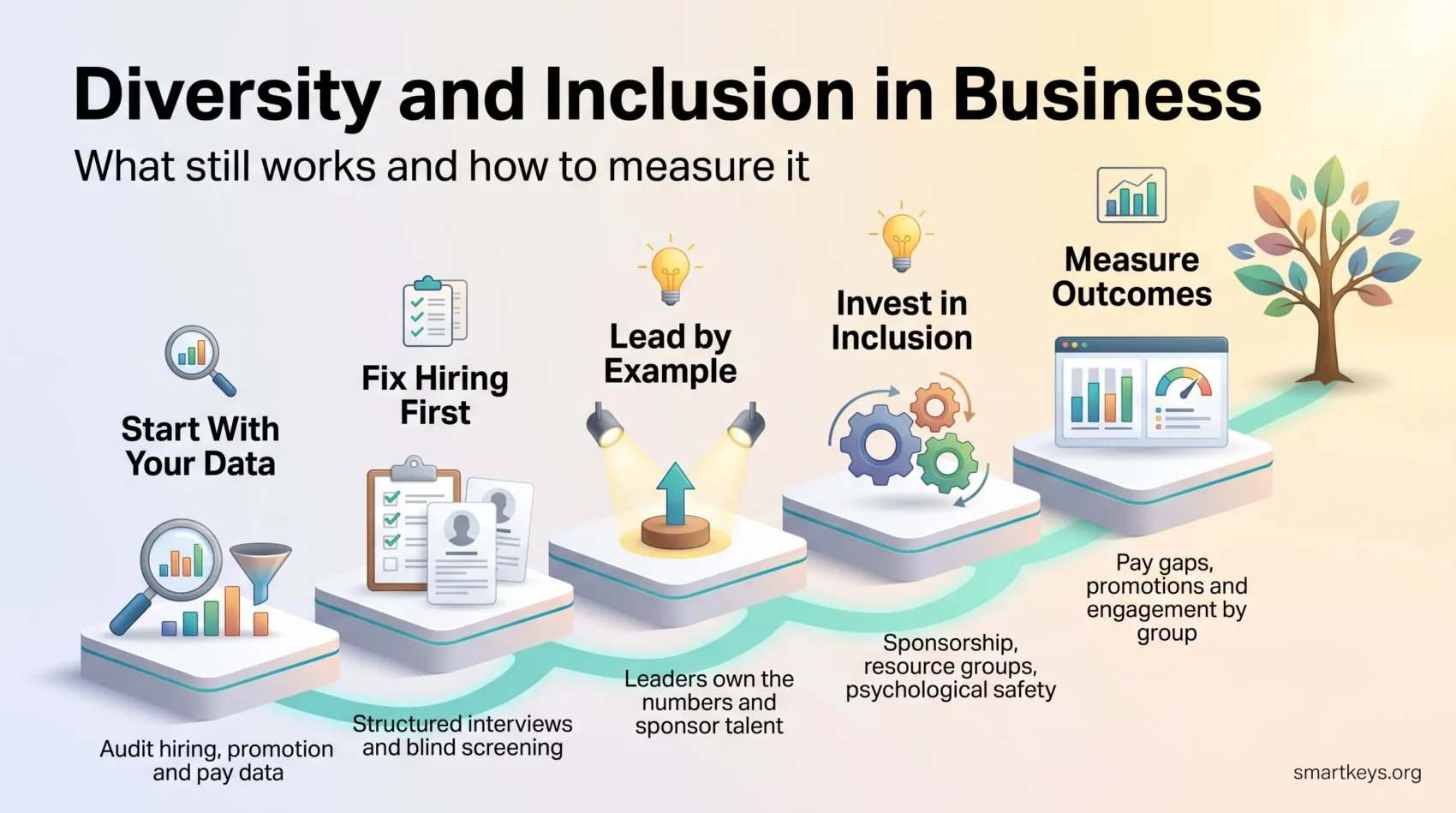
Start with the data you already have
Before running any new initiative, look at what your systems already show. Where do candidates drop out of your hiring funnel? Who gets promoted, and how long does it take by group? What does exit interview data reveal about why people leave? A quiet audit of pay bands by role, tenure and demographics usually surfaces the most fixable problems.
Fix hiring before setting targets
The hiring practices above change who enters the organisation. Targets without those changes tend to produce pressure and resentment rather than better outcomes.
Invest in inclusion, not just diversity
Hiring diverse candidates without changing how the workplace operates is the fastest way to lose them. Employee resource groups, sponsorship (not just mentorship, since sponsors advocate for promotions), and manager training on inclusive meeting practices all show measurable retention effects. Google’s Project Aristotle famously found that psychological safety, more than any demographic factor, predicted team performance.
Measure outcomes, not activities
Attendance at a training session is not an outcome. Better hiring conversion rates, narrower pay gaps, higher promotion equity, and rising engagement scores from under-represented groups are. Publish the numbers internally at least, and be honest when they get worse.
For a broader take on how companies signal openness and follow through on it, see our guide to transparency culture.
Training That Actually Changes Behaviour
Diversity training is a large industry, and much of it does not work. Research by sociologists Frank Dobbin and Alexandra Kalev, summarised in Harvard Business Review, found that mandatory diversity training often produces short-term awareness gains that fade, and can even trigger backlash when framed as blame.
What the research supports instead:
- Skills-based training. Teach specific behaviours (running an inclusive meeting, giving upward feedback, structured interviewing) rather than raising awareness of bias in the abstract.
- Voluntary formats with accountability. People who choose to attend, and who then apply what they learned in a visible way, retain more.
- Bystander intervention. Teaching colleagues how to interrupt exclusionary behaviour in the moment changes team dynamics faster than training the person who did it.
- Manager training over generic staff training. Managers make the daily decisions that shape inclusion, so start there.
- Formats that fit the topic. Short e-learning works for facts and rules; live workshops with role-play work better for skills like handling a difficult conversation.
Measure what changed six months later, not what people rated the session at the end. Compare hiring, promotion and retention data for teams that went through the training against teams that did not. If nothing moved, the training did not work, whatever the completion rate says.
Overcoming Common Barriers
Four barriers show up most often in 2026 inclusion work.
Legal caution has become an excuse. Since the SFFA v. Harvard decision, some companies have used legal risk as cover for winding programs down entirely. Most workplace practices (structured hiring, mentorship for all who apply, accessibility improvements, pay-equity audits) are not affected by that ruling. A good employment lawyer can distinguish what needs adjusting from what does not.
Tokenism. Hiring one person from an under-represented group, then putting them on every panel and in every brochure, signals the opposite of inclusion. It also burns out the people involved.
Programs get measured by input, not output. Counting training completions or ERG membership is easy. Measuring whether the promotion rate for women in engineering rose, or whether the pay gap in a specific job family narrowed, is harder and more useful.
The manager layer gets skipped. Executive commitment and grassroots enthusiasm both matter, but the middle manager who runs your one-on-ones and writes your promotion recommendations is where most inclusion decisions happen day to day. Programs that ignore that layer plateau.
Resistance to change usually comes from fear of losing status or from not understanding why the change matters. Explain the reasons with your own data, invite objections openly, and show early results. For deeper practical steps on running a business that stays engaged with its wider responsibilities, see our overview of business ethics frameworks.
Best Practices for an Inclusive Culture
Building an inclusive workplace in 2026 combines the durable practices that predate the current backlash with adjustments for the new environment.
Inclusive practices worth investing in
- Publish pay bands and promotion criteria so decisions are traceable; pay transparency is now legally required in a growing number of US states and is being rolled out across the EU.
- Offer flexible work as a universal option rather than a case-by-case negotiation, following the direction set by a written hybrid policy.
- Design meetings and documents so people who joined last week or work in another time zone can contribute equally, following the hybrid workspace practices that hold up in 2026 wellbeing data.
- Build accessibility into products and workplaces from the start; retrofitting is more expensive and worse.
- Support ERGs with real budgets, executive sponsors, and a route from group insight to policy change.
- Include neurodivergent employees in workplace design conversations rather than assuming what they need; our guide to neurodiversity in the workplace covers this in more depth.
Feedback loops that keep the program honest
Employees do not always feel safe naming exclusion in a survey, but they will name it in exit interviews, in one-on-ones with trusted managers, and in the differences between what the org chart says and what actually happens. Look at all three sources. Compare attrition, promotion and engagement scores by group, and treat unexplained gaps as questions rather than answers.
Also read what the 2026 engagement data actually shows for context on where inclusion sits inside the broader employee experience.
Cognitive Diversity: The Underrated Version
Cognitive diversity refers to differences in how people think: pattern recognition versus systematic reasoning, big-picture versus detail focus, verbal versus visual processing, risk tolerance versus caution. A team can be visibly diverse and cognitively homogeneous (everyone trained the same way at similar institutions), or visibly homogeneous and cognitively diverse (people from similar backgrounds with genuinely different approaches to problems).
Research from Alison Reynolds and David Lewis, published in Harvard Business Review, found that teams high in cognitive diversity solved a strategic execution task significantly faster than teams that were cognitively homogeneous, regardless of demographic mix. That finding does not replace demographic diversity, which drives representation, retention and market fit, but it explains why some diverse teams still underperform: they may share cognitive style even if they differ visibly.
Practical implications:
- When building a team for a complex problem, look for a mix of thinking styles alongside identity diversity.
- Test decision-making with tools like premortems, structured debate and rotating “devil’s advocate” roles.
- Value quiet contributors and asynchronous input; some cognitive styles do not surface in fast meetings.
Combined with demographic diversity and genuine inclusion, cognitive diversity is where the innovation gains people talk about actually come from.
What This Means for the Next Two Years
The political and legal environment for DEI will keep shifting, and the vocabulary will keep changing. What is not going to change is the underlying business reality: many roles remain hard to fill, customer bases are more diverse than most executive teams, and younger employees treat inclusion as a basic expectation for the companies they join and stay at, a pattern our overview of Gen Z at work covers in more depth.
Companies that quietly kept doing the practical work (structured hiring, pay equity, real career paths, accessible workplaces) will keep the benefits, and they will find the coming EU reporting duties far easier. Companies that only did the visible symbolic work will lose the symbols and, likely, some of the trust as well. The choice is not whether to have an inclusion strategy in 2026. It is whether the one you have would survive being audited by a sceptic, from either political direction.
Found this useful?
Make SmartKeys a preferred source on Google, and our articles will surface more often in your Top Stories, AI Overviews, and AI Mode.
Add as Preferred Source