A business ethics framework is a written method for making hard calls at work. It sets out who decides, which questions get asked, and how the reasoning is recorded, so two managers facing the same situation reach a defensible answer instead of two different ones.
That sounds abstract until you meet a real case. A supplier offers a 12% discount if you sign this week, and your audit team has not finished checking their labour practices. A product manager wants to train a model on support-ticket transcripts that nobody asked those customers about. A sales lead hits target by pre-booking orders that ship next quarter. None of these is clearly illegal. All of them will be judged later.
This guide covers business ethics end to end: what it means, why it pays off, a method for those hard moments, and the governance around it, because a framework nobody owns is just a document. For a related operational view, see our guide to ESG compliance in SaaS strategy.
Key Takeaways
- A business ethics framework turns vague values into a repeatable decision process with named owners.
- Six lenses (rights, justice, utility, common good, virtue, care) expose trade-offs a single viewpoint hides.
- Three fast tests, publicity, reversibility and generalizability, catch most rationalizations early.
- Documented reasoning is what makes a decision defensible once the context is forgotten.
- EU transparency and reporting rules tightened in 2026, and some reach ordinary employers.
- Ethics pays off through trust with customers, staff and investors, but only when practice matches the code.
Why a Business Ethics Framework Matters for Real Decisions
Most bad corporate decisions are not made by bad people. They are made by reasonable people under time pressure, with incomplete facts and no agreed way to weigh competing interests. A framework attacks that failure.
What “ethics” means here, and what it does not
Ethics means the standards and habits that guide how people ought to act in their roles. It overlaps with law, but the two differ. Law sets a floor and moves slowly. Custom can preserve unfair practice. Data tells you what will happen, not whether you should.
“Is this legal?” is a question your counsel answers. “Would we be comfortable explaining this to the people affected?” is the one your framework answers.
Why business ethics pays off: trust, talent and performance
Clear standards shrink the grey area where people improvise, so similar cases get similar treatment. They cut rework, because a decision made properly the first time survives review. And they make promises believable to everyone with a stake in your business: customers, staff, suppliers, investors and regulators.
One visible lapse is rarely contained. It becomes the lens through which every later decision is read, which is why a proactive standard beats a reactive apology. That credibility is tied to digital trust as a business model, especially where customers never meet you in person.
The payoff shows up in three places. Customers stay with brands they trust and talk about them. Employees are more likely to stay when company values match their own, and candidates increasingly check before they apply. Investors read a strong ethics record as lower risk, because misconduct is expensive: fines, lawsuits, lost contracts and management time.
There is also some market evidence. Ethisphere, which runs the annual World’s Most Ethical Companies list, reported in March 2026 that its publicly traded honorees beat a broad global benchmark by 8.2 percentage points over the five years to December 2025 (Ethisphere). Treat that as a correlation from the list’s own publisher, not proof that ethics causes returns. The safer conclusion is simpler: ethical failures destroy value quickly, and consistent standards make that far less likely.
Six Lenses for Analyzing an Ethical Dilemma
A lens is a question that forces one angle into view. Alone, each is incomplete. Together they surface the trade-off you were about to skip.
Rights
Does the option respect people’s basic claims, such as consent, privacy and honest treatment? It asks whether anyone here is being used without knowing it. The support-ticket example fails immediately.
Justice
Is the benefit and burden fairly distributed? Justice comes in several forms: distributive (who gets what), corrective (how a wrong is put right) and procedural (was the process even-handed). Applied to pay, this is why pay transparency has become a governance question rather than an HR preference.
Utilitarian
Which option produces the greatest net good across everyone affected? This is cost-benefit thinking, useful for comparing options at scale. Its known weakness is that it can quietly authorize harm to a small group for a larger gain, so never use it alone.
Common good, virtue, and care
- Common good: does the choice protect shared systems everyone depends on, such as clean air, public infrastructure or a functioning market?
- Virtue: what kind of organisation do you become by doing this repeatedly? Ask about the tenth time, not the first.
- Care: who is most exposed, and who has the least power to object? This keeps the quietest stakeholder in the room.
Take the supplier discount. Utility may favour signing. Rights and care ask what unaudited labour practice means for workers you will never meet. Justice asks whether other suppliers got the same terms. The lenses are meant to disagree, and the disagreement is the analysis. For the non-ethical side of structured choice, see our guide to decision-making models in business.
Build Your Framework Step by Step
Clarify what you actually know
Confirm key facts against an independent source. List what you do not know and who could tell you. Check whether a parallel case was already decided here: inconsistency with your own precedent costs credibility fast. Then map who is affected and what each stands to gain or lose.
Set the decision process
Write down who decides, who is consulted, and where the decision gets recorded. Ambiguity about authority turns a manageable issue into an escalated one. Attach the record to systems you already use, such as vendor approval or risk review. A risk management framework is usually the natural host.
Define standards of conduct
State the hard limits: legal duties, human rights, data protection, conflicts of interest, anti-discrimination, and a working channel for raising concerns. In the EU that last point is not optional. The Whistleblowing Directive (2019/1937) requires private organisations with 50 or more employees to run an internal reporting channel with protection against retaliation, and the 50 to 249 tranche has been in scope since December 2023.
Name the character you want to reinforce
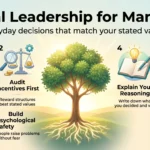
Standards say what is forbidden. Culture says what is expected. Decide which traits should be visible in ordinary work, then check that incentives do not reward the opposite. A quota that pays on booked revenue will produce booked revenue, whatever the code says.
Leaders set that tone in small moments: how they react when someone admits a mistake, whether they ask the ethical question out loud in a meeting, and who gets promoted. Keeping those signals aligned is most of the job. For the manager’s side, with models and real company cases, see our guide to ethical leadership frameworks and examples.
Test consequences before you commit
Name the outcomes you want and the likely harms, then run three checks that take a minute each:
- Publicity: would you be content for this decision, and your reason for it, to be reported accurately?
- Reversibility: would it still look fair if you were on the receiving end?
- Generalizability: would you accept every competitor doing the same?
Most rationalizations fail at least one, so run them before the analysis gets sophisticated.
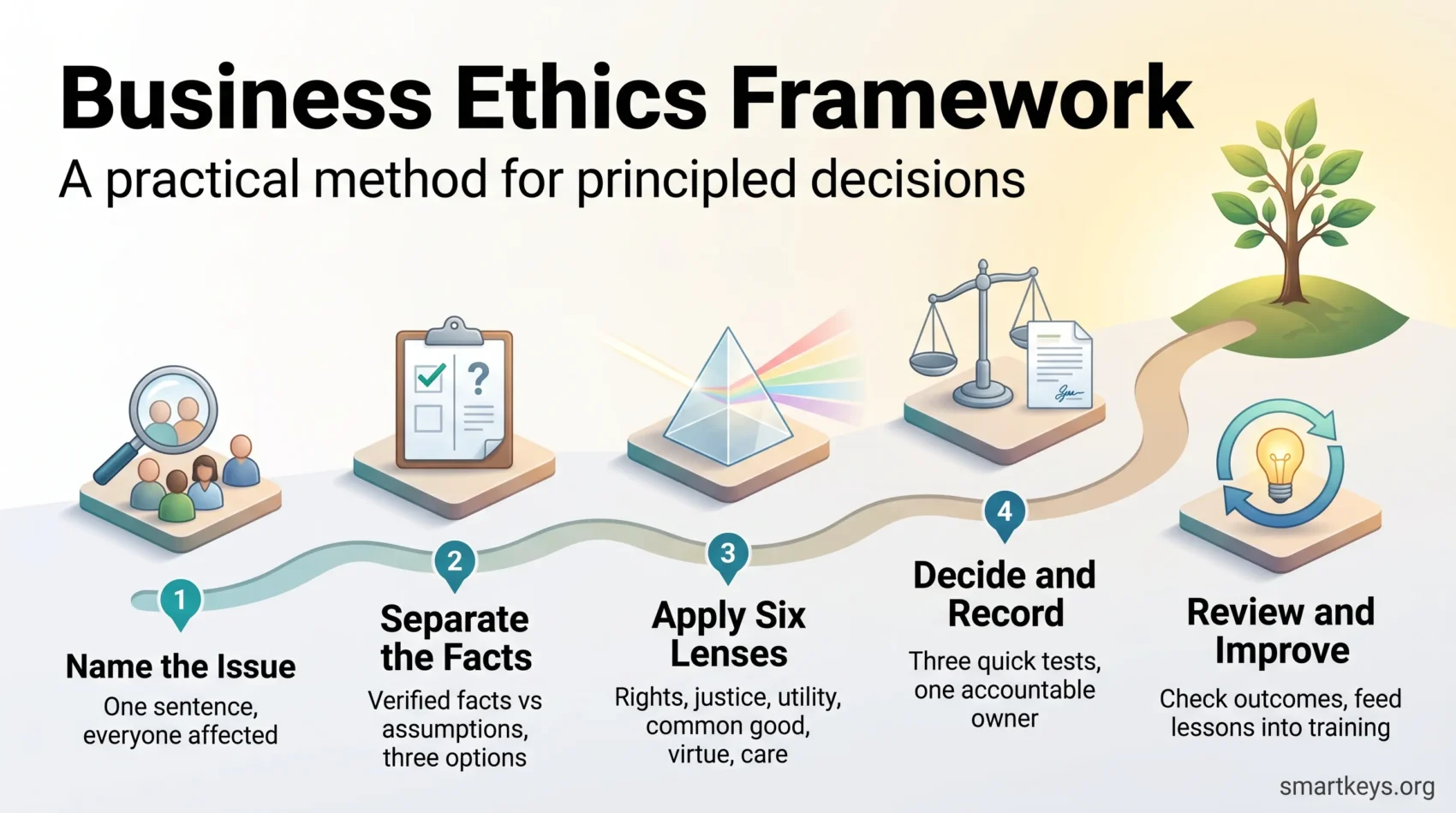
Put It Into Action: A Working Method
This is the framework in use, from blank page to documented decision. The reasoning matches our AI ethics framework for fair decision-making, applied to business choices.
1. Name the issue and who is affected
Write the core issue in one sentence. If you cannot, you do not yet understand it. List who gains and who loses, and whether this is a real conflict between two goods or simply an uneven split.
2. Separate facts from assumptions, then generate options
Mark every claim as verified or assumed. Ask the people affected rather than modelling their preferences. Produce at least three realistic options, because a binary choice usually means someone already decided.
3. Evaluate through the six lenses
Run each option past rights, justice, utility, common good, virtue and care, one line per lens. The aim is not a score but a visible trade-off you can defend.
4. Choose, sanity-check, and implement
Pick the option that balances the trade-offs best, then apply the three tests. Assign the task, set a date, name one accountable person. Record the questions asked and the data used. That record is the difference between a defensible decision and a plausible story told afterwards.
5. Review and improve
Return to the decision once the outcome is visible. Did the predicted harms appear? Did you miss a stakeholder? Feed the answer into training. Tools that surface patterns in behaviour, covered in behavioral analytics, help spot recurring failure points, and explainable AI matters wherever a model contributed to the call.
From Policy to Practice: Governance and Culture
Codes of conduct people can actually apply
A code works when it names the decision, the owner and the escalation path. “Act with integrity” is not a rule. “Any vendor contract above a set value requires a documented labour-practice check, signed off by procurement” is. Link each standard to the process it governs, whether that is digital procurement, hiring or data handling.
Training managers to use the language
Case-based workshops beat policy readings. Give managers real situations from their own function, let them argue, and drill the three tests until they are automatic. Short, repeated sessions beat an annual module, the argument behind microlearning for continuous upskilling.
Integrating with hiring, data, and risk
Embed the framework where decisions already happen: approval thresholds, onboarding, supplier reviews, model deployment. Two areas deserve attention. Hiring algorithms carry documented bias risk, covered in AI hiring bias. Workplace surveillance sits on similar ground, in AI in employee monitoring. In both, the ethical and legal questions now arrive together.
Bringing employees and stakeholders in
A framework written by a small committee and announced by email rarely changes behaviour. People follow standards they helped shape and hear about regularly.
- Involve employees early: ask a cross-functional group to test the code against real cases from their work, and invite feedback on rules that do not fit practice.
- Repeat the message in normal channels: team meetings, onboarding and internal newsletters reach more people than a policy portal.
- Report openly to outsiders: tell customers, suppliers and investors what you committed to and where you fell short. An honest gap builds more trust than a polished claim.
Knowing whether it works
Pick few indicators and watch the trend, not the absolute number: concerns raised through your internal channel, how many are substantiated, time to resolution, whether people say raising an issue feels safe, and repeat audit findings. Data quality decides whether any of it means anything, which is where a data governance strategy earns its place.
What Changed in the Rules in 2026
Two developments matter for anyone updating a framework this year.
First, transparency duties under the EU AI Act started applying on 2 August 2026, a date the European Commission confirmed for enforcement. People must be told when they are interacting with an AI system rather than a person, and certain synthetic content has to be marked as machine-generated. This reaches ordinary employers, not only AI vendors: deploying a chatbot is enough to trigger duties. Our guides to EU AI Act compliance and AI regulation in 2026 cover the tiers.
Second, the EU narrowed its sustainability reporting rules. The Council signed off the Omnibus I directive on 24 February 2026, cutting the scope of the Corporate Sustainability Reporting Directive to companies above 1,000 employees and EUR 450 million net turnover, and the due diligence directive to those above 5,000 employees and EUR 1.5 billion. Member states have until 26 July 2028 to transpose it.
Fewer companies now file, but those that do face a firmer standard, and their suppliers get asked regardless. If you sell to a large European customer, their reporting obligation becomes your data request. Our overview of corporate social responsibility in 2026 follows that shift from pledges to filings.
Linking Ethics to CSR and Sustainability
Corporate social responsibility (CSR) means owning a company’s effects on society and the environment, beyond what regulation strictly demands. Done well, it is the common good lens applied at organisational scale. The pressure also comes from outside: customers, business buyers and investors increasingly want to see how products are made and sourced, not just read a values statement.
Aspire, adapt, amplify
Three steps keep it from becoming a brochure. Aspire: set a standard above the legal minimum and say why. Adapt: fit it to local conditions rather than exporting a head-office template. Amplify: spread what demonstrably worked.
Making it concrete
- Use the same six lenses to choose initiatives, so the selection is defensible rather than convenient.
- Set targets finance and operations both recognise, tied to your sustainability strategy and ESG framework.
- Define success on two horizons: a result you can show this year, and a resilience gain over several.
- Watch for claims that outrun evidence. Overstated environmental marketing is now a regulatory risk, not just a reputational one.
Before committing budget, read what buyers actually reward: sustainability in business.
Conclusion
Turn the framework into a short playbook managers can run without you: name the issue, verify the facts, test through the six lenses, apply the three checks, decide, and record the reasoning. Keep standards tied to real processes, training short and frequent, and incentives pointing the same way as the code.
Then start small. Pick one recurring decision your team finds uncomfortable, run it through the method this quarter, and see whether the record would hold up a year from now.
Found this useful?
Make SmartKeys a preferred source on Google, and our articles will surface more often in your Top Stories, AI Overviews, and AI Mode.
Add as Preferred Source