The EU AI Act is the European Union’s law for artificial intelligence. It sorts AI systems by how much harm they could cause, then attaches duties to each level. It applies to your company even if you have no office in Europe, as long as your software reaches people there.
Two things changed in 2026, and they pull in opposite directions. The strict rules for high-risk systems were pushed back by more than a year. The transparency rules, which say people must be told when they are dealing with AI, took effect on 2 August 2026.
This guide explains what applies today, what is coming, and what belongs on your roadmap. If you want the wider picture first, see our overview of how AI regulation is developing worldwide.
Key Takeaways
- You are in scope when your system’s output is used in the EU, regardless of where your company sits.
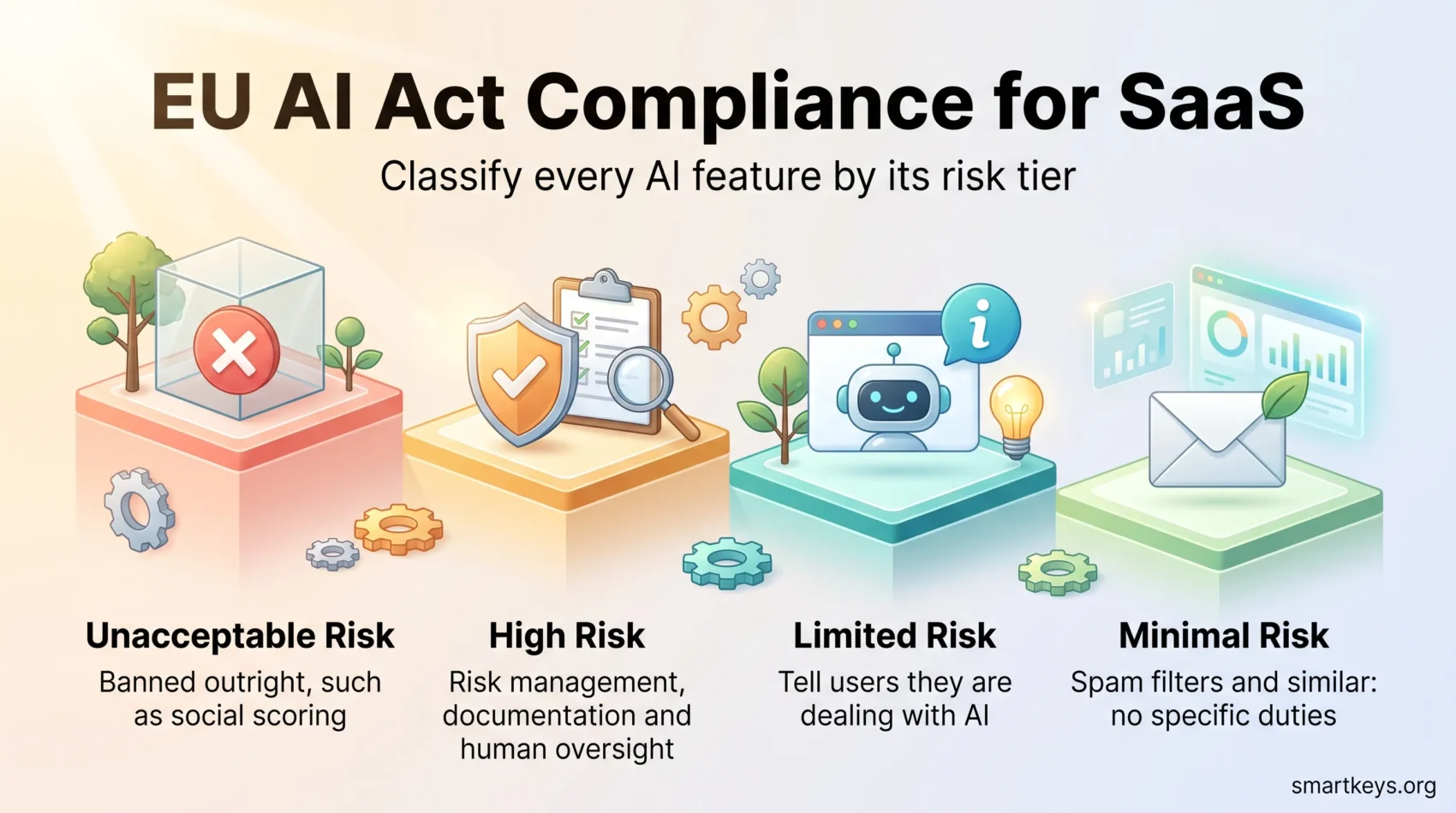
- Four risk tiers (prohibited, high, limited, minimal) decide how much work you have to do.
- Transparency duties for chatbots and generated content have applied since 2 August 2026.
- High-risk duties moved to 2 December 2027 for standalone systems and 2 August 2028 for AI built into regulated products.
- Fines reach 35 million euros or 7% of worldwide turnover for banned practices.
Why the EU AI Act reaches a U.S. SaaS company
The Act uses extraterritorial scope: the trigger is where the output lands, not where your servers or staff sit. If a customer in Berlin sees a score, a recommendation or a generated summary from your system, you are in the European market.
Your duties then depend on the tier your feature falls into.
- Unacceptable risk: banned outright. Social scoring and manipulative systems belong here.
- High risk: allowed, but only with risk management, data quality controls, documentation, human oversight and accuracy testing.
- Limited risk: allowed, with a duty to tell people what they are dealing with. Chatbots and generated media sit here.
- Minimal risk: everything else, such as spam filters or in-game AI. No specific obligations.
Most SaaS products contain features from more than one tier. A support chatbot is limited risk. A module that ranks job applicants inside the same product is high risk. You classify features, not companies. A written inventory beats a general assessment, and an internal AI governance model is worth setting up before audit questions arrive.
Three practical first steps:
- List every feature that uses AI and note what decision it influences. Our guide to where AI is actually used in business operations works as a prompt list.
- Record which data and training sources sit behind each feature.
- Decide, per feature, whether you are the provider (you built it) or the deployer (you use someone else’s model). The duties differ.
The deadlines that actually apply in 2026
The original timetable was rewritten this summer. Regulation (EU) 2026/1744, known as the Digital Omnibus on AI, was published in the Official Journal on 24 July 2026 and entered into force on 27 July 2026. It amends the AI Act rather than replacing it.
Already in force
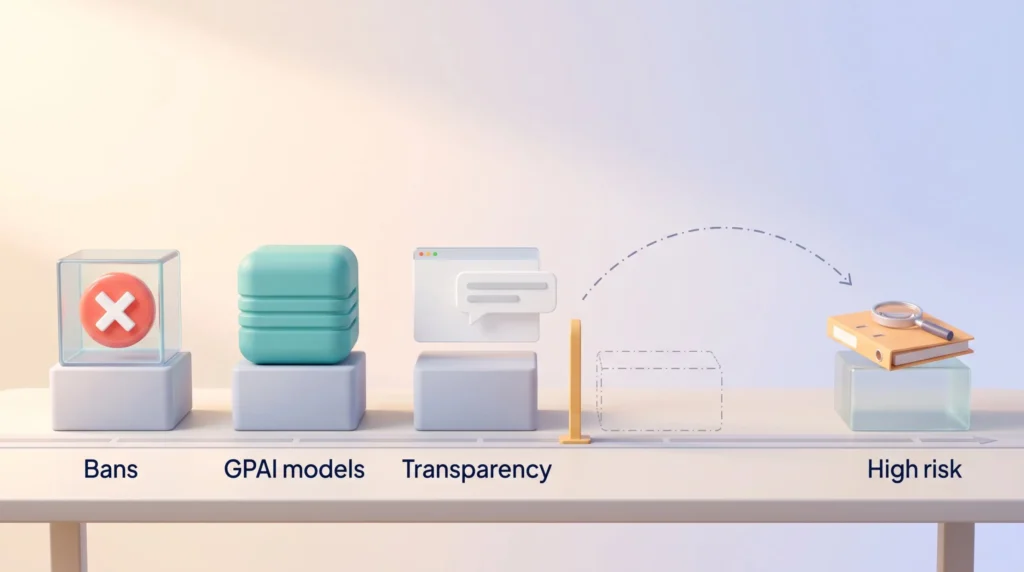
The bans on unacceptable-risk systems have applied since 2 February 2025 under the original Regulation (EU) 2024/1689. If your product does any of the prohibited things, that is a live exposure today, not a future project.
Rules for general-purpose AI models, the large models usable for many different tasks, have applied since 2 August 2025. The Omnibus did not move that date.
Article 50, the transparency article, started applying on 2 August 2026. This is the change most SaaS teams underestimate. It covers chatbot disclosure, labelling of synthetic media and machine-readable marking of AI-generated output.
What moved, and to when
The Omnibus pushed the high-risk obligations back:
- Standalone high-risk systems listed in Annex III: from 2 August 2026 to 2 December 2027.
- AI acting as a safety component inside regulated products under Annex I: to 2 August 2028.
- Watermarking of synthetic content under Article 50(2): a grace period to 2 December 2026 for systems already on the market before 2 August 2026.
The reason given was practical. Harmonised technical standards, the documents that tell engineers what “good enough” looks like, were not ready. Lawmakers chose fixed new dates rather than dates linked to standards being finished, so the calendar is now predictable.
The Omnibus also softened Article 4 on AI literacy. The duty changed from ensuring staff are competent to taking measures that support competence. It clarified that a system which merely assists a user or optimises performance, without touching health or safety, is not automatically high risk. And it added prohibitions on AI-generated child sexual abuse material and non-consensual intimate imagery, with a transition period to 2 December 2026.
What this means for your roadmap
Treat the delay as breathing room, not cancellation. December 2027 sounds distant, but conformity work on a high-risk system takes several quarters. Ship transparency now, since it is already required, and start the documentation and testing for high-risk features this year.
Scoping: high risk, limited risk, or out of scope?
Scope starts at decision points. Ask what happens because of the output. If a person gets or loses access to a job, a place at a school, credit, or a public service, that flow is a candidate for high risk.
What is banned outright
Exclude systems that shape behaviour through manipulation or exploit vulnerabilities. Social scoring of people by public authorities is banned, as is biometric categorisation that infers sensitive traits such as beliefs or sexual orientation. Untargeted scraping of facial images to build recognition databases is banned. So is emotion recognition in workplaces and schools, unless it is strictly for medical or safety reasons, a point worth checking against any plans for AI-based employee monitoring.
Annex III use cases and SaaS examples
Annex III is the list of standalone high-risk uses. It flags systems used for recruitment and candidate screening, worker management and promotion decisions, admissions and exam proctoring, and access to essential services such as credit scoring.
If your SaaS automates any of those tasks, assume high risk. Applicant tracking is the clearest example, and the practical problems are well known: see our reviews of what AI hiring tools actually do and where bias creeps into automated screening.
Two qualifications matter. A feature that performs only a narrow procedural step, or prepares information for a human who makes the real decision, can fall outside the full requirements, but you must document why. If the feature profiles individuals in any Annex III area, the carve-out disappears.
What providers and deployers each have to do
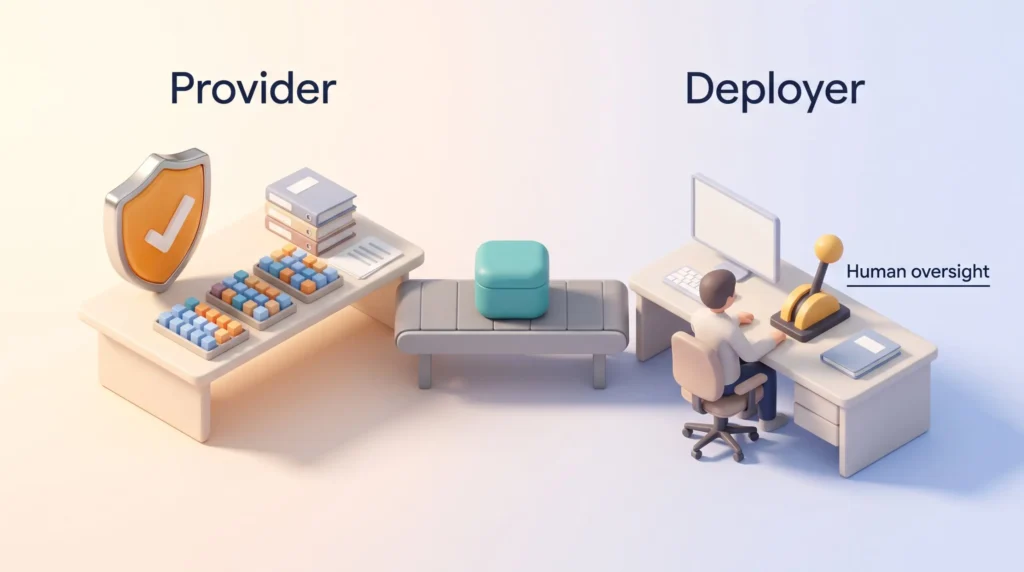
The Act splits duties between the company that builds an AI system and the company that uses it. Many SaaS businesses are both: a provider of their own features, and a deployer of a third-party model underneath.
Provider duties
As a provider of a high-risk system, you need a risk management process that runs for the life of the product, not a one-off assessment. You also need a quality management system, which in practice means documented threat models, tests and sign-offs inside your normal engineering cycle.
Your data governance has to show that training, validation and test datasets are relevant, representative and checked for errors. Keep the evidence in a technical file alongside model evaluations, architecture notes and control descriptions. If your data practices are informal today, our guide to building a workable data governance strategy is the place to start.
Two further engineering duties: automatic logging of events and substantial changes across the lifecycle, and demonstrable accuracy, robustness and security against current threats.
Deployer duties
As a deployer, you support AI literacy among the people who operate the system. Where required, you run a fundamental rights impact assessment, which asks who could be harmed and how you would notice. You follow the provider’s instructions for use, and you put in place human oversight that fits the actual workflow rather than a rubber stamp.
Make the escalation path explicit. A user who disagrees with an automated outcome should be able to reach a person who can change it. Explaining why a system produced an output helps here, which is why explainable AI has moved from research topic to product requirement.
General-purpose AI models and systemic risk
General-purpose AI models are the large models that sit underneath many products, including most AI assistants and the newer agent-based workflows. If you only call such a model through an API, most of these duties sit with the model provider. If you train or substantially modify one, they may sit with you.
Providers of these models publish a summary of the content used for training, respect copyright reservations, and supply technical documentation so that companies building on top know the limits.
A model trained with very large compute, at or above 10^25 floating point operations, is presumed to carry systemic risk under Article 51. Its provider must notify the European Commission within two weeks. Systemic-risk duties then include model evaluations, adversarial testing, incident reporting and strong cybersecurity.
Open and free-licence models still have to respect copyright and publish training summaries, unless they carry systemic risk, in which case the full duties apply regardless of licence. A voluntary Code of Practice for general-purpose AI remains a reasonable way to show good faith while harmonised standards are written.
Transparency in the product: what Article 50 asks for
This is the part that already binds. Treat it as user experience work, not legal paperwork.
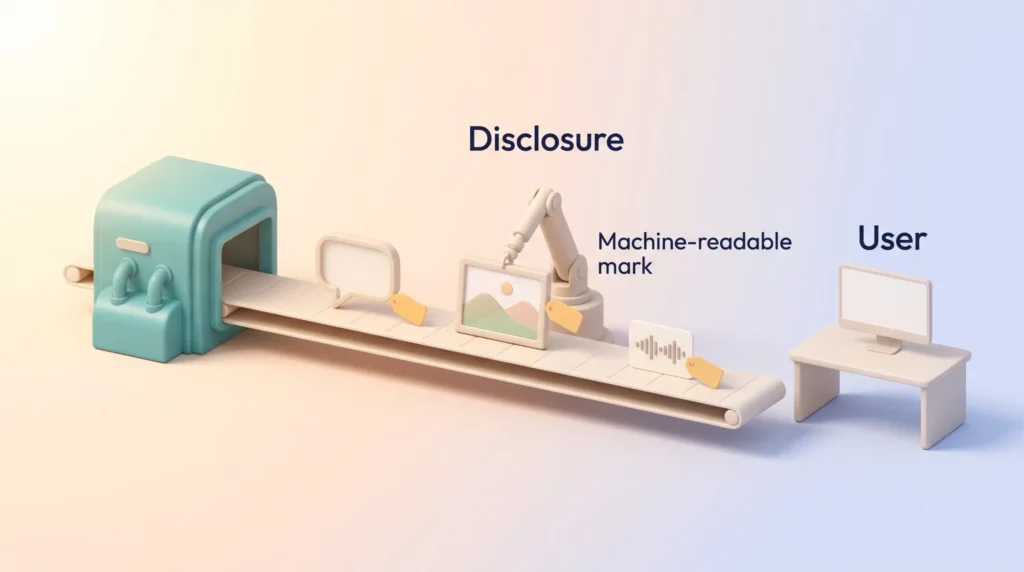
Tell people they are talking to a machine
Users must know when they are interacting with an AI system, unless it is obvious from context. Commission guidance adds a point for agents: the disclosure should say on whose behalf the agent acts. A one-line notice at the entry point of a customer service chatbot satisfies this and costs nothing to ship.
Label generated and modified content
Deployers must disclose deepfakes clearly. The guidance reads the term broadly: it covers realistic content showing a scene that could plausibly have happened, even if it never did. AI-generated text published on matters of public interest also needs a disclosure.
Separately, providers of systems that generate synthetic content must mark that output in a machine-readable format. Narrow exemptions exist for purely technical industrial uses and for ephemeral real-time content. If your product generates images, audio, video or long-form copy, this is an engineering task with a deadline that has passed for new systems and arrives on 2 December 2026 for older ones.
Human oversight that people actually use
Decide in advance when a human must review or override an output, and what information that person gets. Someone reviewing a decision without the underlying evidence is oversight on paper only. Log the oversight actions: those logs are your audit trail, and the habit is part of the digital trust customers now expect.
Penalties, enforcement and help for smaller companies
Article 99 sets three penalty tiers, and they are lower than the figures that circulated in early coverage:
- Breaching the Article 5 prohibitions: up to 35 million euros or 7% of total worldwide annual turnover.
- Failing provider, deployer, importer, distributor, notified body or Article 50 transparency duties: up to 15 million euros or 3%.
- Giving incorrect, incomplete or misleading information to authorities: up to 7.5 million euros or 1%.
For small and medium enterprises, including start-ups, the fine is capped at whichever of the two figures is lower, not higher. That is a meaningful difference for a company with modest turnover.
The EU AI Office coordinates supervision of general-purpose models and can assess systemic risk. National authorities in each member state supervise everything else, take complaints and ask providers for evidence.
Smaller firms get practical support: priority access to regulatory sandboxes, published guidance and reduced conformity assessment fees. Sandboxes let you test a system under supervision before full market launch. If compliance work is new to your team, our overview of regtech solutions covers what that software does well and where it does not.
A short plan for the next two quarters
- Audit for prohibited functionality and remove it. This is the only category with immediate exposure.
- Ship Article 50 disclosures and content marking. Already required.
- Classify every AI feature and write down the reasoning. Keep it in one document.
- Start the technical file for anything that looks like Annex III. Documentation takes longer than code.
- Assign an owner. Some companies formalise this as an AI ethics officer role; a named product lead with real authority works too.
- Fold the work into your existing risk management framework and privacy compliance framework rather than running a parallel process.
The Act is not a reason to stop shipping AI features. Most of what it asks for, clear labelling, documented data sources, a human who can fix a bad outcome, is what customers ask for anyway. Teams that already handle employee and customer data carefully will find much of this familiar.
Found this useful?
Make SmartKeys a preferred source on Google, and our articles will surface more often in your Top Stories, AI Overviews, and AI Mode.
Add as Preferred Source