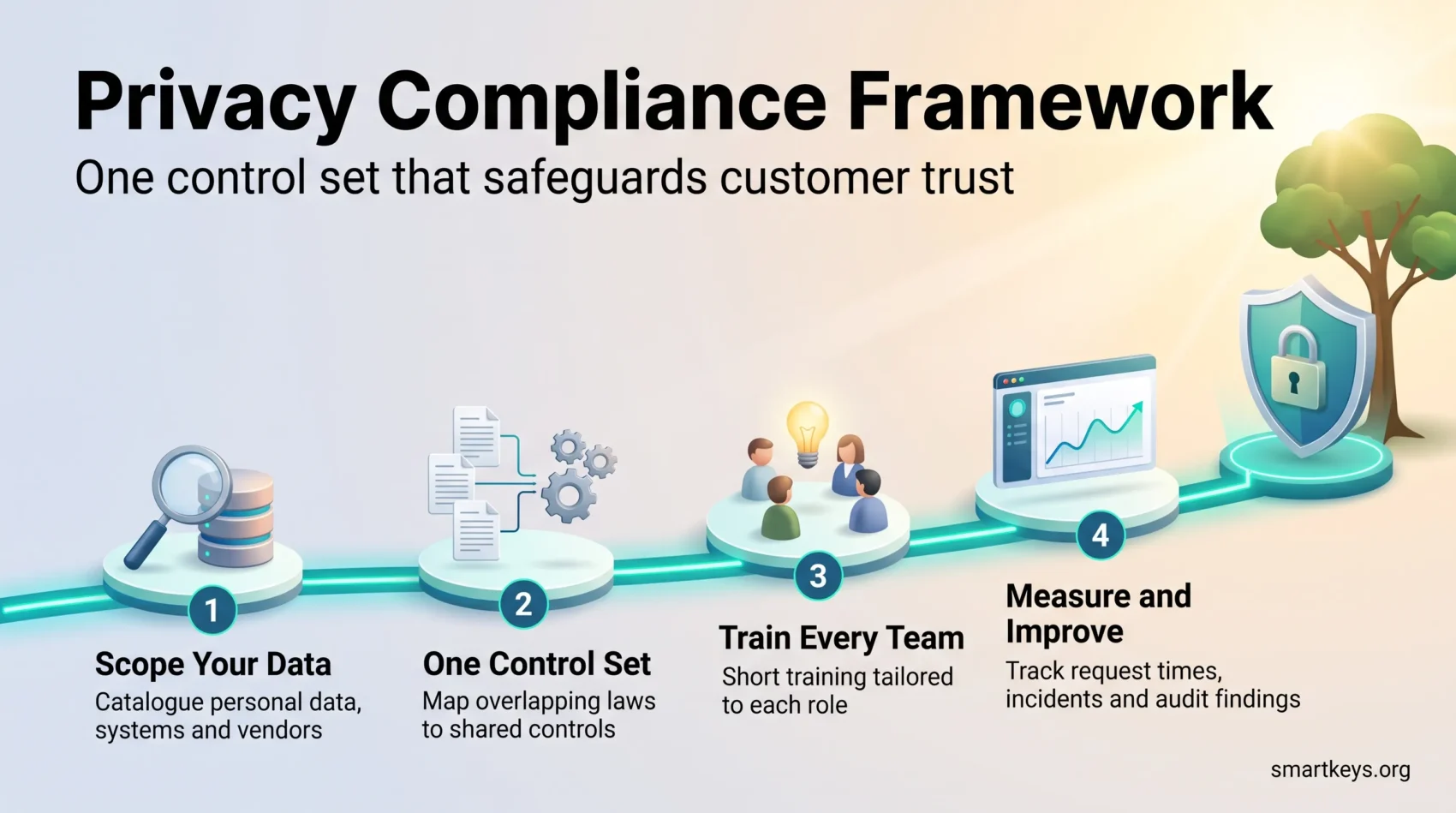
A privacy compliance framework is a documented set of rules, controls and routines that decides how your company collects, uses, stores and deletes personal data. It replaces the scattered habits that build up in most organisations with one repeatable approach that legal, IT and business teams can all follow.
The cost of not having one keeps rising. IBM’s Cost of a Data Breach Report 2026 put the global average breach at $4.99 million, a record and 12% higher than the year before, with the US average at $11.5 million. The same report found the average breach took 247 days to identify and contain, up from 241, reversing five years of improvement.
Regulators have become more concrete too. In May 2026 the California Privacy Protection Agency fined General Motors $12.75 million over connected-vehicle data sales, after a $1.35 million penalty against Tractor Supply in September 2025 for broken opt-out mechanisms.
This guide walks through what a framework contains, which standards to choose, how to map overlapping rules to a single set of controls, and how to prove the whole thing works. For plain consumer-facing wording, our privacy policy generator is a reasonable starting point.
Key Takeaways
- One framework mapped to several laws removes duplicate audit work.
- Knowing which data you hold, and where, decides which controls you need.
- Common controls let you scale protection across regulations instead of per rule.
- Linking incident response to written policy shortens breach recovery.
- Small, measured steps win: scope, train, monitor, improve.
What a privacy compliance framework actually is
Think of it as the operating manual for personal data in your company.
The framework is the structured set of processes you use to find, manage and reduce privacy risk. It gathers your policies, technical controls and daily routines into one place so different teams handle the same situation the same way.
That matters because personal data rarely sits in one system. A single customer email address might live in your CRM (the sales database), your marketing platform, a support tool and a backup. Without a framework, deleting that customer’s data on request means four people remembering four different steps. With one, it means a single documented process with an owner and a deadline.
What it brings together
- Data mapping: a written inventory of what personal data you hold, where it lives and who can reach it.
- Consent and purpose rules: what you told people you would do with their data, and how you stay inside that promise.
- Third-party oversight: checks on the vendors and processors that touch your data on your behalf.
- Response routines: how you handle a customer request or a breach without improvising.
Why ad hoc practice stops working
Most companies start informally. Someone in legal answers privacy questions, someone in IT locks down access, and the two rarely compare notes. That holds until you enter a new market, sign an enterprise customer with a security questionnaire, or receive your first regulator letter.
Established reference points such as the Fair Information Practice Principles, the NIST Privacy Framework and the ISO standards exist so you do not have to invent this structure yourself. Adopting one gives you a backbone for policies, training and steady improvement, and it makes your data governance strategy something you can show rather than describe.
“Good governance turns rules into repeatable action, which speeds responses and trims duplicate work.”
Data privacy vs data security: two jobs, one program
These words get used interchangeably, and treating them as the same thing is where programs go wrong.
Privacy is about lawful use. It answers what you are allowed to collect, why, how long you may keep it, and what rights the person has over it. Laws such as the GDPR in the EU and the CCPA in California set those boundaries.
Security is about defence. Encryption, access control, logging and incident response stop unauthorised people from reaching data, whatever the legal basis for holding it.
You need both, and one does not imply the other. A company can encrypt a database perfectly and still break the law by keeping the records ten years longer than it promised. Another can have a lawful basis for every field it stores and still lose the lot to a stolen password.
- Keep the policy decision (may we hold this?) separate from the technical one (is it protected?), so neither is assumed.
- Tie every legal rule to a concrete control: a two-year retention promise becomes an automated deletion job with a date.
- Build consent, purpose limits and role-based access into the workflow rather than into a policy nobody reads.
Our overview of current cybersecurity trends covers the defensive half in more depth, and data privacy trends for 2026 covers the legal half.
What getting it wrong now costs
Penalties stopped being theoretical some time ago, and the published numbers are worth knowing before you set a budget.
Under the GDPR, the top tier of fines reaches 20 million euros or 4% of worldwide annual turnover, whichever is higher. The regulation also requires notifying the supervisory authority of a qualifying breach without undue delay and, where feasible, within 72 hours.
California works differently. Its statutory penalties are adjusted for inflation, and the California Privacy Protection Agency confirmed amounts of $2,663 per violation and $7,988 per intentional violation or violation involving a consumer under 16, effective 1 January 2025. Separately, consumers can sue over breaches of unencrypted personal information for statutory damages between $100 and $750 per person per incident.
Recent enforcement shows what triggers action in practice:
- General Motors, $12.75 million (May 2026): connected-vehicle data sales practices.
- Tractor Supply, $1.35 million (September 2025): opt-out mechanisms that did not work.
- PlayOn Sports, $1.1 million (March 2026): student data and dark patterns.
- Ford, $375,703 (March 2026): unnecessary friction in the opt-out process.
The pattern is not exotic. Three of the four involve the opt-out and consent journey, which is ordinary front-end work that any company can audit this month.
The 2026 rulebook: what changed
If your program was designed before 2025, four things have moved under it.
Twenty US states, one workable baseline
Twenty states now have comprehensive consumer privacy laws on the books, with Indiana, Kentucky and Rhode Island taking effect on 1 January 2026. Most follow the Virginia template closely, so building to the strictest common denominator, usually California, and adding state-specific notices is cheaper than running twenty programs. Rhode Island is worth checking separately: its thresholds are lower, covering companies that process data on 35,000 consumers.
ISO 27701 now stands on its own
ISO/IEC 27701 is the international standard for a privacy information management system, meaning a documented, auditable way of running privacy work. The 2019 version could only be used as an add-on to an ISO 27001 security certification. The revision published in October 2025 changed that: it can now be implemented as a standalone system, follows the same clause structure as other ISO management standards, and separates the controls that apply to data controllers from those that apply to processors.
For a smaller company without an ISO 27001 certificate, that removes a genuine barrier to certifying privacy practice at all.
NIST realigned its privacy and security guidance
NIST released an initial public draft of Privacy Framework 1.1 in April 2025, realigned with Cybersecurity Framework 2.0 so the two can be run as one exercise rather than two. It was still a draft at the time of writing, so treat it as direction of travel rather than a certification target. If you already use CSF 2.0, the mapping work is small.
AI rules now reach ordinary employers
The EU AI Act’s transparency duties under Article 50 apply from 2 August 2026 and were not deferred. They require telling people when they are interacting with an AI system, marking synthetic audio, image, video and text in machine-readable form, labelling deepfakes, and notifying people exposed to emotion recognition or biometric categorisation. Generative systems already on the market before that date have until 2 December 2026 to implement the marking obligations.
The heavier high-risk obligations were pushed back by the Digital Omnibus agreement: standalone Annex III systems to 2 December 2027, and AI embedded in regulated products to 2 August 2028. Our guides to EU AI Act compliance, AI regulation in 2026 and building an AI governance model go through what each tier requires.
If you run productivity or performance tooling over employee data, treat AI employee monitoring and workplace data privacy rules as part of the same program, not a separate HR matter.
The GDPR simplification is still a proposal
The EU’s Digital Omnibus package would change parts of the GDPR: a narrower definition of personal data for pseudonymised sets, a shorter cookie consent list, easier refusal of abusive access requests, and a single reporting entry point across GDPR, NIS2 and DORA. As of April 2026 none of it was final. Plan against the law as it stands, and watch the file rather than pre-empt it.
Choosing the right framework for your organisation
Start with what you actually run, not with the standard that looks most impressive.
Match data, geography and industry
List your lines of business and what personal data each one touches. Note whether you process EU or California resident data, health records, or payment card details. That list produces your mandatory set almost automatically: HIPAA for US health data, PCI DSS for card payments, GDPR or state law by where your customers live.
Where you store data matters as much as who you serve. Data localization laws can force a hosting decision before you write a single control.
Match your maturity and goals
Score your risk and how mature your management practice really is. A twenty-person SaaS company chasing enterprise deals usually gets more value from SOC 2 or ISO 27001 than from a bespoke program. A company selling into US federal agencies is pointed at NIST and FedRAMP whether it likes it or not.
- Write down why you chose what you chose, so leadership can approve it quickly.
- Avoid sprawl: pick standards that map together with shared controls.
- Sequence by business impact, not by which gap is easiest to close.
The main options at a glance
- GDPR: the EU rule, applies extraterritorially, built around lawful basis and individual rights.
- CCPA/CPRA: California consumer rights to know, delete, correct and opt out, plus non-discrimination.
- ISO 27001 and ISO 27701: a certifiable security management system and, since 2025, a certifiable privacy one.
- NIST CSF 2.0 and the NIST Privacy Framework: risk-driven, free to use, common in US programs.
- Sector and national schemes: HIPAA and HITRUST for health, PCI DSS for cards, FedRAMP, FISMA, IRAP and Singapore’s PDPA where they apply.
Who needs to be in the room
Privacy decisions fail when they are made by people who cannot see how data actually moves.
Bring in counsel and privacy specialists to read the obligations, risk and compliance to weigh exposure, and security and IT to say what is technically possible. Add the business owners who handle customer and employee data every day, usually marketing, sales, support and HR, because they know the shortcuts that policies never capture.
Keep internal audit advisory rather than operational, so it can test the controls later without reviewing its own work.
- Cover the full data flow, from collection through vendors to deletion.
- Write down who owns testing, who owns operations, and who signs off exceptions.
- Name one accountable leader, often a chief privacy officer or senior risk lead, to break ties.
“Clear roles and a single decision owner stop analysis paralysis and speed practical work.”
An ESG framework often runs through the same committee, which is worth checking before you create a third one.
Mapping regulations to controls: one matrix, fewer audits
Build a single control matrix showing which measure satisfies which rule. It is the one artefact that pays for itself, because it turns four separate audits into one evidence set.
Start small. List your data flows, the technical controls you already run, and the legal requirements attached to each flow. Map each requirement to one or more controls and the overlap becomes visible immediately.
- Align GDPR, CCPA/CPRA and HIPAA obligations to ISO 27701, the NIST Privacy Framework and ISO 27001.
- Mark the overlaps where one control answers several obligations, and stop testing it three times.
- Mark the gaps where a specific rule needs its own process or tool.
- Use the NIST Privacy Framework’s alignment with CSF and SP 800-53 to speed technical integration.
- Use ISO 27002’s control catalogue as a practical starting point when HIPAA, SOX, PCI DSS and GLBA all apply.
A worked example: centralising access logs with a fixed retention period satisfies logging expectations under several standards at once. Document the mapping and any justified exceptions, assign each control an owner and a test date, then keep the catalogue current so it does not drift.
“A compact control map turns complex rules into repeatable action and makes audits far less painful.”
Automation helps here more than anywhere else in the program. RegTech tools exist specifically to keep control mappings and evidence current without manual spreadsheets.
Implementation roadmap: scope, tailor, train, monitor
The roadmap turns a chosen standard into work that lands in someone’s calendar.
1. Scope the data, systems, processes and vendors
Catalogue what personal data you hold, which systems store it, which business processes use it, and every third party with access. This map is the foundation for everything that follows, and it is usually the step companies underestimate. Expect to find data in places nobody documented, such as a spreadsheet on a shared drive or a marketing tool bought on a company card.
2. Assess the gap and tailor the controls
Compare current practice against your chosen standard and rank the gaps by risk and business impact. Resist copying a control catalogue verbatim. A control that assumes a 24-hour security operations centre does not fit a company of thirty people, and writing it down anyway just creates a finding at the next audit.
3. Communicate and train
Plan short, role-specific training rather than one long annual session. A support agent needs to know how to recognise and route a deletion request. A developer needs to know which fields count as personal data. Treating this as a change management problem rather than a compliance announcement gets far better uptake.
4. Measure, test and iterate
Set a cadence for testing, monitoring and management review before anyone loses interest. Document exceptions, update them after each audit, and integrate the program into normal change management so controls do not quietly drift out of date.
“Standardised procedures and continuous assessment let you evolve controls as threats change.”
The controls that carry the most weight
Start where the evidence points: access and logging. Most published breach analyses trace back to credentials or unmonitored activity, so these two give you the fastest reduction in real exposure.
- Access control: least privilege and strong authentication for staff, contractors and vendors. Review it when people change roles, not only when they leave.
- Encryption: protect data at rest and in transit. Under California law, encrypted and redacted data is outside the private right of action for breaches, so this control has a direct legal effect.
- Logging and monitoring: centralise logs so anomalies are visible and investigations do not depend on someone’s memory.
- Incident response: write runbooks with named roles and rehearse them. IBM’s 2026 data found organisations with extensive security AI and automation cut breach costs by about $1.93 million and shortened the breach lifecycle by 65 days.
- Vendor risk: classify vendors by access and criticality, put safeguards in the contract, and re-check them on a schedule.
Two forward-looking controls deserve a place on the roadmap even if they are not urgent this quarter. Quantum-safe encryption matters because data stolen today can be decrypted later, and decentralized identity changes how much personal data you need to hold in the first place. A cybersecurity mesh architecture is worth reading about if your systems are spread across several clouds.
Validate all of it through audits, targeted assessments and penetration tests. Untested controls are assumptions.
Operationalising user rights at scale
Legal rights only count once they become a workflow with a deadline.
A data subject access request, usually shortened to DSAR, is a person asking what data you hold about them. Under the GDPR you generally have one month to respond; under the CCPA the window is 45 days, extendable once. Deletion and opt-out requests run on similar clocks.
- Build a request pipeline with four stages: intake, identity verification, fulfilment and record keeping.
- Automate deletion and opt-out across every store and vendor, otherwise the data flows back in at the next sync.
- Respect browser-level opt-out signals such as Global Privacy Control, which several state laws now require.
- Track every request centrally so you can prove your response times during an audit.
- Write breach playbooks with roles, timelines and draft stakeholder messages, and keep them beside your continuity planning.
There is a commercial angle here too. Companies that collect zero-party data, meaning information customers hand over deliberately, carry less compliance weight than those hoarding inferred data, and a well-run customer data platform makes deletion requests a query rather than a project.
“Operational rules that are simple to follow become your best defence against fines and lost trust.”
Documentation that makes audits routine
Good records prove what you do, why you do it, and who owns each step. Keep them tight and tied to technical evidence, or reviews turn into archaeology.
Maintain a compact policy stack that turns high-level rules into procedures people can follow. Keep data inventories, processing records and control mappings current, and document any tailoring you applied.
- Exceptions: record the business and technical justification, plus how you are treating the residual risk.
- Evidence: keep training logs, test results and control artefacts in one repository so audit responses take hours, not weeks.
- Ownership: assign an owner and a review date to every document, so it stays current as systems change.
“Transparency through clear records turns audits into routine checks rather than surprises.”
Measuring whether the program works
Pick a small number of indicators you can measure reliably and report without a special project.
The useful ones are operational and business-facing at the same time. Response time and accuracy on customer requests tell you whether the workflow holds. Detection and containment times tell you whether your monitoring is real. Audit findings, how long they stay open and how often they come back tell you whether fixes stick.
- Request handling: intake-to-closure time against your legal deadline, plus error rate.
- Incident readiness: mean time to detect and to contain, measured in exercises as well as real events.
- Coverage: share of sensitive data encrypted, share of vendors assessed on schedule.
- Adoption: training completion and policy attestation rates by team.
- Business effect: security questionnaires cleared, deals unblocked, breach costs avoided.
Tie the last group to outcomes leadership already tracks. Faster security reviews shorten sales cycles, and fewer privacy incidents keep customers from leaving. Our piece on ESG and SaaS business strategies shows how linking operational metrics to executive priorities speeds funding.
“Measure what matters: clear SLAs, incident timelines and audit signals tell you if controls are working.”
Conclusion
A privacy program earns its budget when it stops being a document and starts being a routine. Choose a standard that matches your data, your markets and your size. Map the overlapping rules to one control set. Give every control an owner and a test date.
The 2026 changes make this easier rather than harder. ISO 27701 can now be certified on its own, NIST has realigned its privacy and security guidance, and enforcement patterns show clearly which parts of the customer journey regulators look at first.
Start with the data inventory, fix the opt-out path, rehearse the breach plan, and measure the four or five numbers that tell you whether any of it is working. That combination protects information, satisfies auditors, and keeps the trust that brought customers to you in the first place.
Found this useful?
Make SmartKeys a preferred source on Google, and our articles will surface more often in your Top Stories, AI Overviews, and AI Mode.
Add as Preferred Source