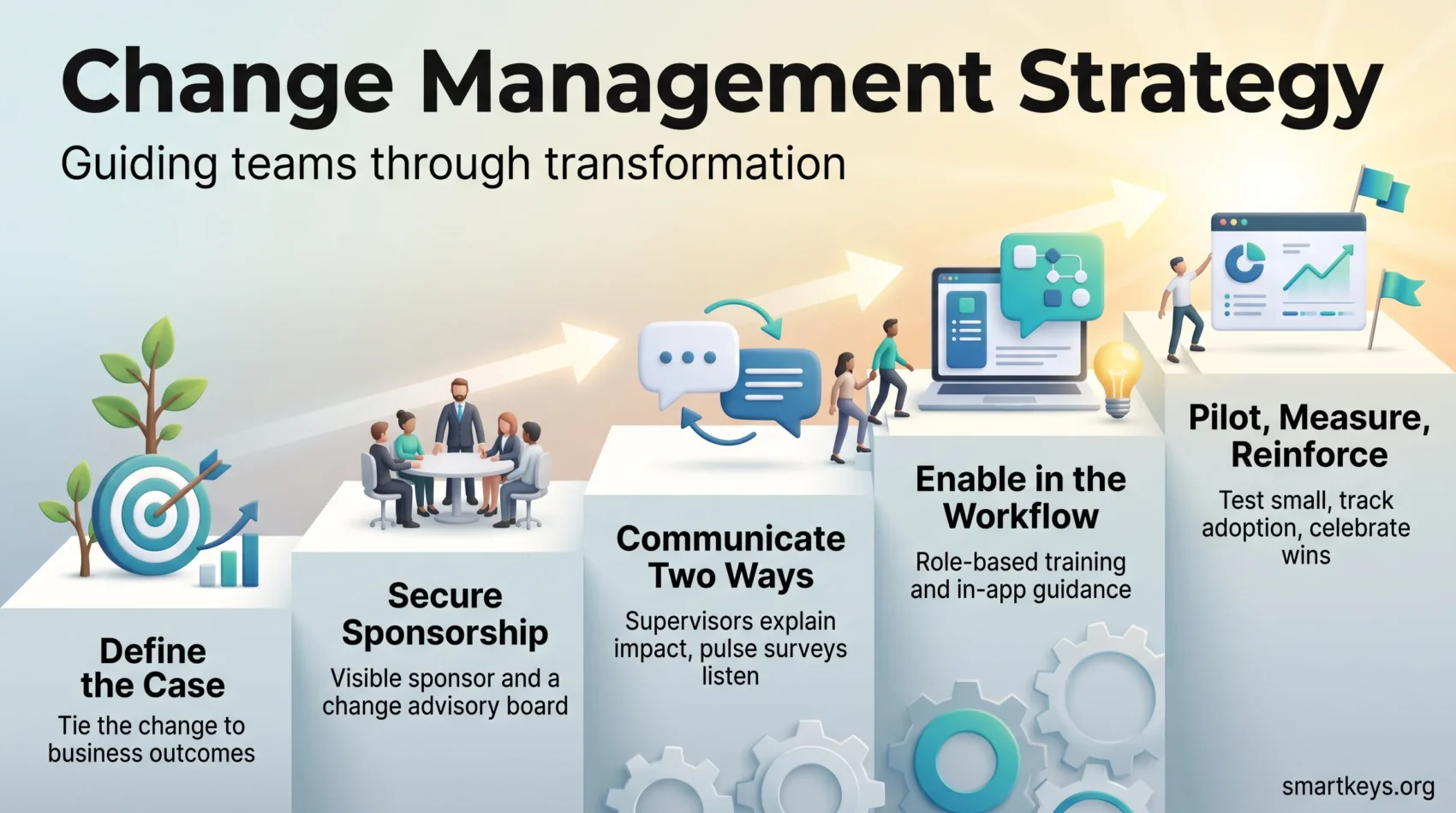
If you are leading a major shift at your company, you face two hard facts: people resist, and the pace keeps accelerating. Woodrow Wilson put it plainly: “If you want to make enemies, try to change something.”
The 2026 evidence is blunt. Gartner research published in July 2025 found that only 32% of mid-to-senior business leaders achieved healthy change adoption in their most recent initiative. A parallel survey of more than 2,850 employees found that 79% hold low trust in change. Volume is part of the problem. PwC data cited by Prosci shows 53% of employees feel overwhelmed by how much is changing at once.
Change management is the work of helping people actually use a new tool, process, or structure. It is not the announcement. This guide sets a practical path. You will learn how to link the case for change to business goals, so your team knows why the shift matters and how success will be measured. The sections ahead cover definitions, planning steps, communication, enablement, rollout, measurement, and real examples.
Focus on people-first leadership and on support delivered inside daily work. Adopt simple feedback loops, clear goals tied to performance, and a governance body that decides which initiatives run first. This approach favors action over perfect plans.
Key Takeaways
- People resist; acknowledge that and lead with empathy.
- Connect the case for change to measurable business outcomes.
- Use governance and clear roles to reduce risk and speed value.
- Deliver communication and support where people already work.
- Routine beats theater: Gartner finds routinizing change about three times more effective than inspirational messaging.
- Success comes from adapting with people, not from perfect plans.
What you will achieve with this how-to guide
You get hands-on tools to lead teams and track measurable progress.
Who this is for and why it matters now
This guide is for people leaders, project owners, and anyone helping a team adopt new ways of working. Organizations now run continuous AI-driven shifts alongside one-off strategic projects. Prosci’s 2026 guidance treats those as two different problems that need separate budgets and staffing. Practical support matters because the two collide in the same calendar week.
Outcomes you can drive this quarter
Align goals to clear success metrics and you can show faster adoption, less resistance, and visible progress. The payoff is measurable: Prosci research finds 88% of participants with excellent change management met or exceeded their objectives, against 13% for those with poor practices.
- Quick framework: Use templates to prioritize initiatives and get early wins.
- People-first rollout: Socialize plans with employees and share ownership.
- Measure & iterate: Set baselines, track progress, and adjust in real time.
- Learning loop: Turn outcomes into a repeatable approach your company can apply next time.
For leadership skills that help you guide teams through this work, see future leadership skills, and scan the wider shifts in leadership trends in modern businesses.
Change management, defined for today’s workplace
Teams now juggle overlapping initiatives that affect daily work and long-term results. Think of this discipline as a structured practice that guides people, processes, and tools through a shift. It is not a one-off memo or a single kickoff slide deck.
What it is and what it is not
What it is: a sustained process embedded in everyday work. It uses guidance delivered inside the tools people already use, regular feedback loops, and clear roles, so people know what to do next.
What it is not: an ad hoc bulletin, a leader’s side task, or the hope that communication alone will fix adoption.
Why adoption is the bottleneck: what the 2026 data shows
The constraint is no longer awareness. It is trust and capacity. Gartner’s July 2025 study of 141 HR leaders found that organizations with ungovernable change are 1.6 times less likely to report high change trust. Its employee survey put low change trust at 79%. The upside of getting this right is commercial: Gartner links better-than-average change adoption to roughly double the year-over-year revenue growth rate.
Gartner’s other finding is counterintuitive and worth planning around. Where change trust is low, inspirational leadership produced healthy adoption in only about 25% of cases. Leaders who routinized change, meaning they built it into normal weekly work rather than staging a launch event, made employees roughly three times more likely to adopt on time.
- Use a shared vocabulary for change types and scope, so cross-functional teams argue about the plan and not the words.
- Equip leaders to model behavior, remove blockers, and reinforce goals. The emerging C-suite roles reshaping accountability are worth watching here.
- Choose tools that scale and that deliver help where the work happens.
What is a change management strategy?
A clear blueprint turns a big idea into outcomes your team can act on. This is not a memo. It is a practical plan that ties each activity to a business goal you already care about.
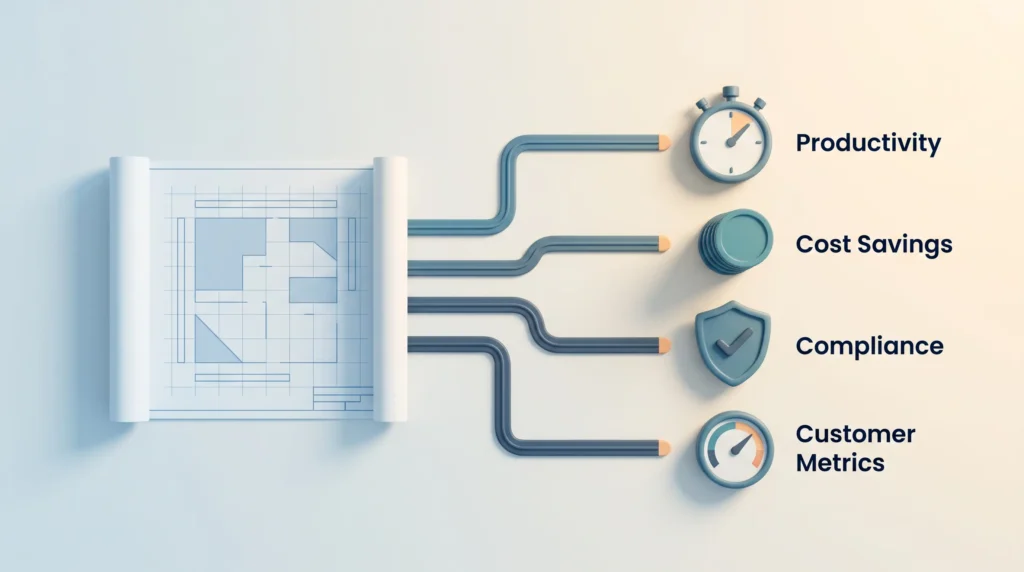
From concept to execution: connecting strategy to business outcomes
Your roadmap should show how the work maps to value. Align goals to productivity gains, cost savings, compliance, or customer metrics, so success is unambiguous.
- Define the case for change and set goals tied to business results.
- Assign owners and timelines so progress can be tracked.
- Use pilots and employee input to reduce resistance and prove value.
The core elements your plan must include
- Vision & scope: clear intent and boundaries.
- Stakeholders & roles: who decides, who acts.
- Governance, risks, and metrics: guardrails and success measures.
- Communication & support: cadence, channels, and in-app help.
Right-size the approach for your company and the size of the initiative. Include leaders and sponsors who remove blockers, document decisions, and keep adoption on track. Monitor adoption, iterate quickly, and make sure the plan protects morale and retention while it delivers the business result. If the shift touches reporting lines, read how AI-driven organizational design is reshaping company structures before you redraw the chart.
Types of organizational change and how to approach each
Not all shifts look the same, so your approach should match the type you face. Classify the work first. That is how you scope effort, risk, and support.
Transformational versus adaptive or incremental
Transformational moves, such as mergers or digital overhauls, need heavy governance, broad training, and visible leaders. McKinsey research cited by Prosci puts the share of transformations that sustain their improvements at around 26%. That is a fair argument for treating them as multi-year capability builds rather than projects. Adaptive or incremental updates, such as a workflow tweak, work best with a rapid pilot and light training.
Individual, exceptional, pendulum, and paradigm
Individual changes affect one role or one employee and need targeted coaching. Exceptional events are one-offs, such as an office closure, and need quick, clear guidance.
Pendulum shifts swing policy back and forth, as rapid remote-to-office reversals do. They demand frequent communication and visible leaders. Paradigm shifts reshape culture and need reinforcement over years. The groundwork usually looks like a transparency culture that makes open disagreement safe.
Choosing an approach when types overlap
Many projects blend types. A platform rollout can be transformational for the business, require individual onboarding, and nudge culture all at once. In those cases, align processes, tools, and resources in one integrated plan. When the problem is still fuzzy, borrow the widen-then-narrow sequencing from design thinking in business.
- Calibrate communication to the level of disruption.
- Match training to role impact and timing.
- Have leaders link the change to a clear business outcome.
How to build your change management plan step by step
Start by framing what will change, why it matters, and who must act. Then run a short readiness assessment, a structured check of whether your organization has the capacity, skills, and attention to absorb the change right now.
Define scope and readiness
List the scope, the outcomes, and the dependencies. Interview frontline staff briefly to spot blockers early. They usually know which step will break first.
Governance and roles
Form a change advisory board, a small standing group with an executive sponsor and cross-functional owners that approves scope and settles disputes. Give each role clear decision rights and a path for escalating problems. Sponsorship is not a formality: Prosci finds projects with extremely effective sponsors meet objectives 79% of the time, against 27% where sponsorship is extremely ineffective.
Map stakeholders and goals
Segment stakeholders by how much the change affects them and how much influence they hold. Then set goals as SMART targets (specific, measurable, achievable, relevant, time-bound) or as OKRs (objectives and key results), and tie each one to a business outcome. Prosci reports that organizations which define success well and measure against it can raise their odds of meeting objectives by up to five times.
Resources, timeline, and risks
- Document processes end to end, and mark where people will need help inside the tool itself.
- Estimate resources (people, budget, and tools) and set review points where the project must earn its next stage.
- Build a risk register with owners, likelihood, impact, and contingency plans. If key roles are thin, pair it with workforce contingency planning.
Then decide the rollout method (linear waves, geometric waves, or big bang) based on your risk tolerance and capacity. Capture adoption and time-to-value metrics from day one, so you can iterate on evidence rather than guesswork.
Design your communication strategy for effective change
Clear, timely messaging moves teams from uncertainty to action. Script the why, the what, the when, and the how, so every stakeholder understands both the business case and the personal impact.
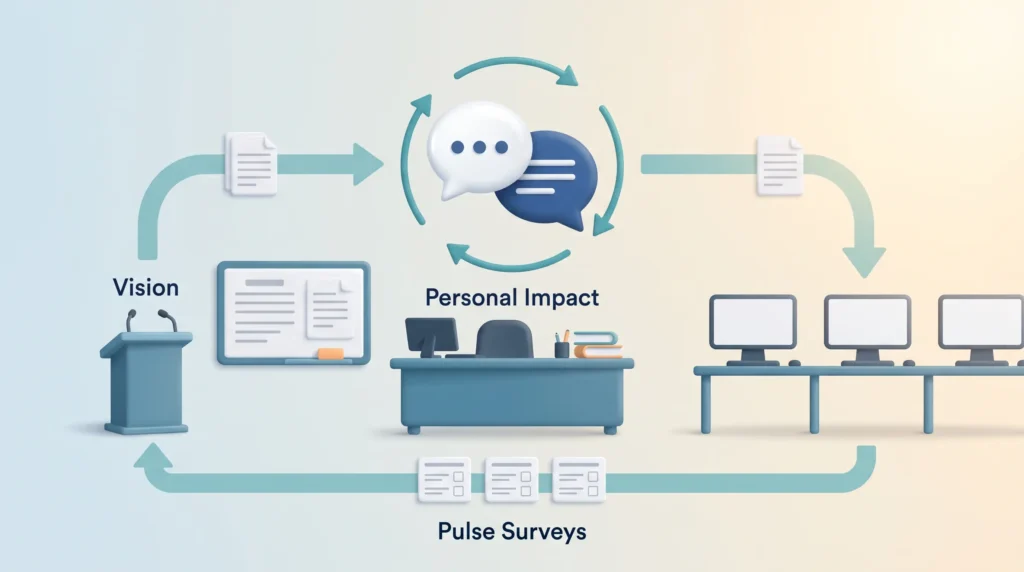
Craft the why, the what, the when, and the how
Write short, role-specific messages that connect the goal to day-to-day work. Use supervisor-led notes to explain personal impact. Prosci research finds 58% of employees prefer to hear change messages from their direct supervisor rather than from senior leadership.
Multi-channel communication: town halls, in-app, intranet, email
Mix executive town halls for the vision with leader videos and intranet hubs for the details. Add targeted emails and in-app prompts, so messages reach people while they work. Distributed teams often need an asynchronous carrier as well. Both internal podcasting and short morning briefings work well for reinforcement.
Two-way feedback loops: pulse and engagement surveys
Use frequent pulse surveys, which are short and repeated, for quick reads. Use deeper engagement surveys to find resistance early. Close the loop visibly by publishing how the feedback shaped a decision. Where you want people shaping the decision rather than reacting to it, participatory management sets out how far to open the door.
Leader-led messaging versus supervisor updates
- Executives: share the vision and its link to business goals.
- Supervisors: explain personal impact and daily expectations.
- Equip both with toolkits: talking points, FAQs, slide snippets.
Track reach and results and adapt when engagement drops or confusion rises. That keeps teams confident and lowers resistance.
Enable people with training, support, and culture-building
Practical training, peer networks, and steady help turn plans into everyday habits. Focus on real tasks rather than theory, so teams learn by doing and errors drop.
Role-based training and support inside the workflow
Design learning around specific processes: short modules tied to daily tasks. Embed guides inside the tools people use, so learning happens during work instead of in a separate session.
Provide quick reference guides and brief videos that mirror real workflows. Track usage and proficiency to target extra help. Where a change redistributes work rather than replacing it, a cross-training strategy is the faster route to coverage.
Employee ambassadors and change champions
Set up an ambassador network to amplify messages and surface issues. Peers model new behaviors and spotlight quick wins, which lowers resistance faster than another executive email. The mechanics overlap heavily with employee advocacy programs, so reuse what already works.
Mentoring, coaching, and resilience training
Offer one-on-one coaching and group mentoring to sustain new habits. Add team resilience training to address fatigue and keep performance steady. Managers who dread the hard conversations can rehearse them first, since AI soft skills training now simulates those scenarios convincingly.
- Continuous support beats one-off workshops.
- Leaders should recognize learning and reward questions.
- Measure adoption and send resources where impact is highest.
Change rollout methods and pilots that reduce risk
Before you scale, run targeted pilots to spot gaps and prove value with real users. A pilot lets you test assumptions, collect feedback, and refine the process without exposing the whole business.

Pilot programs to validate, learn, and de-risk
Set clear entry and exit criteria so the test ends with a decision: scale, iterate, or stop. Capture real user feedback, measure adoption, and log every issue and lesson.
Keep pilots short and measurable. That speeds up learning and keeps the cost low.
Linear release, geometric waves, and big bang: when to use each
Choose the rollout that fits your risk appetite and your resources. A linear release moves group by group at a steady pace and suits low-risk changes. Geometric waves start with a small cohort and roughly double each round, which gives you time to learn between waves.
Reserve a big bang, where everyone switches at once, for cases where alignment, timing, and support are certain. Always include a rollback plan and a communication protocol. Timeline discipline matters here: Prosci reports that only 49.7% of ERP projects hit their original timeline and 38.4% of organizations run over budget. ERP systems run finance, HR, and operations on one platform, so they are the standard stress test for this kind of rollout. Plan the buffer before you need it.
Sandbox environments and guardrails after go-live
Create a sandbox, a practice copy of the system, so teams can rehearse without touching live data. After launch, layer contextual tips, validation checks, and guided flows to reduce errors and shorten the time to proficiency.
- Coordinate IT, operations, and business owners during each switch window.
- Measure adoption and process completion in every wave.
- Capture the lessons and build a reusable playbook for the next initiative.
Measure adoption, performance, and ROI of change
Start by defining a baseline that shows where you begin and what success looks like. The baseline is what lets you track real progress and spot problems early.
Set baselines and define success metrics
Define your KPIs up front: adoption rate, satisfaction, error rate, cycle time, and support tickets. Tie each metric to a business goal, so results map to value rather than to activity.
Track adoption, friction, and time-to-value
Instrument the tools and processes to capture where people start, how long a task takes, and where they drop off. Product analytics shows you which steps slow the rollout down.
Close the loop: iterate on insights and celebrate milestones
Combine the numbers with stakeholder feedback to get the full picture. Review progress on a regular cadence and update the plan quickly. Prosci’s 2026 guidance is explicit on timing: measure adoption continuously through the lifecycle rather than only at project close, so you can course-correct while budget still exists.
- Make dashboards visible so leaders can judge performance and fund the next step.
- Prioritize fixes where adoption gaps cause the most friction.
- Celebrate wins by rewarding milestones such as proficiency thresholds and faster completion times.
Reinforcement is not decoration. Prosci finds 81% of participants who planned for reinforcement met or exceeded their objectives, which makes the post-launch phase one of the cheapest places to buy success.
Change management pitfalls and how to prevent failure
Most failed efforts trace back to a few predictable faults you can prevent. Below are the common pitfalls, each with a fix that protects adoption and keeps your team on track.
Missing business outcomes and weak sponsorship
Problem: Vague goals and quiet sponsors leave teams without direction.
Fix: Tie every initiative to a measurable business outcome, and secure visible executive sponsorship that stays engaged well beyond kickoff.
Poor communication and low buy-in
Problem: Vague messages breed doubt and resistance.
Fix: Tailor communication by audience, give leaders ready-made toolkits, and use two-way feedback to build buy-in.
Insufficient training and no in-app support
Problem: People struggle without role-based learning and help at the moment they need it.
Fix: Provide short modules, embedded guides, and peer ambassadors to cut rework and speed proficiency.
No way to measure impact
Problem: Without baselines or KPIs, problems stay hidden until they are expensive.
Fix: Set baselines, track process KPIs, and review adoption data regularly with sponsors and teams.
Disrupting workflows without a safety net
Problem: Live errors spike when you skip practice environments.
Fix: Use a sandbox for rehearsal, add guardrails after launch, and sequence initiatives so your organization is not overloaded.
Stacking one initiative on top of the last
Problem: Change fatigue is a capacity problem, not an attitude problem. When more than half of employees already feel overwhelmed by concurrent change, a well-designed initiative can still fail because there is no room for it.
Fix: Keep a single portfolio view of every live initiative, sequence deliberately, and retire something before you add something. Tool sprawl compounds the same problem, so see work tech overload for how to simplify the stack.
- Clarify ownership and log decisions, so risks get handled before they block progress.
- Celebrate quick wins and publish progress to maintain momentum and trust.
- Coach leaders to model new behaviors and reinforce the expected process.
Tools and templates that make change practical
Equip your teams with embedded guides and templates, so adoption happens inside the apps they already use.
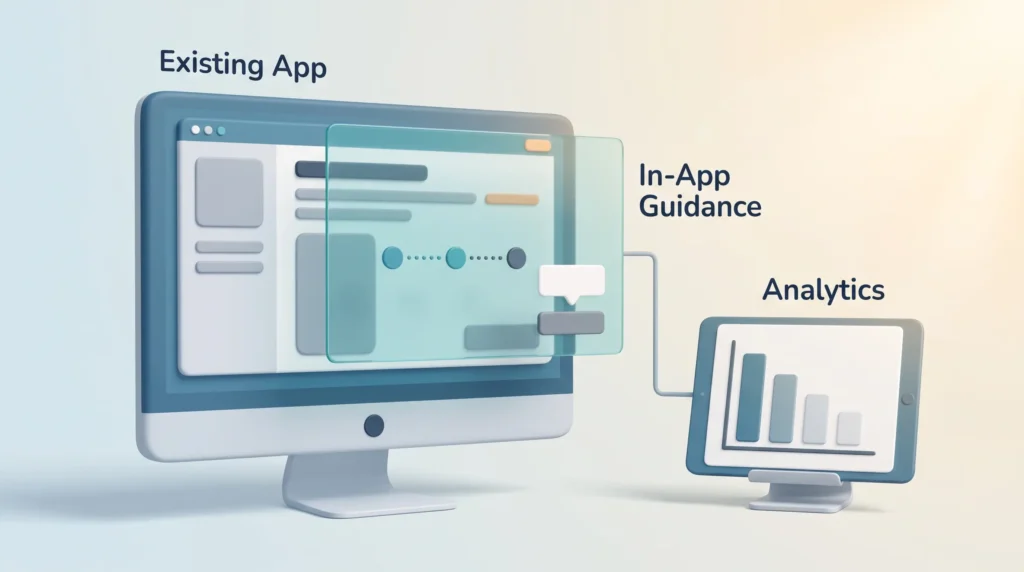
Digital adoption platforms for in-app guidance and analytics
Pick platforms that reduce help desk load and speed proficiency.
A digital adoption platform is software that overlays your existing apps with walkthroughs, smart tips, and contextual self-help. It lets people complete a new process correctly the first time, without leaving the screen they are on.
Connect the platform to your analytics, so you can see drop-offs, task time, and ticket trends in one place. That gives leaders and sponsors a single dashboard. For distributed teams, pair it with AI-powered collaboration tools so guidance travels with the work.
ADKAR-based templates for planning and reinforcement
ADKAR is a five-stage model covering awareness, desire, knowledge, ability, and reinforcement. Its templates give you a repeatable structure for stakeholder mapping, communications, training plans, and KPI tracking.
Package toolkits for sponsors and supervisors: talking points, FAQs, checklists, and dashboards. Reusable assets shorten ramp time for future initiatives, and Prosci’s 2026 guidance argues for funding that capability like infrastructure rather than charging it to each project.
- Standardize processes with reusable checklists and playbooks.
- Integrate tools into your stack so data flows to one performance view.
- Include feedback loops so the templates improve with each rollout.
Real-world examples and scenarios you can model
Look at how real firms paired squads, pilots, and champions to get value faster. These brief cases show tactics your team can copy.
Cross-functional teams and champion networks
Form squads that span product, operations, and frontline staff. IBM’s pivot from hardware to services under Lou Gerstner is the classic example. Leaders and delivery teams were tied to one set of outcomes, so accountability sat where the work happened.
Build a champion network to surface issues fast and model new behaviors. Champions amplify messages and help you adapt the plan with real feedback.
Agile, iterative rollouts for software and process change
Use sprints, demos, and retrospectives to shrink risk and shorten feedback loops. Regional menu testing before a national launch is standard practice in food retail for the same reason: you learn cheaply before you commit.
Run short pilots with clear entry and exit criteria, measure performance, then scale the version that shows real gains. Teams outside engineering can borrow the same cadence, as HR and marketing already do when adopting Scrum and Kanban beyond IT.
Strategic approaches to AI and culture shifts
Plan AI adoption around hands-on use cases and role-based training rather than a blanket tool rollout. This is where continuous change meets project change, and where most 2026 programs are underfunded on the people side.
Document playbooks so other teams can replicate wins, and tailor the approach by risk, regulation, and workforce mix. For the wider context, see digital transformation trends and building resilient workplaces in the age of automation.
Conclusion
Finish strong by turning lessons into repeatable habits your teams can use tomorrow.
You now have a people-first change management strategy that ties each action to a business outcome and a measurable result.
Commit to clear sponsorship, a simple plan, and leader behaviors that build trust. Prioritize role-based training, support inside the workflow, and pilots with a sandbox, so employees learn safely and fast.
Measure adoption from day one, iterate on evidence, and celebrate wins to sustain momentum. Reuse templates and analytics to scale what works across the organization. If people are moving into new roles as a result, career lattice thinking gives them somewhere to go that is not up.
Start with one initiative, apply this plan, and use the early success to prove value and buy time for the next transition.
Found this useful?
Make SmartKeys a preferred source on Google, and our articles will surface more often in your Top Stories, AI Overviews, and AI Mode.
Add as Preferred Source