A transparency culture is a workplace where people can find out what is happening, who decided it, and why. It is not a slogan on a wall. It is a set of habits: goals you can look up, decisions written down, and leaders who answer questions in public.
The business case is not abstract. Gallup’s State of the Global Workplace 2026 report put global employee engagement at 20% for 2025, down from a peak of 23% in 2022. In the United States, Gallup’s first-half 2026 data found that only 49% of employees strongly agreed they know what is expected of them at work. That is well below the 61% recorded in 2015. People are not disengaged because they are lazy. Many of them simply do not know what the plan is.
This guide covers what openness looks like in practice, where it goes too far, what the 2026 pay rules now require, and how to tell whether any of it is working.
Key Takeaways
- Open communication connects company strategy to daily work.
- Clear goals and regular feedback lift engagement more than announcements do.
- Sharing news early reduces rumours and rework.
- Use fixed channels (surveys, written updates, live Q&A) so information is easy to find.
- Privacy is part of transparency: say what you share and what you do not.
- Pay transparency is now a legal duty in much of the US and, from June 2026, across the EU.
What a Transparency Culture Actually Means
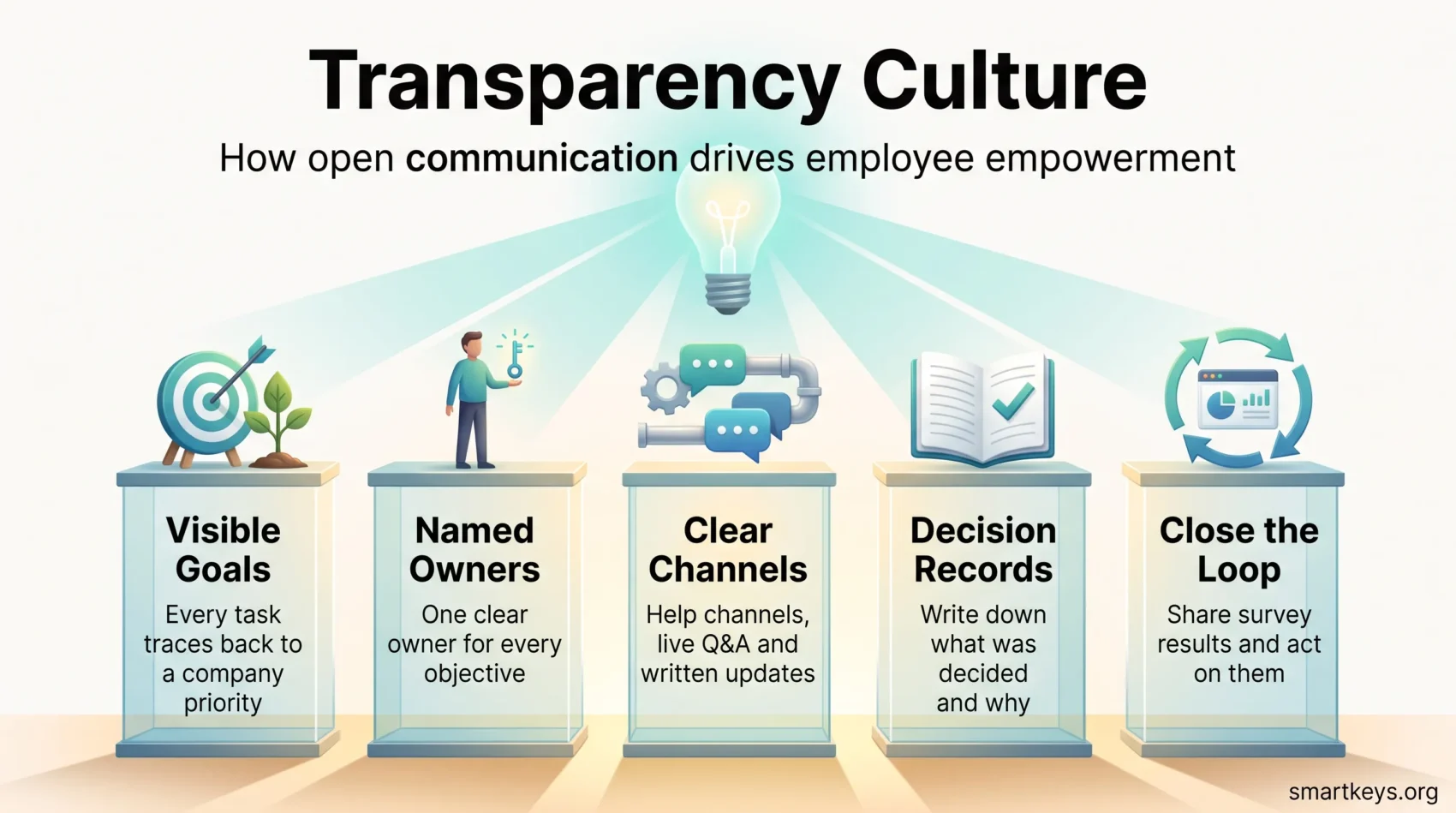
Openness at work rests on three things: goals people can see, named owners, and information that is easy to find.
Start with the goals. Publish the company objectives, then show how each team target and individual target ladders up to them. An engineer should be able to trace their sprint back to a company priority in one or two steps. If they cannot, the link probably does not exist.
Next, name an owner for every objective. An owner is the single person who can answer “where does this stand?” without checking with anyone else. This is about accountability, not blame. Without it, questions bounce between teams for days.
Then agree where information lives. Decide which channel carries routine questions, which carries decisions, and which carries company news. Consistency matters more than the tool you pick. The same logic applies to practical details such as a shared global holiday calendar for distributed teams, so nobody has to guess who is offline this week.
People now expect the reasoning behind changes, not just the changes. That means leaders explain trade-offs: what was considered, what was chosen, and what it costs. Companies that already publish this kind of reasoning externally, as many do under current CSR reporting practices, usually find the internal version easier to start.
“Define who is responsible, how progress is tracked, and where people find answers. Then everyone moves faster.”
Why Open Communication Improves Trust and Performance
When people have context, they spend less time guessing and more time working on the right thing. That shows up in three specific ways.
Fewer duplicated efforts. Two teams solving the same problem in parallel is a symptom of hidden roadmaps, not of poor planning skills.
Faster decisions. If the criteria for a decision are written down, a manager can decide without escalating. If they are not, everything goes up the chain.
Less rumour handling. Announce significant news internally first, or within minutes of any public announcement. Otherwise employees learn about their own company from a news alert, and managers spend the next two days doing damage control.
The engagement data supports the direction of travel. Gallup’s 2026 US figures show 31% of employees engaged and 18% actively disengaged, with declines in whether people feel their opinions count. Those are exactly the measures that respond to being told things. For a broader view of what moves these numbers, see current employee engagement trends.
Trust and Transparency: Getting the Balance Right
Deloitte’s HX TrustID framework describes trust as four factors: capability, reliability, humanity and transparency. It is a useful checklist because it shows that openness alone is not enough. A company that shares everything but misses every deadline is not trusted; it is just loud.
Use the four factors as a quick diagnostic. Is your leadership competent? Do systems work as promised? Are people treated decently? Is the right information shared at the right time? A weak score on any one of them undermines the others.
Proactive, reactive and forced disclosure
Proactive disclosure means you share before anyone asks. It builds the most credibility because it cannot be read as damage control.
Reactive disclosure means you publish because you have to, usually to meet a legal duty such as a pay range in a job advert. It is necessary, but it earns little goodwill.
Forced exposure is different again: monitoring people without telling them, or publishing personal information they did not agree to share. This is where openness turns into surveillance and starts costing you staff. Our guide to algorithmic management covers where that line usually gets crossed.
When privacy builds more trust than visibility
Some information should stay closed. Individual performance conversations, medical and personal circumstances, live negotiations, and security incidents under investigation all belong in a small circle.
The trick is to be transparent about your opacity. Write down what you do not share and why. “We do not publish individual performance ratings, because they are shared context between you and your manager” is a defensible position. Silence with no explanation is not. The same principle underpins good workplace data privacy practice.
Building Communication Infrastructure That Scales
Good intentions do not survive growth. Channels do. A deliberate channel map turns scattered questions into visible answers that the next person can find.
Design channels for questions, not for announcements
Set up dedicated help channels for operational questions, one per function (for example, a finance help channel). Run regular AMA sessions, meaning “ask me anything” forums where leaders take unfiltered questions. Reserve live calls for topics that genuinely need discussion rather than a written update.
Most day-to-day work does not need a meeting at all. A written-first approach, covered in more depth in our guide to asynchronous communication tools, gives people across time zones the same access to information.
Time-bound triage: acknowledge, commit, resolve
Standardise how questions get handled. Acknowledge within a stated window, commit to a date for a full answer, then resolve in the same public thread. People tolerate a slow answer far better than silence, because silence reads as avoidance.
Set expectations for public forums
Default to public channels so colleagues can learn from past exchanges. This speeds up onboarding: new joiners can search the history instead of asking the same question again. Treating those threads as a searchable record is the cheapest form of modern knowledge management.
Discourage anonymity unless safety requires it. When a thread gets heated, move it to a scheduled session with the people who actually know the answer, then post a summary afterwards.
Embedding Accountability, Goals and Decision Records
Visible ownership turns vague responsibility into trackable progress.
Assign one owner per objective and list them in whichever project tool you already use. Link every task to a top-level goal so people can see how their work connects to company priorities. Shared goals also help remote staff, who otherwise depend entirely on their manager for context. Our guide to remote leadership skills covers that gap in detail.
Write down decisions and the reasoning
Keep a lightweight decision record: what was decided, which options were considered, the trade-offs, and who signed it off. Half a page is enough.
This saves more time than it costs. Six months later, nobody has to relitigate a choice from memory, and a new hire can understand the current setup without a series of one-to-one briefings. Where a decision has measurable consequences, link it to the metric it was meant to move.
Managers and Leaders Set the Tone
Managers are the bridge between leadership and everyone else, and they are under strain. Gallup’s 2026 global report found manager engagement fell to 22% in 2025, from 31% in 2022, and attributed most of the overall engagement decline to that drop. Disengaged managers do not pass information down.
Overcommunicate major news. Give managers the message, the reasoning and the likely questions before the company announcement, not after it. A manager who first hears about a reorganisation at the all-hands cannot support their team through it.
Hold consistent check-ins. A short weekly or fortnightly one-to-one meeting is where most real clarification happens. Cancelling it repeatedly sends its own message.
Give feedback continuously. Saving observations for an annual review makes them less accurate and less useful. Gallup’s research on expectations found that employees whose manager helps them set performance goals are far more likely to be engaged. Moving to continuous performance management is usually the single biggest change available to a mid-sized company.
Leaders should also model admitting mistakes. If the only stories shared are successes, people learn that problems are hidden, not solved.
Pay Transparency: What Changed in 2026
Pay is where most transparency programmes get tested, and in 2026 the choice was largely taken out of employers’ hands.
In the United States, more than a dozen states plus Washington DC now require pay ranges in job postings. Illinois and Minnesota rules took effect in January 2025, New Jersey in June 2025, Vermont in July 2025 and Massachusetts in October 2025. Virginia followed on 1 July 2026 and Maine on 29 July 2026, while Connecticut moves from disclosure on request to a posting requirement on 1 October 2026.
In the European Union, the Pay Transparency Directive had to be transposed into national law by 7 June 2026. Candidates get the right to know the pay range before or during the interview. Current employees can request pay data for comparable roles, and employers must answer within two months. Employers with 150 or more staff report gender pay gaps from 2027 using 2026 data. An unexplained gap of 5% or more triggers remedial action.
The practical consequence is that ranges become public whether or not your pay structure is ready. If two people doing the same job sit at opposite ends of a band for no documented reason, that question will now be asked. Our guides to pay transparency and global pay parity cover how to prepare, and future of work legislation tracks what else is coming.
Technology, AI and Worker Privacy
Software can make work more visible in useful ways, and it can also turn a workplace into a monitoring exercise. The difference is consent and purpose.
Useful applications include aggregated insight (where is work getting stuck?), safety alerting, and coaching tools that give an individual feedback only they see. Harmful ones tend to share a pattern: data collected about people, held by managers, used in decisions the person never sees. That gap is what our guide to AI in employee monitoring examines, and it is closely linked to productivity paranoia, where leaders track activity because they cannot see outcomes.
Bidirectional transparency and informed consent
If you collect data about people, tell them four things: what you collect, who can see it, why it helps, and how long you keep it. Then publish what came out of it. People accept measurement far more readily when they can see the result.
This is also becoming a compliance question. Under the EU AI Act, AI used for recruitment, task allocation, performance evaluation and workplace monitoring counts as high risk. Deployers must inform affected workers and their representatives before putting such a system into use. The timetable for the high-risk obligations is still moving: the European Commission’s Digital Omnibus proposal would tie some deadlines to the availability of technical standards. Check the current position rather than a date you read last year. Our EU AI Act compliance guide and our overview of AI ethics at work go into more detail.
Avoid dashboards nobody reads
More visibility is not automatically better. Ten dashboards with no owner produce the same result as none: people stop looking. Pick the handful of indicators that would actually change a decision, set a review cadence, and retire the rest.
How to Measure Transparency’s Impact
Openness is measurable if you decide in advance what you are measuring.
Build a small scorecard across four areas:
- Trust: how quickly questions are answered, and how often commitments are met.
- Engagement: survey participation, and the specific items on clarity and being heard.
- Performance: decision cycle times and escalation volume.
- Safety: whether people report problems early, and what happens when they do.
Then close the loop. Run surveys, publish the results including the uncomfortable ones, and state what you will do and by when. A survey with no visible follow-up teaches people that answering it is pointless, which is why participation falls in the second year. Tools that analyse open-text responses, covered in our guide to AI-powered engagement surveys, help only if someone acts on what they surface.
Segment results by tenure, role and location. Aggregate scores hide the teams that need attention. New joiners and fully remote staff often score lowest on clarity, which is a fixable problem once you can see it.
Real-World Practices You Can Adapt
Start with one change, not a programme.
Publish ranges before you have to. If you hire in a state or country where disclosure is coming, adopt it early and explain how bands are set.
Write a decision log for one team. A single shared page, one entry per significant decision, for one quarter. It is the lowest-cost experiment on this list.
Run one AMA and publish the answers. Including the questions you could not answer fully, with a reason.
Share supplier or operational detail where it matters to customers. Patagonia has published information about its factories and supply chain for years through its Footprint Chronicles, which shows that disclosure can be a durable practice rather than a campaign.
Formalise how disputes get raised. People will only surface problems if the route is obvious and the outcome is predictable. That is also the foundation of digital trust in distributed teams.
Conclusion
Transparency is a habit, not a policy document. Pick one high-impact change, run it for a quarter, and measure what happens.
Start small and be specific. Publish a triage process. Post a salary range on your next job advert. Write down one decision and the reasoning behind it. Each of these is visible proof that information is meant to flow, which is worth more than any statement of values.
The payoff is practical: faster decisions, fewer rumours, and less time lost to work that turns out to have been unnecessary. Leaders set the tone, but the habit only holds if everyone uses it. Take one step this week, then repeat what works.
Found this useful?
Make SmartKeys a preferred source on Google, and our articles will surface more often in your Top Stories, AI Overviews, and AI Mode.
Add as Preferred Source