Algorithmic management means using software to assign work, score performance, and make decisions that a human supervisor used to make. It started on ride-hail and delivery apps. It now runs shift rosters in retail, screens job applications in large companies, and sets pace targets in warehouses.
If you manage people, this probably already affects your job. A scheduling tool proposes next week’s roster. A screening tool ranks 300 applicants before you read one CV. Your part is no longer making every call. It is deciding which calls the software may make, and checking the ones it gets wrong.
This guide covers what these systems actually do, where they pay off, where they cause harm, and what US and EU law now requires of you. The legal picture changed sharply between 2025 and 2026, and several things commonly repeated in older articles are no longer true.
Key Takeaways
- Algorithmic management is software making or shaping work decisions: task assignment, scheduling, scoring, and hiring.
- It works best on high-volume, repeatable, low-context tasks. It works badly where judgment matters.
- The main risks are biased outputs, decisions nobody can explain, and pace targets that hurt people.
- US federal guidance loosened in 2025. State law tightened instead, so your obligations now depend on where you operate.
- You can use data and AI while protecting people and fairness, but only with notice, records, and a human who can overrule the system.
What algorithmic management actually is
In plain terms: software tracks what workers do, turns that into numbers, and uses those numbers to direct or judge them.
Early research by Lee, Kusbit, Metsky, and Dabbish (2015) described how Uber and Lyft assigned rides and rated drivers by algorithm. Those patterns have since spread into ordinary companies.
Five features show up almost everywhere:
- Data collection: apps, badges, and devices capture location, timing, and output.
- Real-time response: the system reroutes work or updates a schedule within seconds.
- Automated decisions: routine choices happen without a person in the loop.
- Scores and ratings: performance becomes a number that drives consequences.
- Nudges: prompts, leaderboards, and alerts push behavior in a chosen direction.
The important question is not whether your company uses these features. It is which decisions you have handed over, and whether anyone can still reverse them.
How the data becomes a decision
The pipeline is short. Devices log activity. Models or simple rules read those logs. The system then assigns, alerts, or scores.
On a delivery platform, that means dispatch, pricing, and driver ratings. In a corporate HR team, it means CV parsing, natural language processing (software that reads free text and extracts meaning) applied to written answers, and a dashboard that ranks candidates.
Ratings, nudges, and automated feedback
Deliveroo has sent riders periodic reports with metrics such as time to accept an order and travel time. Those numbers then become nudges: a badge, a leaderboard position, or a warning when a threshold is crossed.
Nudges are cheap to deploy and easy to overtune. A prompt that says “you are 8% below target” changes behavior. It does not explain what a good day looks like, and it cannot tell the difference between a slow worker and a broken lift.
Three practical rules help here:
- Automate the repeatable, high-volume, low-context work first. Leave the rest alone.
- Check how fast the system decides. Instant prompts speed work up, but a badly tuned one annoys people all day.
- Feed back metrics people can act on. A score with no lever attached is just pressure.
From gig platforms to enterprise HR
The first large-scale cases came from ride-hail and food delivery, where software routed tasks and scored workers in real time. Those platforms proved the method worked at scale.
The same techniques then moved into companies: AI hiring tools for screening, forecasting tools for intelligent shift scheduling, and analytics for performance reviews.
None of this was sudden. Digitally directed work goes back to factory floors in the 1970s. What changed is cost. Cloud computing, cheap storage, and abundant data made these systems affordable for a 200-person firm, not just a multinational.
- Gig-era playbooks scaled into enterprise HR, but not every part translated cleanly.
- For a broader view of how platform work is developing, see our overview of gig economy trends.
The upside: speed, consistency, and useful feedback
The honest case for these systems is throughput and consistency. Software does not get tired on the 200th CV, and it applies the same rule every time.
Faster hiring and staffing
Screening tools process far more applications per hour than a recruiter can. The most-quoted example is L’Oréal, which reported hiring roughly ten times faster and interviewing 25% more applicants after deploying a recruiting chatbot. That figure comes from the vendor’s own 2018 case study and has never been independently audited, so treat it as a vendor claim rather than a benchmark.
The defensible version of the claim is narrower. Automated screening reliably cuts time-to-first-contact. Whether it improves the quality of who you hire depends entirely on what the model was trained to reward.
Algorithms plus manager judgment
The pattern that holds up best is augmentation: the system proposes, a trained person decides. Applied to scheduling, that means the forecast suggests a roster and a manager adjusts it for things the data cannot see, such as a new hire who should not be alone on a late shift.
That split keeps accountability where it belongs, with a person who can explain the call.
- Use the tool to flag high-volume, repeatable work.
- Keep human review for edge cases and anything contested.
- Roll out in phases so you can see what the system gets wrong.
- Measure whether vacancies actually fill faster, not just whether screening is quicker.
Personalized feedback, done carefully
Workers can get targeted metrics they can act on, which beats an annual review nobody remembers. Distributed teams benefit most, because a manager cannot see informally who is overloaded. Tools for continuous performance management aim at exactly that gap.
The line between helpful feedback and constant evaluation is thin. Feedback people asked for feels like support. The same data collected without consent feels like surveillance, and it often grows out of productivity paranoia among remote managers.
The downside: bias, opacity, and pace
When software shapes decisions and nobody can explain its logic, two things break: fairness and trust.
Models learn from past decisions. If your previous hires skewed toward one group, the model learns that pattern and repeats it. This is the core problem behind AI hiring bias, and it does not require anyone to intend discrimination.
Black boxes and accountability gaps
Many systems cannot say why they produced a given output. That is a legal problem as well as an ethical one, because a rejected candidate in Illinois or California can now ask.
Work on explainable AI exists to close this gap. In practice, the simplest safeguard is to keep a record: which tool, which inputs, which version, who reviewed it. Buying a tool does not transfer responsibility to the vendor. California’s rules make that explicit.
Surveillance and autonomy
Monitoring expanded fast during the remote-work shift, and keystroke logging and screenshot capture became ordinary features. The trade-off is consistent across the research: more monitoring gives managers more data and workers less discretion.
Where this goes wrong is usually scope creep. A tool bought to measure one process ends up watching everything. Our guide to AI employee monitoring software and privacy covers how to set those limits before that happens. Tools that claim to read mood or sentiment deserve extra caution, because the underlying science is weak and several jurisdictions now restrict them.
Pace targets and physical harm
This is the clearest documented harm, and it is worth being specific.
In December 2024, the US Senate Committee on Health, Education, Labor and Pensions published an interim report on working conditions at Amazon warehouses. It concluded that the company’s own internal studies linked speed quotas to injuries, and that recommendations to slow the pace were not adopted. Amazon disputes the findings.
Lawmakers responded with disclosure rules rather than limits. Six states now require written notice of any quota: California, New York, Minnesota, Washington, Oregon, and Connecticut, whose law took effect on 1 July 2026. Typical obligations include telling workers the quota in writing, confirming changes promptly, keeping work-speed records for three years, and making sure quotas do not interfere with breaks or restroom use. Connecticut went further and barred standards based purely on ranking workers against each other.
If you set pace targets anywhere in those states, this is compliance work, not a future risk.
Your job as a manager in an algorithmic workplace
Managers who treat a recommendation as a suggestion get better results than those who treat it as an order. That takes a few skills most management training still skips.
Data literacy, ethics, and change leadership
Start small. Your managers do not need statistics. They need to read a model’s output, notice when it looks wrong, and know which question to ask.
A useful test: can the manager explain, in one sentence, why the system ranked candidate A above candidate B? If not, nobody in your company can defend that decision later. A structured data literacy program is the cheapest way to fix this.
Augmentation or automation: pick deliberately
Decide per task, not per tool. Automate where errors are cheap and reversible. Keep a person where they are not.
Three things make that workable: a threshold that triggers human review, a clear escalation path, and a short written note whenever a manager overrides the system. That last habit matters most. It is your only evidence that oversight is real rather than nominal.
- Train with short scenario exercises, not slide decks.
- Put recommendations inside the workflow so review is quick.
- Track how often managers override the system, and why.
A rising override rate is not a failure. It is usually the first sign that the model has drifted away from how the work is actually done. Our guide to AI job augmentation goes deeper on where to draw the line.
US policy in 2026: federal retreat, state advance
This is where most older articles are now wrong. The federal posture reversed in 2025, while states moved in the opposite direction.
What no longer applies. The Biden executive order on AI was revoked in January 2025 and replaced by Executive Order 14179, which prioritises removing barriers to AI development. The Blueprint for an AI Bill of Rights, widely cited in 2023 and 2024 guidance, is no longer the operative federal framework. On 18 February 2025, NLRB Acting General Counsel William Cowen rescinded GC 23-02, the memo arguing that electronic monitoring can interfere with organising rights. Federal labour-law pressure on surveillance is therefore weaker than it was.
What is still pending. The Stop Spying Bosses Act has been reintroduced across several sessions of Congress, most recently as H.R. 9402 in the 119th Congress. It would require disclosure of worker data collection and create a privacy division at the Department of Labor. It has not become law, so plan around it rather than for it.
What actually binds you now. State rules do, and they are specific:
- Illinois: an amendment to the Human Rights Act took effect on 1 January 2026. Using AI that has a discriminatory effect in hiring, promotion, discipline, or discharge is a civil rights violation, and employers must notify applicants and employees when AI is used in those decisions.
- California: FEHA regulations on automated decision systems took effect on 1 October 2025. They cover any computational process that makes or facilitates an employment decision, apply whether you built the tool or bought it, and require ADS records to be kept for four years. Bias testing is not mandatory, but documented testing can support your defence.
- New York City: Local Law 144 still requires an independent bias audit and candidate notice for automated employment decision tools. A State Comptroller audit published on 2 December 2025 found enforcement had been thin: the city received only two complaints between July 2023 and June 2025, and auditors identified at least 17 potential violations among companies the city had reviewed. Weak enforcement is not a safe harbour, and it invites tightening.
- Colorado: the original Colorado AI Act never took effect. Enforcement was halted in April 2026 and the legislature passed a replacement, SB 26-189, in May 2026. The new framework is narrower, focuses on notice and records rather than broad risk assessments, and is scheduled to reach employers from 1 January 2027.
The practical consequence is that your obligations now depend on headcount location, not on a single national standard. Our running summary of future of work legislation and the broader AI regulation picture track these changes as they move.
What the EU rules add
If you employ anyone in the EU, two instruments matter.
The Platform Work Directive must be written into national law by 2 December 2026. It requires platforms to tell workers when automated monitoring and decision-making are in use, to provide human oversight of significant decisions, and to allow those decisions to be contested. It also creates a legal presumption of employment where a platform directs and controls the work, with the burden on the platform to rebut it. Transposition is running late in most member states, so expect a patchwork well into 2027.
The EU AI Act applies separately and reaches ordinary employers, not just platforms. Systems used for recruitment, selection, promotion, termination, and task allocation fall into its high-risk category, which brings duties around human oversight, worker information, and staff competence. Timing is genuinely unsettled: the Commission’s Digital Omnibus proposals would defer parts of the high-risk regime, so confirm the current date before you build a compliance plan. Our EU AI Act compliance guide covers the detail.
Even if you never touch the EU market, the directive is a useful design template. Notice, human review, and a route to contest a decision are what US states are converging on too.
Implementing it responsibly
Start where the work repeats daily and the data is reliable. Prove value on something small and reversible.
Begin with standardized, high-volume work
Good first candidates have clear inputs and outputs: CV screening against defined criteria, routine shift rostering, simple ticket routing. The stakes are low enough that an error costs an hour, not a lawsuit.
Bad first candidates are the tempting ones: promotion decisions, performance ratings, and anything touching discipline.
Communicate before you deploy, not after
How you introduce the system shapes how people read it. Explain what it does, what it does not do, what data it uses, and who is accountable when it is wrong.
Include workers in the pilot. They will find the edge cases your vendor demo did not, usually in the first week. Making that easy to do is what turns early feedback into a fix rather than a grievance.
Measure outcomes, not adoption
Adoption is easy to report and tells you nothing. Track whether the decisions got better: time to fill, quality of hire, schedule stability, turnover, and complaint volume.
Set a threshold that pauses the system. If disparate impact crosses an agreed line, or override rates spike, the rollout stops until someone looks at it. Writing that trigger down in advance is what separates governance from intention. Tools covered in workforce analytics can surface these signals early.
Governance that survives an audit
Four things, in order of how often they are missing: documented model inputs and versions, regular bias testing, named human reviewers for high-impact decisions, and retention periods that meet the strictest state rule you are subject to. In California that is four years; several quota laws require three.
An automation ethics board formalises the review, and an AI governance model defines who signs off on what. For the underlying principles, see our AI ethics framework.
Where this shows up in practice
Recruiting and selection
Most companies start here. Parsers read CVs, language models score written answers, and some tools analyse recorded video interviews.
Video analysis is the most exposed category. Illinois has regulated AI video interview analysis since 2020, and the newer Human Rights Act amendment adds notice duties across the whole hiring process. If you use it, check that your vendor can produce the audit trail your state asks for.
Split the funnel into sourcing, screening, and assessment. Controls belong at screening, where the tool removes people from consideration.
Scheduling in retail, hospitality, and logistics
Forecasting tools predict demand and propose rosters. Handing the forecast straight to a rota generator is what produces unstable hours, clopenings, and unpredictable pay.
The fix is constraints, not better models: guaranteed advance notice, minimum rest between shifts, a floor on weekly hours, and a shift-swap mechanism workers control. Build those in as hard rules the optimiser cannot trade away.
Platform work
On platforms, the algorithm sets task assignment, quotas, and often pay. Acceptance rates and travel times feed back into how much work a person is offered.
Three safeguards do most of the work: explain how pay is calculated, give workers access to their own performance data, and provide a dispute route staffed by humans. The Platform Work Directive will require versions of all three in the EU, and gig economy regulation is moving the same way elsewhere.
What comes next
The open question is not how capable these systems become. It is who gets to see how they work.
When workers can see the same data the system uses, the power gap narrows. Transparency reports, plain-language explanations of how scores are calculated, and access to one’s own record all shift the balance. Where the logic stays hidden, control concentrates with whoever owns the model.
Worker action has already forced change. Pressure from drivers, riders, and warehouse staff put quotas and monitoring on the legislative agenda in the first place, and tech worker organising has pushed some of it into company policy.
Three design choices consistently help:
- Build an appeal route: let people contest and correct a data-driven outcome, with a human deciding the appeal.
- Design for autonomy: make nudges configurable and visibility opt-in where you can.
- Protect collective rights: do not deploy monitoring in ways that expose or chill organising.
Conclusion
Algorithmic management is not a single technology you adopt or reject. It is a set of decisions about which judgments you hand to software and which you keep.
The systems genuinely help with volume, consistency, and speed on repeatable work. They reliably cause harm when they are opaque, when nobody can overrule them, and when the metric they optimise is pace.
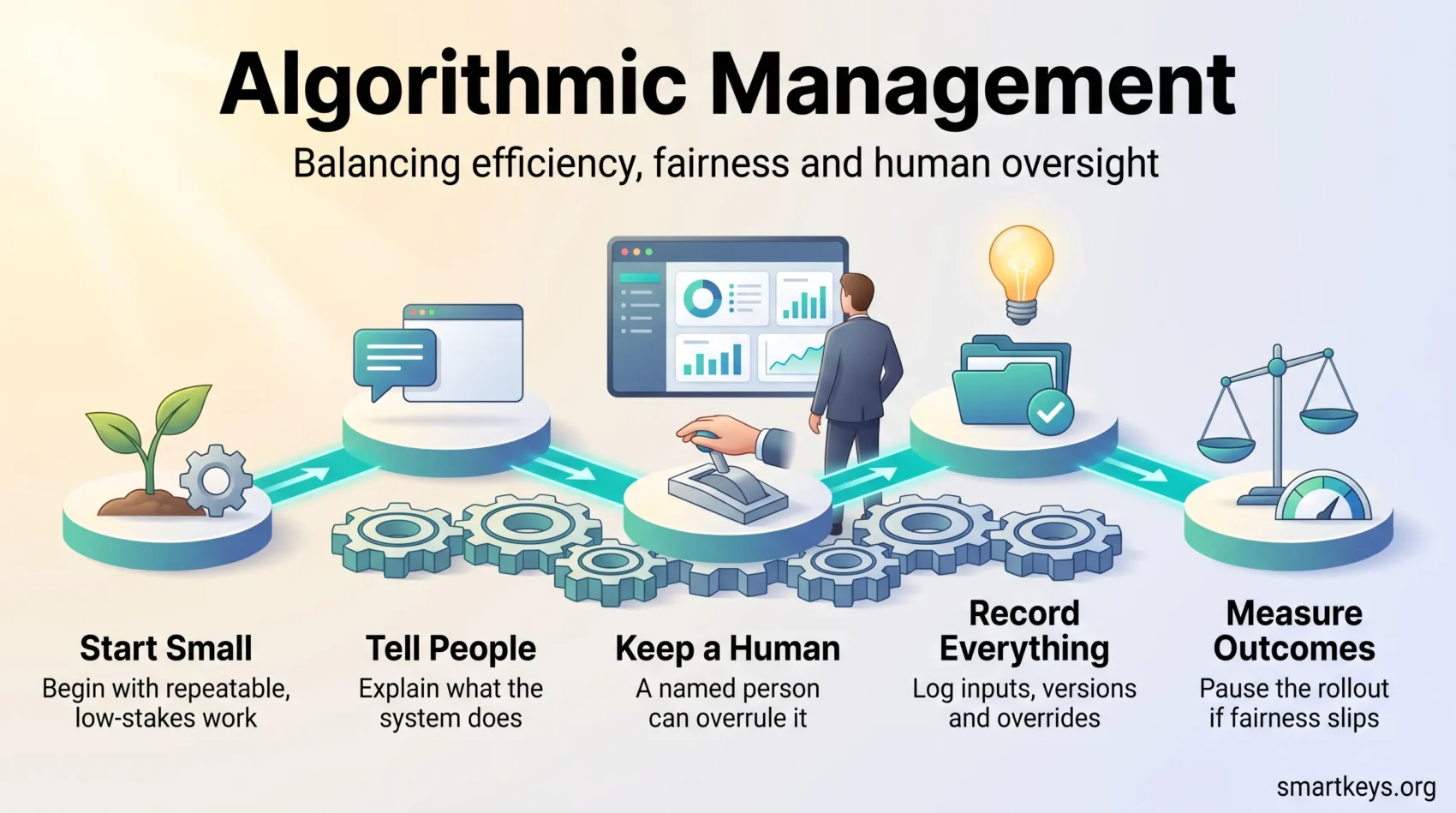
A workable approach fits in five steps. Pick repeatable, low-stakes work to start. Tell people what the system does and what data it uses. Keep a named human able to overrule it. Record inputs, versions, and overrides for as long as your strictest state rule requires. Measure whether decisions improved, and stop the rollout if fairness metrics slip.
Check which rules apply to you before anything else. As of late 2026 that means Illinois and California obligations already in force, New York City’s audit duty, Colorado’s replacement regime arriving in 2027, quota notice laws in six states, and EU deadlines that may yet shift. For a wider view of how AI is changing management, start there.
Found this useful?
Make SmartKeys a preferred source on Google, and our articles will surface more often in your Top Stories, AI Overviews, and AI Mode.
Add as Preferred Source