Neuromarketing is the practice of measuring what happens in the brain and body while someone looks at an ad, a website or a product, and using those measurements to make marketing decisions. Instead of asking people what they think, you watch where their eyes go, how much mental effort a message costs them, and whether their body reacts at all.
The appeal is simple. People are unreliable narrators of their own choices. They forget what they looked at, they rationalise after the fact, and they give the answer they think a researcher wants.
This guide explains what the field can and cannot deliver. You will learn which tool answers which question, what a study realistically costs, what the landmark research actually found, and which rules now apply in 2026. Those rules matter more than they used to: the EU banned some persuasion techniques outright in February 2025, and four US states now treat brain data as protected personal information.
Key Takeaways
- Neuromarketing measures attention, mental effort, emotion and memory instead of asking about them.
- Each tool answers a different question. Eye-tracking shows where people look; EEG shows how hard they are working; fMRI shows which deep brain systems respond.
- The evidence is strongest for attention and comprehension, weaker for claims about specific emotions.
- Since February 2025, the EU AI Act bans manipulative AI systems and emotion recognition at work, with fines up to 35 million euros or 7% of global turnover.
- Colorado, California, Montana and Connecticut have each passed laws that treat neural data as sensitive personal data.
- Start with one cheap, well-defined test rather than a large exploratory study.
What Is Neuromarketing? Definition, Origins, and Why It Matters
Definition: neuromarketing applies methods from neuroscience and physiology to marketing questions. It links three things that surveys struggle with: where attention lands, how much effort a message costs to process, and what people remember afterwards.
The gap it fills is well known to anyone who has run a focus group. Participants say a packaging design is cluttered, then pick it off the shelf anyway. They rate an ad as forgettable, then recall the brand a week later. Stated preference and actual behaviour often disagree, and the disagreement is not random.
Where the field came from
The term was coined in 2002, when the first commercial agencies began selling brain-based testing to advertisers. Academic work had been running for years before that, but two studies pushed the idea into mainstream marketing.
The first is the Pepsi paradox study, published in Neuron in 2004 by Samuel McClure, Read Montague and colleagues. In a blind taste test, participants often preferred Pepsi. When they knew which drink was which, preference shifted to Coke, and brain regions linked to memory and self-image became more active. The brand, not the liquid, changed the choice.
The second is Neural Predictors of Purchases, published in Neuron in 2007 by Brian Knutson, Scott Rick, Elliott Wimmer, Drazen Prelec and George Loewenstein. Participants viewed products and prices inside a scanner. Activity in a reward-related region predicted buying; activity in a region linked to discomfort predicted not buying. The brain signals predicted purchases beyond what people said about the products.
Both are small laboratory studies, not proof that a scanner can read a shopper’s mind in a supermarket. What they establish is narrower and still useful: context changes preference, and physical signals can carry information that self-report misses.
“Physiological signals give you a more honest read on attention and effort than a survey alone. They do not give you certainty.”
Neuromarketing vs Consumer Neuroscience
These two labels describe the same toolkit used for different purposes. Knowing which one you need saves both time and money.
Consumer neuroscience is academic. Labs publish peer-reviewed studies that explain the mechanism behind a behaviour. Sample sizes are small, protocols are strict, and a study can take a year or more.
Commercial neuromarketing applies those findings to a live decision. An agency tests three versions of a video ad and tells you which one holds attention through the brand reveal. Turnaround is days, not months.

What to expect from each
- Rigour against speed: academic work aims for peer review and replication; commercial work aims for a decision this quarter.
- Output: papers and theoretical models against dashboards, heatmaps and a recommended creative version.
- Shared tools, different rules: both use eye-tracking, EEG and brain imaging, but sample sizes and quality controls differ sharply.
Use published research to understand why something works. Commission a study when you need to choose between specific assets. Before you sign, ask the vendor how many participants, how they were recruited, and how the raw signal was cleaned. Vague answers are a reason to walk away.
Neuromarketing vs Traditional Market Research
Traditional research tells you what customers say. Physiological measurement tells you what their eyes and bodies did. Neither replaces the other.
From self-report to measured signals
Surveys and interviews are still the fastest way to learn language, motives and objections. If you want to know why someone distrusts a warranty, ask them.
But self-report fails at anything fast or unconscious. Nobody can tell you that they skipped your headline in 400 milliseconds. Eye-tracking can. Nobody can rate their own cognitive load, meaning the mental effort a task demands, while EEG measures a proxy for it several times a second. Body signals add a rough measure of arousal, which is how activated someone is rather than whether they feel good or bad.
How to combine the two
- Start broad with conventional behavioral analytics and survey work to narrow the field of ideas.
- Test the shortlist with attention and effort measures to find the exact second where a video loses people.
- Confirm with a live experiment. An A/B test on real traffic is the only evidence that the fix moved revenue.
What Neuromarketing Reveals About Consumer Behavior
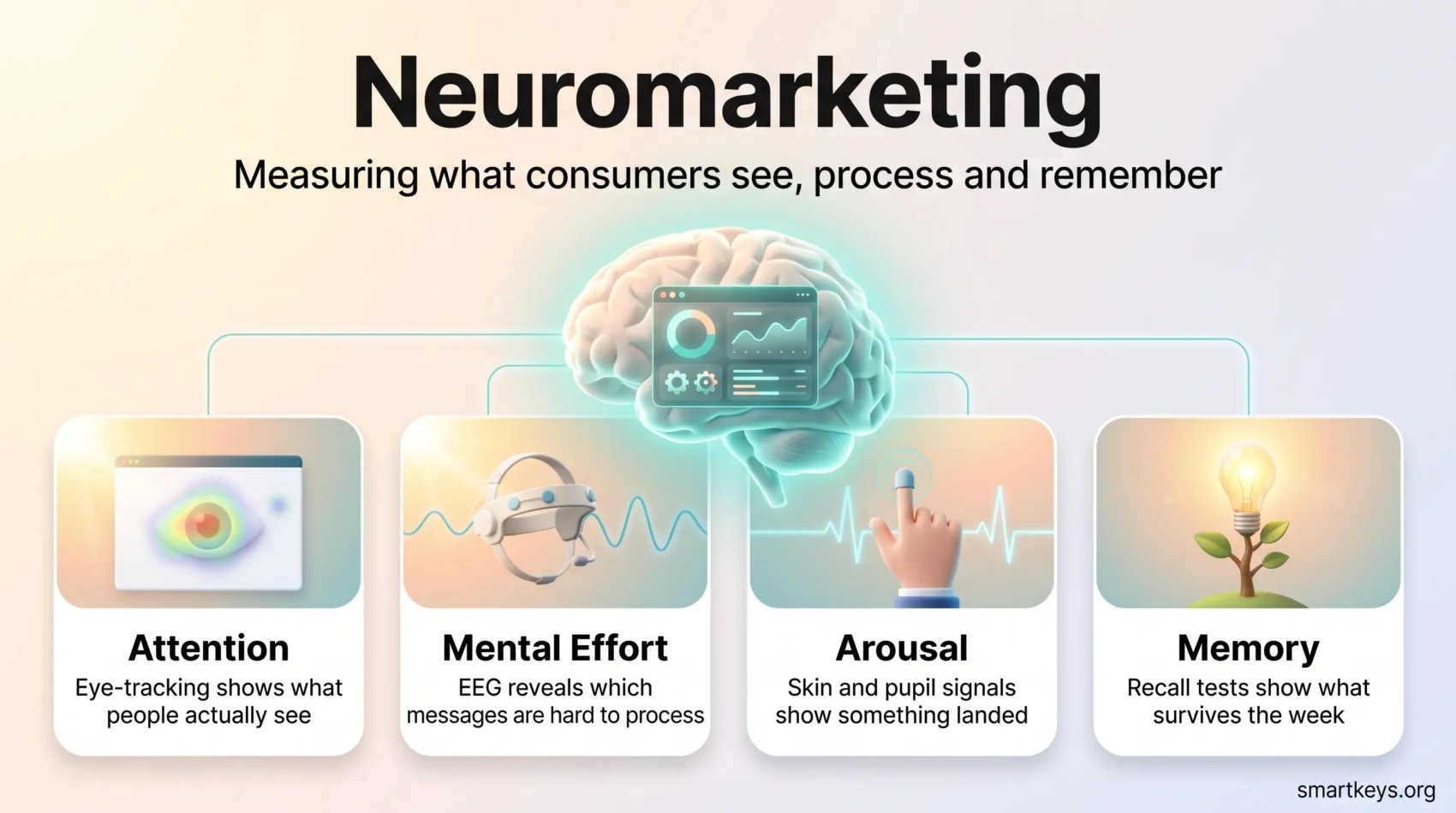
Four things get measured in practice. Each maps to a different failure mode in your marketing.
Attention: what people actually see
Eye-tracking records gaze position many times a second, producing fixations (where the eye pauses), saccades (the jumps between pauses) and heatmaps that summarise both. It answers a blunt question: was your logo, price or button ever looked at?
A typical finding is uncomfortable: the offer is on the page, the client can point to it, and most participants never fixated on it. That is a layout problem, not a messaging problem, and rewriting the copy will not fix it.
Comprehension: how hard your message is to process
EEG-based workload measures rise when text is dense, hierarchy is unclear or a claim needs re-reading. High effort is not always bad: a comparison table should cost some effort, a homepage headline should not. When workload spikes at the same moment attention drops, you have found a sentence people gave up on.
Emotion: arousal first, specific feelings second
Skin conductance and pupil size show that something landed. They are much weaker at telling you which emotion it was. Treat arousal as a signal of intensity, and be sceptical of any dashboard that labels a second of video “joy” with two decimal places.
Memory: what survives the week
Attention without encoding is wasted budget. Memory is usually tested by asking participants to recognise brands and claims after a delay. Distinctive assets, a clear narrative and repetition still outperform clever one-off executions.

Neuromarketing Techniques and Methods: Your Toolkit
Pick the outcome first, the tool second. Name the question you need answered, then choose the method that measures it. Buying a method and then looking for a question is how budgets disappear.
Four families of tools do most of the work. Eye-tracking shows where people looked. EEG, fMRI and MEG measure brain activity in different ways, covered in detail two sections below. Facial coding and implicit tests try to read emotion and association. Body measures such as skin conductance track arousal.
Facial coding and implicit measures
Facial coding software classifies expressions into emotion categories. Its scientific foundation is genuinely contested. A 2019 review in Psychological Science in the Public Interest by Lisa Feldman Barrett and colleagues examined the evidence and concluded that facial movements do not reliably map to specific emotional states across people and situations. Use facial coding as a rough engagement indicator, never as proof of a feeling.
Implicit association tests measure how quickly someone links a brand to a concept. Response speed is harder to fake than a rating scale, which makes these tests useful for brand attribute work.
Cost, access and AI prediction tools
From cheapest to most expensive: webcam eye-tracking, lab eye-tracking, portable EEG, research-grade EEG, MEG, fMRI. AI attention-prediction platforms sit below all of them. Trained on eye-tracking datasets, they predict where people would probably look in seconds, without recruiting anyone. That is useful for screening dozens of variants, but a predictive model reproduces patterns from its training data, so it is least accurate on exactly the unusual creative you most want to test.
Eye-Tracking and Visual Attention in Advertising
Layout decides what gets seen, often within the first two seconds. Eye-tracking makes that visible, which is why it remains the most practical entry point into the field.
Designing creatives that guide the eye
Define your areas of interest before testing: logo, offer, price, call to action. Then check whether the order people looked at them matches the order you intended.
Practical rules that hold up well:
- High contrast draws the eye. If your button matches the background, no copy will save it.
- Faces attract fixations, and people tend to follow the direction a pictured face is looking. Point the model at the product, not at the camera.
- Clutter competes. Removing two elements often does more for your key message than redesigning it.
- Motion holds attention as well as capturing it. An animated banner next to your offer is a competitor, not a decoration.
Where it pays off
Packaging is the clearest case. A shelf gives your product a fraction of a second against dozens of rivals, so whether the brand name survives that glance is worth measuring. Websites are the second: gaze data shows which navigation elements are skipped entirely, useful input for e-commerce personalization and for anyone rebuilding a checkout. Retail environments are the third, where fixation data guides signage and store layout.
For scaling this testing with software, see our overview of AI marketing tools and how they fit a wider digital marketing strategy.
EEG, fMRI, and MEG: Measuring Brain Activity
The three brain measurement methods are not interchangeable. They differ on two axes: how precisely they locate activity, and how precisely they time it.

EEG: fast, portable, imprecise about location
EEG reads electrical activity through the scalp with millisecond timing. That makes it the right tool for questions about sequence and pacing. Did attention hold until the product appeared? Did the voiceover create effort at the wrong moment?
It cannot tell you which deep structure responded, because the signal is smeared on its way through the skull. For most advertising questions that limitation does not matter, since you care about when, not where.
fMRI: slow, expensive, precise about location
Functional magnetic resonance imaging tracks blood oxygen changes as a proxy for neural activity. It reaches deep regions involved in valuation and reward, which is why the landmark purchase-prediction work used it.
The trade-offs are severe. Participants lie still in a noisy tube, which is nothing like a shopping trip, sessions are costly and samples are small. Reserve fMRI for strategic questions such as a brand repositioning.
MEG: good timing and better location, at a price
MEG keeps millisecond timing and localises better than EEG, but it needs a magnetically shielded room and remains rare outside research centres. Teams that use it usually pair it with fMRI.
- Choose EEG for pacing, engagement and creative iteration.
- Choose fMRI for deep questions about valuation and motivation, with the budget to match.
- Choose MEG when you need both timing and location and have access to a facility.
Physiological and Implicit Measures
Peripheral measures track the body rather than the brain. They are cheaper, easier to run outside a lab, and best read as a group rather than one at a time.
What each signal tells you
Skin conductance (also called GSR or EDA) rises with sweat gland activity a second or two after an arousing moment. It marks intensity, not whether the reaction was positive.
Pupil size widens with both interest and mental effort. It is sensitive, which also means it is easily confounded: change the screen brightness and you change the pupil.
Heart rate and heart rate variability shift with stress and engagement across longer stretches, which suits narrative content better than a six-second bumper ad. Respiration speeds up with tension and slows with calm, and is usually a supporting measure rather than a primary one.
Reading them together
One signal alone produces false positives. A pupil dilation at second twelve could be your plot twist or a brighter frame. When several signals move at the same moment, and eye-tracking confirms people were looking at the right element, you have something worth acting on. Decide in advance what you expect to see. Choosing after the fact which peak counts as meaningful is how neuromarketing earns its worst reviews.
Where Brands Apply Neuromarketing
The methods show up in four places, and the business case is strongest where a small design change affects many people.
Advertising and video
Short-form video is the busiest use case. Teams test the first three seconds, the moment the brand appears, and whether attention survives to the call to action. The output is an edit decision.
Branding and storytelling
Logos, colour systems and taglines get tested for recognition speed and recall rather than for how much people say they like them. That evidence fits naturally into brand storytelling work, where the question is which version people remember a week later.
User experience and web design
Gaze and effort data highlight navigation elements people never see and form fields that cost too much thought. Combined with the behavioural data already in your customer data platform, it tells you where a checkout leaks users and why.
Product and packaging
Shelf tests measure whether shoppers find your product at all. Online the same logic applies to marketplace thumbnails, which are a shelf with worse lighting.
The Rules That Apply in 2026
This is the part of the field that changed most since the early 2020s. Brain and body data is now regulated in ways that ordinary marketing data is not.
The EU AI Act
Since 2 February 2025, the AI Act bans two practices that touch this field directly. AI systems that use subliminal techniques beyond a person’s awareness, or that exploit vulnerabilities such as age or disability, to distort behaviour in a way that causes significant harm are prohibited. So are AI systems that infer emotions in workplaces and schools, except for safety or medical reasons. Penalties for breaching these prohibitions reach 35 million euros or 7% of worldwide annual turnover, whichever is higher.
This is narrower than the headlines suggest. Testing an ad with consenting participants is not banned; deploying an AI system designed to manipulate people below the level of awareness is. If your work touches employees rather than consumers, look closely at emotion recognition at work before you start, and check your wider obligations under EU AI Act compliance.
Neural data laws in the United States
Four states have amended their privacy laws to cover neural data, meaning information generated by measuring nervous system activity:
- Colorado (HB 24-1058, in force since August 2024) treats it as biological data where it is used to identify someone.
- California (SB 1223, in force since January 2025) added neural data to the sensitive personal information category of its consumer privacy law.
- Montana (SB 163, in force since October 2025) extended its genetic privacy act and requires a warrant before law enforcement can access neural data.
- Connecticut (SB 1295, effective 1 July 2026) covers central nervous system activity, which in practice means EEG headsets and brain-computer interfaces.
More states have bills moving in 2026, so treat this list as a floor. The practical consequence is that consent, retention limits and deletion rights now apply to your EEG files the way they already apply to health records. A general privacy compliance framework is the cheapest way to stay ahead of this patchwork.
The UNESCO recommendation
On 12 November 2025, UNESCO adopted its Recommendation on the Ethics of Neurotechnology, the first global standard of its kind. It is not binding on companies. It does set expectations, including limits on using neural data for nudging and specific rules for neuromarketing. Standards like this often become the template for later legislation, which is what happened with UNESCO’s 2021 AI ethics text and the EU AI Act. Anyone tracking AI regulation should read it as a preview.
Benefits, Criticisms, and Ethics
The honest upside: you get moment-by-moment data on attention and effort that no survey can produce, and you catch problems stakeholders cannot see because they already know where everything is.
The honest limits: samples are small, lab settings are artificial, and the distance between a brain signal and a purchase is long. The strongest criticism of the field is not that it is sinister but that parts of it are oversold.
Two failure modes are worth naming. The first is reverse inference, which means concluding that a person felt a specific emotion because one brain region lit up. Regions serve many functions, so that conclusion rarely holds. The second is a dashboard that turns noisy signals into a single confident score.
Running studies ethically
Informed consent should say what is being measured and why. Store the minimum, anonymise it, and set a deletion date. Do not test techniques whose purpose is to bypass judgement rather than to communicate better. Those standards are the same ones that apply to any ethical AI programme, and they protect you commercially as well as legally.
“The goal is to understand your customers better, not to find a switch that overrides their judgement.”
How to Run Your First Study Without Wasting Budget
Start with a decision you are already stuck on, not with a technology you want to try.
- Write the decision down. “Which of these two packshots should lead the campaign?” is testable. “How do customers feel about our brand?” is not.
- Pick the cheapest method that answers it. Most first questions are attention questions, and attention questions are eye-tracking questions.
- Define success before you run it. Decide in advance what result would change your choice.
- Validate in market. Run the winning version as an A/B test and compare the lift with what the lab predicted.
- Record the outcome. After three or four cycles you will know whether this research pays for itself in your category, which is the only benchmark that matters.
Where the Field Is Heading
Two shifts are visible. Virtual reality is being used to build shopping environments that behave more like real ones than a screen does, which addresses the artificiality complaint and connects to the hardware trends covered in AR and VR at work. Meanwhile prediction models are pushing the cost of a first look towards zero, moving human testing towards confirmation rather than discovery.
The constraint on both is regulation and consent. As consumer-grade EEG headsets spread, the same brain data that makes richer research possible also attracts the strictest rules, a tension explored in our piece on brain-computer interfaces.
Conclusion
Neuromarketing earns its place when you treat it as a measurement tool rather than a persuasion machine. It is good at telling you what people saw, what cost them effort and what they remembered. It is weaker at telling you how they felt, and it cannot tell you what they will buy on its own.
Start small. Pick one decision, use the cheapest method that answers it, confirm the result with live traffic, and record whether the research changed the outcome. Handle the data the way you would handle health data, because in four US states you now legally must.
Found this useful?
Make SmartKeys a preferred source on Google, and our articles will surface more often in your Top Stories, AI Overviews, and AI Mode.
Add as Preferred Source