AI marketing has moved well past the pilot stage. Teams now run AI inside the tools they already pay for, and finance has started asking what comes back out. Gartner’s 2026 CMO Spend Survey, covering 401 marketing leaders across North America, the UK and Europe between January and March 2026, found that CMOs allocate 15.3% of marketing budgets to AI while only 30% call their organisation ready to scale it.
That gap between spending and readiness shapes everything below. AI genuinely changes how audiences get segmented, how copy is drafted, how bids are set and how service conversations are handled. It does not, on its own, fix messy customer data, unclear positioning or a team with no review process. This guide covers what AI marketing does well in 2026, what the evidence supports, and which rules now apply.
Key Takeaways
- CMOs put 15.3% of marketing budgets into AI in 2026, yet only 30% say they can scale it (Gartner).
- McKinsey estimates generative AI could lift marketing productivity by 5% to 15% of marketing spend, worth roughly $463 billion a year.
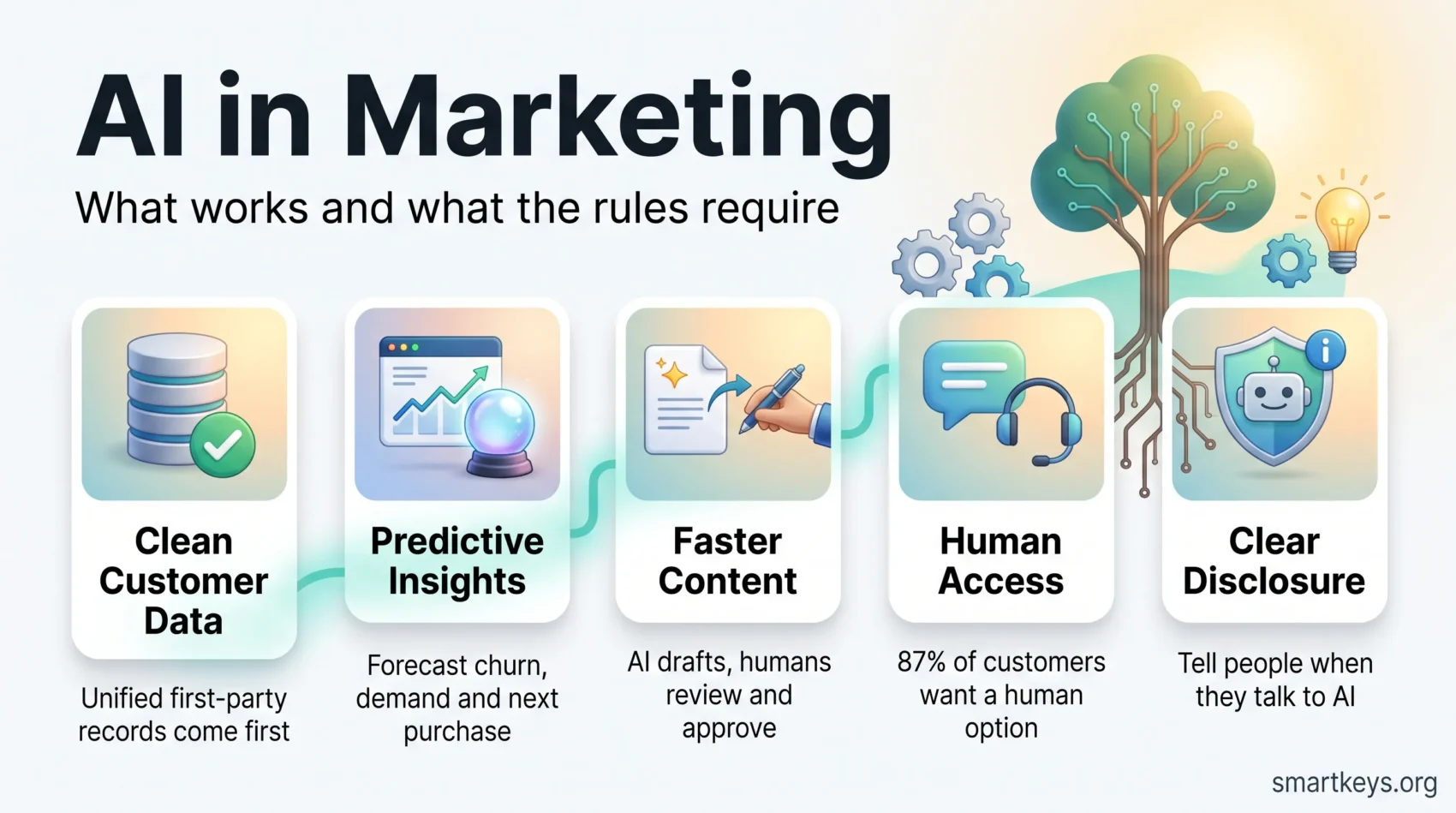
- 87% of customers say a company using generative AI in service must still offer access to a human agent (Gartner, 2026).
- About 68% of US Google searches ended without a click in early 2026, which changes how marketing content earns attention.
- From 2 August 2026, the EU AI Act requires people to be told when they are interacting with an AI system.
Where AI Marketing Stands in 2026
AI in marketing is not new. Recommendation engines, automated bidding and propensity models have run quietly for two decades. What generative models changed is the range of tasks a marketer can hand over.
From Automated Bidding to Agents
The early work was statistical: regression and decision trees to score customers, association rules to find products that sold together. Google Ads arrived in 2000 and moved ad placement and bidding into algorithms. Through the 2010s, streaming and retail platforms made recommendation systems a default part of shopping.
Generative models widened the job description again: drafting, summarising, translating, tagging, researching, and now executing multi step workflows. That last step is the 2026 shift. McKinsey’s global State of AI survey, fielded in May and June 2026, found 44% of organisations scaling AI across the enterprise, up from 38% a year earlier, with roughly 20% scaling AI agents specifically. Consumer goods and retail respondents reported using agents most often in marketing and sales, and the way those agent workflows are structured matters more than the label.
What the Spending Data Shows
Investment is real but cautious. Marketing budgets sit at 7.8% of company revenue in 2026, barely moved from 7.7% a year earlier, so AI is funded mostly by reallocating inside a flat budget rather than by fresh growth money. Organisations Gartner classes as AI ready spend more on both counts: 21.3% of the marketing budget on AI and 8.9% of revenue on marketing overall.
Returns remain harder to point at. In McKinsey’s 2026 survey, 37% of respondents attributed at least some EBIT impact to AI, roughly the same share as a year earlier, and only 6% qualified as high performers. Marketing and sales were among the functions where revenue gains were most commonly reported, which makes the function a sensible place to invest. Even so, most organisations have not converted AI activity into measurable profit, a pattern that repeats in AI adoption across business operations and in AI built into SaaS products. Broader shifts in how buyers and sellers meet are pushing in the same direction.
How AI Technologies Are Transforming Marketing
Two families of technology carry most of the practical load: natural language processing and machine learning. Almost everything else is an application built on top of them.
Natural Language Processing in Marketing
NLP in marketing lets brands read customer language at a scale no team could handle manually. Algorithms parse conversations, reviews, support tickets and search queries. That capability supports:
- Personalised communication: messages shaped by what a customer has actually said and done, not just which segment they landed in.
- Faster customer service: assistants that handle routine questions at any hour and route the rest to a person.
- Sharper insight: sentiment analysis and topic clustering that surface complaints early, feeding social listening and channel strategy.
Machine Learning Applications
Machine learning marketing applications work on structured behaviour rather than language. They learn from historical data and improve as more of it arrives. Typical uses:
- Predicting demand: forecasting what will sell, to whom, and when, based on past patterns.
- Optimising campaigns: reallocating budget and adjusting creative while a campaign is still running.
- Targeting advertising: scoring likely responders so spend concentrates where conversion is plausible.

AI Marketing Tools and Platforms
The tool market is crowded and vendor claims move faster than the products. Think in categories rather than brand names: most teams use AI already bundled into software they own.
The Categories That Matter
- Content generation and editing: drafting, rewriting, translating and repurposing. Useful for first drafts, not for final judgement. Video tools such as the one in our Creatify review sit here too.
- Campaign and channel automation: scheduling, bidding, send-time optimisation and budget reallocation inside ad and email tools.
- Analytics and prediction: churn scoring, lifetime value modelling and forecasting. See how predictive analytics changes business decisions.
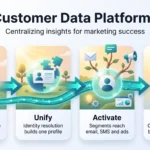
- Customer data and identity: the unglamorous layer that decides whether anything above works. A customer data platform is the prerequisite, not the upgrade.
- Conversation and service: assistants that handle enquiries in the customer’s chosen channel, covered in our guide to AI chatbots in customer service.
Choosing the Right Tools for Your Needs
Work backwards from a specific problem rather than forwards from a feature list:
- Name the task the tool replaces and how you will measure it. If you cannot state that in one sentence, you are buying a demo.
- Check the data it needs. Disappointing results usually trace back to duplicated customer records, not to the model.
- Check integration. A tool that cannot read your CRM creates a second version of the truth.
- Understand the pricing model. Credit and consumption billing is now common, so costs rise with usage rather than headcount.
- Agree review rules before rollout. Written generative AI usage guidelines save more time than any single feature.
The Benefits of AI in Marketing Strategies
The benefits are real, but concentrated in specific places rather than spread evenly.
Enhanced Customer Insights
AI is good at finding structure in behaviour that people would miss. It can segment an audience on predicted actions rather than crude demographics, then keep those segments current as behaviour shifts. That matters most when the data is yours: as third-party identifiers weaken, a first-party data strategy is what gives the models something reliable to learn from.
Programmatic advertising is the clearest example: models decide in milliseconds which impression is worth bidding on and at what price, lifting relevance for the customer and efficiency for the advertiser at once.
Increased Operational Efficiency
The second benefit is simply time. AI absorbs the repetitive parts of campaign work: assembling variants, writing subject lines, tagging assets and summarising results. Teams that measure this honestly find the gain in cycle time rather than headcount, because the reviewing still has to happen. For how these pieces fit into the wider discipline, see how digital marketing strategies have evolved.
Generative AI for Content Creation
Generative AI in marketing changed content economics before it changed anything else. Drafting a blog post, ten ad variants and a launch email now takes a fraction of the time it did.
Automating Content Development
McKinsey’s estimate is the most widely cited figure here, and it holds up because the method was published: generative AI could increase marketing productivity by 5% to 15% of total marketing spend, worth roughly $463 billion annually, within a broader $4.4 trillion global productivity opportunity.
The catch is that output volume is no longer the constraint while distribution has tightened. SparkToro’s analysis of Similarweb clickstream data found about 68% of US Google searches ended without a click in the first four months of 2026, up from around 60% in 2024. Publishing more pages into that environment does not earn more traffic. Content has to be worth citing, not just worth ranking, which pushes value toward original data, first-hand testing and clear points of view.
Risks and Challenges of Generative AI
The risks are practical rather than theoretical. Models state wrong things confidently, and a fabricated statistic in a campaign is a brand problem, not a proofreading problem. Regulated claims in finance, health and children’s products need human sign-off every time. There is also a search risk: Google’s spam policies treat scaled content produced primarily to manipulate rankings as abuse, regardless of how it was generated. Teams that treat AI drafts as raw material, with named owners and a documented review step, avoid most of this. Our guide to ethical AI in business covers the governance side in more detail.
AI in Predictive Marketing Analytics
Predictive analytics in marketing uses historical behaviour to estimate what a customer will do next. It is one of the oldest applications of machine learning in marketing and still one of the most dependable.
Impact of Predictive Analytics on Decision Making
Where it earns its place:
- Sharper segmentation: segments built on predicted purchase likelihood or churn risk, including event-triggered and cross-sell groups.
- Better budget allocation: forecasting with AI shows which channels and cohorts are worth funding before the quarter ends.
- Campaign personalisation: offers matched to a customer’s predicted next need rather than to the last thing they bought.
- Faster market response: models retrained on recent data flag shifts in demand earlier than a monthly report would.
Two caveats keep this honest. Predictions inherit the quality of the data behind them, so a model trained on a fragmented customer view will reproduce that fragmentation. And a prediction is only useful if someone acts on it: scores that never reach the campaign tool are an expensive report.
AI Product Recommendations and Personalization
Personalisation is where customers actually notice AI, and where expectations have hardened. McKinsey’s research on personalised marketing found that 71% of consumers expected companies to deliver personalised interactions and 76% were frustrated when that did not happen.
How AI Enhances Customer Experience
Recommendation engines reduce the work of choosing. They narrow a catalogue of thousands to a handful that fit what a person browsed, bought or abandoned, which shortens the path to purchase.
The commercial effect is meaningful but rarely dramatic on its own. McKinsey reports that well-executed targeted promotions typically deliver a 1% to 2% lift in sales and a 1% to 3% improvement in margins. Those percentages compound at scale, which is why large retailers invest heavily and why smaller businesses should size expectations accordingly. See our guide to AI-driven e-commerce personalisation and our piece on AI-powered personalisation of customer experiences.
What Working Implementations Have in Common
The programmes that deliver share a few traits. They start from a unified customer record rather than a per-channel one. They personalise two or three high-traffic surfaces first, usually the homepage, a product page and one lifecycle email. They test against a holdout group, so the lift is measured rather than assumed. And they set a boundary on what data is acceptable to use, because personalisation that reads as surveillance costs more trust than it wins in conversion.
Chatbots and AI-Powered Customer Interactions
AI chatbots in marketing sit where marketing and service overlap. They answer pre-purchase questions, recover abandoned baskets and qualify enquiries before a person joins in.
Improving Customer Service and Engagement
Gartner surveyed 3,566 B2B and B2C customers in February and March 2026 and found a mixed but improving picture. Half said interactions were easier when companies used generative AI, and among customers who use generative AI at all, 58% had used it to complete tasks on their behalf, rising to 74% in B2B settings.
The more uncomfortable finding is where customers go first: Gartner found people roughly three times more likely to use third-party tools such as ChatGPT, Gemini or Copilot than a company’s own chatbot. Brands now need to be findable and accurately represented inside assistants they do not control. Our overview of conversational commerce looks at how that plays out across channels, and omnichannel marketing covers the coordination problem behind it.
Balancing Automation with a Human Touch
The clearest number in the Gartner data is also the most actionable: 87% of customers say companies using generative AI for service must provide access to a human agent. Gartner’s analysts add that forcing every issue through AI as a mandatory first step backfires, because customers who hit repeated failed AI interactions before reaching a person become less willing to use the tool again. The practical rule is to make escalation obvious rather than hidden, and to route high-stakes or emotional issues to people from the start.
What the Rules Now Require
Compliance moved from future concern to current obligation this year. Article 50 of the EU AI Act applies from 2 August 2026, and two duties matter directly to marketers.
First, AI systems designed to interact with people must tell users they are dealing with an AI system unless that is obvious. The notice has to come at the start of the interaction, be clearly distinguishable and meet accessibility requirements. That covers chatbots, agents and avatars on your site.
Second, providers of generative AI systems must mark synthetic audio, image, video and text output with machine-readable marks. Systems already on the market before 2 August 2026 have until 2 December 2026 to meet the marking duty, and content created earlier needs no retroactive labelling, though the Commission encourages it. The scope is territorial, so non-EU businesses serving EU users are covered. Our EU AI Act compliance guide covers the wider obligations and timeline.
AI Marketing Strategies for the Future
The direction of travel is clear, even if the timing is not.
Emerging Trends and Technologies
- Agents that execute, not just draft: workflows that run a campaign step end to end, with a human approving rather than assembling.
- Visibility inside AI answers: as zero-click behaviour grows, being cited by assistants becomes a discipline alongside search ranking.
- Consumption-based pricing: AI features billed per credit or per result, which makes tooling costs harder to forecast than a seat licence.
- Owned data as the differentiator: models are broadly available, proprietary customer data is not. That asymmetry decides who gets a better answer out of the same tool, and it shapes how AI is applied to pricing.
Preparing for the Changes Ahead
- Audit your customer data first. Fix duplication and consent records before buying anything else.
- Pick two or three high-volume tasks and pilot AI there, against a baseline you measured beforehand.
- Write down who reviews AI output and against what standard, then keep the record.
- Add the AI Act disclosure and marking duties to your launch checklist now rather than at audit time.
- Train the team on verification and the limits of the tools, not just on which buttons to press.
- Protect the human parts of the brand: original research, distinctive voice and real customer conversations cannot be copied out of a shared model.
Conclusion
AI marketing in 2026 is neither the revolution the vendor decks describe nor the fad the sceptics hoped for. It compresses the repetitive parts of marketing work, improves targeting when the data underneath is clean, and disappoints teams that skip the unglamorous groundwork.
The numbers point the same way. CMOs fund AI at 15.3% of budget, yet only 30% say they can scale it and few can show a bottom-line effect. Customers want the convenience and still insist on a route to a person. Regulators now require disclosure. Treat AI as an operating change rather than a purchase: start with the data, pick a narrow problem, measure against a baseline, and keep a human accountable for what goes out under your name.
Found this useful?
Make SmartKeys a preferred source on Google, and our articles will surface more often in your Top Stories, AI Overviews, and AI Mode.
Add as Preferred Source