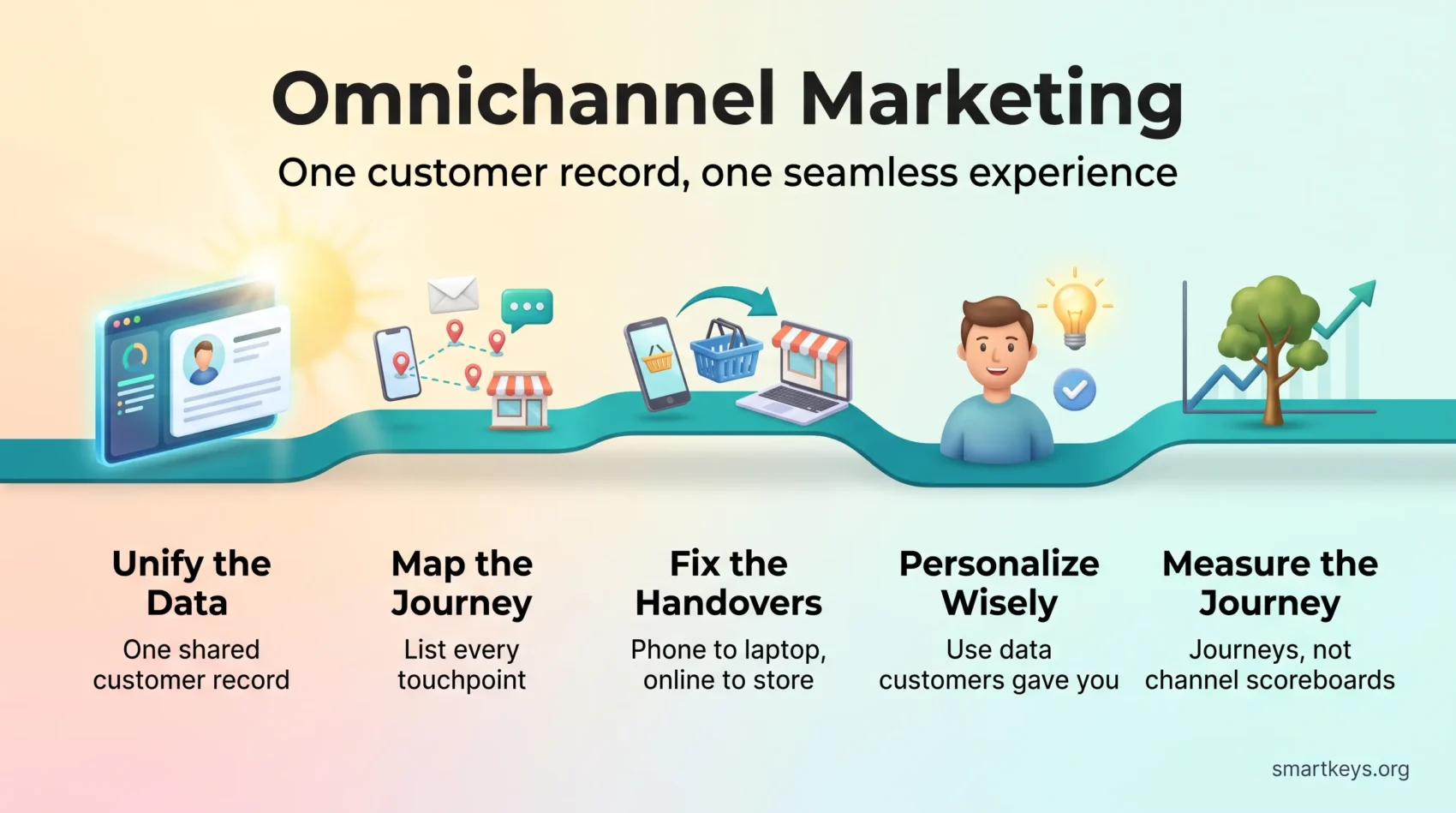
Omnichannel marketing means treating every place a customer meets your brand as one continuous conversation rather than a set of separate campaigns. Your website, app, email programme, social profiles, support desk and physical store all draw on the same customer record, so a person who starts on a phone and finishes on a laptop never has to explain themselves twice.
That matters more each year because online and offline shopping have stopped being separate behaviours. E-commerce accounted for 17.1% of total US retail sales in the second quarter of 2026 and grew 12.2% year over year, according to the US Census Bureau. The remaining four fifths of spending still happens in stores, and a large share of it is researched online first. The two channels feed each other, and a strategy that treats them separately loses the connection. Our overview of current e-commerce trends covers where that spending is moving.
Key Takeaways
- Omnichannel marketing connects channels around one customer record; multichannel simply runs them side by side.
- Consistency in message, pricing and service is what makes the experience feel like one brand.
- Unified data is the hard part. Most omnichannel programmes stall on fragmented systems, not on creative work.
- Personalization pays when it is built on data customers knowingly gave you.
- AI assistants have become a real touchpoint, and disclosure rules now apply to them in the EU.
What Omnichannel Marketing Actually Means
Defining the Concept
Omnichannel marketing is an operating model, not a channel list. Every touchpoint reads from and writes to a shared view of the customer, so context travels with the person instead of staying trapped in whichever system captured it. Someone who abandons a basket on mobile sees that basket waiting on the desktop site. Someone who raised a support ticket last week is not sent a cheerful upsell about the product that broke.
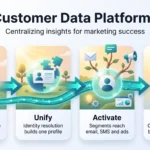
The idea is old, but the plumbing needed to deliver it only became affordable recently. A customer data platform can now resolve identities across web, email, app and point of sale in near real time, which is what separates a genuine omnichannel setup from a well-intentioned one. Forbes describes the goal well in its overview of creating a seamless customer experience.
Omnichannel Versus Multichannel
Both approaches use several channels. The difference is whether those channels share anything.
Multichannel marketing runs each channel as its own unit with its own targets, calendar and reporting. Email optimizes for open rates, paid social optimizes for cost per click, and the store optimizes for footfall. Nothing is wrong with any individual channel, yet the customer experiences a series of disconnected conversations.
Omnichannel marketing subordinates the channels to the journey. The question shifts from “how did email perform” to “what did this customer need at this moment, and did the right channel deliver it”. That reframing changes budgets, team structure and measurement, which is why it is harder than buying another tool. Our guide to customer experience trends covers how organizations are restructuring around it.
That does not make multichannel a mistake. For most companies it is the honest starting point: you run the channels you can staff, and you learn what customers do in each. The signal that you have outgrown it is specific. Customers routinely begin in one channel and finish in another, and your teams cannot tell it was the same person. At that point the separate scoreboards have stopped describing reality, and the next investment belongs in the shared customer record rather than in another channel.
Why a Seamless Experience Pays Off
Trust Comes From Consistency
Consistency is the least glamorous part of omnichannel work and the part customers notice first. A price that differs between the app and the shelf, a promotion the call centre has never heard of, or a returns policy that contradicts the confirmation email all cost more trust than a clever campaign can win back.
Uniform messaging, pricing and service rules do not require identical creative. They require a single source of truth that every channel reads from. For smaller brands this is a genuine advantage: you cannot outspend a large retailer on media, but you can be more coherent than one. That coherence is what earns trust over time.
Satisfaction and Growth
Satisfied customers return, and returning customers cost less to serve than new ones. The mechanism is unremarkable: fewer friction points mean fewer abandoned journeys, fewer support contacts and fewer reasons to try a competitor.
There is measured evidence behind the pattern. A Harvard Business Review study of 46,000 shoppers, published in 2017, found that people who used more than one channel spent 4% more per visit in store and 10% more online than single-channel shoppers. Those using four or more channels spent 9% more in store than those using one. In the six months after an omnichannel experience, the same customers logged 23% more repeat trips to the retailer’s stores. The study predates most of today’s tooling, so treat the exact figures as dated. The direction has held up: the customers who move between your channels tend to be your better customers, which argues for making those moves easy rather than herding everyone into a single channel.
The lever most brands underuse is memory. When a business remembers a past purchase, a stated preference or an unresolved problem, and acts on it in the next interaction, the relationship compounds. Practical approaches are set out in our pieces on customer retention strategies and building customer loyalty.
Brands often cited as omnichannel exemplars, such as Starbucks with its app, rewards balance and order-ahead pickup, or Sephora with its linked online and in-store profiles, are not doing anything mysterious. They simply refuse to let the customer record break at the channel boundary. Large retailers such as Target and Walmart show the same idea in plainer form: a shopper can check store stock, buy online, then collect or return the item in a store. That only works because the stock and order systems answer to one record. Look closely at any example you admire and you usually find a single unglamorous decision underneath it, such as one stock figure that every channel is required to quote.
Mapping the Customer Journey
Identifying Key Touchpoints
You cannot connect touchpoints you have not listed. Journey mapping starts by writing down every place a customer can reach you: organic search, paid ads, email, SMS, live chat, messaging apps, marketplaces, review sites, the store, the call centre and increasingly an AI assistant answering on your behalf.
For each one, record what the customer is usually trying to do there, what data the touchpoint captures, and where that data lands. The gaps in that last column are your real roadmap. Most teams discover two or three systems that collect useful signals and share them with nothing.
Tools for Customer Journey Analytics
Web analytics tells you what happened on a page. Journey analytics tells you what happened to a person across pages, sessions and channels, which is a different question and needs different tooling.
A typical stack combines a web and app analytics tool, a customer data platform for identity resolution, and a reporting layer that marketing can actually query without filing a ticket. Our guide to using big data for customer experience covers what to do with the output. The goal is not more dashboards. It is one shared answer to the question of where customers get stuck.
Unifying Your Brand Message
Consistency Across Channels
Brand guidelines are the cheapest omnichannel investment available. A usable set covers:
- Logo usage, clear space and the situations where each variant applies
- Colour palette with accessible contrast pairings
- Typography, including the fallback stack for email and SMS
- Voice and tone, with worked examples rather than adjectives
- Rules for prices, offers and disclaimers so every channel quotes the same terms
Written examples matter more than abstract principles. A short document showing the same message written for email, for a push notification and for a store sign teaches a new team member more than a page of brand values.
Tailoring Content for Each Platform
Consistent is not the same as identical. A push notification has a few words to work with, an email has a subject line and a scannable body, and a product page has to answer objections without a human present. The message stays the same; the execution adapts to the format and to how people use it. Clear beats clever in every one of those formats, and our guide to email clarity covers the habits that make the difference.
Social platforms in particular reward native behaviour over repurposed assets, which our review of current social media trends examines in more detail. The same logic applies on mobile, where screen size and session length shape what a page can reasonably ask of someone.
The Technology Behind a Connected Experience
Choosing the Right Stack
Tool selection tends to consume the most meeting time and decide the least. What matters is whether the pieces exchange data reliably. Useful questions before you buy:
- Does it write back? A tool that only reads from your CRM cannot close the loop.
- How does it identify people across devices, and what happens when it cannot?
- What is the latency of a data sync, in practice rather than in the datasheet?
- Can you export your own data in a usable format if you leave?
Most stacks are built around a CRM, and the direction that category is taking is covered in our look at CRM trends.
Real-Time Data and Identity Resolution
Real-time sharing sounds like a technical detail and behaves like a strategic one. If the store system learns about the online return the next morning, the apology email goes out anyway. If the support desk cannot see the open order, the agent asks questions the customer already answered.
Identity resolution is the harder half. Matching a logged-out mobile session to a known email address to a loyalty card scan is where omnichannel programmes succeed or quietly fail. The practical implications of that plumbing are discussed in real-time data in business.
Personalization Without Guesswork
Building on Data Customers Gave You
Personalization has strong evidence behind it when it is done with real data. McKinsey’s research on the subject reports that 71% of consumers expect personalized interactions and 76% are frustrated when they do not get them, and puts the typical revenue lift from personalization at 10% to 15%, with company results spanning roughly 5% to 25%.
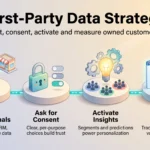
The reliable inputs are first-party and zero-party data: purchase history, stated preferences, quiz answers, service history, explicit consent. These survive privacy changes because the customer handed them over on purpose. Our guides to a first-party data strategy and zero-party data cover how to collect them without making every visit feel like a form. What applies in retail specifically is set out in e-commerce personalization.
Set a boundary before you start. Recommending a complementary product is helpful; referencing something the customer never told you is unsettling. Handling personal data lawfully is a design constraint, not an afterthought, and current data privacy rules shape what is available to you.
Balancing Automation With Human Support
Automation handles volume and consistency well. It handles ambiguity, apology and anything expensive badly. The practical split is to automate the predictable steps, order confirmations, delivery updates, restock alerts, and route anything with emotion or money attached to a person quickly.
The failure mode to avoid is an automated system that hides the exit. If a customer wants a human, the route to one should take a single step. Our piece on customer service trends looks at where teams are drawing that line.
The New Touchpoints of 2026
Two touchpoints that barely registered a few years ago now belong in any serious channel map.
The first is conversational and agentic commerce. Shoppers increasingly ask an AI assistant to compare options, and in a growing number of cases to complete the purchase. That changes what your product data has to look like: structured, complete and machine-readable, because the assistant, not the shopper, is reading it. We cover the shape of this in conversational commerce and AI chatbots in customer service.
The second is discovery outside the traditional search box. Answer engines, voice queries and in-app search inside marketplaces all send buyers who never saw a results page. Our guide to voice search marketing goes into what that shift means for your content and product feeds.
There is a compliance angle too. Under the EU AI Act, transparency obligations for systems that interact directly with people apply from August 2026, which in practice means telling users when they are talking to an AI rather than a person. If you operate in the EU, that disclosure belongs in your chatbot and assistant design now. Our EU AI Act compliance guide sets out the wider obligations.
Ensuring Channel Flexibility
Customers do not move through channels in the order your funnel diagram suggests. They research on a phone during a commute, ask a question in chat, buy on a laptop and collect in store. Flexibility means each of those handovers works without loss of context.
Three handovers are worth testing explicitly, because they break most often:
- Mobile to desktop, where the basket and any applied discount should survive.
- Online to store, where stock accuracy and the collection process decide the experience. Our piece on phygital retail covers this boundary.
- Self-service to human support, where the agent should already have the conversation history.
Legacy systems are the usual obstacle. When a decades-old order management system cannot expose inventory in real time, no amount of front-end polish will fix the resulting experience. Sequencing that replacement honestly, rather than layering another tool on top, is often the highest-value decision in the whole programme.
Training Your Team for Omnichannel Success
Practical Training That Sticks
An omnichannel strategy fails at the point where a store colleague cannot see an online order, or a support agent has no visibility of a marketing promotion. Training closes that gap. What tends to work:
- Short, scenario-based sessions built on real customer journeys rather than slide decks.
- Cross-training so each team knows what the others can see and do.
- A single, current reference for active promotions, prices and policies.
- Shared collaboration tools so answers do not live in one person’s inbox.
Internal Communication and Alignment
Channel friction is usually a symptom of team friction. When marketing, e-commerce, retail operations and support each own a number that can be hit at another team’s expense, the customer experience absorbs the difference.
Two fixes help more than any tooling change: shared metrics that at least one other team can influence, and a standing forum where those teams review the same journey data together. Our guide to sales and marketing alignment covers the incentive side of that problem.
Monitoring and Optimizing Your Strategy
Omnichannel work is measured badly when each channel keeps its own scoreboard. Last-click attribution in particular will always flatter whichever channel sits closest to the purchase and starve the ones that created demand.
A more honest set of measures:
- Customer satisfaction and effort scores collected at specific journey stages, not once a year.
- Conversion by journey type rather than by channel, so a mobile-to-store path can be judged on its own terms.
- Repeat purchase rate and retention by cohort, which is where omnichannel work shows up if it is working.
- Time to resolution for support contacts that cross channels.
- Multitouch or incrementality testing to replace last-click as the budget input.
Review these on a fixed cadence with the same group of people. A metric nobody meets about is a metric nobody acts on.
Loyalty and Life After the First Sale
Loyalty programmes work best when they reward behaviour the business actually wants rather than simply discounting what would have happened anyway. Recognition, early access, easier returns and useful service perks often build more attachment than a points balance, and they cost less margin.
The wider point is that the journey does not end at checkout. Onboarding help, a well-timed replenishment reminder, a genuine request for feedback and a fast response when something goes wrong all belong in the omnichannel plan. Direct-to-consumer brands have generally been good at this part, because the relationship after the first order is the only one they have.
Common Obstacles
Breaking Down Data Silos
Most omnichannel programmes stall on the same problem: customer data sits in separate systems that were never designed to talk to each other. The e-commerce platform knows one thing, the point of sale another, the support desk a third, and no system holds the whole person.
Silos also distort measurement. Without a joined record you cannot tell whether the store visit followed the email or the email followed the store visit, so attribution becomes guesswork and budgets follow the guess.
Inconsistency and Operational Friction
Three recurring issues deserve explicit owners:
Pricing and promotion differences between channels, which read to customers as either a mistake or bad faith. Decide the policy deliberately, then enforce it in one place.
Inventory accuracy, which quietly determines whether click-and-collect delights or annoys. A promise the stock system cannot keep is worse than no promise.
Checkout and payment inconsistency, where different channels support different payment methods or force a re-entry of details already on file. Every extra step here has a measurable cost.
Conclusion
Omnichannel marketing is less a campaign type than an operating discipline. The brands that do it well are rarely the ones with the most channels; they are the ones whose channels agree with each other.
Start with the data layer, because everything else depends on it. Map the journeys you actually have rather than the funnel you wish you had, fix the handovers that break most often, and measure by journey rather than by channel. Add personalization once the foundation holds, using data customers gave you knowingly, and keep a human route open for the moments that need one.
The specific channels will keep changing. AI assistants and answer engines are the current additions, and something else will follow. The underlying requirement is stable: one view of the customer, one set of facts, and an experience that does not fall apart when someone switches device.
Found this useful?
Make SmartKeys a preferred source on Google, and our articles will surface more often in your Top Stories, AI Overviews, and AI Mode.
Add as Preferred Source