For most of the last decade, voice search arrived with a number attached: half of all searches would be spoken by 2020. That did not happen. Typing is still how most people search, and no major search engine reports voice anywhere near half its query volume. The forecast was repeated so often that it became a planning assumption, and a lot of marketing budget followed it.
What did happen is more interesting. Voice stopped being a way to dictate into a search box and became the way people talk to an AI assistant. Ask Amazon’s Alexa+ or Google’s Gemini something in 2026 and you rarely get a list of links read out loud. You get an answer the assistant has written. That one change decides what voice search marketing should look like now, and it has little in common with the advice that circulated five years ago.
Key Takeaways
- The “50% of searches will be voice” prediction never came true. Treat any strategy built on it with suspicion.
- Voice queries now mostly reach an AI assistant, which answers in its own words instead of reading a results page.
- Local intent is where voice still pays off: opening hours, directions, phone numbers, nearby services.
- Optimizing for spoken questions is ordinary good SEO: clear answers, accurate business data, fast pages, structured markup.
- You cannot isolate voice traffic in your analytics. Measure the outcomes it produces instead, such as calls and map actions.
Understanding voice search technology
Voice search means asking a device a question out loud instead of typing it. Speech recognition converts what you said into text, the assistant works out what you meant, and it returns a spoken answer. The chain has three weak points: hearing you correctly, understanding the request, and having something useful to say. The first two are largely solved. The third is where marketing comes in.

The assistants themselves changed more in the last eighteen months than in the previous five years. Amazon rebuilt Alexa around a large language model and, in February 2026, made the new Alexa+ available to all US customers: free for Prime members, who number more than 200 million, and $19.99 a month for everyone else, according to GeekWire’s report on the launch. Google is retiring Google Assistant and moving Android phones, tablets and Nest speakers over to Gemini during 2026, as 9to5Google reported. Apple has been folding generative features into Siri on a similar path.
The practical consequence is simple. The thing on the other end of a spoken question is no longer a search index with a text-to-speech layer. It is a generative model with access to search. If you want to understand the wider shift, our guide to AI-powered assistants at work covers what these systems can and cannot do reliably.
The forecast that never arrived
The “50% by 2020” line came out of the mid-2010s enthusiasm for smart speakers, and it was quoted for years without anyone checking it. Nobody publishes a credible figure showing voice at half of search volume, and the platforms that would know have never claimed it.
This matters beyond bragging rights. A strategy built on a wrong premise sends money to the wrong place. Companies rewrote page titles to sound like spoken questions and built “voice-only” landing pages that nobody ever reached. The useful parts of that work, clearer answers and better structured data, would have helped anyway. The rest was wasted.
The honest position in 2026 is that voice is one input method among several, popular for a narrow band of tasks, and increasingly a doorway into AI answers rather than a separate search channel. Plan for it accordingly, and be sceptical of any voice statistic quoted without a named source and a date.
What people actually use voice for
Watch how people use assistants and a pattern shows up quickly. Voice wins when hands or eyes are busy, when the request is short, and when there is one obvious right answer.
Common uses include:
- Timers, alarms, reminders and unit conversions
- Music, podcasts and smart home controls
- Directions and traffic while driving
- Quick factual questions with a single answer
- “Is it open now” and “call the nearest one” queries about local businesses
Voice loses when the task requires comparing options. Nobody chooses project management software by listening to five summaries read aloud. That distinction tells you which of your pages are worth thinking about in voice terms. Opening hours, service areas and contact details are candidates. A 3,000 word buying guide is not, although it can still be the source an assistant quotes.
Marketers often call these situations micro-moments: the short bursts when someone reaches for a device because they want to know something, get somewhere, or do something right now. The label is useful mainly as a reminder of what these requests have in common. The person is in the middle of something else, has one narrow question, and will accept the first credible answer. Pages that serve them well are short on preamble and specific about facts: what you do, where you are, when you are open, what something costs.
Voice now runs through AI assistants, not a results page
The bigger story is the one voice search is now part of: search results that answer instead of linking. Data from SparkToro, using Similarweb clickstream figures and reported by Search Engine Land, found that 68.01% of US Google searches ended without a click between January and April 2026, up from 60.45% in 2024. AI Overviews now appear on more than 20% of searches, and click-through rates drop sharply when they do.
Spoken queries take that pattern to its limit. A screen can show an AI summary and ten links underneath. A speaker gives you one answer. There is no second position to compete for.
That reframes the goal. You are no longer trying to rank a page so it can be read out. You are trying to be the source a model draws on, and to be the brand it names. That work has a name now, and it overlaps heavily with everything covered in our guide to ranking inside AI search results. The same practices that get you cited in an AI Overview get you cited by a speaker.
Voice search marketing: what actually works
Strip out the hype and the practical list is short, unglamorous and mostly things a good SEO would do anyway.

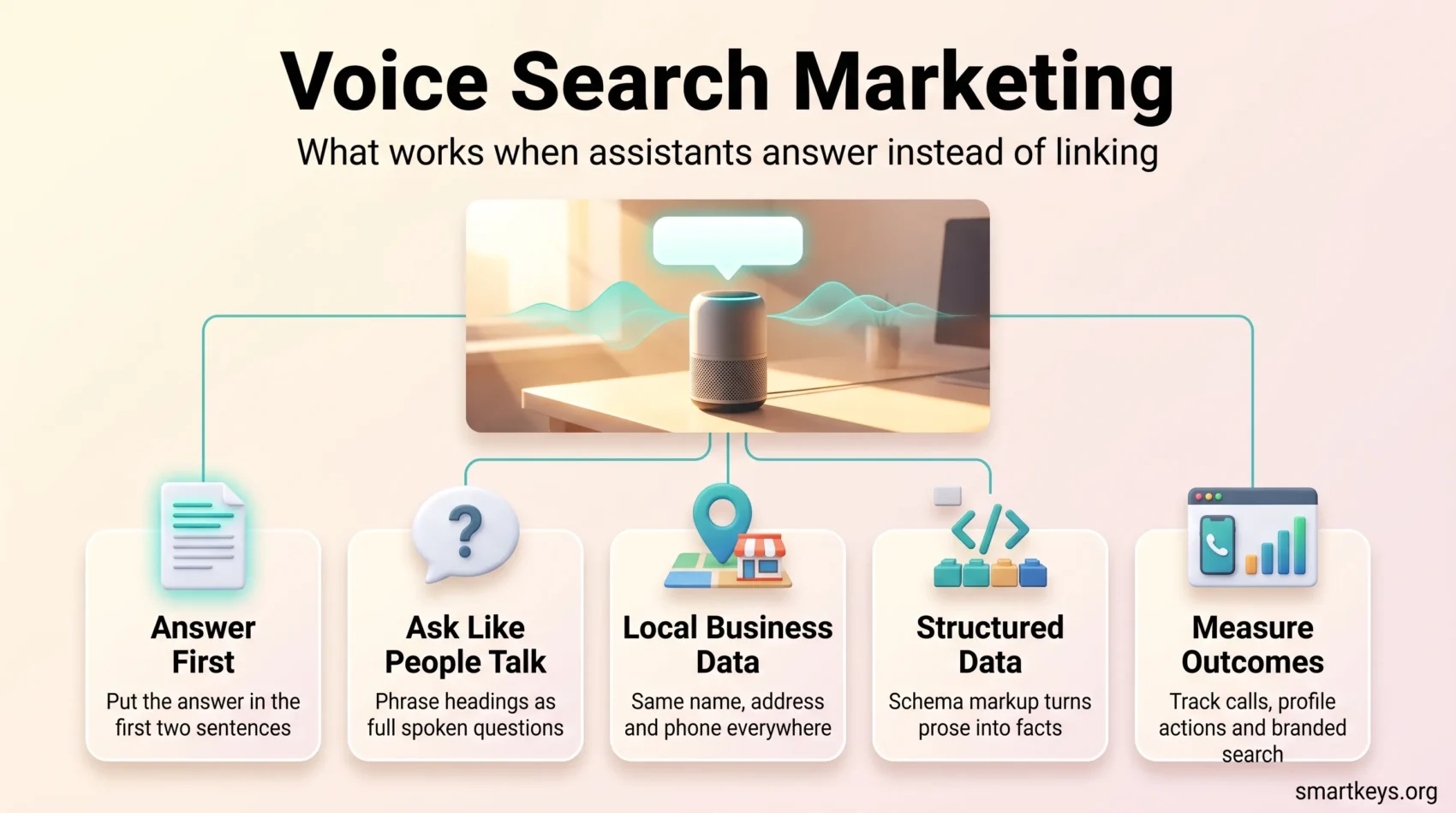
Answer the question in the first two sentences. Assistants and AI summaries lift short, self-contained passages. If your answer only makes sense after three paragraphs of preamble, it will not be quoted. Put the answer first, then explain it. Format helps too. A short paragraph, a numbered list or a small table is easier for a model to lift cleanly than a long argument that only works when you read it end to end.
Write the way people ask. Spoken queries are longer and phrased as questions: “how much does a plumber charge to fix a leaking tap” rather than “plumber cost tap”. Use those phrasings as subheadings where they genuinely fit. Do not stuff them in. Keyword research tools such as Semrush and SE Ranking now report on AI visibility as well as classic rankings, which is a better proxy for voice performance than anything labelled “voice search volume”.
Keep one page per question cluster. Splitting the same topic across three thin pages gives a model three weak candidates instead of one strong one. If you are deciding how deep to go, the comparison in our piece on Surfer SEO and Ahrefs covers how content and link tools approach that trade-off differently.
Be findable as an entity, not just a page. Consistent business name, address and phone number across your site, your Google Business Profile and the major directories is what lets an assistant connect a spoken request to your company at all.
Local search is where voice still earns its keep
If voice search has a home, this is it. Someone driving, cooking or carrying shopping asks where the nearest pharmacy is, whether it is open, and to call it. Every step of that happens without a screen, and the business that gets named wins the whole interaction.
The work is unglamorous. Keep your Google Business Profile complete and current: categories, hours including holiday hours, service area, phone number, and photos. Answer the questions people post there. Reviews count as business data as well: Google names review count and review score among the signals behind local prominence, so asking satisfied customers for a review is practical visibility work rather than vanity. Our piece on turning customer feedback into insight covers what to do with what they tell you. Keep your address identical everywhere it appears. Make sure your phone number is a real number someone answers, because a voice search that ends in an unanswered call is a lost customer, not a conversion.
Independent operators feel this most directly. For many of the small businesses and solo providers described in our overview of current gig economy trends, a phone call generated by a nearby search is the entire lead pipeline. There is no second channel to fall back on.
The technical basics that matter
Three technical items genuinely affect whether your content can be used by a voice assistant.
Structured data. Schema markup tells a machine what your page is about in a form it does not have to guess at. LocalBusiness, Product, FAQPage and Article markup are the ones that pay off most often. This is the single highest-value technical task for voice, because it converts prose into facts.
Speed and mobile rendering. Most spoken queries come from phones and speakers, and assistants favour sources that load quickly. This is standard performance work, not a voice-specific project.
Clean, crawlable HTML. Content that only appears after a click, inside a tab, or through client-side rendering is content a model may never see. If it matters, it should be in the page.
None of this is new. That is the point. The tactics that were sold as voice search optimization were mostly ordinary technical SEO with a new label, which is also why teams that skipped the voice hype lost very little.
What the numbers really support
Voice search statistics are unusually unreliable. Figures get quoted from roundups that quote other roundups, and the original study often turns out to be a small survey from 2018. Before you put a number in a board deck, check who collected it and when.

What is well documented in 2026 is the direction of travel rather than a precise voice share. Zero-click behaviour is rising and measurable. AI answers are appearing on a growing share of results. The assistant platforms are being rebuilt around generative models, with Alexa+ now available to every US customer and Gemini replacing Google Assistant across Google’s devices. Google says its AI Mode has passed one billion monthly users, even though it accounted for a fraction of a percent of searches in the SparkToro sample.
Those four facts are enough to plan with. They point in the same direction: fewer clicks, more answers, and more value in being the source an answer is built from. Our overview of how digital marketing strategies have evolved puts the same shift in a wider context.
Measuring voice search when there is no voice report
Neither Google Search Console nor Google Analytics separates voice queries from typed ones. Anyone selling you a “voice search dashboard” is modelling, not measuring.
So measure the outcomes voice produces instead:
- Calls. Track phone calls from your Google Business Profile and from mobile pages. Local voice searches end in calls more often than in form fills.
- Profile actions. Direction requests, website clicks and calls in your Business Profile insights move when local visibility changes.
- Question-shaped queries. Filter Search Console for impressions on queries starting with how, what, where, when and near. These are not proof of voice, but they track the same conversational intent.
- Branded search volume. When an assistant names you and the user looks you up afterwards, this is where it shows.
If you are building a measurement habit around this, the approach in our guide to behavioral analytics works well here: watch the behaviour that follows the answer, not the answer itself.
Voice commerce: smaller than the headlines
Buying by voice has consistently underperformed its forecasts, for a straightforward reason. People do not want to hear product options read out, and they do not trust a purchase they cannot see. Reordering something familiar works. Choosing between four unfamiliar options does not.
Where voice does contribute to commerce is earlier in the journey: checking stock, confirming a store is open, adding to a list, or reordering a repeat purchase. Treat it as an assist rather than a checkout channel. The broader picture is covered in our look at conversational commerce and, for the device most of this actually happens on, in our guide to mobile commerce trends.
If your interest is in tailoring what an assistant or chatbot says to a specific customer, that is a personalization problem rather than a voice problem. Our articles on e-commerce personalization and AI-powered personalization deal with it directly, and AI chatbots in customer service covers what happens once the conversation moves to your own site.
A practical checklist
If you want to do something useful this month, do these six things in order:
- Audit your Google Business Profile. Fix hours, categories, service area and phone number.
- Check that your business name, address and phone number match everywhere they appear online.
- Add or repair structured data on your most important pages, starting with LocalBusiness and FAQPage.
- Rewrite the opening of your top ten pages so the first two sentences answer the question in the heading.
- Fix mobile page speed on those same pages.
- Set up call tracking so you can see whether any of it worked.
Nothing on that list is exotic. That is the honest conclusion about voice search in 2026: it did not create a new marketing discipline, but it did make the quality of your answers and the accuracy of your business data matter more than they used to. Teams that already invest in AI in marketing and in a coherent customer experience are mostly doing the right work already.
For related tooling, our reviews of Speechify and Murf AI cover the text-to-speech side of the same technology, which matters if you want your own content available in audio as well as text. An audio version of a long article, or a podcast episode alongside it, is worth doing for readers who prefer listening. Be clear about what it achieves, though. It serves people who have already found you. It does not make you any easier for an assistant to quote, because assistants read text.
Found this useful?
Make SmartKeys a preferred source on Google, and our articles will surface more often in your Top Stories, AI Overviews, and AI Mode.
Add as Preferred Source