Mobile is no longer the emerging channel. It is the default one. Most people who visit an online store today arrive on a phone, and a growing share of them also pay on it. During the 2025 US holiday season, smartphones accounted for 56.4% of all online spending, according to Adobe Analytics.
The catch is that phones bring far more visits than sales. Salesforce data for the 2024 holidays showed 79% of global retail traffic coming from mobile, while mobile’s share of orders was just under 70%. Some of that difference comes from shoppers who browse on a phone and buy later on a laptop. A lot of it is friction: slow pages, long forms and checkouts built for a keyboard.
This guide explains where mobile shoppers drop off in 2026 and which fixes actually move revenue. It covers checkout, apps and mobile web, payments, social selling and the newest layer: AI assistants that shop on your customers’ behalf.
Key Takeaways
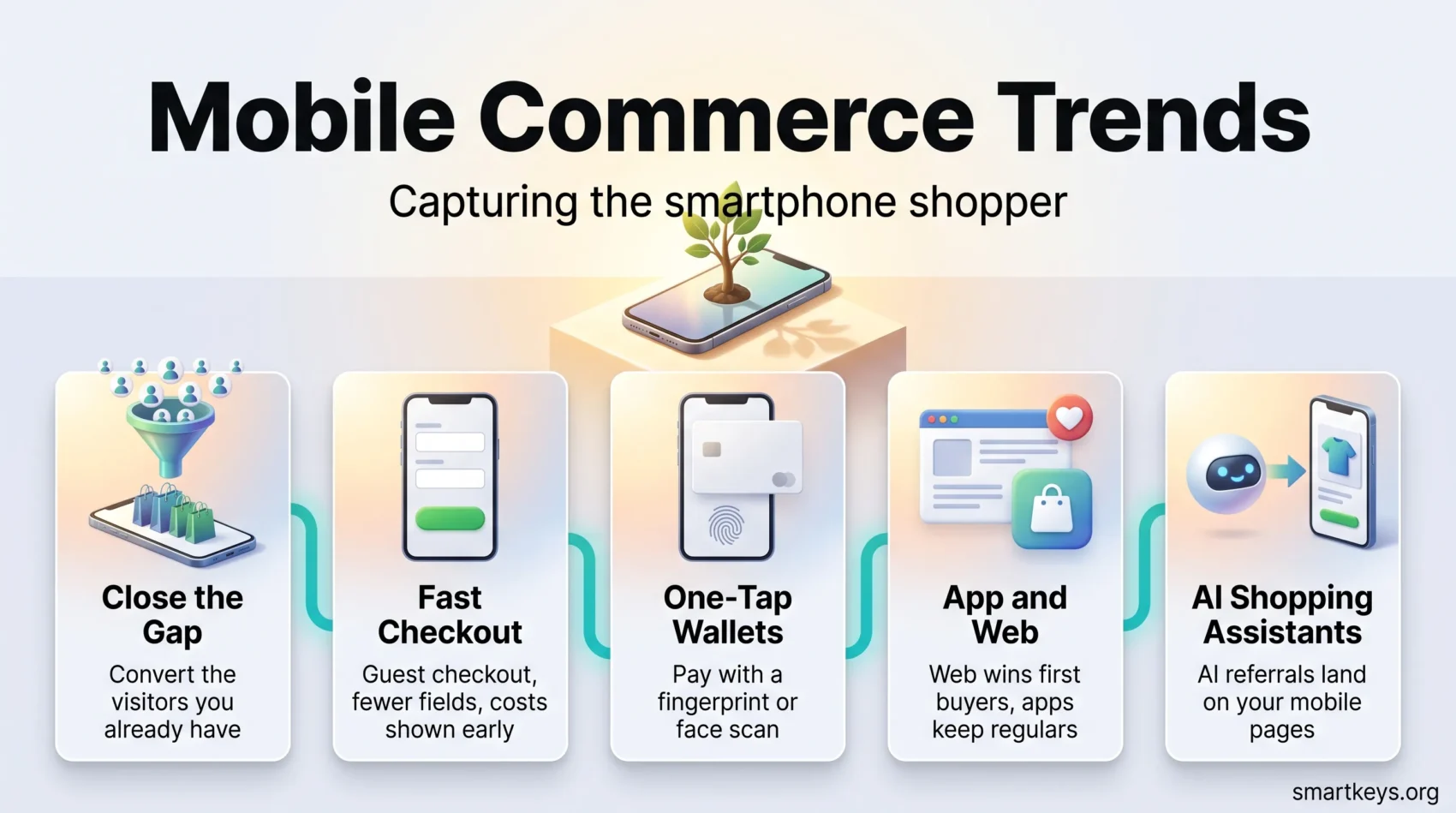
- Phones bring most ecommerce visits but a smaller share of orders. Converting the traffic you already have usually beats buying more.
- Apps hold your repeat buyers. Mobile web is where first-time buyers decide whether to trust you.
- Digital wallets now handle more than half of global online spending, so one-tap payment is expected rather than special.
- AI shopping assistants have become a discovery channel. They mostly send buyers back to your own site to pay, and on a phone that site has to close the sale.
- Published social commerce figures vary widely. Use them for direction and budget against your own sales data.
What changed since 2024
If you last reviewed your mobile strategy two years ago, three shifts matter most.
- Wallets took over online payments. Digital wallets such as Apple Pay, Google Pay and PayPal accounted for 56% of global online spending in 2025, according to the Worldpay Global Payments Report 2026. Offering them no longer sets you apart.
- Buy now, pay later went mobile. BNPL, which splits a purchase into several smaller payments, drove $20 billion in US online holiday spending in 2025. Smartphones accounted for 82.2% of those purchases (Adobe).
- AI assistants started sending shoppers. Traffic to US retail sites from generative AI tools rose 693.4% year over year during the 2025 holiday season (Adobe). New open standards now let those assistants read product catalogs directly.
The state of mobile commerce in 2026
Before you decide where to invest, you need realistic benchmarks. Each source below measures something slightly different.
Global and US numbers
Worldwide mobile ecommerce sales reached about $2.5 trillion in 2025, up from roughly $2.07 trillion in 2024. Those are Statista estimates, as cited by Oberlo. By the same estimates, mobile makes up close to 60% of global online retail sales.
The US runs behind the global average because desktop and workplace shopping remain more common there. eMarketer put mobile at 44.6% of US ecommerce sales in 2024. Peak seasons skew higher: Adobe’s 56.4% holiday figure shows how much gift shopping happens on the couch rather than at a desk.
Asia-Pacific markets lean even more heavily on phones. If you sell in several regions, benchmark each one against local data.
The traffic-to-order gap
This gap should drive your roadmap. The key question is not how to get more mobile traffic. It is: why does the traffic you already have buy less?
Two causes explain most of the gap:
- Cross-device journeys. Many shoppers research on a phone during the day and finish the purchase on a laptop. This is normal and only partly fixable, for example with saved carts that follow a logged-in customer.
- Friction. Slow pages, tiny tap targets, forced account creation and long address forms hit phone users hardest. This part is fully within your control.
Baymard Institute’s checkout research shows how costly friction is. It surveyed US shoppers who abandoned a purchase for reasons other than browsing. 40% left over extra costs, 18% because the site required an account, and 17% because checkout was too long. On a small screen, each problem feels bigger.
Set the right KPIs
KPIs, or key performance indicators, are the few numbers your team agrees to watch. For mobile, two rules help most.
- Track mobile conversion separately. Conversion rate is the share of visits that end in an order. A blended site-wide number hides a weak mobile experience behind a strong desktop one.
- Watch average order value (AOV) by device. AOV is the average amount spent per order. If phone orders are consistently smaller, bundles and better recommendations can raise revenue faster than a redesign.
Apps vs. mobile web: where each one earns its keep
You will often see claims that apps convert several times better than mobile websites. Those figures usually come from app vendors and compare different audiences, because people who install your app already like you. Apps and mobile web do different jobs.
Apps hold your repeat buyers. Saved logins, stored payment details and persistent carts remove most of the friction that hurts mobile web. For a customer who orders every few weeks, that convenience compounds.
Mobile web handles discovery. Ads, search results, social posts and AI assistant links all land on your website. Most of those visitors will never install anything, so a weak mobile site loses the majority of potential first-time buyers.
How to split your investment
- Mobile web: optimize for speed and the first purchase. Offer guest checkout, put wallet buttons where they are visible without scrolling, and keep form fields to a minimum.
- App: optimize for retention. Build fast reorder flows, a personalized home screen and restrained push notifications.
- Do not force the install. Full-screen “get our app” pop-ups on mobile web cost you first-time buyers and can hurt your search visibility.
If repeat purchases are your main growth lever, the app is where loyalty builds up over time. Our guides to customer loyalty in the digital age and customer retention strategies cover that side in more depth.
A middle path exists too. A progressive web app (PWA) is a website that behaves like an app. It loads fast, works on weak connections and can sit on the home screen without an app store download.
Designing for thumbs, not screens
Whichever surface you work on, design for one hand. Phone shoppers are often distracted, on a patchy connection and scrolling with a thumb.
- Product pages that convert: a clear main image, three short benefits and an add-to-cart button that stays visible while scrolling.
- Navigation and search: filters, size guides and results designed for skimming, with tap targets large enough for a thumb.
- Speed: compress images and load lower page sections only when needed. A CDN, a network that stores copies of your site closer to each visitor, also helps.
Google’s Core Web Vitals, metrics for loading speed, responsiveness and visual stability, make a practical checklist. Ship these improvements before peak season, not during it.
Checkout and payments: turning intent into orders
A fast, predictable checkout is the single highest-return fix on mobile. Saved profiles, address autofill and wallet buttons cut a multi-minute task down to seconds.
Wallets are the baseline
A digital wallet stores a customer’s card details on their phone. At checkout, the shopper confirms with a fingerprint or face scan instead of typing sixteen digits. The card number is replaced by a token, a stand-in code that is useless to a thief, which also lowers fraud risk. For the security side, see our overview of biometric payment systems.
With wallets handling 56% of global online spending, Apple Pay, Google Pay and PayPal are the minimum set for most stores. Beyond that, match local habits. BNPL options and regional wallets can lift completed orders in markets where customers expect them. Our analysis of BNPL’s business impact explains the costs and risks, and our piece on digital wallets in work payments covers the B2B angle.
Practical checkout fixes
- Cut fields. Ask only for what you need to deliver the order. Collect extras such as a birthday after the purchase.
- Show the total cost early. Surprise shipping, tax and fees are the top avoidable reason for abandonment in Baymard’s research.
- Allow guest checkout. Offer account creation after payment, when the customer has a reason to say yes.
- Apply extra fraud checks selectively. Reserve additional verification for risky orders so honest customers are not slowed down.
- Monitor payment approval rates. Declined payments look like abandonment in your analytics, so check them before redesigning pages.
Social commerce: large, growing and hard to measure
Checkout is where you convert intent. Social platforms are increasingly where that intent starts. Social commerce means buying directly inside apps like TikTok, Instagram or Facebook, and it is almost entirely a mobile activity.
Published market sizes disagree widely, because the big platforms do not report their shopping sales. eMarketer forecasts that US social commerce sales will pass $100 billion in 2026. Treat any headline number as directional, not as a planning input.
Where to focus
- Match the format to the platform. Short video and live selling carry TikTok Shop, while Instagram leans on visual product posts.
- Test native storefronts so the purchase happens inside the app and fewer buyers drop off during a redirect.
- Judge creators on attributed sales, not reach or likes.
For platform mechanics and live selling, see our guide to social commerce. Chat-based selling through messaging apps is covered in our piece on conversational commerce.
Agentic commerce: the newest mobile channel
Social apps changed where shoppers discover products. AI assistants are now changing who does the searching. Agentic commerce means a customer asks an AI assistant to find, compare and sometimes buy a product for them. That changes who your store needs to be readable by: not just people, but software.
The infrastructure arrived quickly. OpenAI and Stripe launched the Agentic Commerce Protocol in September 2025. At the NRF retail conference in January 2026, Google introduced the Universal Commerce Protocol, developed with Shopify, Etsy, Wayfair, Target and Walmart. Both are shared technical rules that let AI assistants read catalogs and pass orders to merchants.
The model is still settling. In March 2026 OpenAI scaled back Instant Checkout, its in-chat payment feature, and began sending shoppers to merchant sites and apps to complete purchases. For you, that means AI referrals usually land on your own pages, very often on a phone. Your mobile site is where those sessions close or fail.
Why it matters now
- An IBM and NRF study of more than 18,000 consumers, published in January 2026, found that 45% already use AI somewhere in their buying journey, most often to research products.
- Salesforce reported that shoppers arriving from AI search tools during the 2025 holidays converted nine times more often than shoppers arriving from social media.
- McKinsey estimates that AI agents could mediate $3 trillion to $5 trillion of global consumer commerce by 2030. That is a scenario forecast, not a measurement, but it shows the scale being discussed.
What to do this quarter
- Clean your structured data. Structured data is product information in a standard, machine-readable format: price, availability, shipping terms and reviews. It is what an AI assistant actually reads.
- Keep stock levels current. If your inventory updates every half hour, an assistant may recommend a competitor whose data is fresher.
- Make the landing page close. AI referrals arrive with high intent. Send them to the specific product page, not a generic category page.
Our guide to agentic commerce covers the protocols in depth. For the workplace side of the same shift, see AI augmentation.
AR, voice and AI personalization: what actually pays off
Not every new interface deserves equal budget.
AR try-on: worth it in fit-sensitive categories
Augmented reality (AR) overlays a product on the camera view, so a shopper can see glasses on their face or a sofa in their living room. It helps most where returns are expensive: eyewear, cosmetics, furniture and footwear. Be skeptical of dramatic conversion claims, which usually come from vendor case studies rather than independent audits. Our article on AR in e-commerce covers use cases and costs.
Voice: optimize for language, not for speakers
Ordering through smart speakers never reached its early forecasts. The lasting lesson is about wording: shoppers now phrase queries as full questions, whether they type, speak or ask an AI assistant. Write product content that answers those questions directly. Our guide to voice search marketing explains how.
AI personalization: the most dependable bet
Product recommendations, personalized home screens and automated support replies still produce the clearest returns of the three. All of them depend on unified customer data. If web, app and email records sit in separate systems, recommendations stay generic. That is why a customer data platform is usually the first investment, not the follow-up. Our guide to e-commerce personalization shows what to build on top of it.
Constraints: privacy and the physical store
Personalization needs customer consent, and many mobile shoppers are standing in a real store.
Permission hygiene
Ask only for permissions you actually use, such as location or notifications, and explain the benefit when you ask. Over-asking lowers opt-in rates and weakens personalization. Asking customers directly about their preferences, known as zero-party data, is often more accurate than tracking them.
The phone in the aisle
Shoppers routinely check prices and reviews on their phones while standing in a store. That habit, often called showrooming, is only a threat if you ignore it. Show store-level stock accurately online, keep prices consistent across channels, and use QR codes on shelves to surface specs, reviews and fast checkout links. This blending of online and in-store is the core of phygital retail.
Conclusion
The mobile opportunity in 2026 is not more traffic. It is converting the traffic you already have.
Start with checkout and speed, because those fixes are cheap and easy to measure. Make wallet payments effortless. Use your app for retention and your mobile website for first purchases, and stop treating them as one surface.
Then prepare for the next layer. Clean, current product data lets AI assistants find and recommend you, and a fast mobile site lets you close the sale when they send a buyer your way.
For the bigger picture of online retail, see our overview of e-commerce trends.
Found this useful?
Make SmartKeys a preferred source on Google, and our articles will surface more often in your Top Stories, AI Overviews, and AI Mode.
Add as Preferred Source