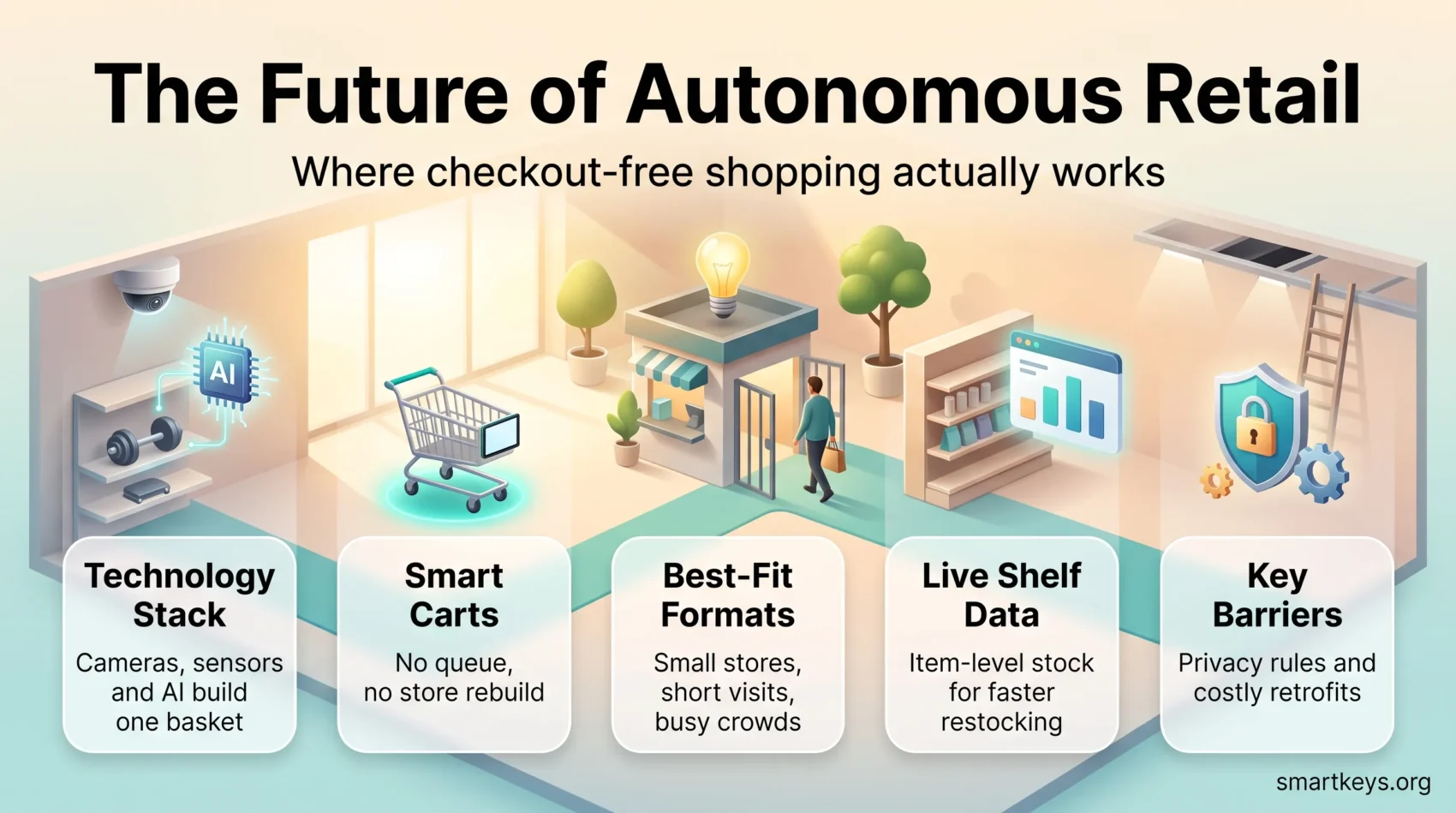
The future of autonomous retail looks very different in 2026 than it did when the first checkout-free stores opened. The technology works. What changed is where retailers choose to use it. After a decade of pilots, flagship closures and quiet licensing deals, a clearer picture has emerged: frictionless checkout is a feature that fits certain formats extremely well, and fits others badly. This article explains what autonomous retail actually is, where it stands today, what it delivers, and what still gets in the way.
Key Takeaways
- Autonomous retail combines computer vision, sensor fusion and AI to let shoppers take products and leave without a checkout step.
- Amazon announced in January 2026 that it is closing its Amazon Go and Amazon Fresh physical stores and converting locations to Whole Foods Market.
- Just Walk Out survives as a licensing business: Amazon reports the technology in over 360 third-party locations across five countries.
- Smart carts have become the pragmatic middle ground, keeping the store layout intact while removing the checkout queue.
- Self-checkout is not free money: the ECR Retail Loss Group’s 2026 study found materially higher shrink in stores that run it.
- Small, high-traffic, closed formats — offices, campuses, stadiums, transit hubs — are where the economics work best.
- Data privacy and retrofit costs remain the two hardest barriers for mainstream grocery adoption.
What Autonomous Retail Actually Means
Autonomous retail describes a store where the purchase completes itself. You enter, take what you want, and walk out. Sensors identify the products, a virtual basket tracks them, and payment is charged to a linked account. There is no scanning step and no queue.
The label covers a spectrum. At one end sit fully unstaffed micro-stores that open with a card tap. In the middle sit staffed stores with smart carts. At the other end sit conventional stores using the same sensing hardware only for stock counting.
The Technology Stack
Three layers do the work. Computer vision — ceiling cameras and shelf cameras — identifies products and tracks who picked what. Sensor fusion merges that visual data with weight sensors, RFID tags and entry gates so the system stays accurate when a camera view is blocked. AI reconciles the signals into a single basket and flags ambiguous events for review.
The same stack produces a second output that retailers often value more than the checkout itself: continuous, item-level shelf data. That feeds replenishment, waste reduction and planogram decisions, and it connects naturally to the wider IoT infrastructure businesses already run. Poland’s Żabka Nano format, built on AiFi’s camera-based system, has taken this approach into offices, campuses and industrial sites rather than trying to replace full-size supermarkets.
For a broader view of how these models work in practice, see how AI is being applied across business operations.
Where Autonomous Retail Stands in 2026
The most important development of the past two years was Amazon stepping back from its own stores. In January 2026 the company announced it would close its Amazon Go and Amazon Fresh physical locations, converting many of them into Whole Foods Market stores and shifting investment toward online grocery and Whole Foods expansion.
That is not a verdict on the technology. It is a verdict on the format. Amazon had already removed Just Walk Out from its Fresh supermarkets in 2024, having found that shoppers in a large basket-size grocery trip wanted things the frictionless model did not give them — a running total, the ability to check weights, and control over the process.
Just Walk Out as a Licensing Business
Where the technology has grown is under other retailers’ brands. Amazon reports Just Walk Out running in over 360 third-party locations across five countries, and in the breakrooms of more than 40 of its own North American fulfilment centres. Stadiums, airports, hospitals, campuses and convenience formats dominate that list.
The pattern is consistent. Checkout-free works where baskets are small, dwell time is short, the queue is the main pain point, and the customer is effectively captive. It struggles where the basket is large, the shopper wants to compare and reconsider, and the queue is only one annoyance among many.
Smart Carts: The Pragmatic Middle Ground
The format gaining ground fastest is the smart cart — a trolley with a screen, cameras and a scale that rings up items as you drop them in. Amazon has been rolling its newest Dash Cart into Whole Foods Market locations through 2026, and Instacart’s Caper Carts are deployed across a range of North American grocers.
Smart carts are popular for an unglamorous reason: they require no ceiling rig, no store rebuild and no all-or-nothing commitment. A retailer can add ten carts, keep every existing lane, and measure the result. They also give the shopper the running total that pure checkout-free stores hide, and they open a screen for offers, which ties them into AI-driven personalization strategies.
The Rise of AI-Driven Retail Technology
AI in retail is no longer confined to the checkout. Its more durable contribution is helping retailers decide what to stock, where to place it and how to price it.
Artificial Intelligence in Assortment and Placement
Models trained on transaction history, local demand patterns and seasonality help decide which products earn shelf space in a given store. In a small autonomous format with a few hundred facings, that decision is existential — there is no room for a slow seller. Retailers pair this with behavioral analytics to understand not just what sold, but what shoppers considered and put back.
Computer Vision Beyond Checkout
The cameras that enable checkout-free shopping also watch the shelf. They flag gaps before a shift manager notices, detect misplaced products, and record how long shoppers linger in each zone. That last signal overlaps with what neuromarketing research tries to capture, but at store scale and in real time.
This is why several retailers install the vision layer without ever switching on frictionless checkout. The operational data justifies the hardware on its own.
Benefits of Autonomous Retail Solutions
The case for autonomous retail rests on three claims that hold up reasonably well in practice.
Improved Customer Experience
Removing the queue removes the single most reliably disliked part of a store visit. In small-format settings — a stadium concourse at half-time, an airport gate, an office building at lunchtime — this is not a marginal gain. It is the difference between a sale and a walkaway. The same logic drives phygital retail formats that blend online convenience with a physical space.
Operational Efficiency for Retailers
Unstaffed or lightly staffed stores extend trading hours without extending shifts, and free the staff who remain from the till. Whether that translates into a better margin depends heavily on format, footfall and technology cost — the savings are real, but they are not automatic and they are not uniform across store types.
Real-Time Inventory Management
Continuous item-level tracking is the benefit retailers describe most consistently. Knowing exactly what is on each shelf right now shortens replenishment cycles, cuts waste on short-dated goods and reduces lost sales from out-of-stocks. It also feeds upstream planning, connecting the store to the same data that shapes modern logistics and supply chain systems.

Self-Service Stores and Their Popularity
Self-service is the older, larger and messier cousin of autonomous retail. Almost every major grocer runs self-checkout lanes, and the lessons from that rollout are directly relevant to anyone planning a checkout-free store.
Consumer Preference for Seamless Shopping
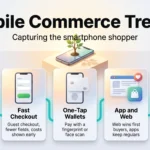
Shoppers reliably choose the fastest route out of a store. Barcode scanning, QR codes and mobile payment have removed most of the friction from small transactions, and app-based ordering has trained an entire generation to expect the transaction to disappear into the background — the same expectation that drives conversational commerce and super apps.
The Shrink Problem Retailers Underestimated
Self-checkout also carries a cost that early business cases understated. The ECR Retail Loss Group’s 2026 Self-Checkout Loss Report, published in June 2026 and drawing on data from 39 retailers, found stores operating self-checkout recorded around 33% higher losses than comparable stores without it, with missed scans the most frequent loss event.
That finding explains why several large US chains have reduced self-checkout lanes, capped basket sizes at them, or reinstated staffed lanes. It also explains the appeal of camera-based systems: unlike a self-scan kiosk, a vision system does not rely on the shopper to declare what they took.
Automated Checkout Systems
Automated checkout covers everything from a self-scan kiosk to a fully sensor-driven store. The direction of travel is toward systems that verify rather than trust.
How Just Walk Out Technology Works
Entry is authenticated first, usually by card, app or palm scan — the same category of technology behind biometric payment systems. Overhead and shelf cameras then track products from the moment they are lifted. Weight sensors confirm ambiguous picks. A virtual basket updates continuously, and payment is taken automatically when you leave.
The hard part is not the happy path. It is the edge cases: a shopper picking up an item, carrying it three aisles and putting it back on the wrong shelf; two people sharing a basket; a child adding items unnoticed. Accuracy on those cases is what separates a working deployment from an expensive pilot.
Where Checkout-Free Formats Fit Best
The economics favour small footprints with high transaction density and limited SKU counts. Convenience stores, staff shops, transit hubs and event venues all qualify. Full-size supermarkets generally do not — the camera count, the SKU variety and the basket size all push cost up and accuracy down at the same time.
Unmanned Retail Stores: A New Benchmark
The emergence of unmanned retail stores reset expectations for what a small store can be. The formats that survived the shakeout share a common trait: they solved a specific access problem rather than chasing novelty.
Formats Worth Watching
- Żabka Nano (Poland): AiFi-powered autonomous micro-stores placed in offices, campuses and industrial sites, where no conventional store would be viable.
- Third-party Just Walk Out sites: stadium, airport and hospital shops licensing Amazon’s technology under their own brand.
- Amazon fulfilment centre breakrooms: closed-environment deployments in more than 40 North American facilities, where the user base is known and stable.
- Smart-cart supermarkets: conventional stores that removed the queue without removing the store.
Consumer Reactions and Adaptation
Reactions remain split. Shoppers consistently praise the speed and the absence of a queue. They remain uneasy about camera surveillance, about what happens when the system charges them incorrectly, and about the loss of retail jobs.
Trust is built through mundane details: a clear receipt, an easy dispute path, visible signage about what is being recorded, and a human reachable when something goes wrong. Deployments that skip these fail on customer sentiment long before they fail on technology.

Digital Commerce Innovations Driving Change
Checkout is one part of a broader shift toward stores that recognise context — who is present, what they came for, and what the store can usefully offer in the moment.
Geolocation and Personalized Shopping
Location data lets retailers time an offer to the moment it is useful rather than broadcasting it. Used well, that means a relevant suggestion near the right aisle, better local inventory allocation, and fewer irrelevant notifications. Used badly, it is the fastest way to make a shopper uninstall an app.
In-Store Signals and Beacon Technology
Beacons and similar in-store sensors support navigation in large spaces, surface product details on demand and trigger contextual promotions. They also generate footfall maps that inform layout decisions. The same sensing principles scale up into smart city infrastructure, and increasingly feed digital twin models that let retailers simulate a layout change before building it.
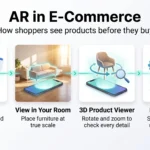
Augmented reality sits alongside this as a way to add information to a physical shelf, an approach explored further in AR’s role in e-commerce.
Challenges Facing Autonomous Retail Implementation
Three obstacles explain most of the gap between pilot and rollout.
Data Privacy and Regulatory Exposure
An autonomous store is a continuous video recording of paying customers. Where biometric identification is involved, the regulatory burden rises sharply, and requirements differ by jurisdiction — a real constraint for chains operating across borders, as covered in our guide to data localization laws. Retailers also inherit a substantial security obligation, since the footage and basket data are attractive targets; distributed architectures such as cybersecurity mesh are one response.
The Investment Question
Camera arrays, edge compute, sensor shelving and integration work all cost money before a single basket is processed. The payback depends on transaction volume per square metre, which is why the format works in a stadium and not in a suburban superstore. Vendors have moved toward hardware-as-a-service pricing partly to remove this hurdle.
Retrofitting Existing Stores
Purpose-built autonomous stores are far easier than conversions. Existing buildings have ceiling heights, lighting, sightlines and shelving that were never designed for camera coverage. Retrofits routinely cost more and take longer than the original estimate, and some layouts simply cannot reach acceptable accuracy without being rebuilt.

The Future of Robotic Retail Experiences
Robotics in retail has settled into two useful roles: moving things people do not want to move, and answering questions before a customer gives up looking.
Enhancing In-Store Navigation with AI
Shelf-scanning robots and in-store apps attack the same problem from different angles: helping shoppers find what they came for, and helping staff spot what is missing. The value concentrates in large stores with deep assortments.
Customer Engagement through Automation
Automated assistance handles the routine questions — where an item is, whether a size is in stock, what a promotion covers — and leaves staff for the conversations that need judgement. Delivery robotics extends the same logic past the store door, a theme explored in our look at autonomous delivery and its impact on e-commerce and at commercial drone applications.
Industry Trends and What to Watch
The near-term trajectory is less dramatic than the 2018 predictions and probably more durable.
Smart Checkout, Realistically
Expect continued growth in smart carts and vision-assisted self-checkout rather than a wave of fully unstaffed supermarkets. The commercial pressure is toward systems that reduce both queue time and shrink at once, since the ECR findings made clear that solving only the first creates a second problem. Faster connectivity underpins all of it, as we discuss in our overview of how 5G will affect business operations.
Future Innovations on the Horizon
Three developments are worth tracking: cheaper edge inference that lowers the per-store hardware bill; standardised dispute and refund flows that make automatic charging feel safe; and the merging of store sensing with fulfilment data.
Sustainability pressure will also shape assortment and packaging in these formats, a shift visible in the growth of resale models covered in our piece on the recommerce trend.
Conclusion
Autonomous retail spent its first decade being sold as the replacement for the supermarket. It is turning out to be something more specific and more useful: a very good answer to a small store with a queue problem, and a very good source of shelf data everywhere else.
Amazon’s 2026 retreat from its own store brands, alongside the continued growth of Just Walk Out under other companies’ logos, tells you where the value settled. The technology is mature enough to license and deploy. The open questions are commercial and social — what it costs to retrofit, who owns the footage, and whether shoppers trust a store that charges them without asking.
For retailers, the practical move is to stop treating this as a binary. Start with the vision layer for inventory, add carts where queues hurt, and reserve full checkout-free builds for the formats where the maths genuinely works.
Found this useful?
Make SmartKeys a preferred source on Google, and our articles will surface more often in your Top Stories, AI Overviews, and AI Mode.
Add as Preferred Source