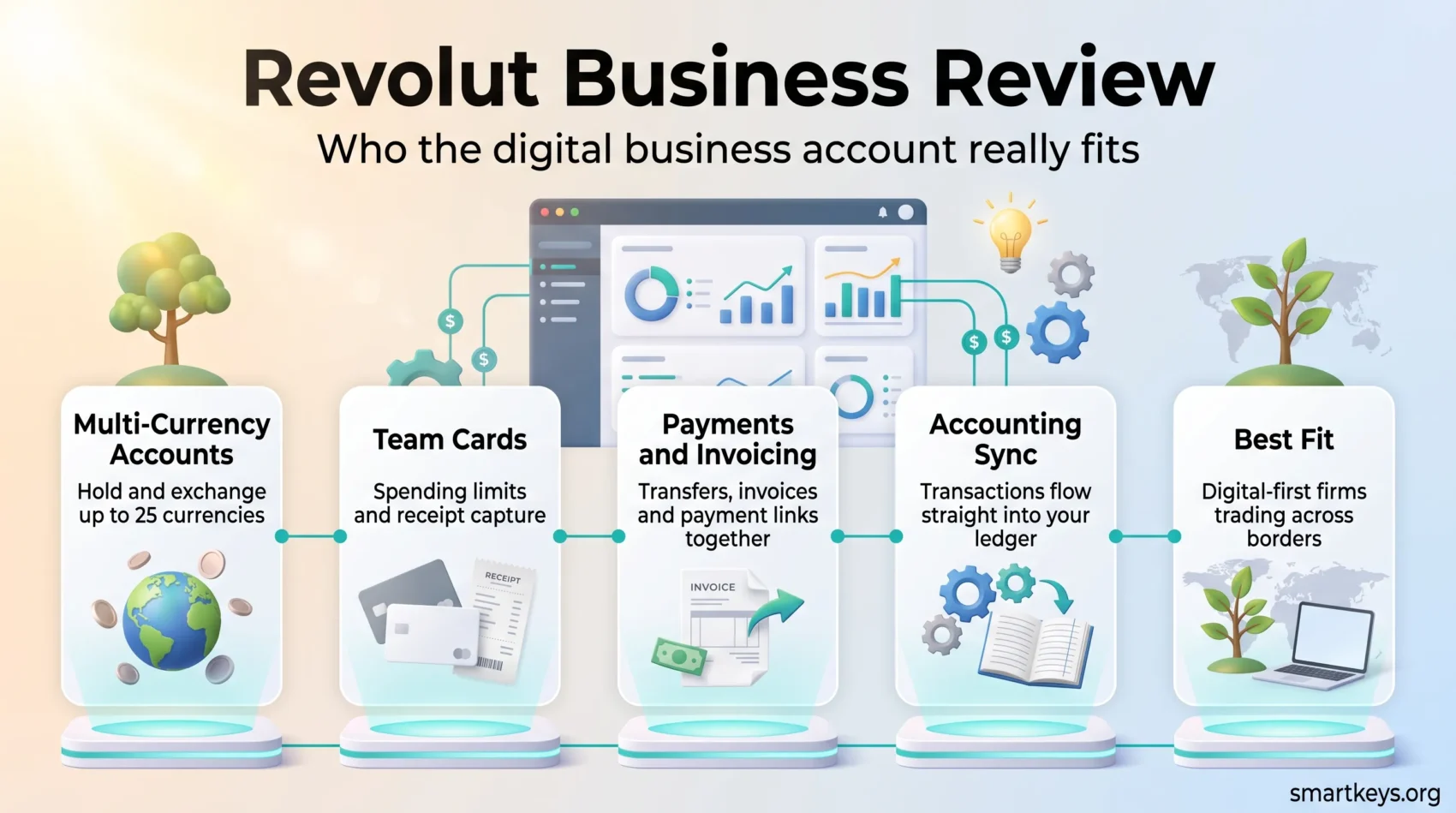
Welcome to our in-depth Revolut Business review. Revolut launched its business arm in 2017 and has since built it into one of the largest non-bank business banking platforms in Europe. In its 2025 annual results, published in March 2026, Revolut reported 767,000 business customers, a 33% increase on the previous year, and $365 billion in business transaction volume.
Two things changed the picture in 2026. Revolut received its full UK banking licence on 11 March 2026, ending roughly 20 months in the regulator’s mobilisation phase. And its business pricing moved up in mid-2025: the Basic plan is no longer free. Both matter if you are deciding whether to move your company accounts here.
Key Takeaways
- Revolut reported 767,000 business customers and $365 billion in business transaction volume for 2025.
- Revolut Business now charges from $10 a month on Basic; the free entry tier is gone.
- Accounts hold and exchange up to 25 currencies at interbank rates within a monthly allowance.
- Revolut won its full UK banking licence in March 2026, unlocking FSCS-protected deposits and lending in the UK.
- The platform suits internationally trading, digital-first companies more than businesses that need branch service.
What Revolut Business Is in 2026
Revolut Business is a digital account and financial operations platform rather than a traditional business current account. You open it online, manage it in a browser or mobile app, and use it for multi-currency balances, domestic and international transfers, cards, expenses, invoicing and payment acceptance.
Its centre of gravity is cross-border money movement. If you invoice in one currency, pay suppliers in another and hold a payroll float in a third, the account is built around that. Companies with a single domestic currency and a local supplier base will get far less out of it, and are often better served by a bank branch relationship plus decent finance automation on top.
Availability is not global. Revolut Business is open to companies registered in a defined list of countries, and the list differs from the one covering Revolut’s personal app. Check your jurisdiction before you build plans around it, particularly if you are expanding into new markets.
Revolut Business Pricing in 2026
Pricing is the part of this review that has aged fastest. Revolut restructured its business plans with effect from 17 June 2025, raising monthly prices and, importantly, removing the free tier.
What the Plans Cost
US pricing, taken from Revolut’s own plan and help pages:
- Basic: $10 a month. Includes 10 no-fee local transfers and a $1,000 monthly currency exchange allowance at interbank rates.
- Grow: $50 a month, or the equivalent of $40 a month billed annually. Adds 100 no-fee local transfers, 5 no-fee international transfers and a $20,000 exchange allowance.
- Scale: $180 a month, or the equivalent of $140 a month billed annually. Adds 1,000 no-fee local transfers, 25 no-fee international transfers and an $80,000 exchange allowance.
- Enterprise: custom pricing, custom allowances, negotiated per company.
UK pricing follows the same ladder, published as £10 a month for Basic and from £30 and £90 a month for Grow and Scale respectively. Prices vary by region, so read your local plan page rather than a comparison table.
How to Read the Price
The headline monthly fee is the smaller half of the decision. What actually drives your cost is the currency exchange allowance. Once you exceed it, exchanges are charged as a percentage on top of the interbank rate, and a company converting six figures a month can pay more in FX markup than in subscription fees.
So work backwards. Estimate your monthly conversion volume, match it to the allowance on each tier, and only then compare the subscription price. That single calculation decides whether Grow or Scale is cheaper for you far more reliably than a feature list does. It is the same discipline that good cash flow management demands elsewhere in the business.
Key Features of Revolut Business
Multi-Currency Accounts
A Revolut Business account can hold and exchange up to 25 currencies, including USD, EUR, GBP, CHF, AUD, SGD, JPY, CAD and AED. Exchanges inside your plan allowance use the interbank rate, which is the core commercial argument against a traditional bank’s spread.
Local account details are available for major currencies, and fully localised details, such as an Australian BSB, in a small number of regions where you have a registered entity. Where local details are not available, incoming payments still work but may route as international transfers.
Expense Management and Cards
You can issue physical and virtual cards to team members, set per-card and per-category spending limits, and require receipt capture at the point of spend. Expenses are categorised and can be pushed to your accounting ledger automatically, which removes most of the month-end reconciliation work that standalone expense tools like Expensify exist to solve.
Team member access is unlimited across all plans, with role-based permissions and approval flows. For distributed teams, including companies employing digital nomads across time zones, that combination of granular limits and remote issuance is genuinely useful.
Payments and Invoicing
Bulk payments, scheduled transfers, payment links, invoicing and card acquiring all sit in the same account. Revolut also supports payment acceptance for merchants, which lets smaller companies collect and hold revenue in the same place they spend it. Businesses tracking wider shifts in how money moves will recognise the pattern from digital wallets in work payments and biometric payment systems.
What the UK Banking Licence Changes
Revolut applied for a UK banking licence in 2021, received a restricted one in July 2024, and exited mobilisation with a full licence on 11 March 2026. Until then it operated in the UK as an electronic money institution, meaning customer funds were safeguarded rather than covered by the Financial Services Compensation Scheme.
With the full licence, eligible UK deposits fall under FSCS protection, the deposit cap imposed during mobilisation is lifted, and Revolut can offer credit products alongside its accounts. For a finance team weighing counterparty risk, that is a material change: the question is no longer only whether the product is good, but whether the balance is protected. Outside the UK, Revolut’s regulatory status varies by market, and safeguarding rather than deposit insurance may still apply. This is exactly the kind of detail that broader open banking rules and regtech tools are pushing firms to check properly.
Benefits of Using Revolut Business
Cost Control on International Money
The strongest argument remains foreign exchange. Interbank rates within an allowance, transparent markups beyond it, and no-fee international transfers on paid plans add up to a real saving for companies moving money across borders regularly. The saving shrinks to nothing if you rarely convert currency.
Speed and Self-Service
Account opening, card issuance, permission changes and payment runs are self-service and usually take minutes rather than days. For fast-moving companies this is the practical difference against a traditional bank, where the same tasks often require forms and a relationship manager.
One Place for Financial Operations
Accounts, cards, expenses, invoices and payment acceptance in one interface reduces tool sprawl and manual data transfer. That consolidation is the same logic driving interest in embedded finance generally: fewer systems between the transaction and the ledger.
Revolut Business Pros and Cons
Advantages
- Multi-currency accounts with interbank exchange inside the plan allowance.
- Fast, fully digital onboarding, card issuance and permission management.
- Unlimited team members with granular spending controls on every plan.
- Native accounting integrations that cut manual reconciliation.
- FSCS-protected deposits and access to credit products in the UK since March 2026.
Drawbacks
- No free tier since June 2025, and prices rose across every plan.
- No branches and no in-person service, which rules it out for cash-handling businesses.
- Support is chat-first; complex account issues can be slow to escalate.
- Account freezes during automated compliance checks are a recurring theme in user reports across neobanks, Revolut included.
- Availability and regulatory protection differ by country, so the UK picture does not transfer everywhere.
Revolut Business Compared with Traditional Banks
The comparison is less about features and more about what each side is optimised for. A traditional business bank sells relationship, credit history, branch access and cash handling. Revolut sells speed, currency efficiency and software.
- Foreign exchange: Revolut’s interbank rates within allowance are typically well below high-street bank spreads.
- Onboarding: minutes to days online, against weeks and paperwork at many incumbents.
- Credit: traditional banks still lead on lending depth and history-based underwriting, though the UK licence narrows this gap.
- Cash and branches: incumbents win outright; Revolut has no branch network.
- Reporting: Revolut’s real-time dashboards and exports are more useful day to day than most bank portals, and feed predictive analytics in finance more cleanly.
Many companies land on both: an incumbent for lending and cash, Revolut for currency and operating spend. That is a reasonable answer, not a fence-sit.
Revolut Business Alternatives
If Revolut is not the fit, the same job is done well by several platforms with different emphases.
Where the Main Alternatives Differ
- Wise Business: the strongest option if transparent per-transfer FX pricing matters more than a full operating platform. Local account details in more currencies than most competitors.
- Airwallex: aimed at companies with heavier cross-border collection and payout volume, with a deeper API for embedding payments into your own product.
- Payoneer: strong where you collect from marketplaces and platforms rather than invoicing enterprise clients directly.
- A traditional bank plus software: pairing an incumbent account with accounting and expense tools is still the right answer for cash-heavy or credit-dependent businesses.
How to Choose Between Them
Compare on the three things that actually vary: total FX cost at your real monthly volume, whether you can get local account details in the currencies you invoice in, and how support behaves when an account is restricted. Feature checklists converge; those three do not. Fintech consolidation means the landscape keeps shifting, as our overview of fintech trends shaping business and the parallel story in P2P lending both show.

Whichever you pick, run a parallel test for a month before migrating payroll or supplier payments. Migration cost is the hidden line item in every one of these decisions.
Integration with Other Tools
Supported Apps and Services
Revolut Business connects natively to the main accounting and workflow tools businesses already run:
- Xero and QuickBooks Online for automatic transaction sync and reconciliation
- FreshBooks for invoicing-led workflows in smaller companies
- Slack for payment and approval notifications
- Zapier and comparable automation tools for everything else
- A public API for custom builds, which teams standardising on integration platforms will want to review first
What Integration Actually Saves
The realistic gains are bank feed reconciliation, expense categorisation, invoice matching and approval routing. These are small individually and substantial monthly. Before you automate, make sure the underlying process is worth automating, and that your access controls hold up; account integrations widen your attack surface, which is why cybersecurity belongs in the same conversation.
Verdict: Who Should Use Revolut Business
Revolut Business earns its place for internationally trading, digital-first companies that convert currency regularly, want cards and controls issued in minutes, and do not need cash or branch service. For those companies the FX economics and the operational speed are hard to match, and the UK banking licence removes the safeguarding question that used to be the strongest objection.
It is the wrong tool if you handle cash, depend on a lending relationship built on trading history, or need to reach a named human quickly when something breaks. The removal of the free tier also weakens the case for very small or pre-revenue companies that were using Basic as a zero-cost second account.
Price it against your real conversion volume, check availability and deposit protection in your own jurisdiction, and test it in parallel before you commit. Approached that way it is a strong operating account, and the same growth aspirations that make it attractive are best served by evidence rather than enthusiasm.
Found this useful?
Make SmartKeys a preferred source on Google, and our articles will surface more often in your Top Stories, AI Overviews, and AI Mode.
Add as Preferred Source