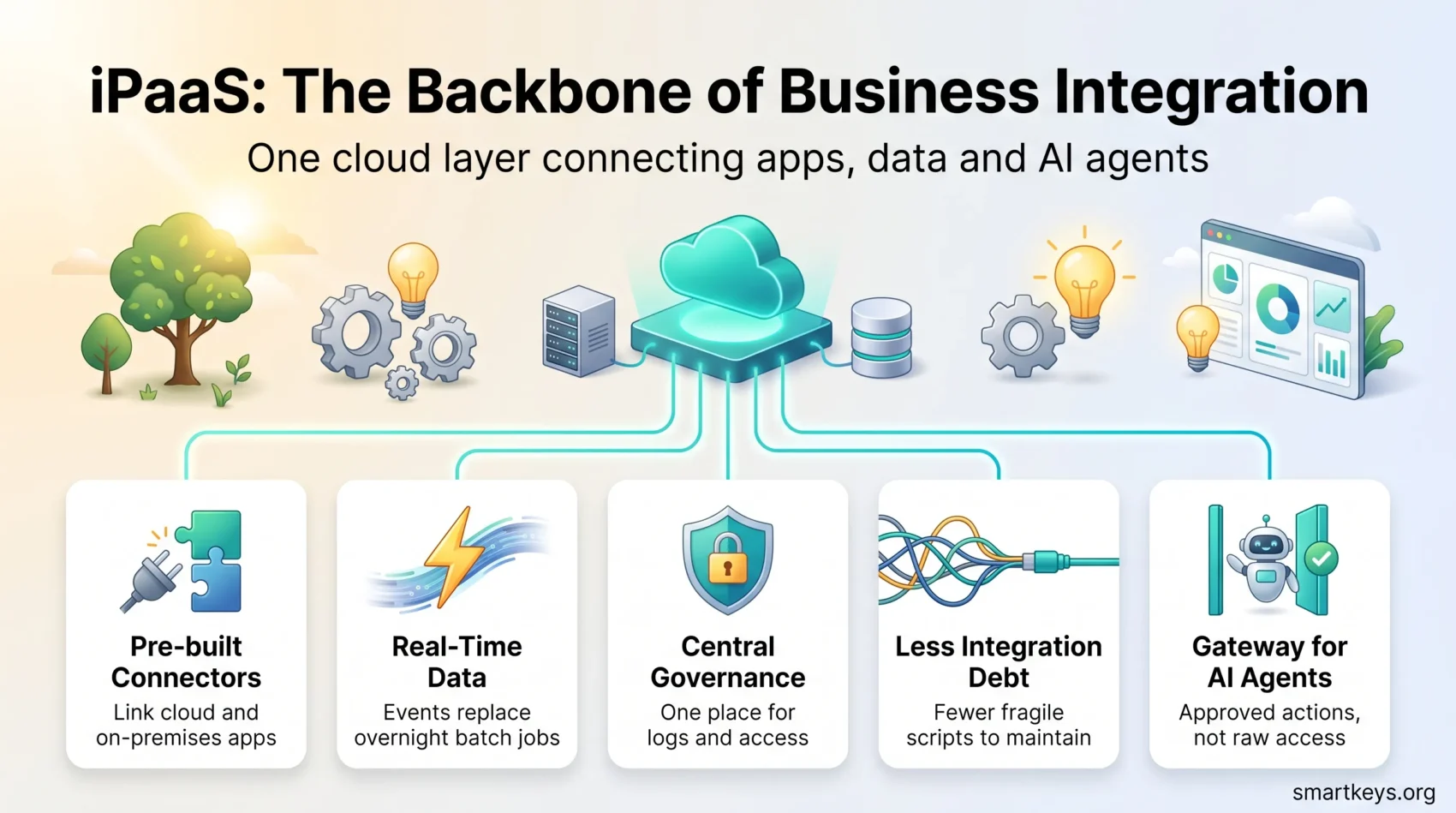
Most companies no longer struggle to buy software. They struggle to make it talk to each other. iPaaS, or Integration Platform as a Service, is the cloud layer that connects those applications, moves data between them and keeps the flows running without a team of developers maintaining custom middleware.
The category has become a substantial market in its own right. Fortune Business Insights values the global iPaaS market at USD 15.63 billion in 2025 and projects USD 19.15 billion for 2026, growing at a compound annual rate of 24.2% to USD 108.76 billion by 2034. The pressure behind that growth is easy to explain: application portfolios keep expanding. BetterCloud’s 2026 State of SaaS report found the average number of applications per organization rose 11% year over year, and that only 56% of the apps in active use carry IT approval.
That combination, more systems with less central control, is exactly the problem iPaaS was built to solve.
Key Takeaways
- iPaaS connects cloud and on-premises applications without custom middleware.
- The market is growing quickly, driven by expanding application portfolios and shadow IT.
- Pre-built connectors and low-code tooling shorten integration projects considerably.
- Governance, not connectivity, is now the harder half of the problem.
- In 2026 the platform is also becoming the controlled gateway between AI agents and business systems.
Understanding iPaaS and Its Benefits
As organizations grow more interconnected, understanding iPaaS is key. iPaaS is a cloud-hosted platform that integrates diverse applications and data sources, whether they run on-premises or in the cloud. It acts as a centralized hub for enterprise integration, connecting systems such as ERP platforms, customer relationship management systems and databases through pre-built connectors rather than bespoke code.
What is iPaaS?
iPaaS is a versatile platform for linking different applications within an organization. It enhances operational workflows and synchronizes data across systems. That matters because most companies run a mixture of legacy systems, industry-specific tools and general-purpose SaaS, none of which were designed to share data.
Key Benefits of iPaaS Solutions
Implementing iPaaS business integration offers several concrete advantages:
- Increased Productivity: Automating processes through iPaaS frees up your team’s time for strategic initiatives.
- Improved Efficiency: Synchronized systems ensure data flows smoothly, reducing delays and errors.
- Cost Reduction: Pre-built connectors are usually cheaper to run than custom integrations, which someone has to maintain indefinitely.
- Scalability: These services adapt as your business grows, accommodating new applications and data sources.
- Governance: Central logging, access control and monitoring apply to every flow instead of being reinvented per script.
Application sprawl is what turns these benefits from nice-to-have into necessary. BetterCloud’s 2026 data shows mid-market organizations growing from an average of 116 to 164 applications in a single year, a 41% jump, and 21% of organizations discovering unsanctioned SaaS and AI tools already in active use. Every one of those tools holds data someone will eventually want joined to something else, which is why consolidating overlapping SaaS tools and integrating what remains tend to happen together.

The Importance of iPaaS in Business Integration
The business world is evolving fast, pushing companies to find better ways to integrate. iPaaS is a practical answer for operational efficiency and faster response times, because it automates data synchronization across applications instead of leaving it to overnight batch jobs.
Why Businesses Are Adopting iPaaS
Most firms turn to iPaaS for flexibility and speed of setup. Low-code tooling reduces the dependency on scarce integration developers, and pre-built connectors mean the first working flow can be live in days rather than quarters. API-driven integration also makes it straightforward to connect newer technologies, and running the platform on modern cloud infrastructure means capacity scales with demand instead of with procurement cycles.
iPaaS vs. Traditional Integration Methods
Traditional integration depends on manual coding and custom middleware, which leads to long development cycles and a maintenance burden that never goes away. iPaaS offers pre-packaged integrations that can be configured with limited technical knowledge, and the vendor handles platform updates, connector maintenance and security patching. That difference matters most when the underlying estate is already moving toward cloud-native and microservices architectures, where the number of endpoints to connect grows faster than any hand-written integration layer can absorb.

iPaaS Business Integration: A Comprehensive Overview
Connecting cloud and on-premises applications is now the normal case rather than the exception. Very few organizations have finished their migration, and many never will, because some systems are too regulated, too customized or too load-bearing to move. iPaaS is designed for that middle state: it breaks down data silos while improving data accessibility and decision-making across the organization.
How iPaaS Connects Cloud and On-Premises Applications
iPaaS provides a framework for connecting applications wherever they run, usually through a lightweight runtime or agent installed inside the corporate network for on-premises systems. Given how many applications the average company now runs, cohesive cloud applications integration is not optional. Platforms supply pre-built connectors and business logic so integration flows can be assembled quickly, which is what makes seamless business process integration across departments realistic rather than aspirational.
Integrating Various Data Sources
Growing application portfolios create data silos, which in turn cause duplicated records, conflicting reports and slow collaboration. iPaaS addresses this by supporting real-time data integration across sources. Connecting IoT devices to existing business applications extends the same approach to operational data, so sensor readings can reach analytics and maintenance systems without a separate pipeline.

Beyond connectivity, iPaaS platforms provide low-code development environments. Integration specialists and citizen developers can build workflows without deep programming knowledge, though this needs guardrails rather than open access. Centralized monitoring also lets teams catch failures before a downstream report quietly goes wrong.
The Role of iPaaS in Digital Transformation
iPaaS sits close to the centre of most digital transformation programmes, because almost every transformation goal depends on data moving between systems that were bought separately.
Accelerating Digital Initiatives with iPaaS
iPaaS simplifies the connection between older systems and newer applications, which is usually the slowest part of any modernization project. Teams can assemble workflows in a fraction of the time custom development would take, and the platform absorbs the retry logic, scheduling and error handling that hand-rolled scripts tend to omit.
With that foundation, companies can take on cloud migration, workflow automation and process redesign without rebuilding the plumbing each time. Back-office work benefits early: finance automation depends entirely on clean handoffs between ERP, banking and supplier systems.
Adopting digital technologies with iPaaS also makes the resulting architecture easier to change later, which matters more than initial delivery speed. Integration decisions tend to outlive the projects that produced them.
Enhancing Data Management with iPaaS
Organizations face increasing demands for effective data management. iPaaS plays a crucial role in enhancing data management by offering streamlined data integration solutions that keep systems synchronized rather than periodically reconciled.
Improving Data Accuracy and Insights
Automated flows reduce manual re-keying, which is where a large share of data errors originate. That improves accuracy, but only if the flows themselves are governed: a fast pipeline moving badly defined data simply spreads the problem further. A data governance strategy that defines ownership, quality rules and definitions is what turns integration into reliable analytics.
Addressing Data Silos in Organizations
One of the significant challenges organizations face is addressing data silos. iPaaS integrates disparate sources so teams get consistent access across departments, which is a prerequisite for data democratization. Without it, self-service analytics simply gives more people access to inconsistent numbers.
Scalability and Flexibility of iPaaS Solutions
Managing an ever-increasing volume of data and applications is a persistent challenge. iPaaS solutions offer scalable integration services that adapt as needs change, with capacity handled by the provider rather than by internal infrastructure planning.
Meeting the Demands of Growing Businesses
A first workflow can typically be running within a day, because the connectors, authentication and scheduling already exist. Platforms ship with adapters for common applications, databases and file systems, which is where most of the effort would otherwise go. That leaves teams to focus on flexible integration solutions for the parts of the process that are genuinely specific to their organization.
Data mapping tools handle format differences between systems, and orchestration features define the rules, triggers and actions that hold a multi-step process together.
In retail, iPaaS supports real-time inventory visibility, automated order processing and supply chain coordination. Manufacturing teams reduce manual data entry by connecting production systems to ERP, and the same connected data underpins predictive maintenance programmes. As the business grows, additional integrations are added to the existing platform rather than built from scratch.

Monitoring and management tools let teams track and troubleshoot integrations in real time. That shortens time to market and improves collaboration between development and operations, mainly because both sides are looking at the same execution logs. Connecting emerging technologies such as IoT devices and AI platforms through the same layer keeps new capabilities from becoming another silo.
Centralizing integration also shows what is actually connected to what, which becomes valuable the moment a system needs replacing.
Cost Savings and Efficiency through iPaaS
Organizations adopt iPaaS to cut costs and boost operational efficiency. The platform simplifies integration work and automates data management, and it helps contain integration debt, the accumulated maintenance burden of one-off connections nobody documented.
Reducing Operational Costs and Integration Debt
Traditional integration produces expensive manual processes and a growing backlog of fragile scripts. iPaaS automates those tasks and reduces the oversight they demand. Pre-built connectors also deliver a consistency that hand-written code rarely matches over time, so organizations address integration debt directly rather than deferring it.
Cost control still requires attention. Most iPaaS pricing is consumption or connector based, so integration spend behaves like cloud spend and benefits from the same discipline described in FinOps best practices.

Less manual labour and more automated workflows free staff for work that needs judgement, and better-connected data enables quicker responses to market changes. That is where the competitive argument for integration ultimately sits.
Real-Time Data Processing with iPaaS
Demand for real-time processing keeps rising. Organizations need current information to make decisions, and iPaaS is central to this real-time data connectivity. Event-driven integration is steadily replacing traditional batch pipelines, so changes propagate as they happen rather than overnight.
Why Real-Time Data Is Crucial for Businesses
Companies that work with real-time data can:
- Respond to customer issues while they are still current.
- Work from a single source of truth instead of reconciling exports.
- Trigger downstream processes automatically rather than on a schedule.
Real-time iPaaS also reduces integration workload, because event subscriptions replace the polling jobs and file drops that batch processes rely on.
Where Real-Time Integration Pays Off
The clearest wins are operational. In e-commerce, inventory and order data stay consistent across storefront, warehouse and finance systems, which prevents overselling. In healthcare, updated patient information reaches the systems that need it without a manual handoff. In logistics, shipment events update customer-facing tracking immediately.
The common factor is that delay carries a measurable cost. Where it does not, batch processing remains perfectly adequate and considerably cheaper, and treating every flow as real-time is an expensive mistake.

Choosing the Right iPaaS Provider
Picking the right provider matters more than picking the right feature list, because integration platforms are difficult to leave once flows are running on them.
Leading iPaaS Platforms in 2026
Gartner published its Magic Quadrant for Integration Platform as a Service on 16 March 2026, evaluating 18 vendors. Among those named Leaders were Boomi, for the twelfth consecutive time, Workato, for the eighth consecutive time and placed furthest in Completeness of Vision for the third year running, and SAP Integration Suite, its sixth appearance as a Leader. In the previous edition, published on 26 June 2025, Gartner also named Informatica Intelligent Data Management Cloud and Microsoft Azure Integration Services as Leaders.
Vendor position is a starting point, not a shortlist. Lighter tools serve smaller estates perfectly well, as the comparison between Workato and Zapier illustrates.
Evaluating Features and Support
When assessing platforms, focus on these points:
- Connector coverage: Check that the systems you actually run are supported natively, not just via a generic HTTP connector.
- Pricing model: Understand whether you pay per connector, per task, per workflow or by data volume, and model it against your real traffic.
- Reliability: Look at uptime guarantees, error handling and how the platform behaves when a target system is down.
- Security and governance: Encryption, access control, audit logging and compliance certifications matter, and fit naturally alongside a distributed security architecture.
- Support and skills: Assess response times, documentation quality and how easily you can hire or train people on the platform.
Prioritizing these factors gives you a provider that fits both current needs and the estate you expect to have in three years.

iPaaS and AI Agents: What Changed in 2026
The most significant shift in the integration market this year has little to do with connectors. As organizations deploy AI agents that take actions rather than just answer questions, someone has to decide what those agents are allowed to do inside business systems.
Giving an agent direct credentials to an ERP or CRM is fast and difficult to govern. The emerging alternative is to route agent access through the integration platform, which already holds the connections, the authentication and the audit trail. Model Context Protocol, the open standard for exposing tools and data to AI models, has become the common way to do this, and major vendors have built agent tooling on top of their platforms. The practical effect is that iPaaS becomes a policy layer: the agent sees a curated set of approved actions rather than raw system access.
This is a governance argument as much as a technical one, and it fits the broader pattern in how AI is being deployed in business operations. BetterCloud’s 2026 figures put the average organization at 27 AI-powered SaaS applications, roughly 22% of the portfolio, which is a lot of surface area to leave ungoverned. Integration platforms are also where AI features inside SaaS products get connected to the rest of the estate.
If you are evaluating iPaaS in 2026, this is worth testing directly. Ask how the platform exposes workflows to agents, what approval and logging exists around agent-initiated actions, and whether that capability is included or billed separately.
Conclusion
Adopting iPaaS is now less a strategic bet than an operational necessity for efficiency in business processes. A cloud-based integration platform links applications, services and data sources across on-premises and cloud environments, and does it without the bespoke code that made earlier integration projects so expensive to maintain.
Its practical appeal is quick deployment and flexible scaling. The cost case rests on removing duplicated manual work and containing integration debt rather than on headline licence savings.
Connecting ERP, CRM and commerce systems into one coherent flow improves data accuracy and shortens the distance between an event and a decision. In 2026 that same layer is becoming the controlled interface between AI agents and the systems they act on, which raises the stakes for getting governance right the first time. Integration sits alongside other technology shifts reshaping business operations, but unlike most of them it is already load-bearing.
Found this useful?
Make SmartKeys a preferred source on Google, and our articles will surface more often in your Top Stories, AI Overviews, and AI Mode.
Add as Preferred Source