Quantum computing spent a decade as a promise. In 2026 it produces numbers you can plan against: funding rounds, hardware roadmaps with dates attached, and regulatory deadlines that already apply to systems you run today. What has not arrived is a machine that reliably beats a classical computer at a commercially useful job.
That gap defines the quantum computing future work discussion. Quantum processors store information in qubits, which hold combinations of states rather than a single 0 or 1. On a narrow set of problems, that lets a quantum machine explore possibilities a classical computer has to work through one at a time. Molecular simulation and certain optimisation and sampling tasks are the best-known examples. On most business problems it offers no advantage at all. Honest planning starts with that distinction.
McKinsey’s Quantum Technology Monitor 2026 counts more than 300 companies actively engaging with quantum vendors and estimates the technology could create up to $2.7 trillion in economic value worldwide by 2035. For the next few years, though, the practical question is narrower. Which of your problems might one day suit a quantum machine? And which of your encrypted data needs protecting long before one exists?
Key Takeaways
- Quantum computing in 2026 is well funded and clearly roadmapped, but no system yet beats classical hardware on a commercially useful task.
- IBM has committed to a fault-tolerant machine, Starling, in 2029, targeting 200 logical qubits and 100 million gate operations.
- Investment in quantum technology start-ups reached $12.6 billion in 2025, 6.3 times the 2024 total, according to McKinsey.
- The nearest-term business impact is defensive: NIST wants 112-bit-security algorithms deprecated by 2030 and disallowed after 2035.
- The talent pool is genuinely small, which makes early training a cheaper advantage than early hardware.
- Sensible preparation means a cryptographic inventory, cloud access to real machines, and a few trained people. It does not mean buying a quantum computer.
The Rise of Quantum Computing in Workflows
Quantum computing marks a significant leap in technology, but its arrival in real workflows is uneven. Pharmaceutical, chemical, energy, logistics and financial firms run the most pilots, because their hardest problems map most naturally onto quantum methods: molecular behaviour, route and portfolio optimisation, and risk sampling.
The money behind those pilots is no longer speculative. McKinsey’s Quantum Technology Monitor 2026 reports that a third of the companies it studied allocated more than $10 million to quantum initiatives in 2025, and 7 percent committed more than $50 million. Quantum computing vendors collectively passed $1 billion in revenue in 2025, a figure McKinsey projects could reach $4.4 billion by 2028.
Those are small numbers by enterprise IT standards, and that is the point. Quantum spending today buys learning, access and option value, not throughput. Most of it flows through cloud platforms rather than on-premises installations, which keeps the cost of experimenting low and the cost of being wrong lower still.

Demand for people is the tighter constraint. QED-C’s State of the Global Quantum Industry 2026 report puts the global pure-play quantum workforce at roughly 16,500 professionals in 2025, up about 2,000 in a year. A field that small cannot staff a sudden wave of enterprise projects. Companies that train internally now will therefore have an easier decade than those that plan to hire later.
Understanding Quantum Computing Technology
Classical computers encode everything as bits that are either 0 or 1. Quantum computers use qubits, which can occupy a superposition, a blend of 0 and 1 that only settles into one value when it is measured. Qubits can also be entangled, meaning their states are linked so that measuring one tells you something about the others. A group of qubits therefore represents an enormous space of possibilities at once. A well-designed quantum algorithm steers that space so the right answer becomes the most likely result when the qubits are read out.
A useful comparison is a maze. A classical computer tries paths one after another, very quickly. A quantum algorithm does not simply try every path at once, as popular articles often claim. Instead, it arranges for wrong paths to cancel each other out and right ones to reinforce, which only works for problems with the right mathematical structure.
Several qubit technologies compete, and none has clearly won. Superconducting circuits, used by IBM and Google, are fast and manufacturable but need dilution refrigerators, which cool the chip to a fraction of a degree above absolute zero. Trapped ions hold their states far longer and connect more flexibly, at the cost of slower gates. Neutral atoms and photonic systems each trade something else. Silicon spin qubits attract interest because they borrow existing semiconductor manufacturing.
The number that matters most is not raw qubit count but logical qubits: error-corrected units built from many noisy physical qubits. Today’s machines are noisy and shallow: they run short circuits before errors overwhelm the result. Error correction is the bridge between the hardware that exists and the applications people describe, and it is where most serious engineering effort now sits.
Potential Applications of Quantum Computing
The credible near-term applications are narrower than the marketing suggests, but they are real, and they concentrate in three areas.
AI and Machine Learning Optimization
Quantum methods are being explored for sampling, feature mapping and certain optimisation steps inside machine learning pipelines. No quantum model currently outperforms a well-tuned classical one on a production task, so treat quantum machine learning as research rather than a shortcut.
The more useful lesson runs the other way: the discipline that makes AI useful in business is exactly the discipline you will need to judge a quantum claim. That means clean data, measurable baselines and explainable outputs.
Financial Modeling and Risk Management
Banks and insurers were early experimenters because their core calculations are computationally brutal and commercially valuable. Examples include Monte Carlo simulation (running thousands of random market scenarios to estimate risk), derivative pricing and portfolio optimisation. Quantum algorithms promise faster convergence on some of these problems, though current hardware cannot yet run them at useful scale.
In the meantime, most of the gain for finance teams comes from classical work. That means better predictive analytics in finance and a risk management framework solid enough that a faster engine would actually change a decision.
Drug and Chemical Research Advances
Simulating molecules is the application most physicists expect to pay off first, because chemistry is quantum mechanical by nature. Modelling catalysts, batteries and drug candidates accurately is exactly the task classical approximations struggle with. Moderna’s collaboration with IBM on quantum methods for mRNA research is one of the better-documented examples.
Results so far are proofs of principle on small systems, not replacements for laboratory work. That pattern is familiar to anyone tracking connected technology in healthcare.
What Quantum Computing Means for Future Work
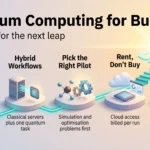
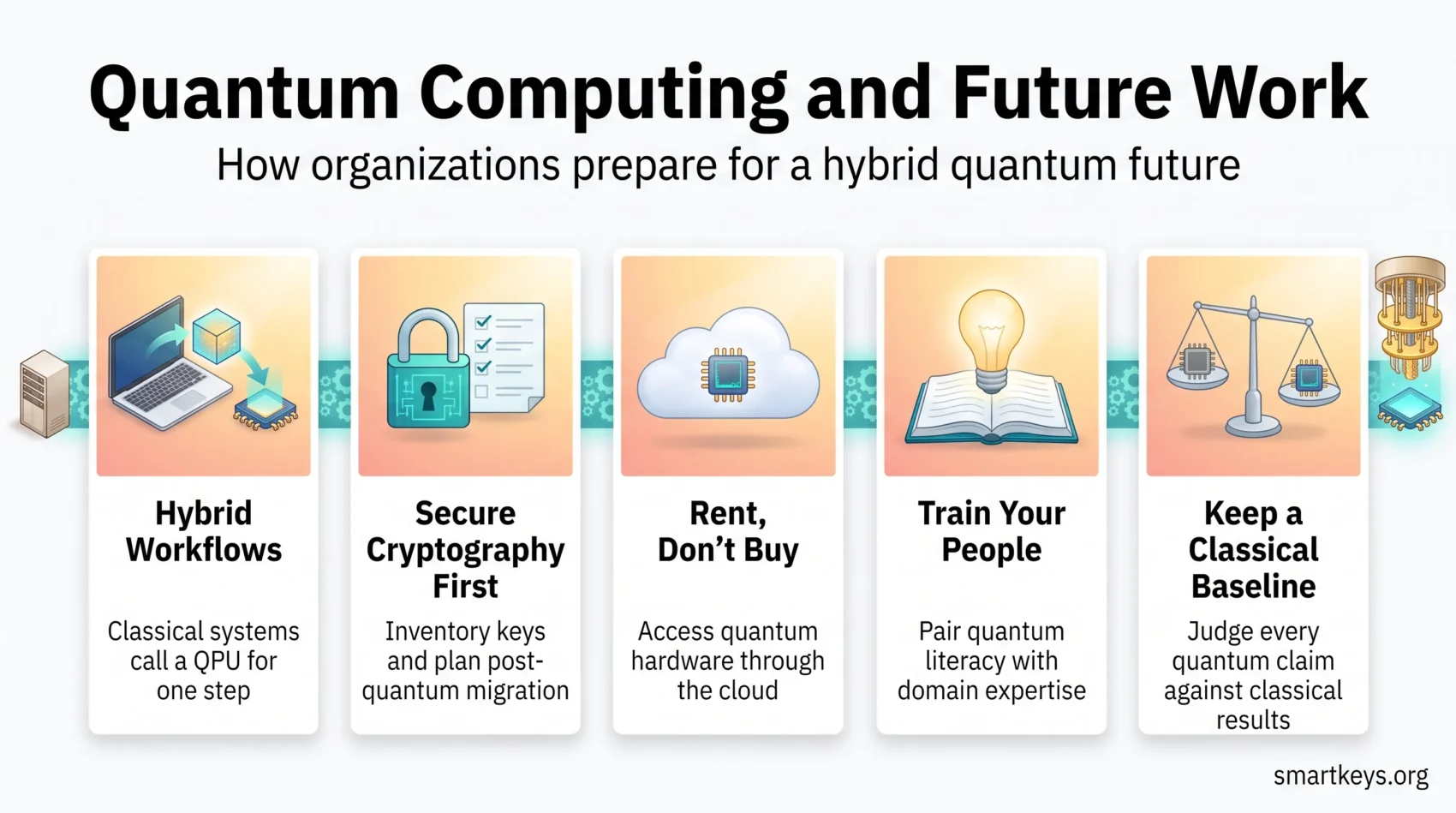
The realistic picture of quantum computing future work is hybrid. A classical system handles data preparation, coordination and post-processing. A quantum processing unit (QPU), the quantum equivalent of a CPU, is called only for the one step where it might help. Nobody’s job becomes “quantum” overnight. Instead, existing roles gain a quantum-adjacent edge. Think of a computational chemist who can express a problem for a QPU, or a security architect who can plan a cryptographic migration. Another example is a developer who can read a circuit written in Qiskit, IBM’s open-source quantum toolkit.
That is why the emerging skill set looks less exotic than expected. Domain expertise plus enough quantum literacy to tell a genuine opportunity from a vendor claim is worth more than a physics doctorate with no industry context. It mirrors what happened with AI and automation at work, where most people gained new tools rather than new job titles. Adjacent fields matter too: quantum networking and sensing may reach commercial use before general-purpose quantum computing does.
The Quantum Insider projects 250,000 new quantum sector jobs by 2030 and 840,000 by 2035. Projections of that kind deserve scepticism. Still, the direction matches every hiring signal in the field: demand is growing from a very small base, and the constraint is trained people rather than open budgets.
How Quantum Computing Will Transform Industries
Different sectors will feel this on completely different timelines. Two are waiting for hardware. One is not.
Biotech Revolution
Drug discovery stands to gain most from accurate molecular simulation, because a better model of how a candidate binds saves years of laboratory screening. Early work focuses on small molecules and specific reaction steps rather than whole pipelines, and progress here tracks error correction more closely than qubit counts.
Supply Chain Enhancements
Routing, scheduling and inventory allocation are classic optimisation problems. Quantum-inspired algorithms, classical software that borrows ideas from quantum methods, already run on ordinary hardware today. ExxonMobil and IBM, for example, have modelled maritime inventory routing for LNG shipping on quantum devices, a problem with more possible decision combinations than any computer can check. IBM describes that work as exploratory, aimed at the day the hardware scales.
Genuine quantum advantage in logistics remains unproven, so the sensible sequence is to fix the data layer first. Firms learned the same lesson with blockchain in logistics, where the technology outran the processes around it.
Cybersecurity Implications
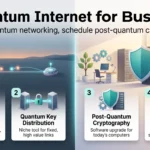
This is the one area with a deadline. RSA and elliptic-curve cryptography protect most web traffic, logins and digital signatures today. A large fault-tolerant quantum computer running Shor’s algorithm, a method for factoring huge numbers quickly, would break both. Attackers do not need to wait for that machine: they can harvest encrypted traffic now and decrypt it later.
The US standards body NIST has set the response timeline in its guidance IR 8547. Algorithms offering 112-bit security, the level of many RSA and elliptic-curve keys in use today, are to be deprecated by 2030 and disallowed after 2035. That makes post-quantum migration a current programme rather than a future one.
Practically, that means inventorying where cryptography lives, pressing vendors on their migration plans, and folding the work into existing cybersecurity priorities and any zero-trust programme already underway.

The Benefits of Quantum Over Classical Computing
Quantum computers are not faster at everything. They are differently capable at a few things, and knowing which is the difference between a useful pilot and an expensive one.
Speed and Efficiency in Data Processing
The theoretical advantages are specific. Shor’s algorithm factors large integers exponentially faster than the best known classical method. Grover’s algorithm speeds up unstructured search, such as finding one matching entry in an unsorted list, though only by a square-root factor. Quantum simulation reproduces quantum systems directly instead of approximating them. Outside cases like these, a quantum machine is simply a slower, colder, more expensive computer.
In October 2025 Google reported the first verifiable quantum advantage using its Willow chip and a “Quantum Echoes” algorithm. Unlike earlier claims, the result can be checked by other quantum hardware. It is a genuine scientific milestone, not a commercial application, and the distinction is worth holding on to.
Enhancing Decision-Making Capabilities
Where quantum methods eventually help decisions, they will do so by making previously intractable scenarios cheap enough to explore. That only pays off if the surrounding decision process can absorb the answer, which is why augmented analytics and a clear data governance strategy are better investments right now than quantum hardware access.

Quantum Computing Career Opportunities
Quantum roles are scarce, specialised and well paid. The Quantum Insider aggregated 2026 compensation data from Glassdoor, ZipRecruiter and LinkedIn. It puts most specialist engineering roles in the range of $130,000 to $220,000, with quantum algorithm and error-correction researchers reaching $250,000 and above. Those figures reflect scarcity as much as seniority.
The job titles are becoming more standardised. Quantum software engineers and algorithm developers write and optimise circuits. Quantum hardware engineers design and operate the processors and their cooling and control systems. Research scientists work on error correction and new algorithms. Around them sits a growing ring of hybrid roles, such as security architects who own post-quantum migration and domain scientists who translate business problems into quantum form.
Skills in Demand for Quantum Workforce
Employers consistently look for a combination rather than a single credential:
- Working knowledge of a quantum SDK (software development kit) such as Qiskit, Cirq or Q#
- Linear algebra and probability strong enough to reason about circuits
- Error correction and noise-aware programming, now the central engineering problem
- Deep expertise in a domain such as chemistry, finance, logistics or cryptography
- The judgement to say when a classical method is the better answer
The last point separates useful practitioners from expensive ones. Most quantum projects end with a classical solution, and the people who reach that conclusion quickly are the ones worth hiring.
Training and Upskilling the Workforce
You do not need a physics department to start. IBM Quantum, Microsoft Azure Quantum, AWS Braket and Google Quantum AI all publish free learning material and give access to simulators, with real hardware available at modest cost. Universities have expanded quantum master’s programmes considerably, and several national programmes now fund industry training directly.
For most organisations the efficient route is a small internal group with a cross-training strategy that pairs quantum literacy with existing domain depth, rather than a specialist hire with nothing to apply it to. The same logic applies to wider upskilling and reskilling plans: build on what people already know.
For individuals, a realistic start is one free course on a single SDK, followed by a small experiment on a problem from your own field. That combination shows employers both quantum literacy and the domain judgement they struggle to find.

Mainstream Adoption Timeline of Quantum Computing
The vaguer predictions have been replaced by dated engineering roadmaps, which makes them easier to hold vendors to.
IBM has published the most specific plan. Its Nighthawk processor, introduced in 2025, uses a 120-qubit square lattice. Kookaburra, planned for 2026, is meant to show the first module combining logical processing with quantum memory, and Cockatoo follows in 2027 as a further step toward modular, error-corrected systems. The target is Starling in 2029, a fault-tolerant machine designed to run 100 million gate operations across 200 logical qubits. Google, Quantinuum, IonQ and several neutral-atom start-ups publish comparable roadmaps on similar horizons.
McKinsey’s 2026 monitor sizes the quantum computing market at $43 billion to $71 billion by 2035, within a broader quantum technology market of $60 billion to $100 billion. Those are estimates a decade out and should be read as scenarios rather than forecasts.

The honest summary: expect narrow, domain-specific advantage in the second half of this decade, and broad enterprise relevance in the 2030s. Plan cryptography against the earlier date and applications against the later one.
Preparing Organizations for Quantum Computing
Preparation is cheaper and more mundane than most coverage implies. Three moves cover almost every organisation.
Start With Your Cryptography
Build an inventory of where cryptography is used: in products, in data transfers, in storage and across your suppliers. Then identify data whose confidentiality must survive past 2035, such as health records, contracts or intellectual property. That inventory is the prerequisite for any post-quantum migration, and it delivers value immediately by exposing certificate sprawl and unmanaged keys. Treat it as part of ongoing digital transformation work rather than a separate quantum project.
Access Hardware Through the Cloud
Almost no organisation should buy a quantum computer. Every major provider offers QPU access on demand, so experimentation costs engineering time rather than capital. That fits the same pattern as current cloud computing trends and the shift of specialised workloads toward distributed and edge processing: rent capability, keep expertise.
Collaborate With Quantum Experts
The field moves fast and vendor claims vary in quality. Working relationships with academic groups, national programmes or a specialist partner give you a way to sanity-check what you are told. Choose one candidate problem, define what success would look like against a classical baseline, and be prepared for the honest answer to be no.
Investment Trends in Quantum Computing
2025 was the year private capital committed. McKinsey’s Quantum Technology Monitor 2026 records $12.6 billion invested in quantum technology start-ups during 2025. That is 6.3 times the 2024 figure, with roughly 90 percent going to quantum computing companies.
The composition shifted as sharply as the total. Public sources accounted for about a third of investment in 2024 and just 3 percent in 2025, meaning private investors now carry the field. That is a vote of confidence and a source of fragility: private money can leave faster than government programmes can.
Government commitment has not disappeared. National quantum strategies across the United States, European Union, United Kingdom, China, Japan, India and Australia continue to fund research, infrastructure and training. Much of that spending now targets workforce development and the shift to quantum-safe encryption rather than hardware alone. Regional hubs are forming around that money as well. In Chicago, the state-backed Illinois Quantum and Microelectronics Park broke ground in 2025 with PsiQuantum as its anchor tenant, pairing hardware development with local training pipelines.

For a business leader, the useful reading of these numbers is not that quantum is imminent. It is that enough capital and enough dated commitments now exist that the milestones planned for 2029 to 2031 deserve to be in your planning assumptions.
Challenges Facing Quantum Computing Adoption
Three obstacles stand between current hardware and routine business use, and none of them is close to solved.
Hardware and Error Correction Limitations
Qubits decohere. Gates misfire. Error correction fixes this by spreading one logical qubit across many physical ones, historically at a punishing ratio. Surface codes, which arrange qubits in a grid of repeated error checks, made the approach practical but costly. Newer quantum low-density parity-check (qLDPC) codes cut that overhead sharply. IBM reports that its “gross” code protects 12 logical qubits with 288 physical qubits, a job that would need nearly 3,000 with the surface code. That efficiency is why IBM’s roadmap leans on them.
Progress is real but incremental, and every claimed milestone should be checked against the same question: how many logical qubits, at what error rate, running how deep a circuit?
The Need for New Programming Paradigms
Quantum programming is not a new syntax on familiar concepts. Superposition, entanglement and measurement break the intuitions that classical developers rely on, and debugging is constrained by the fact that measuring a system collapses it. Toolchains have improved substantially, but the learning curve remains steep and the pool of people who have climbed it is small.
Verifying the Advantage
The subtler problem is proof. Demonstrating that a quantum machine genuinely outperformed classical alternatives is hard, and several past claims were later matched by improved classical algorithms. Google’s 2025 verifiable-advantage result matters partly because it addresses that weakness. Any vendor claim without a credible classical baseline should be treated as marketing.
Conclusion
Quantum computing in 2026 is a serious engineering programme with dated milestones and, for now, no commercial advantage to show. Both halves of that sentence matter. Dismissing the field means missing a cryptographic transition with regulatory deadlines already in view; overinvesting means paying for capability that will not arrive on your timeline.
The proportionate response is small and specific. Inventory your cryptography and start the post-quantum migration, because that work is due regardless of when quantum hardware matures. Give a handful of people real access and real training, since the talent constraint is tighter than the capital one. Identify one or two problems in your business that genuinely fit a quantum profile, and keep a classical baseline against which to judge any claim.
Do that, and the technology arriving over the next decade becomes an opportunity rather than a scramble, much like every other shift that has quietly reshaped how technology changes daily work.
Found this useful?
Make SmartKeys a preferred source on Google, and our articles will surface more often in your Top Stories, AI Overviews, and AI Mode.
Add as Preferred Source