A freelance talent platform is an online marketplace where you post a job, review applicants and pay them through the site. It lets you hire a specialist for a few hours or a few months without adding anyone to your payroll.
That matters when the work is real but the headcount is not. You need a landing page rebuilt, a product video edited or a backlog of contracts reviewed, and you need it in weeks rather than the months a permanent hire takes.
The catch is that these sites are not interchangeable. Upwork, Fiverr, Contra, goLance, 99designs and the curated developer networks each charge differently, screen differently and let you talk to candidates under different rules. Pick the wrong one and you lose days to verification steps, auto-generated bids or a candidate pool that never had the skill you needed.
This guide sorts them by the job you are actually trying to do: what each model is good at, what it costs in 2026, and how to run a hire from brief to delivery.
Key Takeaways
- You can scale work quickly without a long recruiting cycle.
- Open marketplaces, curated networks and contest sites solve three different problems.
- Platform fees, messaging rules and verification steps all change your real cost.
- A short roster of trusted freelancers can replace an agency for recurring work.
- Time zone overlap and worker classification decide how smoothly a cross-border hire runs.
What You Will Get From This Buyer’s Guide
Use this as a working checklist rather than a ranking: the “best” platform depends entirely on how tightly you can define the job.
Who this guide is for
You are the audience if you buy work rather than sell it: a founder hiring a first contractor, an operations lead building a roster of specialists, or any team leaning on on-demand talent instead of permanent headcount.
How we judge a platform: quality, speed, flexibility and cost
We look at the parts of the process that cost you time: how long a post takes to go live, whether the proposals are tailored or automated, how much screening happens before candidates reach you, and what the bill looks like once fees are included.
Four practical checks before you commit to any site:
- Define first: write down the deliverable, the deadline and the ceiling on your budget before you open a single platform.
- Shortlist two sources, not five: posting the same job everywhere multiplies your screening load without improving the pool.
- Add a screening question: one specific question about your project filters out generic bids in seconds.
- Price the whole thing: platform fee, your own screening hours and likely revision rounds, not just the hourly rate.
Understanding the Types of Freelance Talent Platforms
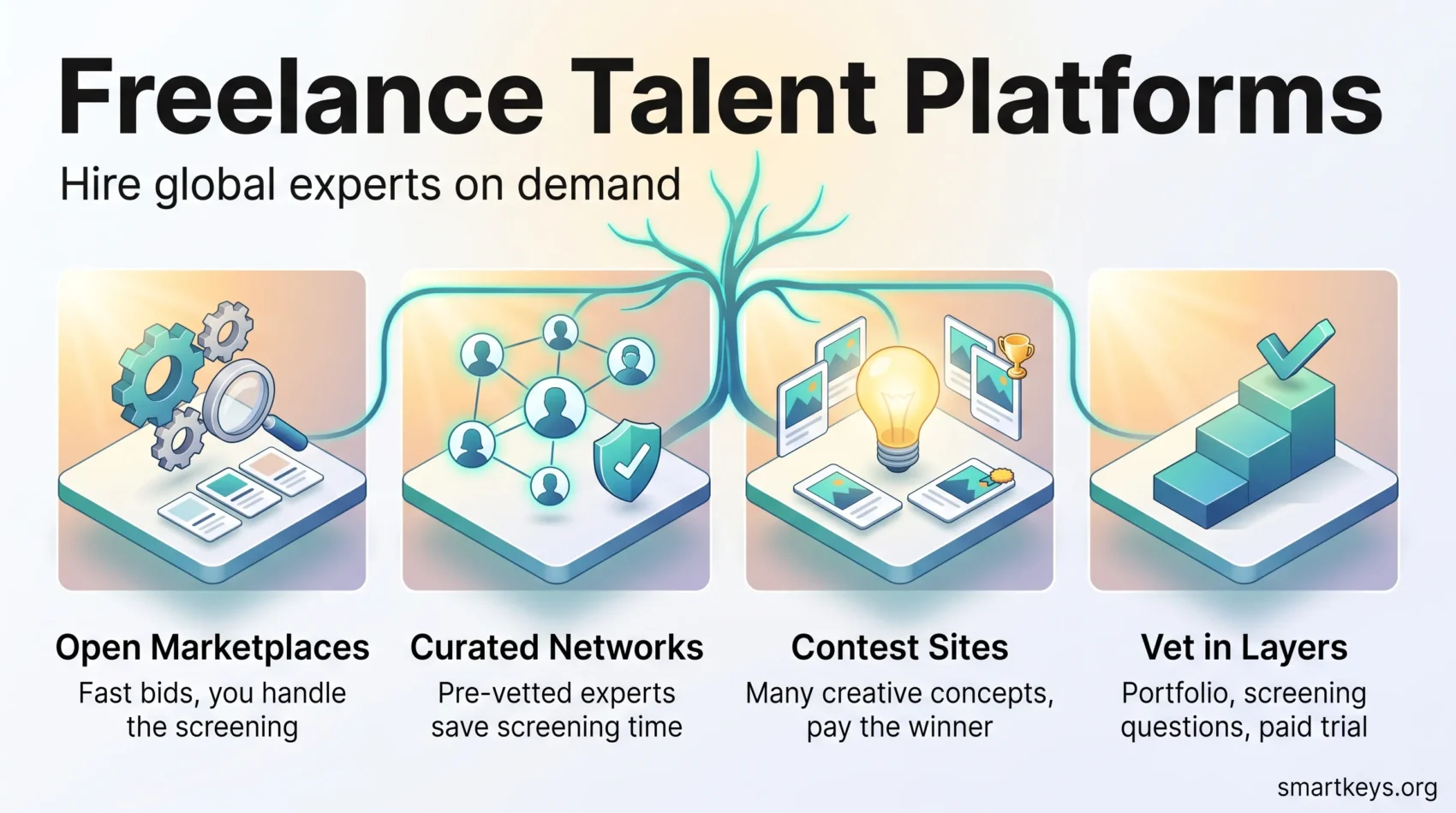
Not all hiring channels behave the same way. Some flood you with bids, some send a handful of pre-screened people, and some invite dozens of creative directions before you choose one. The three models below cover almost everything on the market.
Open marketplaces such as Upwork and Fiverr let you post a job and collect proposals fast. You control the screening, the interviews and the contract. This suits you when your team has the time to review candidates and the job description is clear enough to judge answers against. It is the model most closely associated with the on-demand hiring shift of the past decade.
Curated networks such as BairesDev, Arc, CloudDevs, X-Team, Aloa and Index.dev screen candidates before you see them and often supply a whole staffed team rather than one person. You pay more per hour and get back most of the screening time. These fit longer, structured projects that need continuity across several months.
Contest sites such as 99designs, Crowdspring, DesignCrowd and Atom (formerly Squadhelp) invite many designers to submit concepts against one brief, and you pay the winner. This is crowdsourcing applied to creative work: useful when you want breadth of ideas up front, poor value when you already know what you want built.
Three questions settle the choice quickly:
- Is this a one-off deliverable or ongoing work? One-off leans marketplace, ongoing leans curated.
- Can one freelancer finish the job, or does it need several skills coordinated?
- Do you want one solution or many options? Only the second case justifies a contest.
For the wider picture of where this market is heading, see our overview of the future of freelancing and the current freelancing trends worth planning around.
Freelance Talent Platforms: Your Shortlist at a Glance
A tight shortlist gets you from brief to hire faster than a broad search does. Match each option to the scope, timeline and amount of oversight you can realistically give.
Best for complex projects: Upwork
Upwork has the deepest search filters, screening questions and open communication with candidates. Use it when the job spans more than one skill and you want proposals that show someone actually read the brief.
Best for quick, defined tasks: Fiverr
Fiverr works when the deliverable is already specified: a logo cleanup, a short voiceover, a video trim. Turnaround is measured in hours or days. Messaging stays inside the platform, which is fine for work that needs no discovery.
Best for curated matches: Contra
Contra surfaces polished profiles with clear portfolios, which cuts your first screening pass. The candidate pool is smaller than Upwork’s, so it works better for design, marketing and content roles than for niche engineering.
Low-fee alternative: goLance
goLance positions itself as the low-fee alternative to Upwork and includes work diaries, time tracking and multi-currency payouts. It suits recurring hourly work where you want oversight without paying a large marketplace margin. Check its current fee terms directly before you budget, since these change.
How to Choose the Right Platform for Your Project
Before you post anything, settle three things: the scope, the deadline and how your team will actually work with this person day to day.
Time zone overlap and nearshore options
Overlap matters more than distance. A developer six time zones away can work fine on a well-specified backlog and badly on a project that needs daily decisions. If you expect frequent back-and-forth, prioritise candidates who share four or more working hours with your team, or adopt a deliberate follow-the-sun handoff so the gap becomes an advantage. Teams that hire across several countries usually end up formalising this, as our guide to managing cross-border remote teams covers in more detail.
Where overlap is impossible, lean harder on asynchronous working habits: written briefs, recorded walkthroughs and agreed response times.
Vetting, screening and speed to hire
Curated networks charge more because they absorb the screening. Marketplaces charge less because you do it. Decide which resource is scarcer right now, money or your own hours, and pick accordingly. Whichever you choose, structured questions and a scored work sample beat gut feel, even on a five-candidate shortlist.
Pricing models, fees and total cost
Compare hourly against fixed-price milestones, then add the platform’s cut on top. Hourly with time tracking suits work whose shape will change. Fixed-price with milestones suits a deliverable you can describe precisely.
On Upwork, clients on the free Basic plan pay a service fee of 3% to 5% on freelancer payments, plus a contract initiation fee; the Business Plus plan carries a higher 8% to 10% service fee but limits initiation fees to small fixed-price contracts. Freelancers separately pay 0% to 15% depending on the contract, and can subscribe to Freelancer Plus at $19.99 a month (source: Upwork).
On Fiverr, the price shown on a gig is not the price you pay. Fiverr adds a buyer service fee at checkout and applies an extra surcharge to very small orders, so compare final checkout totals rather than headline prices.
Curated networks quote you a blended hourly rate with the screening already priced in. That is usually the higher number and often the lower total cost once you count your own time.
Upwork: Deep Talent Pools and Strong Contract Tools
When a project needs several skills coordinated, Upwork is usually the fastest way to assemble them in one place.
When Upwork fits multi-discipline work
Use Upwork when the job spans research, design and development, or when you expect the scope to evolve. The platform grew out of the Elance and oDesk merger and relaunched under the Upwork name in 2015 with stronger search and matching tools.
It also suits long relationships rather than one-off transactions. Many clients keep the same contractor on a rolling contract for years, which is closer to a fractional hire than a gig.
Posting, screening questions and filters
You shorten the shortlist by writing a tight job post and adding two or three screening questions specific to your project. Filters let you narrow by skill, category, earnings history and client feedback before you read a single proposal.
When you evaluate, weight two things heavily: whether the proposal responds to your actual brief, and whether the work history shows the same kind of project rather than merely the same job title.
Payments, contracts and communication
Choose hourly contracts with time tracking when the work will evolve, or fixed-price milestones held in escrow when the deliverable is defined. Upwork allows open messaging, so you can move from chat to a live call during hiring without leaving the platform.
One caveat worth planning for: because anyone can bid, proposal volume can be high. Screening questions and a narrow job title are the cheapest filters you have.
Fiverr: Fast Execution for Clear Deliverables
When the brief is already settled, Fiverr often returns finished work in hours rather than weeks.
Where it fits: narrowly scoped design, audio and content tasks where speed matters more than strategy. Think logo refinements, simple video edits, audio cleanup or a short voiceover. The platform long ago outgrew its original five-dollar-gig format and now spans a wide price range.
Where it fits badly: anything needing discovery, stakeholder input or a shifting scope. Messaging stays inside the platform, leaving little room to explore a problem before you commit.
Using filters, reviews and portfolios to judge quality
Filter sellers by delivery time, price and review volume, then read the samples rather than the star rating. Forty detailed reviews in your exact category tell you more than 900 across unrelated work.
- Order one small paid test before a larger order to confirm style and turnaround.
- Send a precise brief with brand assets and reference examples to cut revision rounds.
- Compare gig tiers carefully: the difference is usually revision count and delivery speed, not quality.
- Confirm what file formats and usage rights you receive before you order.
Contra: Curated Profiles, Smaller Pool
Contra tends to surface polished profiles that cut down your first screening pass. Profiles usually include a real portfolio and a role-specific summary, so you spend more of your time validating fit and less filtering noise. That is a genuine saving on design, content and marketing roles.
The trade-off is reach. The pool is smaller than Upwork’s, so specialised technical roles can go unfilled. Treat Contra as one source in a shortlist rather than your only channel, and run the same portfolio check and paid test task you would run anywhere else.
Contest Platforms for Design and Naming
When you want many creative directions quickly, a contest gives you volume and variety that a single hire cannot.
How contests work: you post a brief and a prize, designers submit concepts, you give feedback across one or two rounds, then you award the prize to one winner and receive the rights to that work. 99designs covers logos, web design and packaging. Crowdspring pairs naming with brand marks. DesignCrowd handles business collateral such as cards and brochures. Atom, which rebranded from Squadhelp in April 2024, focuses on company naming and sells matching domains alongside contest results.
Prices are published and fixed. A 99designs logo contest runs from $249 for Bronze to $1,050 for Platinum, with higher tiers restricting entries to more experienced designers and adding a dedicated project manager (source: 99designs pricing page).
To get usable entries rather than filler:
- Write the brief around brand attributes, audience and hard constraints, not adjectives like “modern”.
- Give feedback in short, specific rounds; vague praise produces vague revisions.
- Check finalists across the formats you will actually use: favicon, signage, social avatar.
- Confirm originality and the rights transfer before you award, especially for a name you intend to trademark.
Tip: set the prize high enough to attract experienced designers, and consider hiring your winner directly for follow-on work so the brand stays consistent.
Alternatives to Toptal and Nearshore Options
If Toptal’s premium, heavily vetted model feels too slow or too expensive, a wide middle market sits between it and the open marketplaces.
Why look beyond Toptal: you may want more pricing flexibility, a faster match, or a partner whose working hours overlap yours for real-time collaboration.
Latin America for real-time collaboration
Nearshore teams overlap the North American workday, so feedback cycles shorten and meetings stop being a scheduling problem. CloudDevs, for example, matches pre-vetted Latin American developers within about 24 hours, quotes roughly $45 to $75 an hour, and offers a 7-day risk-free period with rolling weekly contracts and no minimum commitment (source: CloudDevs).
Rates vary widely by region and seniority across the global gig economy, so treat any quoted band as a starting point rather than a benchmark.
Which networks to consider
- BairesDev: staff augmentation and full engineering teams for longer engagements.
- CloudDevs: fast matches, published rate bands and short trials.
- Arc, Aloa and Index.dev: curated shortlists with their own screening layers and trial periods.
- X-Team: full-time remote developers on flexible contracts for teams that need to scale.
Compare them on three things: how deep the vetting goes, whether a real trial period exists, and how much working-hour overlap you get. Vetting claims are easy to make and hard to verify, so the trial is the more reliable signal.
Platforms to Approach With Caution
Some sites deliver good hires quickly. Others add steps that quietly cost you days. None of the platforms below is unusable, but each carries a friction you should price in before you post.
Guru: onboarding friction
Guru requires identity and payment verification before you can transact. Reasonable in principle, but it sits between you and your first hire. On a tight deadline, start verification well before you need the work, or use a platform you have already cleared.
Freelancer.com: bid noise and upsells
Freelancer.com generates a high volume of near-instant bids and pushes paid upgrades to promote your listing. The result is a crowded inbox in which considered proposals are hard to find. Replies that ignore your screening questions are the clearest thing to filter on.
PeoplePerHour and ServiceScape: approval and scope limits
PeoplePerHour reviews job postings before they go live, which can delay a listing at exactly the wrong moment. ServiceScape covers a narrower set of categories, mostly writing, editing and translation, so it simply will not reach some kinds of specialist.
- Build verification and approval time into any deadline you promise internally.
- Protect your time with a tight brief, one specific screening question and a small paid test.
Budgeting, Workflow and Quality Control
Clear budgeting and a repeatable workflow remove most of the risk from freelance hiring. Match the payment model to the scope: hourly when the work will evolve, fixed-price with milestones when the deliverable is defined. Escrow protects both sides on fixed-price work; time tracking does the same job on hourly contracts.
Budgets, milestones and payment methods
Tie milestones to something you can inspect, not to calendar dates. “First draft delivered and reviewed” holds up. “Week two” does not.
Keep invoicing and payment records in one place from the first hire, not the tenth; our FreshBooks review covers what a small-business invoicing tool needs to handle. Paying contractors in several countries adds currency and compliance questions a general accounting tool will not solve, which is where dedicated global payroll and contractor payment platforms earn their fee.
Classification: the risk most first-time hirers miss
A freelancer who works set hours, uses your equipment and takes day-to-day direction from your managers starts to look like an employee to a tax authority, whatever the contract says. The tests differ by country and several jurisdictions have tightened them, as our overview of gig economy regulation explains.
Practical protection: contract for outcomes rather than hours, let the freelancer control how and when the work gets done, and take local advice before a long engagement abroad. If a contractor is genuinely becoming part of the team, a contract-to-hire arrangement is the honest answer.
Vetting: portfolios, screening questions and paid trials
Run vetting in layers so each stage costs you less than the one after it. Read the portfolio first, ask two focused screening questions second, then pay for a short trial task before any large commitment.
A paid test tells you what a portfolio cannot: how someone handles feedback, whether they ask good questions, and whether they hit an agreed deadline. Structured skills testing does the same job at larger volumes, which is the case our Workello review examines. Keep a simple record of skills, rates and availability so your second hire is faster than your first.
Workflow: tracking, handoffs and quality checks
Choose one place where work is tracked and one place where files live, then hold to it. Platforms such as goLance include work diaries and reporting; your own project tool plus a shared drive does the same job.
Write a short acceptance checklist for every handoff covering file formats, performance expectations and brand rules, so “done” means the same thing to both sides. Turning that checklist into a reusable standard operating procedure makes the fifth hire cheaper than the first, and a short remote onboarding routine stops every new freelancer asking the same five questions.
Finally, be deliberate about which work leaves the building at all. Outsourcing low-value tasks frees your team for work only they can do; outsourcing your core judgment rarely ends well. Protecting time for deep, creative work is usually the point of hiring help in the first place.
Conclusion
Choose the hiring route that matches your deadline, your budget and how precisely you can describe the work.
Be pragmatic. Scope the job tightly, write a clear brief, run one small paid test and tie payments to milestones you can inspect. Use contest sites for a burst of creative options, curated networks for complex builds that need continuity, and open marketplaces when speed matters more than hand-holding.
Then keep the roster. The real return on this process is not the first hire; it is the fourth, when you already know who to call and what good looks like.
Found this useful?
Make SmartKeys a preferred source on Google, and our articles will surface more often in your Top Stories, AI Overviews, and AI Mode.
Add as Preferred Source