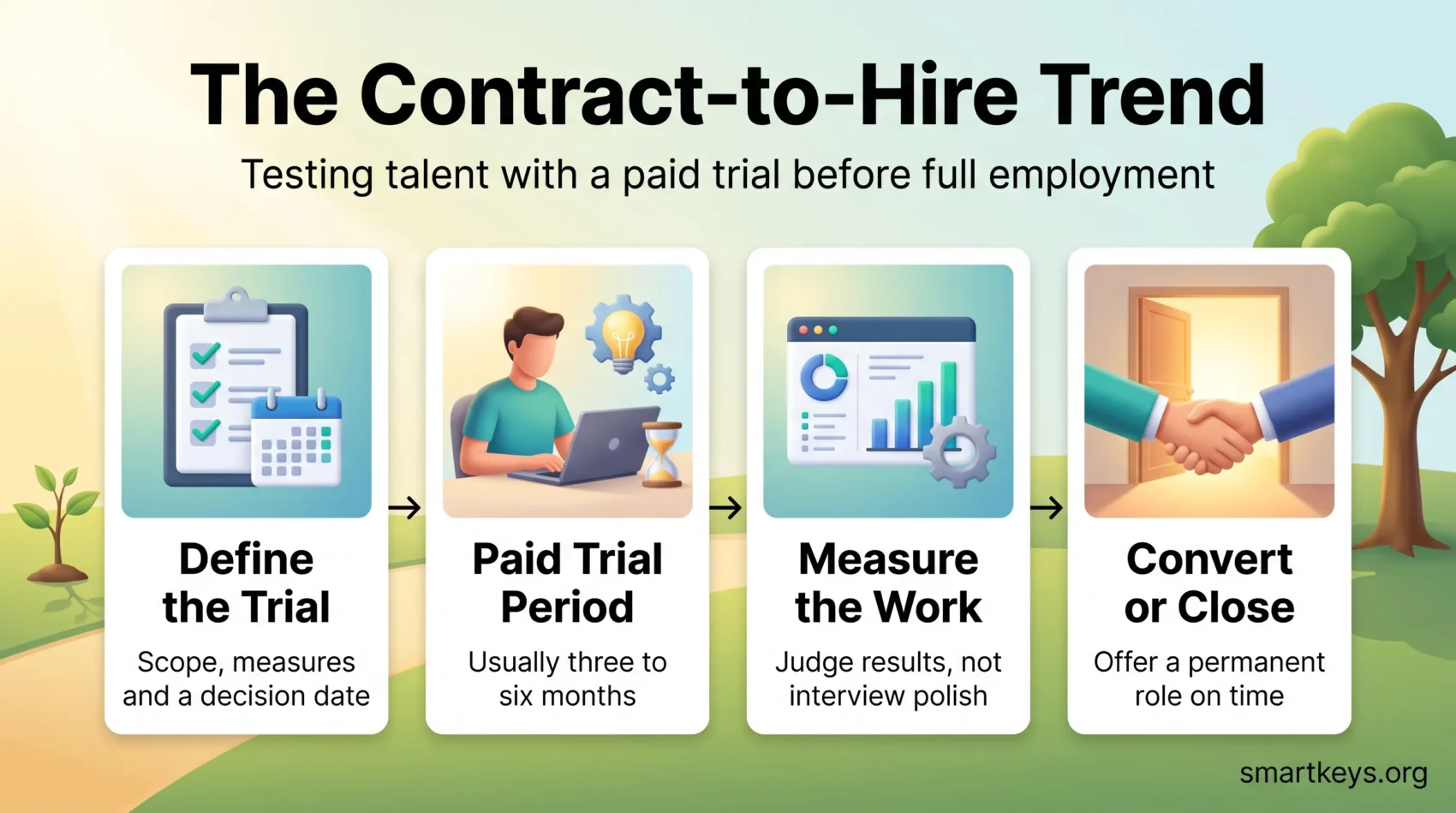
Contract-to-hire means you hire someone for a paid, fixed-term trial and decide afterwards whether to make the job permanent. It is often shortened to C2H, and it has become a standard option in US hiring rather than a niche one.
The idea is simple. Instead of judging a candidate on interviews alone, you bring them in on a contract, give them real work, and use the results to decide. Both sides end up with evidence instead of impressions.
This guide covers how the model works in practice, what the current data shows, what it really costs, and which rules apply in 2026. It is written for hiring managers, small business owners and candidates weighing an offer.
Key Takeaways
- Contract-to-hire is a paid, fixed-term trial with a written path to a permanent job.
- Trials usually run three to six months and are judged on criteria agreed in advance.
- A staffing agency often acts as the legal employer during the trial, then you take the person onto your own payroll.
- The model suits specialist and fast-changing roles better than roles needing long institutional knowledge.
- Worker classification, records, and any AI used in screening are the compliance points to get right.
What Contract-to-Hire Actually Means
Picture a data engineer joining your team on a five-month contract to build one reporting pipeline. The work is real, the pay is real, and at the end you either offer a permanent role or the contract ends. Nothing about the job is a simulation.
How it differs from temp work and direct hire
Direct hire commits you on day one. You extend an offer, add the person to payroll, and find out how they actually work afterwards.
Temporary staffing is the opposite. It fills a gap for a set period, with no expectation of a permanent role at the end.
Contract-to-hire sits between the two. A conversion path is written into the agreement from the start. That one difference changes behaviour: candidates treat the assignment as an extended interview rather than a stopgap.
The trial period and what gets measured
Most trials run three to six months. Some technical engagements stretch to a year when the project cycle demands it.
Define the measures before day one, and make them concrete: features shipped, tickets resolved inside a target time, a migration completed without unplanned downtime, a report the finance team accepts without rework. Vague measures such as “cultural fit” invite arguments later.
Write down who decides, on what date, and what happens if the decision slips. A trial with no decision date quietly turns into cheap long-term contracting, which is exactly the arrangement regulators examine most closely.
Pay, benefits and the employer of record
During the trial a staffing agency often acts as the employer of record, meaning it is the legal employer: it runs payroll, withholds taxes, and provides whatever limited benefits the contract specifies. You direct the work; the agency carries the employment paperwork.
Pay is usually hourly. Full benefits normally begin at conversion, when the person moves onto your payroll and the agency arrangement ends. Put this in writing. Benefit timing is the most common source of bad feeling in these arrangements.
For the wider shift behind the model, see our guides to the future of contract work and to project-based work.
Why the Contract-to-Hire Trend Keeps Growing
The market picture in numbers
Flexible staffing is not a fringe part of the US labor market. America’s staffing companies hired 12.7 million temporary and contract employees over the course of 2023, and nearly 2.2 million were working in an average week during 2024, according to the American Staffing Association.
Federal data points the same way. In its July 2023 survey of contingent and alternative employment arrangements, the Bureau of Labor Statistics counted 6.9 million contingent workers (4.3% of employment), plus 11.9 million independent contractors, 945,000 temporary help agency workers and 862,000 workers supplied by contract firms. Contingent here simply means work that is not expected to last.
The hiring market itself is steady rather than frantic. US unemployment was 4.1% in August 2026 and nonfarm payrolls rose by 162,000 that month, according to the BLS employment situation release. In a market like that, employers hesitate over permanent headcount but still need the work done. A paid trial resolves that tension.
Speed and lower risk
Two forces drive adoption. First, skills change faster than job descriptions. A role written for a cloud team two years ago may need a different toolset now, and a trial lets you sharpen the scope while the work is under way.
Second, a mis-hire is expensive. You pay salary, onboarding time and manager attention, then start the search again. A trial caps that exposure at a defined number of weeks. Our overviews of which skills are most in demand and of upskilling and reskilling explain how quickly the requirements move.
Where the Model Is Used Most
IT, healthcare and engineering lead. All three combine specialist skills, project cycles and strict compliance, so watching someone work before committing is worth a great deal.
Inside IT the pattern is sharper still. Cloud migration, DevOps, data engineering, security and machine learning roles are hard to judge from a resume. A candidate can describe a Kubernetes rollout convincingly and still struggle to run one.
Outside those sectors the model appears wherever a project has a clear end and an unclear staffing need afterwards: a marketing team hiring for a rebrand, a finance team preparing a system migration, an operations team piloting automation. Related reading: on-demand workforce strategy.
Remote, Global and Nearshore Trials
Opening a trial to remote candidates widens the pool immediately. It also creates problems you have to solve on purpose.
Set the overlap first. Agree the hours when everyone is online and put them in the calendar rather than in a hopeful sentence in the contract. Two to four overlapping hours a day is usually enough, because most of the work is asynchronous.
Write the norms down: how decisions are recorded, where questions go, what a handoff must contain. Someone three weeks into a contract cannot absorb unwritten rules the way a permanent employee does over a year.
Nearshore hiring, meaning nearby countries in similar time zones, gives you most of the reach with less of the friction. Our guides to managing cross-border remote teams, follow-the-sun scheduling and global payroll cover the mechanics.
The Employer View: Benefits, Risks and Best Fit
What you gain
Proof instead of promises. Hiring decisions rest on delivered output, not interview polish.
Budget flexibility. A trial is a variable cost that ends on a known date, which protects permanent headcount when demand is uncertain.
Conversions that stick. People who convert have already tested the role, the manager and the way the team works, so the usual first-year surprises are behind them.
What can go wrong
Treating trial staff as outsiders. Leave them out of planning and team channels and you learn how someone performs while excluded, which is not the information you wanted.
Security and continuity. Limit sensitive access sensibly, and never let an unconverted contributor become the only person who understands a critical system.
Candidate perception. Vague timelines read as a way to avoid committing. Written criteria read as fairness.
When it fits, and when it does not
Good fits: pilot projects with an evolving scope, short demand spikes, and specialist work you want to see proven.
Poor fits: roles that depend on long institutional memory, positions needing security clearance from day one, and any role where a break in continuity would hurt customers.
See also our guides to supervising contractors well and remote onboarding.
The Candidate View
If you are the one taking the contract, treat it as a paid audition with a scoreboard you help design.
Ask three questions before signing. What does success look like at the end? Who makes the conversion decision? On what date? If nobody can answer, the conversion path may not really exist.
During the assignment, keep your own record of what you delivered. Numbers help: response times cut, a backlog cleared, a release shipped on schedule. That record is what you negotiate with later.
Weigh the trade-off honestly. You gain an entry point, useful experience and a real look at the culture. You also accept hourly pay and thinner benefits for several months. If you value variety over conversion, straight contract work may suit you better. Our guide to freelancing trends compares the two paths.
What It Actually Costs
The headline saving is deferral. You postpone salary, benefits and severance exposure until you are confident.
The costs that catch people out sit outside the hourly rate:
- Agency markup. The bill rate includes the agency’s margin on top of the worker’s pay.
- Conversion fee. Many agreements charge a fee when you move the person to your payroll, often reduced the longer the trial ran.
- Overlap. Handovers can mean paying two people for the same work for a few weeks.
- Ramp-up. If a role needs three months of context before anyone is productive, a four-month trial tells you very little.
Model those four items before comparing a trial against a direct hire. For roles with a long ramp, direct hiring is usually cheaper. Our piece on weighing workforce costs against productivity shows the arithmetic style.
Legal and Compliance Essentials in 2026
Classification and records
Get worker classification right, meaning the legal question of who counts as an employee and of whom. Confirm in writing who the employer of record is during the trial and which obligations sit with them.
Keep the signed agreement, the job description, hour and wage records, tax forms and the conversion criteria. If a classification question comes up later, those documents are your answer.
Assign intellectual property and confidentiality on day one, not at conversion. Work produced during a trial belongs to somebody, and silence is not a plan.
AI in the hiring process
If you screen candidates with automated tools, three US rules matter now.
Illinois HB 3773 took effect on 1 January 2026. Employers must notify workers when AI is used in employment decisions, covering recruitment, hiring, promotion, selection for training, discipline and discharge.
California’s fair employment regulations on automated decision systems took effect on 1 October 2025. Evidence of anti-bias testing, or the lack of it, is relevant to a discrimination claim, and automated-decision-system data has to be kept for four years rather than two.
The Colorado AI Act was postponed and now takes effect on 30 June 2026, so companies with Colorado staff have a fixed date to prepare for.
Deeper coverage sits in our guides to AI hiring tools and the law, AI hiring bias and future of work legislation.
Cross-border trials
If the person works from another country, local employment law applies to them, not yours. Check working-time rules, notice periods, social contributions and how a conversion is handled locally. Use a partner who already operates there. See our guides to work-from-anywhere policy and on-demand hiring.
Working With Staffing Agencies
A good agency compresses weeks of sourcing into days. It screens candidates, runs background checks, schedules interviews, handles payroll during the trial and manages the conversion paperwork at the end.
Judge partners on four things: how fast they deliver a shortlist, how well that shortlist matches the brief, how clearly they state fees and conversion terms, and whether their references include conversions that actually happened.
Share your success criteria at the start. A recruiter who knows what the trial is measuring sends better candidates than one working from a job title alone. Freelance talent platforms are the self-service alternative when you can screen candidates yourself.
How AI Changes the Pipeline
AI mostly speeds up the front of the process. It drafts and posts the role, ranks applications, schedules interviews, and pulls signals from public code repositories and portfolios. That shortens the gap between an approved role and a candidate starting.
What it does not do is decide. Ranked shortlists still need a person reading them, and the state rules above assume a human is accountable for the outcome. Document which tools you use, on what data, and who reviews the result.
Used well the combination works: AI narrows the field quickly, and the paid trial supplies the evidence no model can give you. See our guide to job descriptions in the AI era.
A Short Checklist Before You Start
- Write the scope, the success measures and the decision date into the agreement.
- Name who decides on conversion and who signs off an extension.
- Confirm the employer of record and which benefits apply during the trial.
- Model agency markup, conversion fee, overlap and ramp-up time.
- Onboard the person like a permanent hire, minus the sensitive access.
- Give feedback at least monthly so the final decision is never a surprise.
- Record any automated screening you used and who reviewed it.
Conclusion
Contract-to-hire works when both sides know what is being tested and when the answer is due. It gives you evidence instead of assumptions, and it gives the candidate a real route into a permanent role.
It is not a substitute for hiring properly. The trial only tells you something useful if the scope is clear, the measures are written down, and the person is treated as part of the team while it runs.
Use it where the work is well defined and the skills are hard to verify on paper. Use direct hiring where continuity matters most. For the wider context, see our overview of HR trends in 2026.
Found this useful?
Make SmartKeys a preferred source on Google, and our articles will surface more often in your Top Stories, AI Overviews, and AI Mode.
Add as Preferred Source