Contract work means being hired for a defined piece of work instead of a permanent job. You might be called a freelancer, an independent contractor, a consultant or a gig worker. The label changes, the arrangement does not: you invoice, you carry your own benefits, and the relationship ends when the project does.
That arrangement is no longer a fallback. MBO Partners counted more than 72 million Americans working independently in its 2025 State of Independence study. Upwork’s Future Workforce Index put 28% of US knowledge workers in independent work, earning a combined $1.5 trillion in 2024.
Automation runs through the same story. AI is absorbing some tasks, creating demand for others, and changing which skills clients will pay a contractor for. This guide covers what the evidence shows, what changed in the rules during 2026, and what that means if you work on contract or hire people who do.
Key Takeaways
- More than 72 million Americans worked independently in 2025, and a record 5.6 million independent professionals earned over $100,000 (MBO Partners).
- The World Economic Forum expects 170 million new roles and 92 million displaced roles by 2030, a net gain of 78 million.
- Stanford’s payroll analysis found no economy-wide displacement, but a widening gap for young workers in the most AI-exposed jobs.
- EU member states must put the Platform Work Directive into national law by 2 December 2026.
- The US Department of Labor proposed a new independent contractor test on 27 February 2026.
What “Contract Work” Actually Means
The words in this field overlap, which makes the topic harder than it needs to be. Four terms cover most of it.
An independent contractor is a legal and tax classification: you are in business for yourself, so the client does not withhold tax or provide benefits. A freelancer is the same thing described by how the work feels, usually several clients at once and project-based. A gig worker normally means someone finding short tasks through an app, from delivery driving to skilled work booked on a talent platform. Contract-to-hire is a fixed-term role, often three to twelve months, that can convert into a permanent job; the contract-to-hire model lets both sides test the fit first.
What Automation Is Really Doing to Jobs
Predictions about automation and employment have a poor record, so it pays to separate what people expect from what has been measured.
The Displacement Numbers, in Context
The most cited forecast is the World Economic Forum’s Future of Jobs Report 2025. Employers expect 170 million new roles and 92 million displaced roles by 2030, a net gain of 78 million. The same report puts 39% of core skills on course to change. Treat those figures as expectations, not measurements: they come from a survey of hiring plans.
The measured picture is narrower. In August 2026 the Stanford Digital Economy Lab published an updated analysis of ADP payroll records covering November 2022 to June 2026. It found no widespread displacement linked to AI, with one sharp exception. Employment among workers aged 22 to 25 in the most AI-exposed occupations sat about 19% below where it would have been had it tracked less-exposed peers. That gap was 15% in July 2025. The adjustment came through slower hiring, not layoffs. It concentrated in work built on codified knowledge, meaning tasks that follow documented rules. Roles leaning on tacit knowledge, the judgement you only pick up by doing the job, held up better.
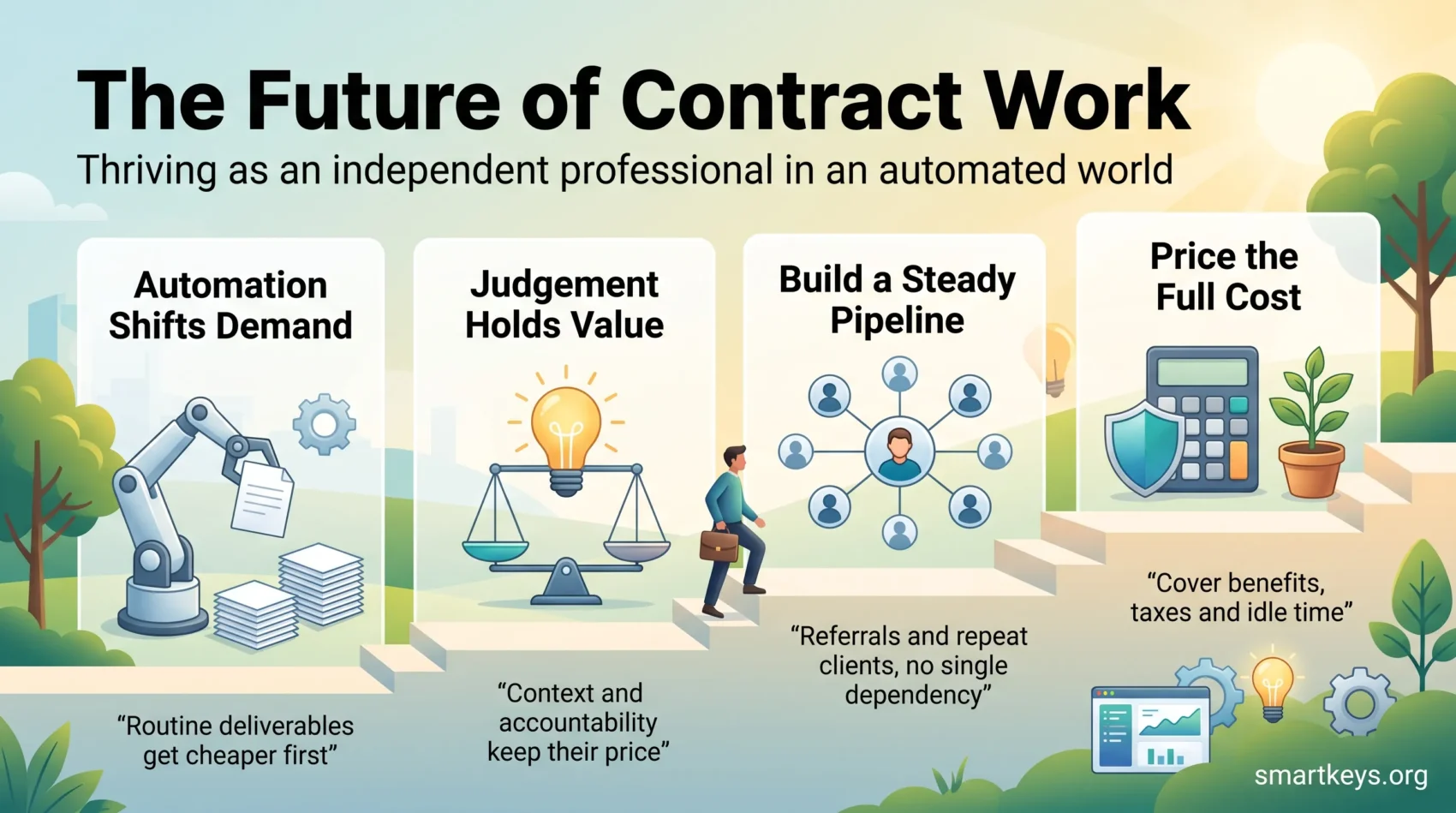
For contract workers, that pattern is the useful part. Routine, well-documented deliverables get cheaper first, while work requiring context, accountability and judgement holds its price. Our guide to how workers are adapting to job automation goes deeper on the same evidence.
Where Automation Creates Contract Demand
Automation does not only remove work. It also creates projects companies cannot staff internally, because the skills are new and the need is temporary.
Upwork reported that gross services volume for AI-related work on its platform grew 60% year over year in 2024. Contractors also tend to be ahead of employees on these tools. In Upwork’s study, 54% of freelancers reported advanced AI proficiency against 38% of full-time employees. MBO Partners found 74% of independents using generative AI.
An example helps. An insurer automating claims triage needs three people: a data engineer to clean the claims history, a specialist to test the model on real cases, and a compliance reviewer to document decisions. All three jobs end once the system runs.
How Many People Actually Work on Contract
You will see wildly different numbers quoted for the size of the independent workforce. They are not contradictory; they count different things.
The US Bureau of Labor Statistics measured the narrow version. In its July 2023 Contingent Worker Supplement, 11.9 million people (7.4% of employment) were independent contractors in their main job. Another 6.9 million held contingent jobs they expected to be temporary.
MBO Partners counts the broad version: 72 million people who did any independent work in 2025, including occasional side work alongside a salaried job. Upwork sits in between: 28% of skilled knowledge workers, more than 20 million people, now work independently.
The practical reading: contracting as a primary livelihood covers roughly 7% of the US workforce. Doing some paid work outside an employer is far more common. If you are planning a career move, the first number matters more than the headline one.
Which Contract Roles Are in Demand
Demand concentrates where a skill is scarce, the need is temporary, or the work is project-shaped:
- Technology: software development, data engineering, cloud and security work, plus AI implementation and evaluation.
- Healthcare: specialist clinical cover and telehealth, where staffing gaps are chronic.
- Creative services: design, video and editorial work, increasingly focused on direction and quality control rather than volume production.
- Consulting and finance: interim leadership, systems migrations and audits bought by the project.
Companies use contractors for a reason that has little to do with cost per hour: they can add a capability in weeks and release it when the project ends. That is why workforce contingency planning and on-demand workforce strategy are now standing items for operations teams.
The Rules Changed in 2026
Classification law decides who counts as an employee. Two large changes landed in 2026, and both are worth understanding before you sign anything.
United States: a New Classification Test Proposed
On 27 February 2026 the Department of Labor proposed replacing the 2024 independent contractor rule with the framework used in 2021. The 2024 rule weighed six factors equally under a totality-of-the-circumstances test, which the department criticised as unworkably vague. The proposal instead gives primary weight to two: the nature and degree of control over the work, and the individual’s opportunity for profit or loss.
The transition is messy in a way that matters. The 2024 rule still applies in private lawsuits under the Fair Labor Standards Act, even though the department stopped enforcing it and directed field staff to an older 2008 framework. The comment period ran to 28 April 2026. Until the rulemaking concludes, classification can be judged by different standards depending on who is asking.
Europe: the Platform Work Directive
EU member states must transpose the Platform Work Directive into national law by 2 December 2026. It introduces a rebuttable presumption of employment: where the facts point to direction and control, the worker is presumed to be an employee and the platform has to prove otherwise.
The directive also sets rules on algorithmic management, meaning the software that assigns work, scores performance and closes accounts. Platforms may not process certain personal data, including emotional states and data gathered outside working time. An automated system alone cannot suspend or terminate an account. A human has to make that call, and workers are entitled to an explanation. Our overview of algorithmic management covers how these systems work day to day, and gig economy regulation tracks the wider legal picture.
Portable Benefits Start to Appear
The oldest complaint about contract work is that benefits are tied to employment. A few US states have begun testing an answer. Alabama’s Senate Bill 86, effective 31 December 2025, lets companies contribute voluntarily to a contractor’s portable benefits account for health cover, retirement or life insurance. The contribution is tax-deductible for the business and excluded from the contractor’s gross income, and it does not turn the contractor into an employee. Utah and Tennessee have their own portable benefits laws. These programmes are new and voluntary, so treat them as a signal of direction rather than a safety net.
What Contract Work Actually Costs
The flexibility is real. So is the bill, and it is easy to underestimate when you compare an hourly rate to a salary.
A contractor covers their own health insurance and retirement saving, pays self-employment tax on top of income tax, absorbs unpaid gaps between projects, and usually cannot claim unemployment insurance. Paid holiday and sick leave do not exist unless you price them in. Add the unbilled hours spent selling, invoicing and chasing payment, and a working year holds far fewer billable days than a salaried one.
None of that argues against contracting. It argues for pricing that reflects the full cost, and for a cash buffer sized to your longest realistic gap between contracts. Comparing your rate against published pay ranges and against what a benefits package is worth is more honest than comparing it to a salary alone.

Platforms and On-Demand Work
Platforms are now the main front door to contract work. MBO Partners found that 42% of independents rely on online platforms as their primary way of finding work. Marketplaces such as Upwork, Fiverr and Toptal compress the time from need to signed contract to days.
The trade-offs are worth naming. Platforms take a commission, concentrate competition on price, and tie your access to clients to a rating and an account you do not own. That last point is what the EU’s algorithmic management rules address. Contractors who do best treat platforms as one channel among several, alongside direct referrals. On the buying side the logic reverses: managing freelancers well turns a marketplace hire into a repeat relationship, and global payroll and contractor payment tools handle the cross-border admin.
How to Build a Contract Career That Lasts
Three habits separate contractors who compound from those who restart every year.
Keep Your Skills Ahead of the Automation Line
The Stanford findings point in a clear direction: the more standardised your deliverable, the more exposed it is. Move deliberately towards work that requires judgement, client context or accountability for an outcome.
That means practical learning rather than collecting courses. Get fluent with the AI tools in your field, so you can deliver faster than a client could in-house. Learn enough about the systems around your work, from data to compliance, to be trusted with the whole problem. Then make it visible: a portfolio does the job a title does for an employee. Our guides to the skills employers are paying for and to upskilling and reskilling cover where demand is heading.
Build the Pipeline Before You Need It
Referrals and repeat clients are the difference between a steady year and a scramble. Keep in touch with former colleagues and clients when you need nothing from them. Publish something useful at a pace you can sustain. Answer questions where your clients already are.
Aim for a rough balance: no single client should account for so much of your income that losing them ends your year. If one does, start selling now rather than when the contract ends.
Price for the Whole Job
Quote for the outcome and the risk you carry, not only for hours at a desk. Write payment terms, scope and revision limits into the contract before work starts, and invoice on a schedule rather than at the end. Since your leverage sits in results rather than time on the clock, it helps to understand how performance-based pay is structured. The soft skills that hold their value, clear writing, negotiation and expectation-setting, are what let you charge properly for the technical part.
Conclusion
Contract work is not being wiped out by automation, and it is not being handed an easy win either. The measured evidence shows AI reshaping which tasks are worth paying for rather than eliminating work wholesale, with the pressure falling hardest on standardised, entry-level output. Meanwhile the independent workforce keeps growing, and 2026 brought the first serious attempt in years to settle who counts as an employee.
If you contract, the practical response is unglamorous. Move up the judgement curve. Keep a pipeline you did not build in a panic. Price for the full cost of being your own employer, and read your classification terms with the 2026 rules in mind. If you hire contractors, the same shifts decide whether good people take your next project. For wider context, see our overview of future work trends, of where the gig economy is heading, and of how remote work productivity shapes the way distributed contract teams deliver.
Found this useful?
Make SmartKeys a preferred source on Google, and our articles will surface more often in your Top Stories, AI Overviews, and AI Mode.
Add as Preferred Source