Last updated: 21 September 2026. Adds practical guidance for businesses that hire gig workers. The status of the US contractor rule was last checked in late August 2026.
The gig economy is the part of the labour market where people are paid per job, project or shift instead of drawing a salary. It covers a delivery rider, a contract software developer and a part-time finance director serving four companies at once. It is no longer a forecast but a permanent part of how work gets done. So the question for 2030 is not whether independent work keeps growing, but who captures the value it creates.
Roughly 72.9 million Americans now work independently in some form, about 36% of the US workforce depending on how you count. Globally, the World Bank estimates that online gig work alone involves between 154 million and 435 million people, or 4.4% to 12.5% of the global labour force.
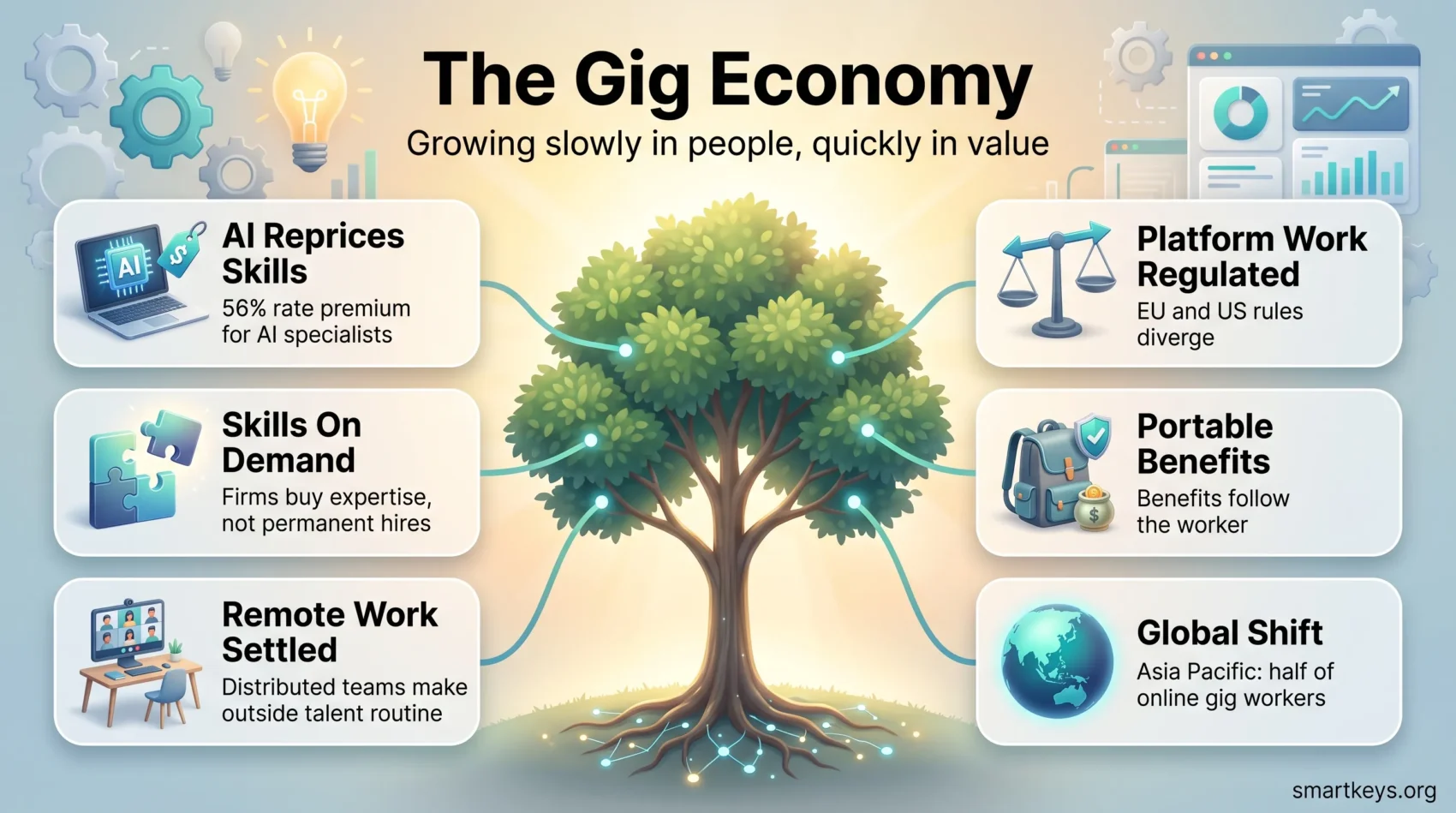
The biggest change of the past two years is not the headcount but the price of the work. Skilled freelance earnings now sit at roughly $1.5 trillion a year, and demand for AI-related freelance skills more than doubled in twelve months. The gig economy is growing slowly in people and quickly in value.
Key Takeaways
- About 72.9 million people in the US work independently, roughly 36% of the workforce. Estimates range from 70 to 76 million.
- Skilled freelancers earn around $1.5 trillion annually, and six-figure freelancers have grown from roughly 3 million to 5.6 million in five years.
- Demand for AI-tagged freelance skills grew 109% year over year, with AI video work up 329%.
- The EU Platform Work Directive must be written into national law by 2 December 2026. It assumes platform workers are employees unless the platform proves otherwise.
- In the US, the Department of Labor proposed a new contractor test in February 2026, moving the opposite way. As of late August 2026 it is still only a proposal.
- Remote work has settled at roughly 27% of paid US workdays, neither collapsing nor exploding.
The Gig Economy in 2026: Where Things Actually Stand
Before looking at 2030, be honest about the present. Much gig economy commentary still recycles projections written in 2018 that were never accurate. Here is what holds up.
How Many People Really Work Independently
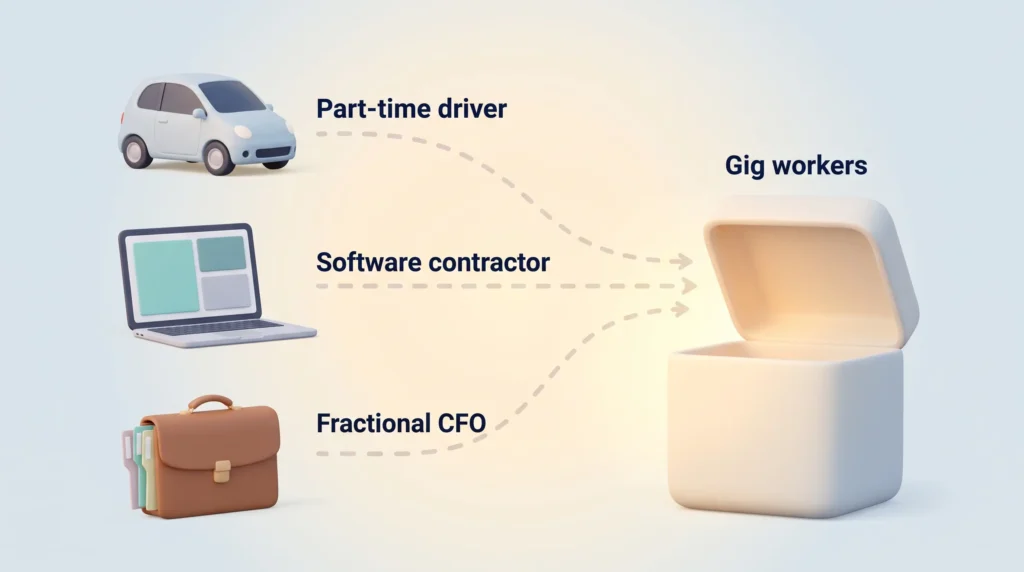
There is no single number, because there is no single definition. Someone driving twelve hours a week, a full-time software contractor and a fractional CFO all count as “gig workers” in different datasets. Fractional here means a senior specialist who sells a slice of their week to several companies rather than joining one; see our guide to fractional executives.
The most defensible figures for 2026:
- United States: roughly 72.9 million independent workers, about 36% of the workforce, per MBO Partners. Estimates range from 70 to 76.4 million.
- Global online platform work: 154 to 435 million people, per the World Bank, equal to 4.4% to 12.5% of the global labour force.
- Platform landscape: around 545 online gig platforms serving 186 countries, roughly three quarters of them regional rather than global.
You will still see the claim that 50% or even 80% of workers will freelance by 2030. Treat it with caution. Upwork projects that 50.9% of the US workforce will do some freelance work by 2027, but “some freelance work” includes a single paid side project a year. That is very different from half the country leaving traditional employment.
How Big the Market Is, and Why Estimates Disagree
Market sizing here is messy, because analysts count different things: every ride-hailing booking, only freelance marketplace volume, all spending on temporary labour, or only platform transactions.
The figures most commonly cited in 2026:
- $674 billion global gig economy market value in 2026, growing at roughly 15.8% a year.
- $1.5 trillion in annual earnings by skilled US freelancers.
- Longer-range forecasts of $1.85 trillion by 2030, which assume both broader definitions and continued platform expansion.
The takeaway is the direction and the mix, not the exact number: fewer low-margin micro-tasks, more high-value specialist engagements.
Six Forces Shaping the Gig Economy by 2030
1. AI Is Repricing Freelance Skills
This is the biggest shift of the past two years. According to Upwork’s In-Demand Skills report published in February 2026, earnings from AI-tagged freelance skills grew 109% year over year. Within that, AI video generation and editing grew 329%.
Freelancers specialising in AI work, including prompt engineering (writing the instructions that get useful output from a model), command a rate premium of roughly 56% over comparable non-AI categories.
The mechanism matters. Independents adopt generative AI faster than salaried staff, keep the hours they save, and can raise their rates within weeks. An employee who becomes twice as productive waits for an annual review. A freelancer can reprice the next proposal. Our overview of AI and automation at work in 2026 sets out the wider picture.
2. Companies Are Buying Skills, Not Headcount
Around 77% of business leaders say AI is pushing them toward specialised, part-time talent rather than permanent hires. Hiring full time for a capability that may be obsolete in eighteen months is an expensive bet.
The maths runs the same way for smaller employers, with or without AI. Onboarding a permanent hire at a small or mid-sized company can cost more than $40,000 once recruitment, equipment, training and slow early productivity are counted. A defined project looks cheap against that. See our guides to building an on-demand workforce strategy and choosing a freelance talent platform.
The same logic now reaches hourly work. Many employers fill short-notice shifts in warehouses, retail and hospitality through apps that match vetted workers to open slots, often within hours. Our guide to how employers use hourly shift platforms in the gig economy 2.0 explains how that model works and what it costs.
3. Remote Work Has Settled, Not Collapsed
Despite years of return-to-office headlines, the data has barely moved. Roughly 27% of paid full-time US workdays are worked from home, according to Stanford’s Work From Home Research, against under 5% before 2020. The pandemic forced companies to build the remote tools and habits that now make working with outside specialists routine.
Among remote-capable employees, Gallup finds about half work hybrid, roughly a quarter to 28% are fully remote, and around one in five are fully on site.
This matters for gig work because when companies already run distributed teams, hiring a specialist in another city or country stops being an exception. For more, see our analysis of the future of remote work and our guide to nomad visas.
4. Platform Work Is Now Regulated Work
The most consequential change for the next four years is legal, not technological. The two largest economies are rewriting who counts as an employee, and they disagree. The regulation section below summarises where each one stands.
5. Benefits Are Becoming the Competitive Battleground
The old trade-off in gig work was flexibility in exchange for no safety net. That is eroding from both directions: platforms are piloting portable benefits to keep good workers, and regulators are starting to require them.
Portable means the benefit follows the worker, not the contract: instead of health cover or a pension attached to one employer, several clients each pay into a pot the worker keeps. Expect the 2030 debate to be less about whether independent workers deserve benefits and more about how those pots are funded and moved between platforms.
6. The Centre of Gravity Is Shifting Globally
East Asia and the Pacific account for around 51% of online gig workers. Low and middle income countries generate roughly 40% of all gig platform traffic, and online gig work there grew 41% between 2016 and 2023.
India is the clearest example. Its gig workforce is growing at roughly 21% a year, and the government think tank NITI Aayog projects about 23.5 million workers by 2029-30, up from around 7 million in 2021. For a region-by-region breakdown of who does gig work and what it pays, see our global gig economy statistics by region.
Regulation: The EU and the US Are Moving in Opposite Directions
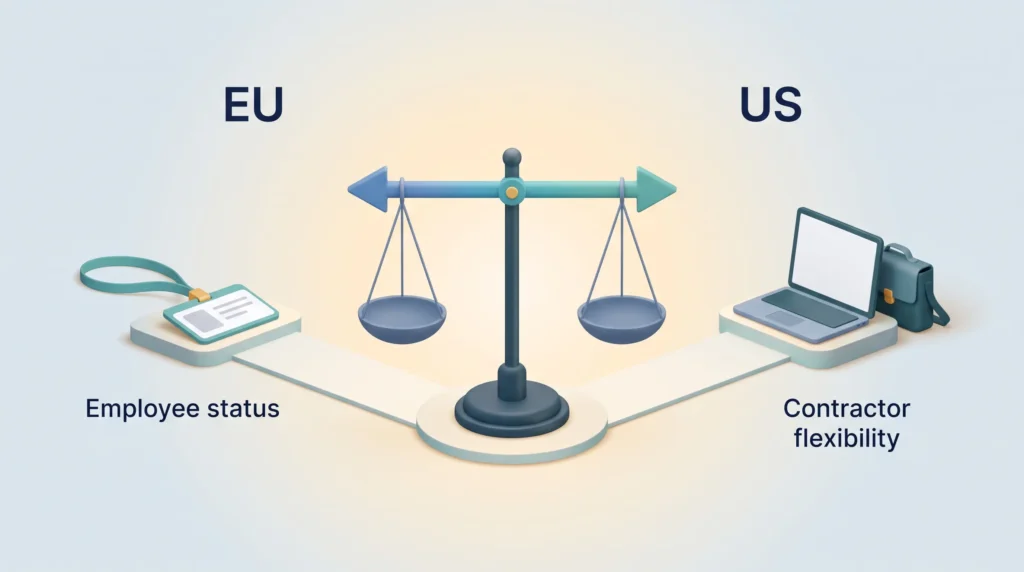
If you take one thing from this article, take this. The two largest regulatory blocs are heading in opposite directions at once. Anyone hiring or working across both should plan for that split rather than wait for a single global standard.
| European Union | United States | |
|---|---|---|
| Instrument | Platform Work Directive (EU) 2024/2831 | DOL proposed rule, Feb 2026 (FLSA, FMLA, MSPA) |
| Key date | National laws due by 2 December 2026 | Comment period closed 28 April 2026, final rule still pending |
| Direction | Toward employee status | Toward contractor flexibility |
| Core mechanism | Workers are assumed to be employees where the platform controls the work; the platform must prove otherwise | Simplified “economic reality” test, largely restoring the 2021 approach |
| Algorithmic management | Binding rules: human review of significant decisions, explanation rights, data processing limits | Not addressed at federal level |
| Fragmentation risk | High. Implementation varies by member state | High. State tests such as California’s ABC test still apply |
What the Split Means in Practice
In the EU, the directive flips the burden of proof. Where a platform controls how the work is done, the worker is presumed to be an employee unless the platform shows otherwise. It also sets the first binding rules anywhere on algorithmic management, meaning the software that assigns jobs, scores performance and deactivates accounts. Most member states had not finished their national laws by mid-2026, so the same contract may be treated differently in Madrid and Munich well into 2027.
In the US, the Department of Labor proposed on 26 February 2026 to replace the 2024 contractor rule with a simpler test. It weighs how much control a worker has and whether they can profit or lose from their own decisions. As of late August 2026 that rule is still pending. State law applies regardless: California’s ABC test treats a worker as an employee unless the hiring business meets all three of its conditions.
Our guide to Platform Work Directive compliance and the other gig economy rules of 2026 covers deadlines, pay floors and classification step by step. Our overview of how governments are shaping remote and AI policy gives the wider context.
Skills That Will Be in Demand Through 2030
The skills conversation has become far more specific than the old advice to “be adaptable”. Current demand data points to:
- AI engineering and prompt engineering: the fastest-growing category by a wide margin.
- Full-stack development (building both the visible interface and the server side of an application): still the largest single share of global freelance project demand.
- Digital marketing and SEO: around 31% of freelance job postings.
- Video production and AI-assisted editing: the highest growth rate of any subcategory.
- Data analytics and cybersecurity consulting: steady, high-rate specialist demand.
Around 80% of freelancers in global surveys hold a bachelor’s or postgraduate degree, and roughly 70% took part in skills training in the past year. Independent work is no longer a low-skill fallback. See also which job skills are most in demand in 2026 and our guide to upskilling and reskilling.
The Challenges That Have Not Gone Away
Income Volatility
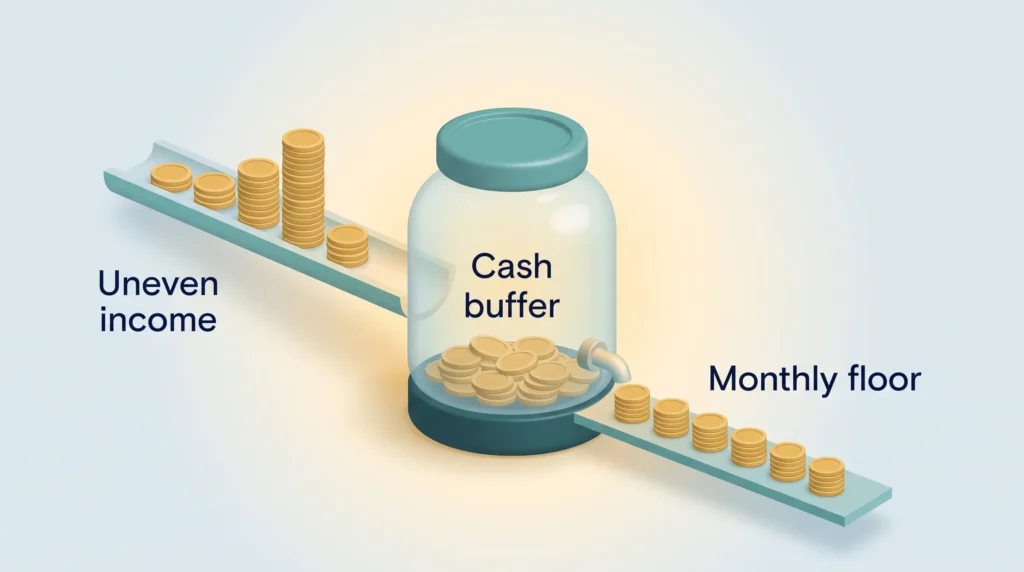
Average figures flatter the picture badly. The reported average US freelancer income of roughly $108,000 is pulled upward by a small group of high earners. The record 5.6 million six-figure freelancers are real, and so is the much larger group earning under $50,000 with no predictable monthly floor. The practical implication: size your cash buffer against your worst quarter, not your average one.
Benefits and Retirement
Most independent workers still buy their own health cover and fund their own retirement. In the US they also pay the full 15.3% self-employment tax on top of income tax, because they cover both the employee and employer halves of Social Security and Medicare. Headline hourly rates rarely reflect that. A $100 hourly rate is not a $100 hourly wage.
Algorithmic Opacity
When a platform changes how it ranks or recommends workers, someone’s income can halve overnight with no explanation and no appeal. The EU directive is the first serious attempt to create a right to that explanation. Whether others follow is an open question.
What This Means for You
If You Work Independently
- Specialise into a category with a demonstrated rate premium rather than competing on price.
- Treat AI tools as leverage on your own output, then reprice. The freelancers gaining most are keeping the saved hours, not passing them on.
- Work with at least three clients so no single algorithm or contract controls your income.
- If you have EU clients, check how your engagement looks against the directive’s control criteria before December 2026.
If You Hire Independent Talent
For a business, the appeal is simple. You pay for a defined result instead of carrying a permanent salary, and you can scale up or down without a long hiring process. The trade-off is less day-to-day control and a real classification risk. Used well, independent talent fills gaps. Used carelessly, it creates legal exposure and uneven quality.
Start with the right work. Three kinds of tasks suit gig workers best. The first is a project with a clear start and end. The second is a seasonal peak, such as holiday trading or year-end reporting. The third is a short burst of specialist input you do not need all year, like a security review or a brand refresh. Design, content, digital marketing and development work are common first candidates. Before you hand anything out, run an hourly-value test to decide which tasks to outsource first.
Pick the platform for the job. Open marketplaces such as Upwork and Fiverr offer the widest pool and hourly or per-project pricing. Curated networks cost more but screen talent for you, which matters when a mistake is expensive.
Treat contractors as part of the team, not as a ticket queue. Give them a short onboarding with access to the tools and context they need. Add a regular check-in, prompt feedback and simple recognition when the work lands. All of this raises quality and brings good freelancers back. Shared project management and messaging tools help too, as long as contractors still decide how they do the work. Our playbook on managing freelancers day to day sets out a full routine.
Then protect the arrangement:
- Audit engagements country by country. The same contract can be compliant in Texas and reclassified in Spain.
- Document genuine independence: control over schedule and method, and the freedom to work for others.
- Budget for possible reclassification in the EU rather than assuming current arrangements survive.
- If a contractor is working out, know the route to a permanent offer. See our piece on testing talent with gig work before full employment.
The Outlook for 2030
By 2030, expect a gig economy that looks less like a marketplace of interchangeable tasks and more like a distributed professional services layer sitting alongside traditional employment.
Three things are likely. Headcount growth will be steady rather than explosive. Value per engagement will keep rising, driven by AI-augmented specialists. And the legal status of platform work will be settled in most major markets, though not the same way in each.
The workers who do best will not be the ones who freelanced earliest. They will be the ones who specialised deliberately, priced their leverage, and learned the rules of the places they sell into. For related reading, see the freelancing trends to watch in 2026, the future of contract work, the shift to project-based work, how workers are adapting to automation, and how Gen Z is reshaping work.
Found this useful?
Make SmartKeys a preferred source on Google, and our articles will surface more often in your Top Stories, AI Overviews, and AI Mode.
Add as Preferred Source