Freelancing is no longer a side story in the labor market. In 2026, 39% of U.S. workers do some form of freelance work, up four percentage points from the year before, according to Upwork’s Future Workforce Index. That is not a fringe group. It is roughly two in five working Americans earning at least part of their income outside a traditional payroll.
What changed recently is not the size of the freelance workforce so much as the conditions around it. Generative AI has taken measurable bites out of some categories and created new demand in others. Europe is about to apply a common rulebook to platform work. The United States has torn up one worker-classification rule and not yet replaced it. And the tax paperwork that follows freelance income changed shape in 2026.
This guide covers what the current data actually supports, what it does not, and what each shift means if you freelance or hire freelancers.
Key Takeaways
- 39% of U.S. workers freelanced in 2026, and 38% of skilled knowledge workers now work independently (Upwork Future Workforce Index).
- Freelancers earned a combined $1.5 trillion in 2024 (Upwork, April 2025).
- AI cut demand in writing and image work but grew it elsewhere: skills that explicitly reference AI rose 109% year over year on Upwork.
- EU member states must apply the Platform Work Directive by 2 December 2026, including a legal presumption of employment for platform workers.
- The U.S. Department of Labor rescinded its 2024 classification rule and proposed a replacement in February 2026 that is not yet final.
- The 1099-NEC and 1099-MISC reporting threshold rose from $600 to $2,000 for payments made after 31 December 2025.
- Fractional and specialist roles are growing: 77% of business leaders say AI is increasing their need for specialized part-time expertise.
How Big the Freelance Workforce Actually Is
Headline numbers about freelancing are often quoted without a source or a definition, so it is worth being precise about what is measured.
Upwork’s Future Workforce Index puts the 2026 figure at 39% of U.S. workers doing freelance work of some kind. That includes people with a full-time job and a weekend client. A narrower and more useful figure sits alongside it. Among skilled knowledge workers, meaning people in professional roles such as software, design, marketing and consulting, 38% now work independently rather than as employees.
The money is substantial. Upwork put collective freelancer earnings at $1.5 trillion for 2024. Statista projects 86.5 million U.S. freelancers by 2027, which would be 50.9% of the workforce. Treat that last figure as a projection built on a broad definition of freelancing, not a measurement. Projections of this kind have repeatedly been quoted as though they had already happened.
Two other findings are worth carrying with you. Freelancers are more credentialed than the average employee: 92% hold a bachelor’s degree or higher, against 69% of full-time employees. And most do not depend on a single client, with 63% working with several organizations at once. That mix is part of why project-based staffing has become a normal way to run a company rather than an emergency measure.
What AI Is Really Doing to Freelance Work
This is the question most freelancers actually want answered, and it has a clearer evidence base than most people assume.
Where Demand Fell
Researchers Xiang Hui, Oren Reshef and Luofeng Zhou at Washington University’s Olin Business School studied Upwork data around the release of ChatGPT and the early image generators. In the months after ChatGPT launched, freelancers in writing categories such as proofreading and copy editing saw about 2% fewer monthly jobs and 5.2% lower monthly earnings. Freelancers doing image work, exposed earlier to DALL-E and Midjourney, saw a 3.7% drop in jobs and 9.4% less income.
One result surprised the researchers. Higher-rated, more experienced, higher-priced freelancers lost more than lower-rated ones. The explanation they offer is that AI raises the floor: it makes a mediocre worker noticeably better, which narrows the visible quality gap clients were paying a premium for.
These are short-term effects measured on one platform, not a verdict on the profession. But the direction is consistent with what many writers and designers describe, and it is a useful counterweight to the claim that AI only creates freelance work. For a wider view of how creative roles are shifting, see our piece on AI in creative work.
Where Demand Grew
The same period produced sharp growth elsewhere. Upwork’s research reports that skills explicitly referencing AI grew 109% year over year, covering work such as building chatbots, fine-tuning models, writing prompts and evaluation sets, and wiring AI tools into existing systems.
Freelancers are also ahead of employees in using these tools. Some 41% of freelancers use AI agents, meaning software that carries out multi-step tasks on its own, compared with 24% of full-time employees. Among Gen Z, 61% of freelancers use generative AI against 41% of their full-time peers. Independent workers adopt faster because the productivity gain lands directly in their own margin.
The practical reading: AI is compressing the market for generic deliverables and expanding the market for judgement, integration and accountability. A client can generate a draft alone. They still cannot generate someone who will sit in a meeting and defend a recommendation.
Freelancing Platforms in 2026
Upwork, Fiverr and Freelancer remain the largest general marketplaces, and all three have built AI matching and AI-assisted briefs into their products. Their economics have not changed much: high visibility, high competition, and downward pressure on rates for commodity work.
The more interesting movement is at the specialist end. Marketplaces now cluster around a single discipline or a single seniority level. Developer-only networks, consulting networks, and rosters of vetted fractional executives all charge more and screen harder than the open marketplaces. Narrower supply is exactly what lets those freelancers hold their rates.
If you are choosing where to sell your time, our comparison of freelance talent platforms sets out how the fee structures and vetting models differ. On the buying side, our guide to managing freelancers covers how companies structure this work without creating a compliance problem.
The New Rules Around Independent Work
Regulation is the biggest genuinely new development since this article was last updated, and it cuts in different directions on each side of the Atlantic.
Europe: The Platform Work Directive
EU member states must have national laws in force implementing the Platform Work Directive by 2 December 2026. Two parts matter most.
First, a legal presumption of employment. Where a platform’s relationship with a worker shows certain markers of control, the worker is presumed to be an employee, and the platform carries the burden of proving otherwise. That reverses the usual order, in which the worker had to prove they were misclassified.
Second, transparency over algorithmic management, meaning the automated systems that assign work, set prices and restrict accounts. Platforms must disclose how those systems make decisions. Our explainer on algorithmic management covers what that looks like in practice.
The directive targets platform work, such as ride-hailing, delivery and task marketplaces. It is not aimed at a consultant invoicing three clients directly. But how far each country stretches the definition is still being decided, so watch the national transposition rather than the directive text. See also our overview of gig economy regulation and future of work legislation.
The United States: An Unsettled Test
The U.S. picture is less settled. The Department of Labor rescinded its 2024 independent contractor rule and stopped applying it in investigations. On 26 February 2026 it proposed a replacement built on the “economic reality” test, which asks whether a worker is economically dependent on the hiring business or genuinely running their own.
The proposal leans on two core factors: how much control the worker has over the work, and whether they can make a profit or a loss through their own initiative or investment. Skill, permanence and integration into the business are secondary. The comment period closed on 28 April 2026 and the rule was not final as of September 2026.
Two things follow. Federal wage-and-hour classification is in flux, so a contract written to the old rule may not age well. And state law has not paused: California, New Jersey and others apply stricter tests than the federal one regardless of what the DOL settles on.
New Tax Reporting Thresholds
The paperwork changed too. Under the One Big Beautiful Bill Act, the 1099-NEC and 1099-MISC reporting threshold rose from $600 to $2,000. That applies to payments made after 31 December 2025, and the figure will be indexed to inflation from 2027. The 1099-K threshold for payment platforms went back to $20,000 and 200 transactions, applied from the 2025 returns filed in 2026.
The practical effect is that fewer forms will land in your mailbox. Your obligation has not changed at all. Income is taxable whether or not a client sends a form, and some states set lower thresholds than the federal one. Keep your own records rather than reconstructing the year from whatever paperwork happens to arrive. Sound cash flow management matters more, not less, when the reporting trail gets thinner.
Who Freelances Now
The stereotype of the young freelancer scraping together gigs does not match the data well. Freelancers are more educated than employees on average, and most have been doing it for a while: 63% have freelanced for three years or more, and 8% for over a decade.
Pay is closer than the stereotype suggests too. Skilled freelancers earned about $101,000 in 2025 against $109,000 for comparable full-time employees. The average sits lower, but the gap is smaller than the risk premium most people assume. And 86% of freelancers say they are satisfied with their compensation, against 68% of full-time employees.
Younger workers are shaping the direction. Gen Z freelancers adopt AI tools faster than their employed peers, and many treat multiple income streams as normal rather than transitional, a pattern we cover in the polywork trend. Location independence is part of the same picture: see our guide to digital nomads for how visas and infrastructure have caught up.
The Skills Clients Pay For in 2026
Demand has shifted toward work that is hard to specify in a prompt.
AI-adjacent technical skills lead the growth, but the demand is not only for model builders. Companies want people who can connect an AI tool to a messy existing process and be answerable for the result. That is integration work, and it requires understanding the client’s business.
Fractional and interim roles keep expanding. A fractional role means senior expertise bought by the day or the week rather than by the year: a part-time finance lead for a company with twenty staff, for example. Upwork reports that 77% of business leaders say AI is increasing their need for this kind of specialized talent, because the skills change faster than a hiring cycle.
Soft skills remain the differentiator at the top of the market, as we discuss in soft skills for the future of work. Clear scoping, honest status updates and the ability to say no to a badly framed brief are what convert one project into a retainer. For the wider skills picture, see future job skills and upskilling and reskilling.
Why People Still Choose Freelance Work
The numbers above describe what the market is doing. They do not explain why people keep moving into it, and that matters if you are weighing the switch yourself.
Control over the schedule is the most common reason. Deciding when to work, and being able to shift a morning around a school run or an appointment, is worth more to many people than the extra admin it costs them. Freelancers also choose their clients. Turning down a badly run project is a real option in a way it rarely is inside a company.
The income ceiling works differently too. An employee’s pay is set once a year by somebody else. A freelance rate can be raised with the next client, and a second client can be added without asking permission. That upside is uneven, and it comes with the risks set out below, but it is a genuine structural difference rather than a marketing line.
The satisfaction data fits this picture. Freelancers report higher satisfaction with their pay than employees do while earning slightly less on average. People are not only buying income. They are buying control over how that income is earned.
Challenges Facing Freelancers in 2026
The upside is real and so are the constraints.
Rate pressure on commodity work. If your service can be described completely in a brief, AI plus a lower-cost competitor will meet that brief. The response is to move up: value-based pricing works when you can point at an outcome, not an output.
Uneven income and late payment. Freelance earnings arrive in lumps, and getting paid on time is a running administrative job rather than a given. Late payment shows up as a top complaint in every freelancer survey, and it bites hardest when one client makes up most of a month’s income. Three habits do most of the work: take a deposit before starting, bill in stages on anything longer than a few weeks, and put payment terms and a late fee in the contract so chasing an invoice is a process rather than a favour. A cash buffer covering several months of fixed costs is the backstop for when all of that still fails.
No employer benefits. Health cover and retirement saving come out of your own rate. Price them in from the start rather than discovering the gap later. Our overview of how employee benefits are evolving is a useful benchmark for what you are replacing.
Classification risk. With the U.S. rule unsettled and the EU tightening, both freelancers and clients should keep contracts current and behaviour consistent with them. A contract that says “independent” while the client sets your hours is the exact fact pattern regulators look for.
Isolation. Working alone removes the incidental contact that keeps most people steady. Coworking spaces, peer groups and regular in-person work all help, and the effect on wellbeing is well documented in our piece on remote work and mental health.
How to Position Yourself for the Next Two Years
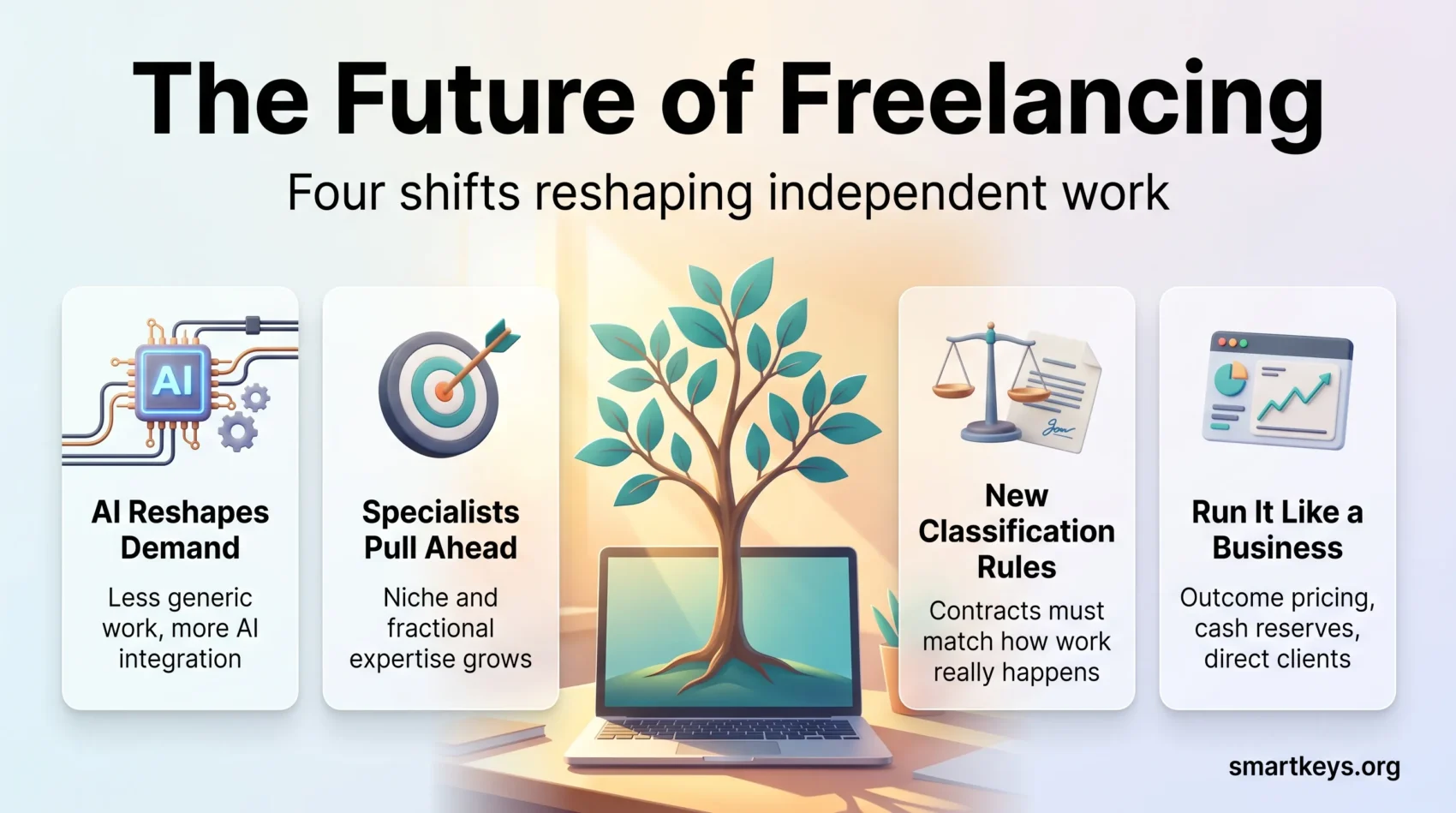
Four moves follow from the evidence above.
Move toward accountability. Sell decisions, judgement and outcomes rather than hours of production. That is the part AI does not cover and clients cannot self-serve.
Specialize into an industry, not just a craft. A copywriter competes with everyone. A copywriter who understands medical device compliance competes with very few.
Use AI openly and price for the result. Freelancers who adopt these tools deliver faster. Charging by output while working three times as fast just quietly cuts your own rate.
Build direct client relationships alongside platform work. Marketplaces are useful for discovery and terrible for margin. The freelancers holding their rates in 2026 mostly own their client list.
The Business Side: Money and Visibility
Positioning wins the work. Two less glamorous habits decide whether the business survives a slow quarter.
Run Your Own Finance Function
Nobody withholds tax for you, tops up a pension or pays you while you are ill. Those costs belong in your rate rather than in an unpleasant discovery at the end of the year.
Move a fixed share of every payment into a separate tax account on the day it arrives, so the money is never sitting in the current account waiting to be spent. Build a reserve worth three to six months of fixed costs, the range most financial planners suggest for variable income. Then buy the cover an employer would otherwise provide: health insurance, income protection where you can get it, and professional liability if you advise clients for a living.
Budget from your quietest months rather than your best ones. A good quarter is easy to absorb. A quiet one is what ends freelance careers.
Be Findable Without a Marketplace
If every lead arrives through a platform, the platform owns the relationship and takes the margin. Fixing that takes steady small effort rather than a campaign.
Keep one place you control, usually a simple site with a few worked examples and a plain statement of who you help. Ask satisfied clients for a referral while the project is still fresh, because referrals convert faster than any profile. Stay visible where your clients already are, whether that is an industry association, a feed or a conference hallway. And keep learning in public: a short write-up of how you solved a real problem is a better credential than a certificate.
Conclusion
Freelancing in 2026 is bigger, better paid and more regulated than the picture most articles still describe. Roughly two in five U.S. workers do some freelance work, skilled independents earn close to their employed peers, and the majority say they see more opportunity than a year ago.
The forces reshaping it are specific rather than vague. AI has cut demand for generic writing and image work while multiplying demand for AI integration skills. Europe applies a common set of platform rules from December 2026. U.S. classification law is mid-rewrite. Tax reporting thresholds have moved.
None of that argues against freelancing. It argues for treating it as a business with a strategy: a defined niche, contracts that match reality, prices tied to outcomes, and a client list you own. For the wider context, see our overviews of future work trends, how remote work changed the workplace and how automation is redeploying workers.
Found this useful?
Make SmartKeys a preferred source on Google, and our articles will surface more often in your Top Stories, AI Overviews, and AI Mode.
Add as Preferred Source