Remote work has stopped being an experiment. Roughly a quarter of all paid working days in the United States were done from home in May 2026, according to the Survey of Working Arrangements and Attitudes run by Nicholas Bloom and colleagues, and the US Bureau of Labor Statistics found that 35% of employed people did at least some of their work at home during 2025. The arrangement has settled. So has the evidence about what it does to your mental health.
That evidence is more awkward than either camp in the return-to-office argument would like. Gallup’s State of the Global Workplace 2026 report finds fully remote employees are the most engaged group in the workforce and among the least likely to be thriving in their lives. Working from home hands you control, quiet and time. It also removes the incidental contact most people need more than they realise.
Key Takeaways
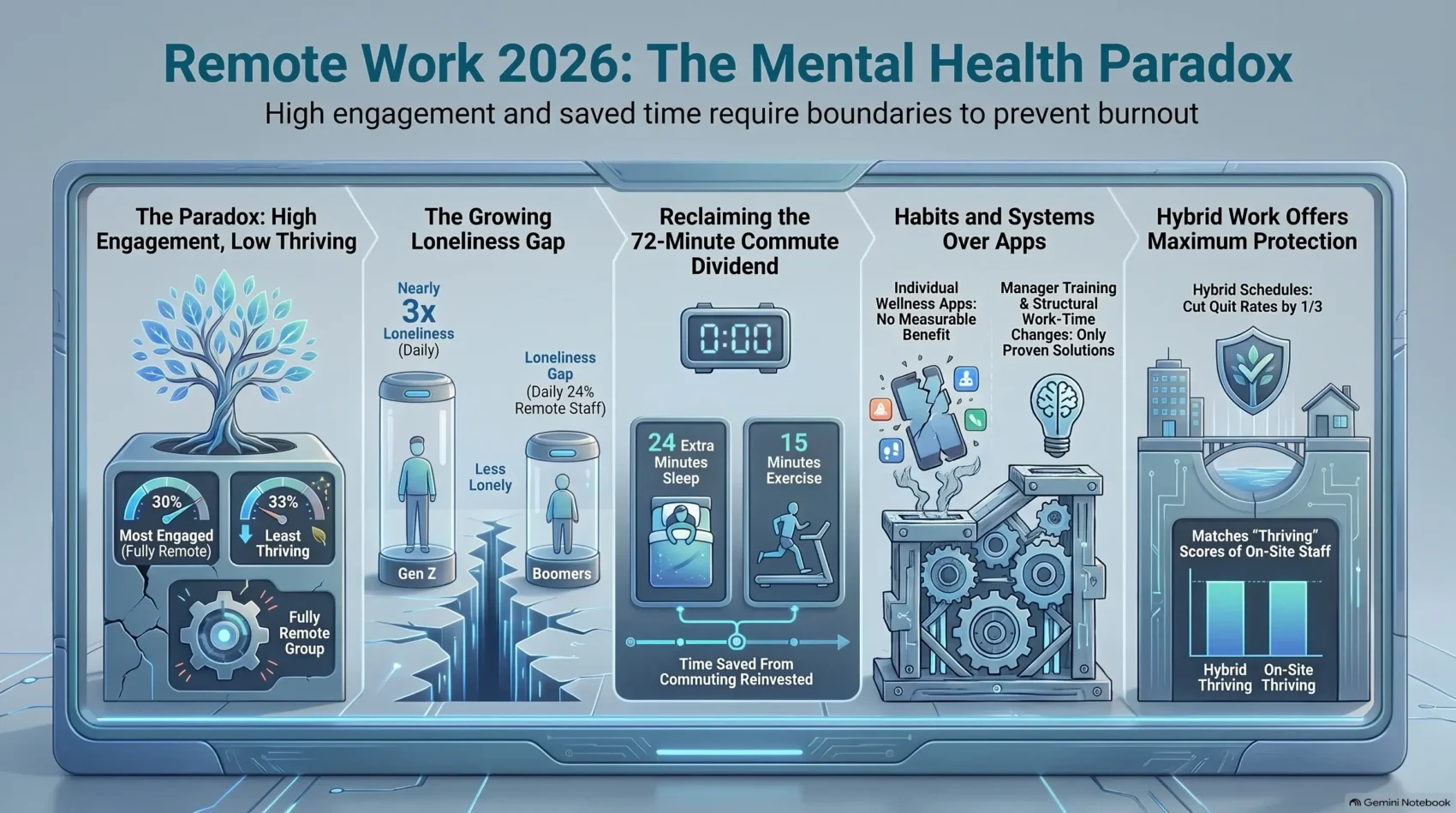
- Fully remote employees are the most engaged (30%) but the least likely to be thriving (33%), according to Gallup’s State of the Global Workplace 2026.
- 24% of fully remote and hybrid employees felt lonely a lot of the previous day, against 18% of on-site remote-capable staff (Gallup, 2026).
- Working from home saves an average of 72 minutes of commuting per day across 27 countries (AEA Papers and Proceedings, 2023).
- A randomised trial published in Nature found two work-from-home days a week cut quit rates by roughly a third with no drop in performance.
- Individual wellness perks show no measurable benefit: a UK study of 46,336 workers found no wellbeing improvement from apps, mindfulness or resilience training.
- Gen Z remote-capable workers report loneliness at nearly three times the rate of baby boomers (Gallup, 2025).
The Impact of Remote Work on Mental Health
Remote work changed where the job happens, not what the job demands. The mental health effects follow from that gap: the same workload, minus the commute, minus the office, minus the colleagues you never chose but got used to.
How Much Work Actually Happens at Home
Among remote-capable employees in the United States, Gallup’s hybrid work indicator put the split at 52% hybrid, 26% exclusively remote and 22% fully on-site as of 1 May 2026. Hybrid, not full remote, is the norm. Across Europe, the European Commission reported that 20.3% of workers were working from home at least partially in 2024, roughly double the pre-pandemic share. The Global Survey of Working Arrangements found average work-from-home days had stabilised at about 1.3 days a week. Our guide to flexible work schedules and what the evidence shows covers the policy side.
The Remote Work Paradox
Gallup’s 2026 report breaks its global data down by work location, and the pattern is consistent rather than flattering:
- Engagement: 30% exclusively remote, 25% hybrid, 24% on-site remote-capable, 17% on-site non-remote-capable.
- Thriving in life: 33% exclusively remote, 45% hybrid, 45% on-site remote-capable, 32% on-site non-remote-capable.
- Daily stress: 41% exclusively remote, 46% hybrid, 46% on-site remote-capable.
- Daily loneliness: 24% exclusively remote, 24% hybrid, 18% on-site remote-capable.
- Daily sadness: 30% exclusively remote, 24% hybrid, 20% on-site remote-capable.
Fully remote workers report the lowest stress and the highest engagement, and simultaneously the most sadness and the lowest life evaluation. Hybrid workers carry more day-to-day stress but match the thriving score of full-time office staff. Globally, 20% of employees were engaged in 2025.
The takeaway is not that remote work is bad for you. It is that engagement and wellbeing are different things, and remote work moves them in opposite directions unless someone intervenes.
Benefits of Remote Work on Mental Health
The advantages are real and reasonably well documented.
More Control Over Your Working Day
Autonomy does most of the work here. Companies that offer remote arrangements let you shape your schedule around your life rather than the reverse, and that control matters more than the location itself.
A 2025 study of 24,763 Norwegian public-sector office workers in the International Archives of Occupational and Environmental Health found that employees practising flexible working from home, when needed or wanted, were less likely to report mental distress than those with no home working at all. Employees on fixed work-from-home agreements showed no such benefit. Self-chosen was the variable that mattered.
The Commute You Do Not Make
Across 27 countries, working from home saves an average of 72 minutes a day in commuting, according to research in AEA Papers and Proceedings (2023). Workers put about 40% of that time back into their jobs.
The UK Office for National Statistics measured the rest. In 2024 time-use diaries, home workers saved 56 minutes by not travelling and spent 24 minutes more on sleep and rest and 15 minutes more on exercise, sport and wellbeing than those who commuted. Those are two of the most reliable levers on mood there are: see our pieces on why sleep is your best productivity tool and the role of exercise in boosting productivity.
Lower Daily Stress and Better Retention
Gallup’s 2026 figures put daily stress lowest among exclusively remote workers, at 41% against 46% for hybrid and on-site staff. Employers see the effect too. In a randomised controlled trial published in Nature in 2024, Nicholas Bloom, Ruobing Han and James Liang assigned 1,612 employees at Trip.com to either five days in the office or a hybrid pattern with two work-from-home days. Over six months, quit rates fell from 7.2% to 4.8% – a reduction of roughly a third, and larger still for women and long-commute employees. Performance review grades, lines of code written and promotion rates showed no significant difference. Self-reported job satisfaction rose from 7.84 to 8.19 on a ten-point scale.
Same output, fewer people leaving, happier staff: that is the strongest single piece of evidence for hybrid work, and it matches the 2026 remote employee engagement data.

The Mental Health Costs of Remote Work
The costs are just as real, and they concentrate in specific groups.
Loneliness and Isolation
Loneliness is the clearest signal in the data. In Gallup’s 2026 report, 24% of fully remote and hybrid employees felt lonely a lot of the previous day, against 18% of remote-capable employees on site.
Age splits it sharply. Gallup’s May 2025 survey of 19,043 US adults found that among remote-ready full-time employees, 27% of Gen Z reported loneliness a lot of the previous day, compared with 21% of millennials, 15% of Gen X and 10% of baby boomers. The American Psychological Association’s 2024 Work in America survey found the same shape: 45% of workers aged 18 to 25 said they feel lonely while working, against 14% of those over 65.
The most exposed group is early-career staff who never built an office network in the first place. Countermeasures are covered in our guide to employee wellness in a virtual world.
Blurred Boundaries and the Infinite Workday
Remote work blurs the line between the job and everything else, and the data on digital communication shows how far that has gone. Microsoft’s Breaking Down the Infinite Workday report, published in June 2025 from Microsoft 365 telemetry and a survey of 31,000 knowledge workers, found that workers are interrupted roughly every two minutes during core hours – around 275 interruptions a day. The average employee receives 117 emails and 153 Teams messages per weekday. Meetings after 8pm were up 16% year over year, and 29% of active workers were back in their inbox by 10pm. Almost half described their work as chaotic and fragmented.
None of that is caused by working from home. But without the commute or the shared exit at six o’clock, nothing marks the end of the day for you. Our guide to setting instant messaging boundaries deals with constant pings.
What the Evidence Actually Says About Anxiety and Depression
A figure repeated everywhere claims that 40% of fully remote workers show symptoms of anxiety or depression against 35% of in-person workers. It comes from a 2023 analysis by the Integrated Benefits Institute of US Census Household Pulse Survey data collected between July 2021 and August 2022 – pandemic conditions, and a survey that stopped collection in 2024. It should not be quoted as a current number.
The better evidence is more recent and much less dramatic. A 2025 study in Occupational Medicine analysed Household Pulse data from September 2022 to October 2023 and, after adjusting for covariates, found hybrid workers had slightly lower odds of depression risk (adjusted odds ratio 0.98) and fully remote workers slightly higher odds of anxiety risk (1.02) compared with non-remote workers. The authors concluded that hybrid work “may be a healthful working style.” Both effects are small.
The honest summary: work location is a weak predictor of mental health. Workload, job security, autonomy and the quality of your manager are stronger ones.
Burnout Is Not Evenly Distributed
The APA’s 2024 Work in America survey found that 67% of workers had experienced at least one outcome commonly associated with burnout in the previous month. Its 2025 edition found 54% saying job insecurity has a significant effect on their stress at work, and 42% reporting that work stress disrupts their sleep.
Burnout is a workload and control problem before it is a location problem. See managing employee burnout in the future of work and managing stress for better productivity for the detail.
How to Protect Your Mental Health While Working Remotely
These four moves have the clearest support behind them.
Set Working Hours and Defend Them
Decide when the day ends and make it visible to your team. Policy alone will not do it: Eurofound surveyed 1,634 workers in Belgium, France, Italy and Spain and found over 80% received work communications outside contracted hours in a typical week – and that a legal right to disconnect did not reduce the likelihood of being contacted.
Habits do the work that policy cannot. Our guide to remote work habits, boundaries and routines covers how to make an end-of-day ritual stick, and company-wide unplug days show what the organisational version looks like.
Make Social Contact Deliberate
If contact does not happen by accident any more, it has to be scheduled. The good news is that video calls are not the villain they were assumed to be. A 2025 experience-sampling study in the Journal of Occupational Health Psychology, covering 125 employees across 945 meetings, found video meetings were no more exhausting than face-to-face ones – and that video meetings shorter than 44 minutes were actually less exhausting than meetings in other formats.
So the fix is not fewer calls but shorter, better-run ones, plus enough asynchronous working that you are not living in your calendar.
Build a Workspace That Helps
A dedicated area you can leave at the end of the day does two jobs: it improves focus while you work and signals a boundary when you stop. Light, a door and a chair you can sit in for six hours matter more than anything in an ergonomics catalogue. Our guide to creating a productive home office covers the setup.
Use Breaks, Movement and Attention Deliberately
Short breaks with actual movement beat scrolling at your desk, and breathing exercises are the cheapest intervention available – see our rundown of breathing techniques to reduce work stress. Pairing that with time management strategies matched to your peak hours keeps the day from becoming one undifferentiated block.

Preventing Remote Work Burnout
Burnout builds slowly and is easier to interrupt than to recover from.
Recognizing the Signs Early
Watch for:
- Chronic fatigue that a weekend does not fix
- Difficulty concentrating, or output falling while hours rise
- Feeling overwhelmed by tasks you used to handle easily
- Increased irritability, cynicism or detachment from the work
A Routine That Holds Up
- Fix a start and an end time, and treat the end time as real
- Take breaks away from the screen, not in another tab
- Protect one activity outside work that is in your calendar
- Say what your workload actually is, before it becomes a crisis
- Turn off after-hours notifications rather than relying on willpower
What Employers Should Do Instead of Buying an App
This is where most organisations get it wrong. A 2024 study in the Industrial Relations Journal examined 46,336 workers across 233 UK organisations and eleven individual-level interventions: mindfulness training, resilience courses, relaxation classes, wellbeing apps. It found no evidence that participation improved wellbeing. The author’s conclusion was that organisations have to change the workplace, not just the worker.
Two things do have evidence behind them:
- Train the managers. A cluster randomised trial published in The Lancet Psychiatry gave 88 managers, responsible for around 4,000 employees, a four-hour mental health training course. Work-related sick leave in their teams fell by 18% over the following six months while it rose in the control group. Our guide to remote leadership skills covers what that looks like day to day.
- Change the working time. A study in Nature Human Behaviour in July 2025 followed 2,896 employees across 141 organisations through a six-month four-day workweek trial with no pay cut. It found improvements in burnout, job satisfaction, mental health and physical health that were not observed in twelve control companies.
Structural change beats a meditation subscription. If you do fund individual support, wellbeing stipends at least leave the choice with the employee.

Support and Resources for Remote Workers
Individual effort has limits. What surrounds it decides whether it holds.
Employee Assistance Programs and Counselling
Employee Assistance Programs give staff confidential access to short-term counselling, usually at no cost. The Workplace Outcome Suite report published by the Employee Assistance Professionals Association and TELUS Health in 2024 covers 141,297 counselling cases. Employees reported absenteeism falling from 7.9 to 4.3 hours a month and presenteeism at problem level dropping from 57% to 34% after using the service. These are self-reported before-and-after measures rather than a controlled trial, so treat the effect size with caution.
Where the Law Is Going
The right to disconnect is now enforceable in parts of the world. In Australia it applied to employers with 15 or more staff from 26 August 2024 and to small businesses from 26 August 2025: employees may refuse to respond to contact outside working hours unless refusing would be unreasonable. Eurofound counted nine EU member states with right-to-disconnect legislation as of June 2023, including France, Italy, Spain, Portugal and Belgium. At EU level there is no directive yet – the Commission opened a second-stage consultation with social partners in July 2025.
The Bottom Line
Remote work is neither a mental health problem nor a mental health solution. It amplifies whatever the job already was. Good work with a decent manager gets better when you remove the commute. Overloaded work with a bad manager gets worse when you remove every boundary around it.
The evidence points in a consistent direction. Hybrid looks mildly protective. Full remote buys engagement and loses connection, especially early in a career. Choice matters more than the pattern, and the interventions that move the numbers are structural – manager training, working-time change, realistic workloads – not another app. The two highest-leverage things you control are a hard end to the day and deliberate contact with other people.
Found this useful?
Make SmartKeys a preferred source on Google, and our articles will surface more often in your Top Stories, AI Overviews, and AI Mode.
Add as Preferred Source