Work-life balance gets harder every time a work app follows you home. The right to disconnect is the idea that you should be able to ignore work messages outside your agreed hours without it counting against you.
Some countries have turned that idea into an enforceable rule. The United States has not. In 2026 there is no federal law and no state law, so your evenings are governed by your employer’s policy, your contract and wage rules written long before smartphones. Here is where the law stands and what you can do today. For the bigger picture of how work and personal time are being renegotiated, see our guide to work-life balance and what actually helps.
Key Takeaways
- The right to disconnect means you can decline non-urgent work contact outside your hours without being penalised.
- No US federal or state law is in force in 2026, though New Jersey introduced a fresh bill in January 2026.
- Australia has the strongest version: a legal right to refuse unreasonable out-of-hours contact.
- For hourly staff, the Fair Labor Standards Act already makes unpaid after-hours work a legal risk for employers.
- An availability statement, delayed email send and clear emergency rules solve most of the problem without any new law.
What the Right to Disconnect Actually Means
The term covers two very different things, and mixing them up causes most of the confusion.
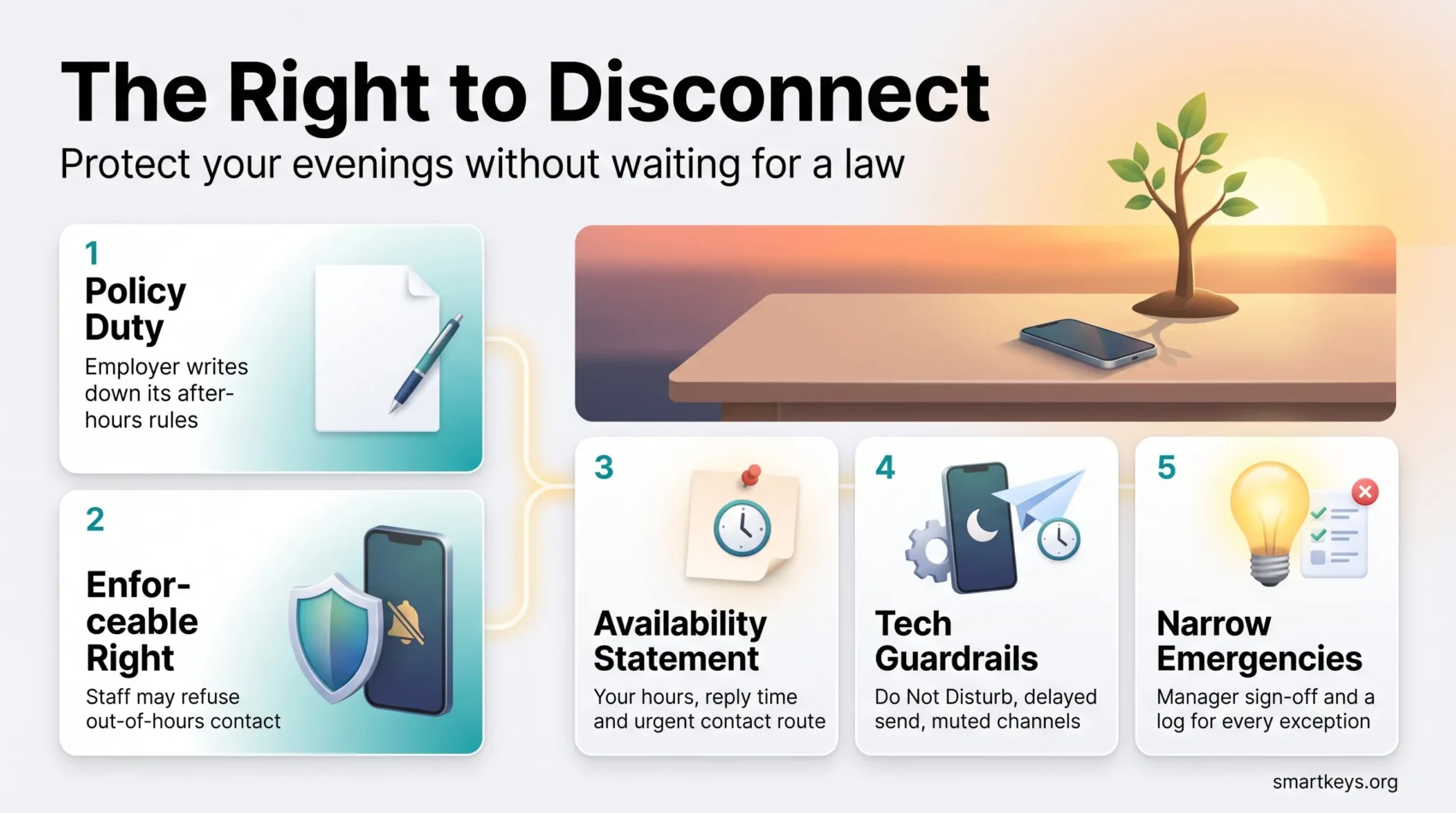
The weaker version is a policy duty: the employer must write down how after-hours contact works and share it with staff. Ontario, Canada, does this. Employers with 25 or more employees must publish a written policy on disconnecting from work, and Ontario’s own guidance says plainly that the rule “does not create a right to disconnect from work for employees.”
The stronger version is an enforceable right. An employee may refuse to read or answer out-of-hours contact, and that refusal is protected. Australia went this way.
So when you read about a new bill, ask one question: does it give you a right to say no, or only require a document? Our overview of future of work legislation tracks the wider shift.
Where the United States Stands in 2026
No right to disconnect law is in force anywhere in the US. Not federally, not in any state or city.
The bills that have come and gone
- California AB 2751 (2024): introduced by Assemblymember Matt Haney, it would have required employers to adopt a written policy giving employees the right to ignore employer contact during nonworking hours, with carve-outs for emergencies and last-minute scheduling. It was held in committee and never became law.
- New Jersey A3416 (January 2026): the most recent attempt. It would require a policy protecting the right to ignore contact outside agreed nonworking hours. Employees could report a “pattern of violation”, meaning three or more documented instances, to the state Commissioner of Labor and Workforce Development, with civil penalties starting at $100. Introduced on 13 January 2026 and referred to the Assembly Labor Committee.
- Earlier attempts: proposals in Washington State and New York City failed.
Practical effect for 2026: treat any new bill as a signal about where expectations are heading, not as protection you can rely on.
The rule that already binds your employer
Even without a disconnect law, the Fair Labor Standards Act (FLSA) applies. If you are non-exempt, meaning you are entitled to overtime, then answering emails at 10 p.m. is compensable work. An employer who lets that happen without paying for it carries real legal exposure, so the cheapest way to comply is also the humane one: stop sending non-urgent messages to hourly staff after hours. If your company tracks activity data too, see our guides to AI employee monitoring and data privacy at work.
What Other Countries Have Already Done
Australia has the clearest rule. Since 26 August 2024 for larger employers, and 26 August 2025 for small business employees, workers may refuse to monitor, read or reply to contact outside working hours unless that refusal would be unreasonable. The test turns on the reason for the contact, the role and whether the employee is paid to be available. It is a right to refuse, not a ban on sending.
France has required larger companies to negotiate disconnection arrangements with staff representatives since 2017. Belgium requires employers with 20 or more workers to set disconnection rules in a policy or collective agreement. Spain and Portugal both place duties on employers to protect rest time, with Portugal going furthest: a general duty to abstain from contacting staff outside working hours.
There is still no EU-wide directive. Talks between employer and union bodies collapsed in late 2023, and a European Commission consultation opened in April 2024 has produced no proposal since. If you employ people across borders, that patchwork is a live compliance question. See our guide to managing cross-border remote teams.
Why Always-On Work Costs More Than It Looks
The case for boundaries does not rest on new law, but on what constant availability does to attention and health. OSHA reports that more than 80% of US workers experience work-related stress, and more than half say it affects their life at home. Microsoft’s 2025 analysis of anonymised Microsoft 365 activity found the day stretching at both ends: meetings after 8 p.m. up 16% year over year, more than 50 messages per employee outside core hours, and interruptions roughly every two minutes.
Two things follow. Recovery time shrinks, which is how ordinary pressure turns into burnout, and focus fragments, because someone who expects a ping at any hour never settles into hard work. See our guides to managing work notifications, focus time policies and remote work and mental health.
How to Disconnect Without Damaging Your Career
You can protect your evenings and stay easy to work with. The trick is to be specific rather than silent.
Write a short availability statement
Three lines is enough: the hours you work, how fast you normally reply, and how to reach you if something genuinely cannot wait. Share it with your manager and pin it in your team channel. Our guide to setting boundaries at work has language you can borrow.
Let the tools carry the rule
Turn on Do Not Disturb outside your hours. Schedule emails you write late to send next morning, so your own habits do not set expectations. Mute channels that are never urgent. Grouping replies into set windows, as in our guide to email batching, cuts how often you check at all.
Script the conversation with your manager
Try this: “I check messages until 6 p.m. If something is urgent after that, call me and I will pick up. Anything else I will handle first thing.” That names a channel for real emergencies, so nobody has to guess, and makes your response time predictable, which is usually what managers actually want.
Know when to escalate
- If you are non-exempt and doing unpaid work after hours, raise it as a pay question, not a preference. Your employer has to answer that.
- Log repeated requests with dates and topics. A pattern is easier to discuss than a feeling.
- Negotiate on-call terms: which hours, how the rota works, what you are paid for being available.
How Employers Can Write a Policy That Holds Up
A good policy protects staff time and still covers the business. Keep it to one page of plain language.
Define the hours and the exceptions
Tie nonworking hours to each person’s actual schedule, not a company-wide fiction, and state clearly that nobody is penalised for not answering. Define an emergency narrowly, require manager sign-off before anyone uses the exception, and log each use. An exception nobody reviews stops being an exception. The same discipline applies to a hybrid work policy.
Keep it legal
- Align the policy with the FLSA for non-exempt staff and record any off-hours work that happens.
- Coordinate with ADA and FMLA duties, since accommodations and leave change what availability is reasonable.
- Keep evidence that you enforced the rule consistently. Selective enforcement is where the risk sits.
Make managers the control point
Most after-hours pressure comes from planning, not malice. Train managers to set deadlines inside working hours, label urgency honestly and model the behaviour. A manager who sends Sunday night messages has cancelled your policy whatever it says. Our guides to remote leadership skills and psychological safety cover whether people dare use the policy, and a flexible PTO policy raises the same enforcement question.
Measure whether it works
Track aggregate after-hours contact volume, never message content, and review it quarterly with staff feedback. Where written updates can replace a meeting, our guide to asynchronous work shows what to move off the calendar.
Conclusion
You do not need to wait for a law. In 2026 the US has no right to disconnect statute, California’s AB 2751 died in committee, and New Jersey’s A3416 is only starting its path through the Assembly. Australia’s rule is live, and several European countries have had one for years.
The practical moves are available today. Write an availability statement. Use delayed send. Define what counts as an emergency and stick to it. Employers should align after-hours practice with the FLSA first, because that duty already exists.
If the hardest part is turning down a late request in the moment, our guide on how to say no at work politely has wording you can adapt.
Found this useful?
Make SmartKeys a preferred source on Google, and our articles will surface more often in your Top Stories, AI Overviews, and AI Mode.
Add as Preferred Source