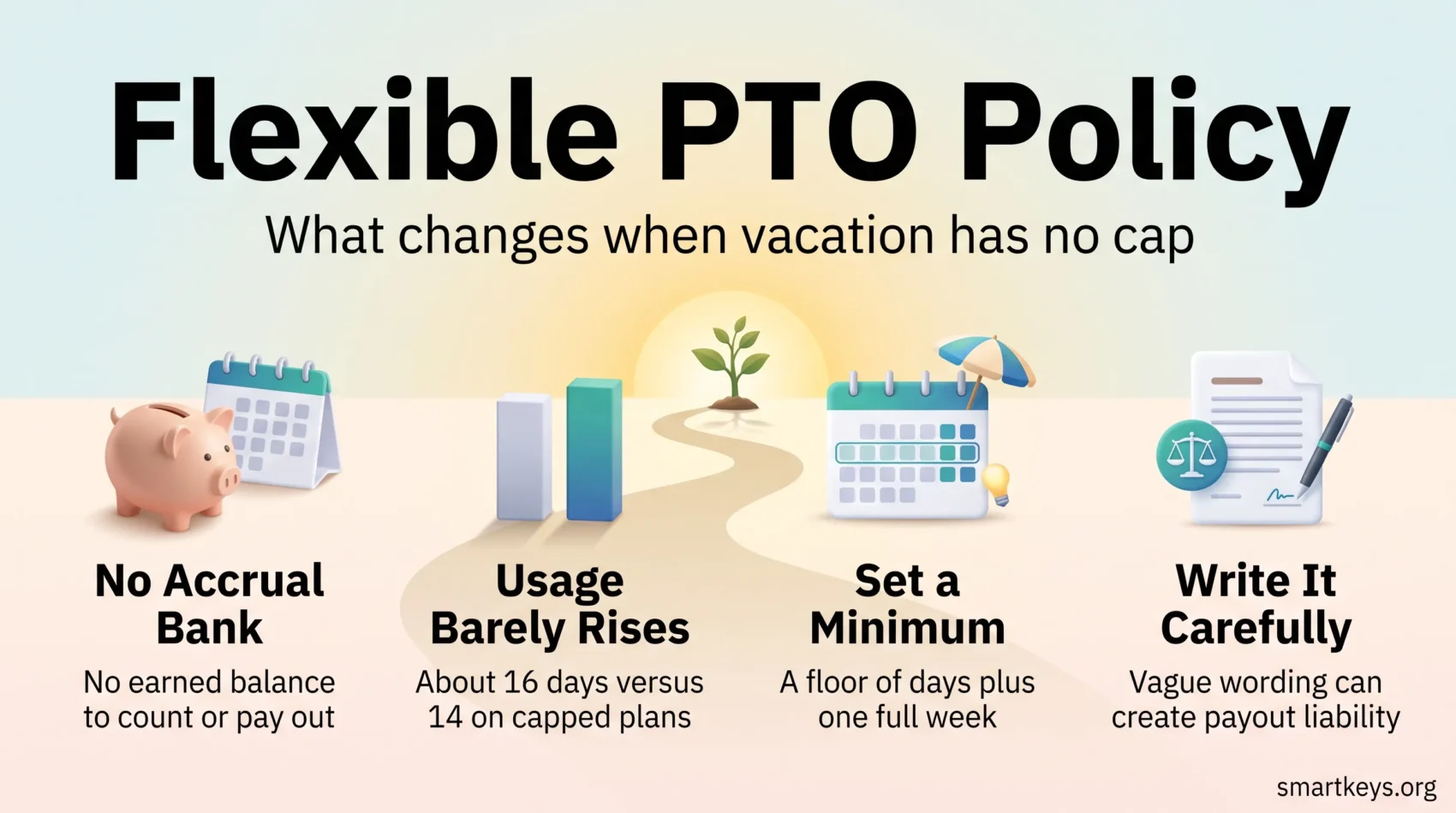
A flexible PTO policy lets employees take paid time off without a fixed annual allowance. Instead of counting down a balance of earned days, managers approve requests based on coverage and results.
PTO stands for paid time off: the days your employer pays you for while you are not working. A flexible policy removes the ceiling on those days. It does not remove the request, the approval, or the need to hand your work to someone else.
The idea sounds generous, and candidates like hearing it. The practice is harder. Employees often take fewer days once the number disappears, and loose wording can create the exact payout liability the policy was meant to avoid.
This guide covers what changes when you drop accrual, how common these policies are, what the usage data shows, the US legal traps, and how to pilot one before committing the whole company.
Key Takeaways
- Flexible or unlimited PTO removes the earned-days bank; traditional plans credit hours each pay period.
- Only 6% of US employers offered an open leave policy in 2026, according to SHRM.
- Usage barely moves. Culture and manager behaviour decide whether people actually take time.
- A mandatory minimum number of days is now the most common fix, and most employees want one.
- Vague wording can turn “unlimited” into accrued vacation that you must pay out when someone leaves.
What a flexible PTO policy actually is
Before you change how your team takes leave, it helps to be precise about the three terms that get used interchangeably.
PTO, FTO and “unlimited”: the terms explained
Traditional PTO gives each employee a set number of days or hours. Those days accrue, meaning they build up gradually over the year, usually a few hours per pay period. The balance is tracked, and in many states it must be paid out in the final paycheck.
Flexible time off (FTO) and unlimited PTO describe the same thing: no bank of earned days. Employees request time off, and a manager approves or declines it based on workload and coverage.
Minimum PTO is the newer variant. It removes the cap but adds a floor, for example “no upper limit, and you must take at least 15 days a year”. It exists because the pure version quietly discourages people from taking leave.
What changes for accrual, tracking and payout
- Accrual: Nothing accrues. There is no balance because there is no earned entitlement to count.
- Tracking: You log requests and approvals instead of counting down hours. You still need the log, because it is the only way to see who is not taking time.
- Payout: With no accrued balance, there is usually nothing to cash out at separation. That is the main financial attraction for employers, and the main legal risk if the policy is written loosely.
Word choice decides which of those three actually applies. If your handbook implies a set number of days, or if managers in practice approve roughly the same amount for everyone, a court can treat the plan as accruing vacation. The legal section below covers the case that established this.
For a broader look at how leave fits alongside other scheduling changes, see our guide to flexible work schedules.
How common is unlimited PTO in 2026?
Rarer than the coverage suggests. The 2026 SHRM Employee Benefits Survey found 6% of US employers offer a paid open leave policy, unchanged from the previous year. By comparison, 99% offer vacation, 95% offer sick leave, and 68% run a combined PTO bank.
It is a niche benefit concentrated in technology, professional services and startups, not a mainstream shift. The best known adopters are Netflix, uncapped since the 2000s, and HubSpot. Microsoft joined them in January 2023, moving US salaried staff to “Discretionary Time Off” and paying out their accrued balances as a one-off.
For the wider context, see our overview of how employee benefits are changing in 2026 and the HR trends for 2026.
The case for flexible time off
Recruiting and retention
When two offers pay similarly, the leave policy often becomes the tiebreaker for knowledge workers. An open policy signals autonomy and trust, and it is easy to describe in a job advert.
It also removes an awkward conversation. Under accrual, a new hire with three days banked cannot take a week off in month two. Under a flexible policy they can, provided the work is covered. That fits the approaches in our guide to talent retention strategies.
Less administration and a smaller balance-sheet liability
You stop maintaining accrual schedules, carryover caps and expiry dates. Payroll no longer calculates a balance each period, and accrued vacation stops sitting on the books as a liability.
That is a real saving, and also the reason to be careful: the same feature that removes the liability is what gets examined when a policy is vague.
What the usage data actually shows
Be honest with yourself about the size of the effect. An Empower study cited by SHRM found employees with unlimited PTO took an average of 16 days a year, against 14 days for those on a capped plan. Namely’s payroll data showed an even smaller gap: 12.09 days versus 11.36.
Two extra days is not nothing, given that US Bureau of Labor Statistics data puts the typical private-sector entitlement at around 11 days after a year of service. But it is far from the transformation the label implies. If the goal is rested employees rather than a recruiting line, pair the policy with the practices in our guide to burnout prevention.
The risks you have to plan for
People take less time, not more
This is the central failure mode. Without a number to spend, employees guess what is acceptable, and guess low.
A Patriot Software survey of 1,000 employed Americans published in March 2026 found that 66% would limit themselves to 15 days or fewer even with unlimited PTO, and 91% thought open policies should include a mandatory minimum.
The reasons are not mysterious. Pew Research Center surveyed 5,188 US workers in February 2023 and found 46% of those with paid time off take less than they are offered. Among them, 49% worried about falling behind and 43% felt bad about colleagues picking up the slack. Removing the cap addresses neither worry. Guaranteed coverage does, which is why a cross-training strategy matters more here than the policy wording.
Coverage gaps and uneven use
Without norms, one person books six weeks and their teammate books four days. The team absorbs the difference and resentment follows.
Stacked requests are the practical version. If three of five people on a support rota want the same week in August, someone has to say no. Decide in advance who decides, and name the peak periods when requests are restricted. Our guide to workforce contingency planning covers building that backup layer.
Inconsistent manager decisions
Under accrual, the balance made the decision. Under a flexible policy a manager does, and two managers will not judge the same request the same way. That is where employees compare notes and conclude the benefit is not real.
Write down the criteria: notice given, coverage available, effect on committed deliverables. Then review approvals as a group each quarter. Managers new to this kind of call need help, which our guide to remote leadership skills covers for distributed teams.
Is a flexible PTO policy the right fit for your company?
Not every role suits it. Start by sorting jobs by how tightly they are tied to a schedule.
Roles that need fixed windows: customer support queues, field operations, clinical shifts, manufacturing lines. Someone has to be there at a specific hour, so open-ended leave creates a rota problem rather than solving anything.
Roles that adapt well: engineering, design, marketing, finance and other project-based work where output matters more than presence.
Then look at your calendar. Most companies have predictable crunch periods: quarter end, a product launch, tax season, the holiday retail peak. Mark those as restricted windows before you announce anything.
A tiered model is often the practical answer. Keep accrual for hourly staff, where wage-and-hour tracking is mandatory anyway, and offer flexible time to salaried employees. Explain the reasoning, because unexplained differences in benefits read as favouritism. The same logic applies to a hybrid work policy or a digital nomad policy.
Decide one more thing before rollout: what happens to balances people have already earned. Microsoft paid its out. You can also freeze them and let employees draw them down. Whichever you choose, put it in writing.
How to implement it step by step
1. Define the boundaries. State how requests are submitted, how much notice is expected, which periods are restricted, who approves, and how conflicts between requests are resolved.
2. Set a minimum. Given how consistently usage falls short, name a floor: a number of days everyone is expected to take, and at least one block of a full week. This is the single change that separates policies that work from policies that look good in a job advert.
3. Build a simple request workflow. A form plus a shared team calendar is enough. Automate the notification so a manager sees the request and can confirm coverage the same day.
4. Normalise taking leave. Ask leaders to announce their own time off and to stay offline while away. If the head of department answers email from a beach, everyone learns what the policy really means. Clear expectations about after-hours contact help here, and our guide to the right to disconnect covers how companies formalise them.
5. Pilot for 90 days. Pick one stable department. Track requests, days taken, coverage incidents and complaints. Then adjust notice periods and restricted windows before you roll out further.
Legal and compliance considerations for US employers
How you write the policy matters more than how you feel about it. A vague plan can be reclassified as accrued vacation, which brings payout obligations you did not budget for.
Why “unlimited” is a risky word
Avoid describing the benefit as boundless. Describe the approval standard instead: time off is granted subject to business needs and coverage. That framing supports the argument that no fixed entitlement was ever promised.
Payout, wage statements and hourly staff
Sixteen states require accrued vacation or PTO to be paid out when employment ends, including California, Colorado, Illinois, Massachusetts and Minnesota. If you convert from accrual, decide how existing balances are handled before the switch, not afterwards.
Wage statements need a look too. California requires employers to show available paid sick leave on the pay stub or an accompanying document. The state Labor Commissioner confirms that an employer with an unlimited policy “may indicate ‘unlimited’ on your pay stub”.
For hourly employees, keep tracking time off separately. Overtime and statutory sick leave calculations depend on hours, and a flexible policy does not exempt you from either. These obligations keep shifting, as our overview of future of work legislation shows.
What McPherson v. EF Intercultural Foundation established
In April 2020, the California Court of Appeal ruled on an unlimited vacation policy for the first time. EF Intercultural Foundation told employees their time off was uncapped but never put the policy in writing. In practice, the plaintiffs took between one and 20 days a year, which the court read as an implied cap. It treated the time off as vested vacation and ordered a payout.
The court also listed what a compliant written policy needs. It must say the time off is not a form of additional wages. It must spell out the rights and obligations on both sides. It must give employees a genuine opportunity to take the time. And it must be administered fairly, so it does not become use-it-or-lose-it in practice.
The judgment is specific to California and the court was careful to say it was not ruling on genuinely unlimited policies. Treat it as the drafting checklist it effectively is, and have counsel review your wording. Nothing in this article is legal advice.
Manager enablement: making it work on your team
Managers set the tone. How they handle requests determines whether people take breaks or quietly stop asking.
Give them a short rubric with plain criteria: notice, coverage, and effect on deliverables. Provide wording for overlapping requests and for the rare case where a request has to be declined. Coach them to notice the opposite problem too, the employee who has not booked a day in eight months, and to raise it before it becomes a resignation.
The wider shift is from measuring hours to measuring outcomes. When reviews focus on results, employees stop treating time off as evidence of low commitment. That is the same move described in our guide to continuous performance management, and it underpins the engagement patterns covered in remote employee engagement.
Longer breaks deserve their own treatment. If you want people to step away for more than two weeks, a formal sabbatical policy handles it better than stretching a flexible PTO policy to cover it.
Measuring success and iterating
Track a small number of indicators so you can tell whether anything changed.
Days taken, by team and role. The headline number. If the average sits below your minimum, the policy is not working, whatever the engagement survey says.
Distribution, not just the average. A team average of 18 days can hide someone who took four, so look at the bottom of the range.
Coverage incidents. Count the times work slipped because nobody was covering. Each points at a cross-training gap, not approval.
Engagement and retention. Watch employee Net Promoter Score, which measures how likely staff are to recommend working for you, alongside voluntary exits and overtime hours. Read these next to the benchmarks in our guide to employee engagement trends.
Publish aggregated figures to managers so they can nudge people who rarely take leave, without naming individuals. Survey employees once a year on whether the policy feels clear and fair.
Conclusion
A flexible PTO policy is an administrative and recruiting decision first. It removes an accrual ledger and a payout liability, and it reads well in a job advert. What it does not do on its own is get people to rest.
The evidence is consistent: usage rises by a day or two, most employees self-impose a cap well below what they are offered, and the great majority would prefer a stated minimum. So the minimum, the coverage plan and the manager training are the parts that matter. Removing the cap is the easy half.
Start with one department, put the policy in writing, measure who is not taking time, and adjust. If the numbers do not move, the honest options are a minimum-days rule or a generous fixed allowance. Both beat a policy that sounds unlimited and delivers less leave than the one it replaced. If you are weighing broader changes to hours, compare the evidence on the four-day workweek and on shorter workdays.
Found this useful?
Make SmartKeys a preferred source on Google, and our articles will surface more often in your Top Stories, AI Overviews, and AI Mode.
Add as Preferred Source