A customer-centric culture means your company makes decisions by asking what the customer needs first, and what suits your internal structure second. It is a way of working, not a slogan on a wall.
That sounds obvious. In practice it is rare, because most companies are organised by department, and customers do not experience departments. They experience one continuous journey: finding you, buying, getting started, asking for help, deciding whether to stay.
This guide explains how to build a customer-centric culture: what customer centricity actually involves, what the current evidence says about its payoff, where it usually fails, and how to measure it with three numbers your finance team will accept.
Key Takeaways
- Customer centricity is a company-wide operating choice, not a job for the support team.
- Customer satisfaction in the US fell sharply again in 2026, so the bar to stand out is lower than it looks.
- Keeping existing customers is usually cheaper than replacing them, and the effect compounds.
- Employee experience now shows up directly in customer experience scores.
- Three metrics carry most of the weight: churn rate, Net Promoter Score and customer lifetime value.
What a customer-centric culture actually is
Customer centricity means you arrange your teams, tools and processes around the customer’s journey rather than your org chart. Decisions get tested against one question: does this make the customer’s experience better, and can we show it?
A concrete example makes the difference clear. A software company notices that new accounts go quiet in week three. A department-first response sends the churn problem to the retention team. A customer-first response asks why week three is hard, fixes the onboarding step that causes it, and tells sales to stop promising a feature that ships later.
How it differs from customer service and satisfaction
These three words get used interchangeably, and they are not the same thing.
Customer service is a function. It handles problems after they happen. Customer satisfaction is an outcome. It measures how someone felt about a specific interaction. Customer centricity is the strategy that shapes both. It decides what you build, how you price, who you hire and how you measure success, so that fewer problems occur in the first place.
You can have excellent service inside a company that is not customer-centric at all. Great agents cheerfully apologise for a product decision nobody outside the company would have made. If you want to see how the service side is changing on its own, our overview of current customer service trends covers it in more detail.
Design around the journey, not the org chart
Customers notice internal handoffs. They notice when sales promises one thing and onboarding delivers another, or when they repeat their account number to a third person.
Three practical moves fix most of this:
- Map the journey end to end, from first contact to renewal, and name an owner for each stage.
- Give every customer-facing team the same record, so nobody has to ask a question the company already knows the answer to.
- Put customer outcomes into the roadmap review, not just into the support dashboard.
“Design for people, not for your org chart. Customers notice the difference.”
Why this matters more in 2026
The case for customer centricity used to rest on the idea that everyone else was getting better, so you had to keep up. The current data says something more interesting: experience quality is slipping across the board.
The American Customer Satisfaction Index (ACSI), which tracks satisfaction across the US economy, reported in its Quarter 2 2026 release that satisfaction declined sharply and that complaints reached record levels. Forrester’s 2025 Global Customer Experience Index shows the same drift: 21% of the brands it measured got worse and only 6% improved. Our overview of where customer experience is heading in 2026 covers the wider shifts behind those numbers.
That is bad news for customers and an opening for anyone willing to do the unglamorous work. When most companies are drifting, steady, visible improvement stands out.
It also raises the cost of getting it wrong. PwC’s “Experience is everything” survey found that 32% of customers would stop doing business with a brand they love after a single bad experience, and 59% of US consumers would leave after several. The same study found people will pay up to a 16% premium for a good experience, and that they value four things above all: speed, convenience, knowledgeable help and friendly service.
The business case: retention, loyalty and the bottom line
The commercial argument for customer centricity rests mostly on retention. Growth that leaks out of the back door is expensive growth.
The best known figure comes from Fred Reichheld’s work at Bain & Company: a 5% increase in customer retention can raise profits by 25% to 95%. It is worth knowing where that range comes from. The original 1990 Harvard Business Review article by Reichheld and Sasser put it at 25% to 85%, measured across a set of service industries. The size of the effect depends heavily on your margins and how long customers normally stay, so treat it as a direction, not a promise you can put in a board deck.
The mechanism behind the number is simple enough. A customer who stays another year costs you nothing to acquire, buys more as they get comfortable, needs less hand-holding, and occasionally refers someone. None of that shows up in an acquisition report.
Two practical consequences follow. First, small improvements in onboarding pay back faster than almost anything else, because they shorten the time before a customer sees value. Second, it is worth knowing which customers are worth keeping, which is what lifetime value is for. Our guides to customer retention strategies and customer loyalty in the digital age go through the tactics in detail.
Common barriers that block customer centricity
Most customer centricity programmes fail for the same three reasons, and none of them is a lack of good intentions.
Siloed teams and protected turf
When departments are measured separately, they optimise separately. Marketing hits its lead target with leads sales cannot close. Sales hits quota with deals support cannot serve. Everyone hits their number and the customer has a bad time.
The fix is structural, not motivational: shared goals that at least two teams own together, and recognition for the handoff rather than the handover.
Fragmented data
If the support desk, the CRM and the billing system each hold a different version of the customer, nobody has the full picture. Staff guess, personalisation misfires, and customers repeat themselves.
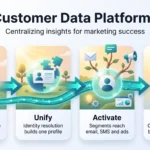
Start by unifying the core record. That may mean consolidating into one CRM, or adding a customer data platform, which is a system that merges customer data from several tools into one profile that other systems can use.
Short-term metrics
Quarterly targets quietly push people toward decisions that cost more later: the aggressive upsell, the fee that surprises, the cancelled fix. Given the PwC finding above, a single bad experience is enough for roughly a third of customers to walk.
Prioritise with an impact-versus-effort view, and make sure at least one metric in every team’s scorecard runs longer than a quarter.
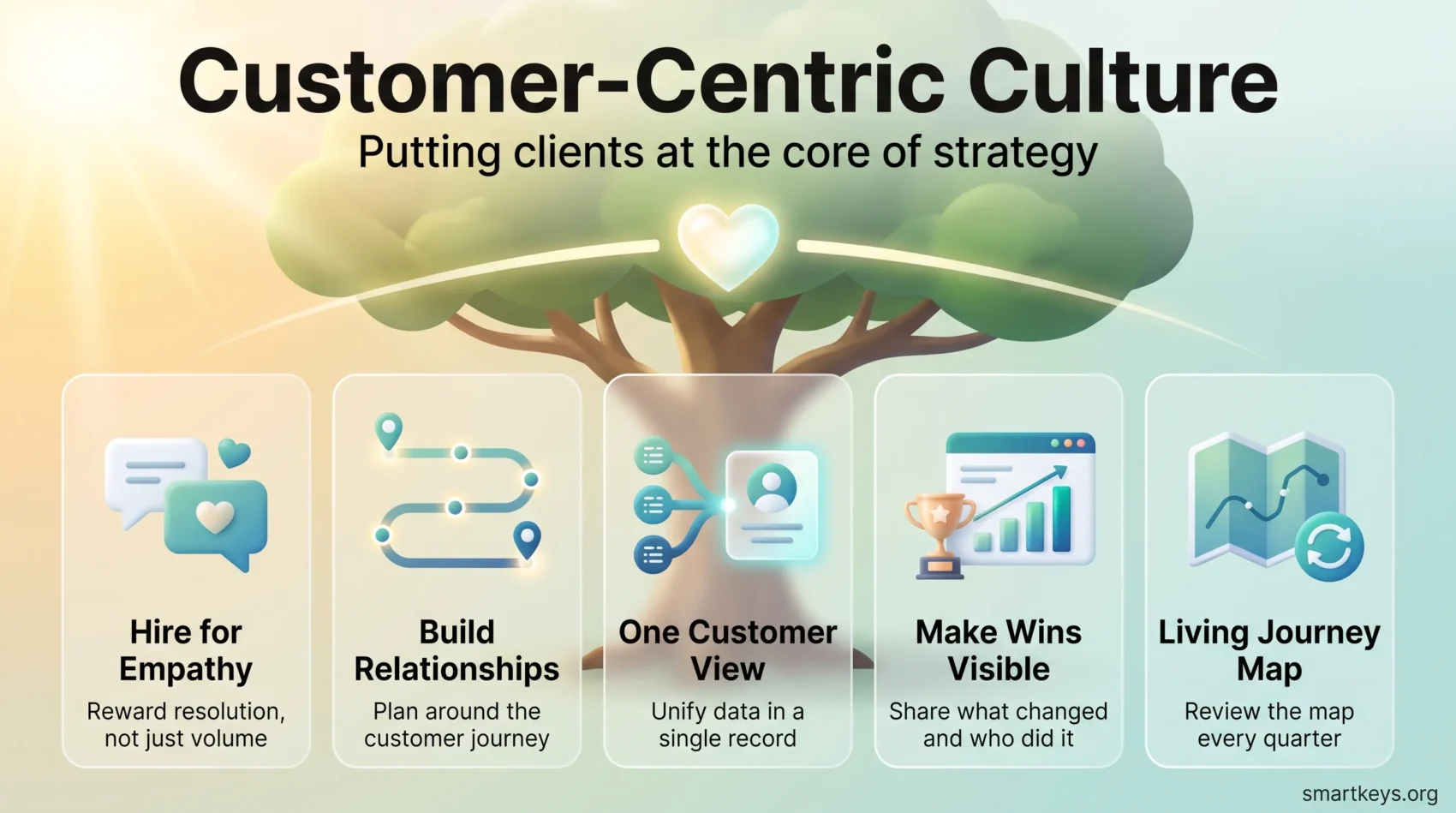
Five pillars of a customer-centric business
These five pillars turn the idea into something a team can actually do on a Monday morning.
1. Hire, train and reward for empathy
Recruit for communication and problem solving, and use real customer scenarios in interviews rather than hypothetical ones. Then make the reward system agree with the message: if bonuses only track volume, empathy is a hobby.
2. Build relationships, not transactions
Move from one-off campaigns to lifecycle marketing, which means planning communication around where a customer is in their journey rather than around your campaign calendar. Scheduled check-ins with larger accounts catch problems while they are still cheap to fix.
3. Unify your data into one customer view
A single customer record covering behaviour, purchases and support history lets any team pick up the thread. This is the foundation for everything else, including AI personalization in customer experience, which only works when the underlying data is clean and complete.
4. Make the wins visible
Publish short internal case studies: what changed, what it moved, who did it. People copy what they can see. A quiet improvement that nobody hears about teaches the organisation nothing.
5. Keep a living journey map
Map the stages from discovery to renewal, mark where customers get stuck, and review it quarterly. A journey map that is updated twice a year is a poster. One that is reviewed every quarter is a management tool.
Operationalising customer experience with data and CRM
A customer relationship management system (CRM) is the software that holds your customer records and interaction history. It is the practical backbone of customer centricity, because it is what stops each team from working with a different version of the truth.
Three things make a CRM earn its cost:
- One record. Sales, marketing, support and product read and write to the same profile.
- Segmentation. Group customers by need and value so you can spend attention where it matters.
- Triggers. Turn usage patterns into action: an onboarding nudge when setup stalls, a check-in when usage drops, a renewal reminder before it is urgent.
Automate the routine touches and keep humans for the complicated ones. A renewal reminder can be automatic. A conversation about a customer who is unhappy should not be. For the wider market picture, see our guide to CRM trends, and for the tools built specifically to spot churn risk, our overview of customer success tools.
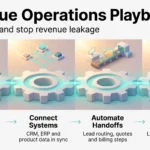
Two more pieces sit alongside the CRM. AI chatbots in customer service handle routine questions at a cost no staffed team can match, provided you make the handover to a human easy. And on the revenue side, RevOps automation tools keep sales, marketing and customer success working from shared numbers. RevOps, short for revenue operations, is the practice of running those three teams under one set of data and targets.
Employee experience is now part of customer experience
This connection used to be an article of faith. It now has numbers attached.
Forrester’s 2026 Total Experience rankings combined three measures into one score: customer experience, brand experience and a new Employee Experience Index. The study covered 406 brands across 11 industries and 13 countries, drawing on more than 350,000 consumer perceptions. In the US, 150 brands were assessed with the new employee measure, and 37% of them showed a negative employee experience impact against 25% showing a positive one.
Read plainly, that means more than a third of the US brands measured are working against themselves. Whatever the customer team does, staff who are frustrated, under-informed or badly equipped drag the experience back down.
The same research contains a warning about easy wins. US scores improved for 53% of brands year over year, but the improvement came more from how non-customers perceive brands (48% of those scores rose) than from what actual customers experienced (28%). Brand perception improved faster than service did.
There is a practical version of this that does not need a budget. Zapier runs what it calls all-hands support: engineers take a weekly rotation on escalated technical tickets, and staff outside the support team spend a half day a week helping customers. The company reports faster fixes, better product decisions and a support team with more standing internally.
If you want to measure the internal side properly, employee Net Promoter Score and AI-powered engagement surveys are the two most common instruments, and our overview of employee engagement trends covers what moves the number.
Measuring what matters: three metrics
Keep the metric set small. Three numbers, reviewed regularly, beat a dashboard nobody opens.
Churn rate
Churn rate is the share of customers who leave in a period. Divide customers lost during the period by the average number of customers in that period.
The number on its own tells you little. Break it down by cohort, which means grouping customers by when they signed up, and by segment. A spike among customers in their first ninety days points at onboarding. A spike among long-standing accounts points at price or a competitor.
Net Promoter Score
Net Promoter Score (NPS) asks one question: how likely are you to recommend us? Subtract the percentage of detractors, who answer 0 to 6, from the percentage of promoters, who answer 9 or 10. The result runs from minus 100 to plus 100.
Ask after onboarding, after a support interaction and once a quarter. The score itself matters less than the written comments underneath it, which is where the reasons live.
Customer lifetime value
Customer lifetime value (CLV) estimates what a customer is worth over the whole relationship. A simple version: average annual revenue per customer multiplied by the average number of years they stay, minus what it cost to acquire them. For a customer paying $2,000 a year who stays five years and cost $1,000 to win, that is $9,000.
CLV is what turns retention from a virtue into a budget argument. It tells you which segments justify a dedicated success manager and which do not. It is also the number that makes sense of acquisition spending, which is why it belongs in any conversation about aligning sales and marketing or building an account-based strategy for high-value clients. For forecasting these numbers forward, see our guide to RevOps tools for business forecasting.
What it looks like in practice
The examples worth copying are usually smaller than the case studies suggest.
McDonald’s added self-order kiosks and table delivery after customers made clear that queueing to order was the worst part of the visit. The change did not require new food. It removed a step people disliked.
Trader Joe’s keeps a deliberately narrow product range and adjusts it based on what shoppers tell staff in store. The feedback loop is short because the decision makers are close to the shop floor.
Costco and Nordstrom both built reputations on returns policies that are more generous than they strictly need to be. The cost is visible on the returns line. The benefit, repeat purchase and trust, is spread across everything else.
Zappos gives support agents the latitude to solve a problem without escalating, including staying on a call for as long as it takes. That works because the company hires for it and measures agents on resolution rather than call time.
The pattern in all four is the same: find the moment customers dislike most, then remove it rather than apologise for it. The same logic applies to selling directly to consumers, where you own the whole experience and the whole problem. Our guides to direct-to-consumer strategy and D2C brands in retail cover what that takes, and e-commerce personalization and wider e-commerce trends show where online expectations are heading.
Where to start
You do not need a transformation programme. You need a first move that produces evidence.
Pick one journey, usually onboarding, because it is where value is won or lost fastest. Map it honestly, including the steps nobody likes to talk about. Find the point where customers most often stall, fix that one thing, and measure churn in the following ninety days.
Then do it again. Unify the data as you go, share what worked, and add a customer outcome to the scorecard of a team that does not currently have one. Customer centricity is not a project with an end date. It is what a company looks like once enough of these small decisions have gone the customer’s way. For the broader direction of travel, our overview of customer experience trends is a useful companion piece.
Found this useful?
Make SmartKeys a preferred source on Google, and our articles will surface more often in your Top Stories, AI Overviews, and AI Mode.
Add as Preferred Source