A price is a decision, not a number. It tells buyers who your product is for, funds everything you build next, and is the fastest lever you have when the market moves.
A pricing strategy framework is the written set of rules your company uses to set and change prices. It names your cost floor, the ceiling your brand can support, who may approve a discount, and how you test a new price before rolling it out. Without those rules, price becomes whatever the loudest person in the room says it is.
Three core approaches sit underneath every framework: cost-based, competitor-based, and value-based. Walmart is the textbook cost-based operator, Samsung watches rivals closely, and Tesla charges for the outcome it promises. This guide covers all three, the research that shows what customers will actually pay, and what changed in 2026 as AI moved pricing decisions into software.
Key Takeaways
- A documented framework replaces gut calls with rules the whole team can apply.
- Your cost floor comes from COGS, operating costs, and the cost to serve each customer.
- Cost, competitor, and value logic solve different problems; most companies use all three.
- Conjoint analysis measures willingness to pay before you commit to a price.
- Hybrid pricing became the most common B2B software model in 2026.
Why a Pricing Framework Beats a Gut Feeling
Most companies do not have a pricing problem. They have a pricing-decision problem: nobody has written down how prices get set, so every launch and discount request is argued from scratch. A framework turns those judgement calls into standing rules, so marketing, sales, product, and support work from the same numbers.
What a documented approach actually changes
Take the most common leak: a sales rep offers 20% off to close a deal at quarter end. With no rule in place, that discount is approved, repeated, and eventually expected. With a framework, the rep knows the floor, knows who approves an exception, and knows what the customer gives up in return, such as a longer contract.
The three questions it has to answer
Every framework answers the same three: how low can we go (the cost floor), how high can we go (the ceiling your brand and competitors support), and who decides. Answer those and you can move quickly when demand shifts. For how pricing fits a wider launch plan, see our go-to-market strategy playbook.
The Numbers You Need Before You Set a Price
Start with the floor. If you do not know what it costs to deliver one more unit or serve one more customer, every other pricing decision is a guess.
Your cost floor: COGS, operating costs, and cost to serve
COGS (cost of goods sold) covers what it takes to produce the thing you sell: materials, manufacturing, production labor, supplier payments, and normal losses such as spoilage or returns. Rent, salaries outside production, and marketing are operating costs, not COGS.
Cost to serve is the third piece and the one companies forget. It is what a single customer costs you after the sale: onboarding time, support tickets, hosting, shipping, payment fees. A software plan can look profitable on COGS alone and lose money once a customer files four support tickets a month.
Add all three together and you have a floor you can defend.
Gross margin and markup: two different numbers
People use these interchangeably, which causes real errors. Markup is how much you add on top of cost to reach the selling price: buy for $60, sell for $100, and your markup is roughly 67%. Gross margin is the share of the selling price left after direct costs, so the same example gives a 40% margin.
Use markup to calculate a price. Use margin to judge whether the business works. Protecting margin is what gives you room to run a promotion safely.
- Compare operating, EBITDA (earnings before interest, taxes, depreciation, and amortization), and net margins to see which costs you can influence.
- Set a minimum acceptable margin before you look at competitor prices, so theirs do not anchor yours.
How price shapes what people think they are buying
Price is also information. Faced with two products they cannot easily compare, many buyers read the higher price as the better one, while a very low price reads as a warning about quality.
So find out which features your customers care about and what they will trade away. Set a floor and a rough ceiling, then test inside that range rather than betting the launch on one number. For how revenue operations teams feed price decisions with cleaner data, read RevOps trends.
Why the Right Price Changes Brand Perception and Profit
The price you publish tells the market who your product is for before anyone reads a feature list. Get it right and you attract the customers you want to serve.

When a higher price makes a product more desirable
For status and aspirational products, a premium price is part of the product. A watch, a business-class fare, or a consulting engagement all trade partly on exclusivity, and cutting the price can reduce demand rather than raise it.
This only works when the price is backed by proof. Superior materials, a faster response time, a longer warranty, or a documented outcome give buyers a reason to accept the premium. Without proof, a high price reads as arrogance.
When a low price destroys trust
Discounting reliably lifts short-term sales, and the cost shows up later. Customers who bought at 30% off wait for the next 30% off, and a permanently discounted product starts to look permanently second-rate.
Hold a floor that covers cost to serve so you never compete on who can lose money fastest. Retention economics beat discount economics, as our guide to customer retention strategies explains.
Anchoring against competitors
Buyers judge your price against whatever they looked at just before. That reference point is the anchor, and you can influence it. If you sit above the market, say why in the same breath: what is included that rivals leave out, what the support commitment is, what happens when something breaks.
- Signal quality: show what is included, not just what it costs.
- Frame the choice: a stripped-down option next to a premium tier makes the premium tier legible.
- Protect margin: justify any higher price with an outcome the customer can name.
Pricing Strategy Framework: The Pillars You Build On
A framework needs pillars that match your business, not a generic template. Otherwise you optimise one number, usually new revenue, while losing ground on margin or retention.
Tie every tier to a customer outcome
Map how price supports growth, margin, and the promise your brand makes. Then give each tier a one-line reason to exist: who it is for, and what they get that the tier below does not. If you cannot write that line, the tier confuses your buyers.
Balance revenue, profit, and retention
Short wins are easy to buy and expensive to keep. A price cut that lifts sign-ups by 15% is a bad trade if it also raises churn, the rate at which customers cancel. Weigh acquisition gains against churn and margin erosion before you celebrate. This is the same tension behind the shift toward a profitability focus rather than growth at any cost.
Decide who approves a price change
- Define the pillars that match your business model, segments, and competitive set.
- Set a review cadence, quarterly for most subscription businesses, so prices do not drift out of date.
- Write the decision rules for holding, raising, or cutting, based on margin guardrails and customer signals.
- Name the approver. Say who signs off on exceptions, how changes are announced, and which metrics prove the change worked.
Find Out What Customers Will Actually Pay
You can measure willingness to pay before launch instead of discovering it afterwards. The methods are well established and cheaper than a failed launch.
Conjoint analysis vs older survey methods
Conjoint analysis, also called discrete choice modelling, shows people realistic product options at different prices and asks them to choose. Because they must trade features against price, you learn what they will actually give up, not what they say they value.
Older methods such as Van Westendorp and Gabor-Grainger ask people what feels too expensive or too cheap. They give a rough acceptable range, useful early on, but cannot tell you which feature mix wins at a given price.
Simulate bundles, tiers, and competitor moves
With conjoint data you can model scenarios before committing. What happens to share and profit if you add a feature to the mid tier, or if a competitor drops its price by 10%? You get an estimate instead of a debate.
Turn the results into packaging
Use the findings to build tiers around real buyer choices, not internal assumptions about who is a “power user”.
- Validate bundles: keep what customers pay for, drop what they ignore.
- Benchmark offers: compare against competitors so you can explain any price gap.
- Feed the roadmap: build the features that raised willingness to pay first.
The Three Core Pricing Strategies and When to Use Them
Most companies end up using all three: cost for the floor, competitors for context, and value for the ceiling.
Cost-based: simple floors and Walmart-style execution
Cost-based pricing adds a fixed markup to your cost. It is fast, easy to explain, and hard to get badly wrong.
Walmart runs a version of this at scale: push supplier costs down, keep the markup thin, make money on volume. Use it when margins are tight, products are comparable, and scale is your advantage. The weakness is that it ignores demand, so if customers would happily pay double, you leave that money on the table.
Competitor-based: benchmark and respond
Here you set price relative to rivals. Samsung prices its flagship phones with a close eye on Apple, positioning just under or alongside depending on the model.
This works well in crowded categories where buyers compare directly. The risk is drifting into a price war that shrinks margins for everyone. Watch how direct-to-consumer brands handle this, since they often compete on service rather than headline price.
Value-based: charge for the outcome
Value-based pricing starts from what the product is worth to the buyer and works backwards. Tesla has sustained premiums this way, selling range, software, and a charging network rather than a metal box.
It captures the most margin but demands the most work: clear differentiation, evidence of the outcome, and research showing customers agree. The value stick framework for value-based pricing breaks that research into four levers you can measure.
- Use cost-based for floors and high-volume operations.
- Use competitor-based for positioning in comparable categories.
- Use value-based where your offer is genuinely different and the benefit is measurable.
What AI and Hybrid Pricing Changed by 2026
Pricing calls that used to wait for a quarterly meeting now happen in software. The dynamic pricing software market grew from about $3.49 billion in 2025 to roughly $4 billion in 2026 and is forecast to reach $6.9 billion by 2030, according to The Business Research Company.
AI sharpens value-based pricing, it does not replace it
Algorithms do not invent a new strategy. They estimate what a product is worth to a specific customer in a specific moment, then recommend a price inside the floor and ceiling you already set. The framework still comes from you; the software runs more experiments than a human team can. For how automated systems read demand signals, see our guide to dynamic pricing strategies for e-commerce and retail and our overview of AI in SaaS.
Hybrid pricing is now the most common B2B software model
Hybrid pricing means a predictable base fee plus a usage-based component: the customer pays a platform charge, then more as they consume more.
It became dominant fast. In the 2026 State of B2B Monetization report, which surveyed more than 230 software and AI companies in April and May 2026, 37% used a hybrid model, up from 25% a year earlier. Per-seat pricing survives mostly at larger vendors: 29% of companies above $150 million in annual recurring revenue still rely on it. Nearly three quarters, 74%, had changed pricing or packaging in the previous year.
The pressure behind that churn is AI cost. When a feature costs you money every time it runs, a flat seat price stops covering it. That is why the usage-based pricing model for SaaS keeps gaining ground, and why 33% of those companies planned to introduce AI credits within six to twelve months.
The trust problem nobody has solved
Faster price changes carry a cost spreadsheets miss. In a CivicScience survey of 1,674 US adults in March 2024, 68% agreed that dynamic pricing amounts to price gouging, up from 61% in July 2023. Customers noticing prices move around them is a retention risk, not just a PR one, and it compounds the subscription fatigue many buyers already feel.
What this means for your framework
- Keep your guardrails: AI recommends prices faster, but your cost floor and brand ceiling still apply.
- Test hybrid structures: pair a predictable base price with usage-based upside the customer can see.
- Review quarterly: with packaging changing across the market every year, an annual review is too slow.
- Explain every change. If a customer cannot understand why their price moved, the algorithm cost you more than it earned.
“AI changes how fast you can test a price, not whether you still need a floor, a ceiling, and a reason customers believe in.”
Tactical Pricing Plays That Move Markets
Small, deliberate moves often decide whether products win or fade in a crowded market. Each play below solves a specific problem and has a failure mode.

Penetration pricing: buy share, then normalise
Penetration pricing launches deliberately low to win customers quickly, then raises prices once habit and loyalty take hold. Budget airlines built the playbook: enter a route well under the incumbent fare, fill seats, then adjust. The failure mode is common: if customers only came for the low price, they leave when it rises.
Price skimming: capture early adopters first
Price skimming does the opposite. You launch high, collect revenue from the people who must have it first, then lower the price as the market broadens. Apple runs this every year: a new iPhone debuts at a premium while previous models step down. It needs genuine novelty, because skimming a product rivals already sell cheaply just loses you the launch.
Premium pricing: signal quality permanently
Premium pricing is a standing position, not a launch tactic. Consulting firms charge multiples of the market rate because reputation and results back the claim, which protects margin and filters for customers who value outcomes over cost.
Bundle pricing: raise average order value
Bundling combines items into one price lower than the parts. It lifts average order value, simplifies a confusing choice, and moves slow inventory. The McDonald’s Happy Meal is the enduring example: one decision instead of four.
Loss leaders and the predatory pricing line
A loss leader is a product sold at or below cost to bring people in, on the expectation they buy something profitable too. That is legal and common.
Predatory pricing is different: pricing below cost specifically to drive competitors out, then raising prices once they are gone. US antitrust law treats it as unlawful, and courts have leaned on the Areeda-Turner test, which asks whether a price sits below an appropriate measure of cost. Take legal advice before any sustained below-cost campaign.
- Pick plays based on category dynamics and how easily buyers compare prices.
- Train sales and support on the legal guardrails and on what to say when prices change.
- Test small, and measure the effect on sales, churn, and margin before scaling.
Pricing Models vs Pricing Strategies: Do Not Mix Them Up
The model decides how you package and bill. The strategy decides what number goes on it. Confusing the two produces plans that are hard to explain and margins hard to defend.
Subscription, flat-rate, and tiered plans
Subscription and flat-rate billing make costs predictable for the customer and revenue predictable for you. Tiered plans layer on top: a simple entry option for mainstream buyers, advanced tiers for heavier users.
Three tiers is the common pattern because it lets you anchor a middle “best value” plan between a basic and a premium option. More than four usually creates choice paralysis. Our overview of subscription-based business models covers how these structures are evolving.
Freemium and pay-as-you-go
Freemium gives away a limited version permanently and charges when users outgrow it. Dropbox built its early growth on a free storage tier that ran out exactly when files started mattering. It works when the free product is genuinely useful and the upgrade trigger is obvious, a balance our guide to the freemium model examines in detail.
Pay-as-you-go charges purely for consumption. It suits products where usage varies widely between customers and ties revenue to value delivered, at the cost of harder forecasting.
How the two fit together
Pick the model that matches how customers buy, then apply cost, competitor, or value logic within it. A self-serve product usually pairs freemium or usage-based billing with value-based pricing; an enterprise sale pairs tiered subscriptions with negotiated value pricing. That trade-off is the heart of product-led versus sales-led growth.
Monitoring Competitors and Adjusting Prices
Watch the market on a schedule so price changes are decisions rather than reactions. Log competitor moves, note what triggered them, and review on a fixed cadence.
Three ways to respond
Cooperative: match the competitor to hold share and avoid a wave of cancellations. Sensible when the products are close substitutes.
Aggressive: undercut to win volume fast. Test on one segment first, because an irreversible rollout is how price wars start.
Dismissive: hold your price and say nothing. This is right more often than people think, especially when customers stay for reasons a rival’s discount does not touch.
When to hold, match, or lead
Set thresholds in advance: how far a competitor has to move, how much margin you will give up, and how big a gap your value story can carry. Written rules keep teams from reacting to a single lost deal.
- Set a monitoring cadence and the signals that trigger an immediate review.
- Choose the response based on your position, margin, and customer expectations.
- Assess the downside, including price wars and margin compression, before reacting.
- Prepare the customer message alongside the price change, not afterwards.
Metrics, Guardrails, and Price Architecture
Price architecture is the structure that holds your offers together: the floors, the ceilings, the tiers, and the add-ons, plus the rules for who can change what. You already have the floor. Set the ceiling from what research says customers will pay, what competitors charge, and what your brand can support without straining credibility. Between the two sits a range you can test inside safely.
The five metrics that tell you if pricing works
Track these together, because each one alone can mislead.
- ARPU (average revenue per user): total revenue divided by customers. Shows whether prices are actually rising.
- Gross margin: confirms the revenue is worth having.
- CAC payback: how many months of revenue it takes to recover what you spent acquiring a customer. Under twelve months is a common healthy benchmark for software.
- Churn: the share of customers leaving each period. A price rise that lifts ARPU while doubling churn is a loss.
- Expansion revenue: extra revenue from existing customers upgrading. The clearest sign your tiers are built correctly.
Tools that surface these signals early are covered in our guide to customer success tools.
Regional and time-based prices without damaging trust
Regional pricing reflects real differences in cost, tax, and purchasing power. Customers accept it when you explain it and resent it when they discover it themselves.
Keep the value message identical across regions, name the reason for the difference, and avoid publicising temporary discounts so often that buyers learn to wait. Rising expectations around fairness sit inside the wider shift covered in customer experience trends, and personalised pricing is increasingly touched by AI regulation.
Putting the Framework to Work This Quarter
You do not need a six-month project to get most of the benefit. This sequence fits one quarter.
A twelve-week sequence
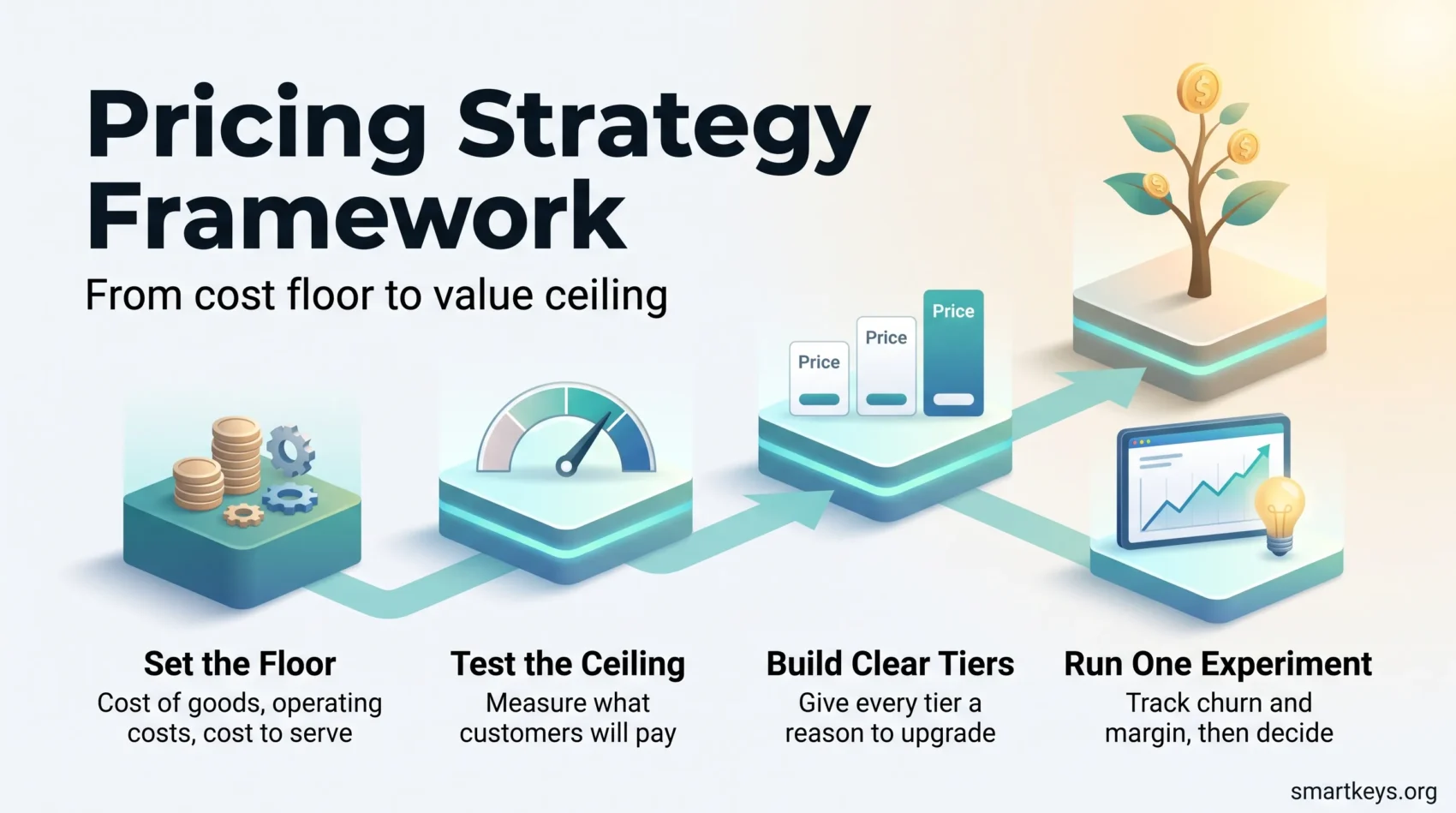
- Weeks 1 to 2, establish the floor: calculate COGS, operating costs, and cost to serve for each plan. Most companies find at least one offer that is quietly unprofitable once support and payment fees are counted.
- Weeks 3 to 5, test the ceiling: run a conjoint study, or preorder and landing-page tests at different price points if budget is tight. You want evidence, not opinions, about where buyers stop.
- Weeks 6 to 8, rebuild the packaging: give each tier a clear owner and reason to upgrade. Check the entry tier is not so generous that nobody moves up, and the top tier not so vague that nobody buys it. This is where pricing meets business model innovation.
- Weeks 9 to 12, run one experiment: pick a single change, define the success metric first, and test it on one segment with a holdout group. Watch churn and conversion, and be ready to roll back.
Conclusion
A pricing framework is the difference between a price you can defend and a price you have to apologise for.
Build the floor from real costs, including the cost to serve. Set the ceiling from research and competitive context. Choose the billing model that matches how customers buy, then apply cost, competitor, or value logic within it.
The 2026 shift toward hybrid and usage-based pricing does not change those fundamentals. It raises the cost of getting them wrong, because packaging now changes across the market every year rather than every three. So make it repeatable: test one change at a time, measure the effect on margin and churn, and explain every price move before customers have to ask.
Found this useful?
Make SmartKeys a preferred source on Google, and our articles will surface more often in your Top Stories, AI Overviews, and AI Mode.
Add as Preferred Source