Customer experience, usually shortened to CX, is the sum of every contact a person has with your company: finding you, buying from you, getting help afterwards. In 2026 the interesting part is not that CX matters, but that two of its foundations moved at once.
The first shift is where people find you. Search increasingly answers questions on the results page instead of sending a click, and more shopping starts on Amazon, TikTok or an AI assistant.
The second is what happens once you have someone’s attention. Almost every company has tried generative AI in service and marketing; very few can show what it earned them. That gap, rather than the technology itself, is the story of the year.
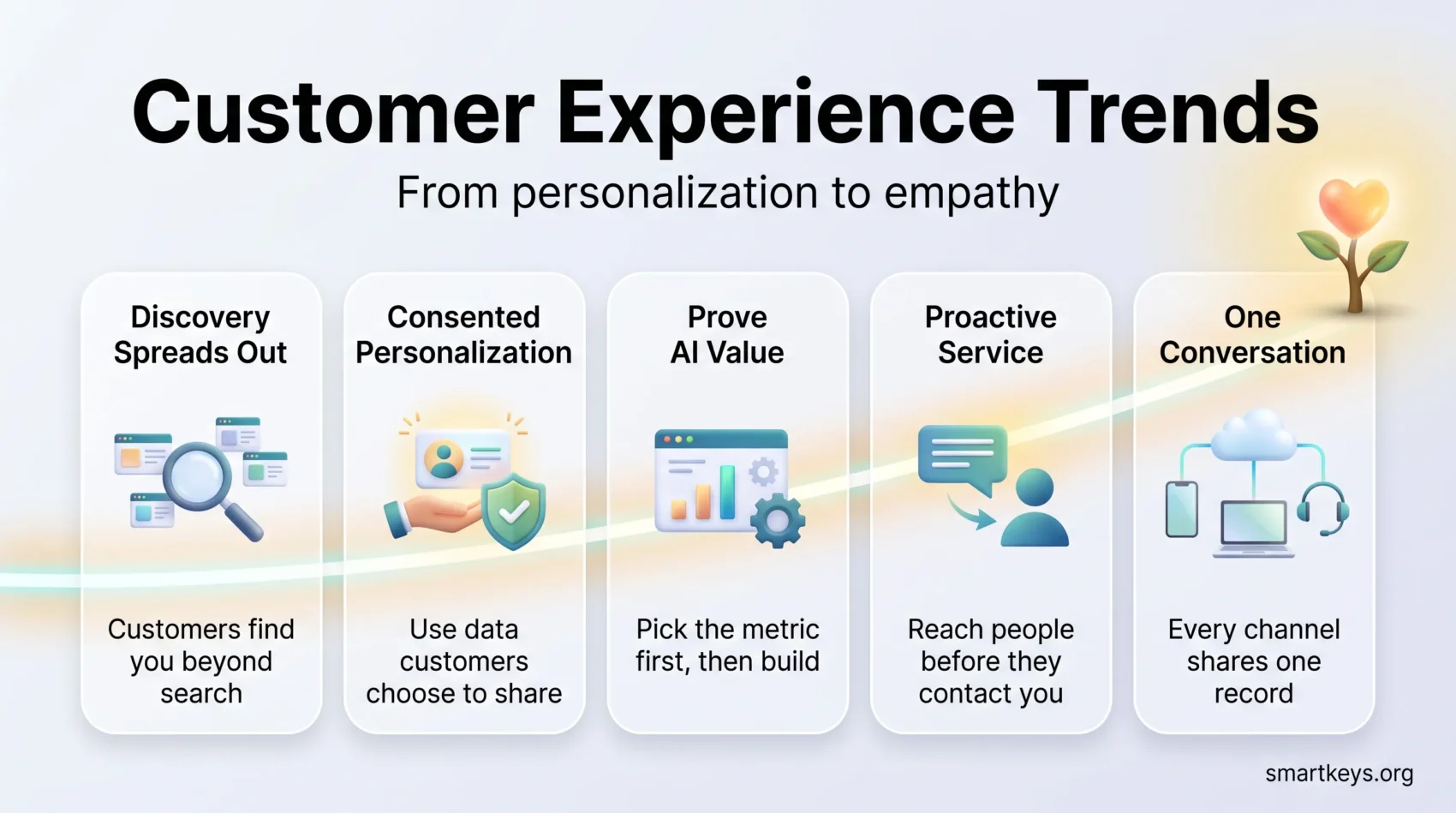
This guide covers both shifts: how discovery changed, what personalization is worth, how to prove an AI project paid off, and why proactive contact now decides whether someone stays.
Key Takeaways
- Most Google searches now end without a click, so visibility has to be earned outside your own site as well as on it.
- Personalization has a measurable payoff, but only where consent and data quality are in place first.
- AI pilots fail on unclear goals and messy data far more often than on model quality.
- Tie every AI deployment to plain metrics: cost per resolution, satisfaction, revenue.
- Contacting customers before they contact you removes work and builds goodwill at the same time.
- From 2 August 2026, EU rules require you to tell people when they are talking to an AI system.
Why customer experience trends matter right now
Search used to be a referral machine: you published something useful, Google sent a visitor, you served them. That arrangement is weakening. In the first four months of 2026, 68% of US Google searches ended without a click on any result, according to SparkToro’s analysis of Similarweb clickstream data. In 2024 the same measure was 60%. AI Overviews, the summary boxes at the top of many results, are the main reason: when one appears, far fewer people click through to a website.
What this changes for your business
It does not mean search stopped working. It means the click is no longer the only unit of value. Your content has a second job now: to be accurate and quotable enough that an AI summary represents you correctly, even when nobody visits.
So make sure your prices, opening hours, shipping terms and product specifications are machine-readable and correct, because assistants will repeat them either way. Keep the site fast and crawlable, and decide deliberately which AI crawlers you allow: blocking all of them also removes you from the answers they generate.
Discovery has spread out
Shopping increasingly starts somewhere other than a search box. Amazon alone accounts for roughly 40% of US retail e-commerce sales on eMarketer’s estimates, and product discovery on social platforms keeps growing. Answer engines such as ChatGPT and Perplexity now sit alongside them.
The practical response is unglamorous: be present and accurate in every place your customers look, rather than optimising one channel perfectly. Our guides to social commerce in 2026 and voice search in 2026 cover those two routes.
Economic pressure is reshaping what buyers expect
When budgets tighten, buyers get more deliberate. They compare more, they wait for a reason to buy, and they notice which brands give them something concrete rather than a slogan.
Two mechanisms answer that directly. Brand-funded cashback returns part of the purchase price to the buyer. Receipt-scan programmes let a customer photograph a till receipt to claim a reward, which also tells the brand what was bought and where, even when the sale happened in a shop it does not own.
Why these programmes matter beyond the discount
Both generate what marketers call first-party and zero-party data. First-party data is what you observe directly: orders, support tickets, site behaviour. Zero-party data is what a customer deliberately tells you, such as their size, their preferences or when they next plan to buy.
Both are collected with the customer’s knowledge, which is exactly why they have become valuable as third-party tracking cookies faded out. Our guides to zero-party data and first-party data strategy go through the collection mechanics in detail.
The prerequisite most companies skip
None of it works if the data lands in five systems that do not talk to each other. A customer data platform, which merges records about the same person from different tools into one profile, is the usual fix. It is also the step teams postpone, because it produces no visible feature. Skipping it has a predictable cost: your recommendation engine works from a partial picture, so the recommendations are worse than the effort you put into them. See our overview of customer data platforms.
From personalization to hyper-personalization
Personalization means adapting what someone sees to what you know about them. Hyper-personalization is the same idea with faster inputs: the profile updates during the session rather than overnight, so the next page reflects what the person just did.
What it is actually worth
The most reliable public figures come from McKinsey. Its research found that 71% of consumers expect personalized interactions and 76% are frustrated when they do not get them. On the revenue side, McKinsey puts the typical lift from personalization at 10% to 15%, with a range of roughly 5% to 25% depending on the sector and how well a company executes.
That range is the honest part. Personalization is not a switch that adds a fixed percentage: a retailer with a wide catalogue and frequent repeat purchases has far more to gain than a company selling one product every five years. Much of that gain comes from prediction: spotting who is about to buy, or about to leave, before they act. Our guide to predictive analytics for customer experience covers the data work behind it.
How to build profiles without unsettling people
The line between helpful and creepy is mostly about whether the customer understands why you know something. A recommendation based on what they just browsed reads as useful. One based on data they never knowingly gave you reads as surveillance, even when it is legal. Three habits keep you on the right side of it:
- Give people a preference centre where they can see and change what you hold about them.
- Prefer data the customer supplied over data you inferred, and say which is which.
- Personalize timing and relevance before tone. The right message at a sensible moment matters more than a first name in a subject line.
For the mechanics of applying this in a shop, see e-commerce personalization and our look at AI personalization in customer experience.
From hype to hard ROI: the AI reality check
Almost every company has run an AI pilot in service or marketing. Far fewer have anything to show a finance director.
The failure rate is real, and the reasons are boring
In 2024, Gartner predicted that 30% of generative AI projects would be abandoned after the proof-of-concept stage by the end of 2025. A 2025 report from MIT’s Media Lab put the picture more starkly, finding that roughly 95% of enterprise generative AI pilots produced no measurable effect on profit and loss.
Both figures point at the same causes, and none of them is model quality. Pilots stall because the underlying data is inconsistent, because nobody agreed in advance what success would look like, or because the tool was never wired into the system where the work actually happens.
Decide the number before you start
The fix is unfashionable but effective: pick the metric first, measure the baseline, then build. Useful ones for CX are:
- Containment rate: contacts fully handled without a human. Track it alongside satisfaction, because a bot that traps people scores well here and badly everywhere else.
- Cost per resolution: channel cost divided by issues actually resolved.
- First-contact resolution: issues closed on the first interaction.
- Average handle time: useful for spotting where agents lose time, misleading alone.
- Revenue effect: measured against a holdout group that did not get the new experience.
The holdout group is the part teams skip and the part that makes the result credible. Without a comparison group you cannot separate what your AI did from what the season did.
Governance is now a legal requirement, not a nice-to-have
Since 2 August 2026, Article 50 of the EU AI Act requires that people are told when they are interacting with an AI system rather than a human, unless that is obvious from the context. Certain AI-generated content must also be marked as such. If you serve EU customers, a chatbot that pretends to be a person is no longer just poor manners.
That makes basic governance worth doing properly: record which models you use and on what data, keep a human review path for consequential decisions, and be able to explain an output on request. Our guides to EU AI Act compliance and AI regulation in 2026 cover the detail.
Specialized AI beats general-purpose tools for support
A general chatbot answers anything plausibly. A support agent has to answer your specific returns policy correctly, every time. Those are different jobs, and the second is where narrower tools win. A purpose-built CX agent is constrained to your own material: help articles, order data, policy documents. It is usually cheaper to run and easier to keep on topic, and it can be blocked from answering outside its remit rather than inventing something.
What to check before you buy
- Can it read your live systems, so it knows where an order actually is rather than describing the process in general?
- What happens when it does not know? A clean handover beats a confident wrong answer.
- Where is your data processed, and does the vendor train on your conversations?
- Can you see and change the rules it follows, or is the behaviour a black box?
Gartner forecast in March 2025 that agentic AI would autonomously resolve 80% of common customer service issues by 2029. Whether or not that figure holds, the direction is clear enough to plan around: routine contacts move to software, and human time concentrates on the complicated and the emotional. Our review of AI chatbots in customer service covers what works in practice today.
Proactive service: reach people before they contact you
Most support tickets are not surprises. A payment fails, a delivery slips, a subscription is about to renew at a higher price. In each case you know before the customer does. Proactive service means using that head start: instead of waiting for the complaint, you send the message. Your payment did not go through, here is the link to fix it. The ticket never gets created, and the customer feels looked after rather than let down.
How to build it
Start by listing the five events that generate the most inbound contact. For most companies the list is predictable: failed payments, shipping delays, account lockouts, renewal price changes, usage limits about to be hit. For each one, write the message you would have sent had you known in advance, then trigger it automatically from the event. Keep it specific and give a way to act in the same message. A vague “there may be a delay” creates a ticket instead of preventing one.
Measure prevention, not just speed
The metric that matters is contacts avoided: how many tickets never arrived because the outreach went out. Compare a group that receives the message with one that does not, counting inbound contacts for the same event in both. That comparison is the whole argument for the programme.
Proactive contact also feeds retention, because the moment a problem is handled well is the moment loyalty is decided. Our guide to customer retention strategies goes further on that link.
Omnichannel: make every channel feel like one conversation
Omnichannel means a customer can move between your website, app, email, phone and social messaging without starting again. The test is simple: if someone explains their problem in chat and then rings you, does the person on the phone already know? For most companies the answer is no, and the reason is structural. The chat tool, the phone system and the email inbox each store their own history, and nothing joins them.
What actually fixes it
The fix is a shared customer record that every channel reads from and writes to, usually the CRM or the customer data platform, so channel tools become interfaces onto one history rather than five archives. Our overview of CRM trends in 2026 covers how that layer is evolving.
Three things must travel with the customer: the transcript, the intent behind the contact, and any commitment your company made. The last matters most. Nothing erodes trust faster than a promise made in one channel that nobody in the next can see.
Design the handover between bot and human
When a bot passes a conversation on, the agent should arrive with the transcript and the stated problem already in front of them. Asking the customer to repeat everything undoes whatever time the automation saved and confirms their suspicion that the bot was a filter rather than a service.
For the strategic view of the same discipline, see our piece on omnichannel strategies.
Voice and conversational commerce
Voice assistants handle a narrow set of tasks well: reordering something bought before, checking where a delivery is, adding to a list. They handle open-ended shopping badly, because comparing options is a visual task. So build for the narrow set. Reorders, status checks and simple account changes are worth wiring up properly; browsing a catalogue by voice is not.
Two terms come up constantly here. Natural language processing (NLP) is how software breaks spoken or written language into something it can work with. Natural language understanding (NLU) works out what the person actually wants, so “where’s my stuff” and “track my order” reach the same place.
What decides whether a voice feature is useful is not recognition accuracy. It is whether the assistant can finish the job. An assistant that finds the order but cannot change the delivery date has moved the customer one step closer to calling you. Our guide to conversational commerce looks at where these interactions genuinely sell.
AR and VR: useful where uncertainty blocks the sale
Augmented reality (AR) puts a digital object into a view of the real world, usually through a phone camera. It earns its cost in one specific situation: when a customer would buy, but cannot tell whether the thing will fit, suit them or match what they already own.
That is why it took hold in furniture, eyewear, cosmetics and paint, and not where the buyer already knows what they are getting. Placing a sofa in your own living room answers a real question; an AR view of a phone charger answers nothing.
How to judge whether it is worth it
Pick a category with a high return rate driven by “it did not look like that” and measure two numbers against customers who did not use the feature: return rate and conversion rate. If returns do not fall, the feature is decoration.
Our article on AR in e-commerce covers the retail applications in more detail.
Loyalty in an age of choice
Loyalty programmes have split in two. One rewards spending with points that expire before anyone uses them. The other gives something people actually want: money back, faster delivery, priority support, early access.

Design for redemption, not enrolment
The number worth watching is not how many people joined. It is what share of earned rewards get redeemed. A low redemption rate means members are carrying a promise they never cash in: a liability on your balance sheet and a disappointment in their inbox. Make the reward easy to reach and easy to spend, and tie benefits to what a segment actually values rather than to a tier number. A frequent buyer wants faster delivery; an occasional big spender wants help choosing.
Be explicit about the trade
Members are exchanging information for value, and they know it. Saying so plainly beats pretending the programme is a gift: tell them what you collect, what they get, and how to leave. Our guides to customer loyalty in the digital age and data privacy trends in 2026 cover programme design and the rules shaping it.
Organic brand marketing returns
Paid channels have grown more expensive and less predictable, and AI made competent-looking content cheap to produce. Both push the same way: what stands out now is material that could only have come from you.

What is hard to imitate
Your own data, your own customers and your own mistakes. A support team that publishes the five problems it sees most often, with the actual fixes, produces something no general model can generate, because the raw material never left your company. The same applies to customer content: reviews, photographs and questions from real buyers carry a credibility polished copy does not, and they answer the specific doubts that stop a sale.
Write to be quoted
With most searches ending on the results page, being cited in an answer is a distribution channel in its own right. That rewards a particular style: state the answer plainly near the top, keep claims specific and attributable, and structure the page so a machine can tell which paragraph answers which question.
Our piece on AI in marketing covers the operational side of this.
Conclusion
The two shifts in this article are connected. Discovery moved away from your website, so the value of each contact you do get went up, and AI made it cheap to handle those contacts badly at scale.
The companies doing well in 2026 are not the ones with the most AI. They are the ones that fixed their data first, picked a small number of measurable problems, and stayed honest with customers about what is automated.
If you do one thing this quarter, make it the boring one: pick a single high-volume customer problem, measure what it costs you, then change it and measure again. That habit outlasts any particular technology, and it lasts longest in companies where every team asks what the customer needs before it asks what suits the org chart. If that is where you want to get to, our guide on how to build a customer-centric culture covers the roles, rituals and metrics involved. For the service side, our overview of customer service trends in 2026 is a good next step.
Found this useful?
Make SmartKeys a preferred source on Google, and our articles will surface more often in your Top Stories, AI Overviews, and AI Mode.
Add as Preferred Source