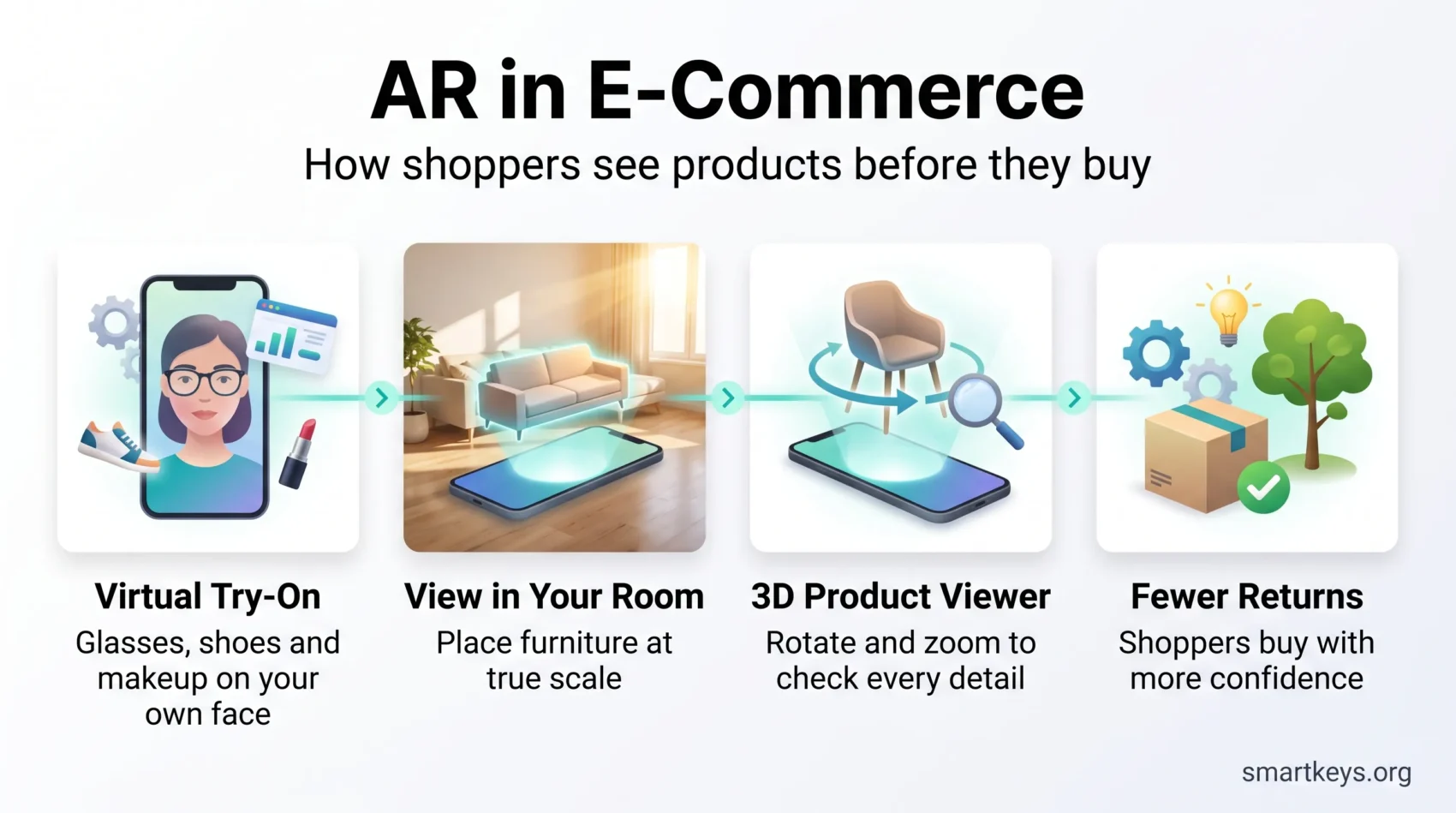
Augmented reality (AR) lets online shoppers see a product on their own body or in their own room before they buy it. That fixes the oldest weakness of online shopping: the gap between the photo and the real thing. The sofa turns out too big, the glasses do not suit your face, the lipstick looks different in daylight. AR e-commerce closes part of that gap by putting the product into the shopper’s real surroundings through a phone camera.
This article explains what AR in online shopping is, what the evidence says about conversion and returns, where AR shopping happens in 2026, and how a store of any size can get started.
Key Takeaways
- AR shopping means seeing a product in your real environment through a camera. It runs mostly on smartphones, not on headsets.
- The strongest business case is fewer returns. US retailers expected $849.9 billion in returned merchandise in 2025, and 19.3 percent of online sales came back (NRF and Happy Returns).
- In a Shopify case study, shoppers who viewed a Rebecca Minkoff product in AR were 65 percent more likely to buy. Such results come from single brands, not from the whole market.
- Google, Amazon and Snapchat now offer AR or AI try-on at platform level, so shoppers can use it even when the store itself has no AR feature.
- Smart glasses sold in the millions in 2025, but AR shopping on glasses is still early. In 2026 the phone remains the device that matters.
What Augmented Reality Means in Online Shopping
AR is often confused with virtual reality, and the two solve different problems for retailers.
Defining Augmented Reality
Augmented reality adds digital objects to a live view of the real world. You point your phone at your living room and a 3D model of a lamp appears on your side table at the right size. Virtual reality (VR) is different: it replaces your surroundings entirely with a computer-generated scene, usually through a headset. For shopping, AR is the more useful of the two. It answers the question customers actually have: “How will this look in my life?”
Most AR shopping uses one of three delivery methods: a retailer’s own app, such as IKEA’s Kreativ tool; web AR, where a 3D model on a product page opens in the phone’s built-in viewer with nothing to install; or a platform feature, such as a Snapchat Lens or Google’s try-on button in Search. The shift of shopping to mobile devices made all three practical, because almost every shopper now carries a capable camera.
How AR Changes the Way People Shop Online
Traditional product pages give you photos, dimensions and reviews. You still have to imagine the rest. AR removes some of that work: a shopper can check whether a bookshelf fits the alcove, whether frames suit a round face, or whether a foundation shade matches their skin. Each of those checks used to require a store visit or a return.

The effect is strongest where fit, size or colour decide the purchase: furniture, eyewear, footwear, cosmetics and fashion. AR is one of several trends reshaping how people buy online, and it works best alongside good product data rather than as a standalone showpiece.
What the Evidence Says About Conversion and Returns
AR vendors quote big percentages, and many cannot be traced to a real study. Here is what can be verified.
Conversion: Real Results from Single Brands
Shopify publishes case studies from merchants that added 3D and AR to product pages. For fashion brand Rebecca Minkoff, shoppers who viewed a product as a 3D model were 44 percent more likely to add it to the cart. Shoppers who viewed it in AR were 65 percent more likely to buy (Shopify, Rebecca Minkoff case study). These are strong numbers, but they describe one brand’s customers, and shoppers who open an AR view are already more interested than average. The fair conclusion: AR improves results for the shoppers who use it, and how many use it depends on the category and on how visible the feature is.
Returns: The Bigger Prize
Returns are where AR earns its keep. The National Retail Federation and Happy Returns estimated that US consumers would return $849.9 billion of merchandise in 2025, or 15.8 percent of annual sales. For online sales the rate was 19.3 percent (NRF, October 2025). Every avoided return saves shipping, handling and often a markdown.
A 2022 survey of 4,028 shoppers by Alter Agents, commissioned by Snap and Publicis Media, found that two-thirds were less likely to return a product after using AR, and 80 percent felt more confident in their purchase (reported by Retail Dive). The study was funded by an AR platform, so treat it as directional. The mechanism is easy to understand, though: a shopper who has seen the sofa in the room is rarely surprised when it arrives. The same logic applies to resale and recommerce platforms, where accurate size and condition information decides whether a second-hand item stays sold.
Key AR Features for Online Stores
Three feature types account for almost all AR shopping in 2026: virtual try-on, product placement in the room, and interactive 3D viewers.
Virtual Try-On
Virtual try-on puts a product on the shopper’s face, feet or body using the phone camera. Eyewear made it work first, because a face is easy to track; Warby Parker has offered try-on in its app for years. Footwear followed. Beauty is the largest use case by volume. L’Oréal’s ModiFace technology powers makeup try-on across its brands. In June 2026 L’Oréal and OpenAI announced that Maybelline try-on would run directly inside ChatGPT, so a shopper can test a lipstick shade while chatting with an AI assistant (L’Oréal press release, 17 June 2026).
Clothing is the hardest category, because fabric drapes and bodies vary. Here the technology has shifted from live AR toward AI image generation. Google launched an apparel try-on feature in Search in July 2025 that places garments on a photo of the shopper. It added shoes and expanded to Australia, Canada and Japan in October 2025, and since December 2025 a simple selfie is enough (TechCrunch). Google shut its standalone Doppl try-on app on 30 April 2026 and folded the feature into Search and Shopping. The result is a still image rather than a camera view, but for the shopper the question answered is the same.
Seeing Products in Your Own Room
For furniture, lighting and decor, placement in the room is the killer feature. IKEA’s Kreativ tool, launched in 2022 on technology from its acquisition Geomagical Labs, scans a room into an editable 3D model. You can erase your existing furniture and place IKEA products in the cleared space. Amazon offers “View in Your Room” for furniture and decor. Paint brands such as Dulux use a visualiser app to preview colours on the shopper’s actual walls.
Dimensions on a spec sheet rarely stop people from buying the wrong size; seeing the item in the room does. This is also where online and physical retail blur, a shift covered in our guide to phygital retail experiences.
Interactive 3D Product Viewers
Not every product needs to be placed in a room. A 3D viewer that lets the shopper rotate and zoom already answers many questions about materials and finish. Amazon’s “View in 3D” supports shoes, eyewear, furniture, toys and electronics, and Shopify lets merchants attach 3D models to product pages. The 3D model is the raw material for all three feature types: produce it once, reuse it everywhere.
Where AR Shopping Actually Happens in 2026
In 2026 most AR shopping happens on platforms the retailer does not own.
Marketplaces and Search
Amazon lets sellers add 3D models, “View in Your Room” and virtual try-on for shoes and eyewear at no extra cost beyond a professional selling plan, provided the models meet its technical requirements (Amazon Seller Central). Google’s try-on works on product listings across Search, Shopping and Images. Shoppers may therefore meet a brand’s AR experience in a search result before they ever visit its site. Feeding accurate product data and 3D assets into these channels is part of any serious omnichannel marketing approach, and it matters most on large digital marketplaces where listings compete side by side.
Social Platforms
Snapchat remains the largest AR shopping surface. Snap reported 493 million daily active users in the second quarter of 2026, and its Lenses let brands offer try-on for glasses, sneakers or makeup inside the app. At Retail Week Live 2025, Snapchat said that 81 percent of Gen Z shoppers want AR to enhance in-store shopping too. These features live where younger shoppers already spend time, which is one reason social commerce keeps growing as a sales channel.
Smart Glasses: Real Sales, Early Days for Shopping
The device story changed in 2025. EssilorLuxottica sold more than 7 million Ray-Ban Meta and Oakley Meta smart glasses in 2025, more than triple the year before, and estimates about 9 million units since the October 2023 launch (Q4 2025 results, reported by UploadVR). Meta Ray-Ban Display, the first model with a built-in screen, went on sale on 30 September 2025 at $799. At I/O in May 2026, Google announced Gemini-powered glasses made with Samsung, Gentle Monster and Warby Parker for autumn 2026, audio-only first and display versions later. Snap has scheduled a launch event for its consumer Specs AR glasses on 16 September 2026.
For shopping, expectations should stay modest. Today’s best-selling glasses have cameras and AI assistants but no display, or a small one for messages and directions. They can identify a product and answer questions about it. They cannot render a sofa in your room. Apple’s Vision Pro can, but at a starting price of $3,699 since June 2026 it is a niche device. Snap’s CEO expects broad adoption of AR glasses “towards the end of the decade”. Our overview of smart glasses at work and our guide to wearable technology in the workplace cover what current models can do.
How to Add AR to Your Online Store
You do not need an app or a development team to start.
Start with the Products That Get Returned
Pull your return data and sort by reason. Products returned for “wrong size”, “does not fit the space” or “looked different” are the candidates. Produce 3D models for those first and measure the effect before scaling. This follows the logic of any customer experience improvement: fix the moments where expectations and reality diverge most.
Produce 3D Models Once, Reuse Everywhere
A 3D model can come from a CAD file, from photogrammetry (photographing the object from many angles), or from AI tools that build a model from a few images. A poor model undercuts trust, so check each one on a real phone. Models in the standard GLB and USDZ formats serve Shopify, Amazon listings and web AR alike. Companies that already use AR and VR in product prototyping often have assets they can reuse for selling.
Use Platform Features, Then Measure
Amazon’s free 3D and AR options, Google’s try-on and Snapchat Lenses reach shoppers where they already are. A custom AR app makes sense only for brands with a large catalogue and repeat visitors, such as IKEA. Then track three numbers: how many product page visitors open the AR view, their conversion rate compared with everyone else, and the return rate for AR-enabled products before and after. Our guide to using big data to improve customer experience shows how to set up that comparison.
Limits and Risks
Accuracy comes first. A 3D model that is slightly off in colour or scale creates the very mismatch AR is meant to remove. Cost is second: professional models for a large catalogue add up, and each product change requires an update. Adoption is third. Many shoppers never notice the AR button, so place it prominently and explain it in one line.
Privacy deserves its own paragraph. Try-on features process images of faces and bodies, and photo-based try-on may store them. Say plainly what is kept, for how long, and whether it trains any models. In the EU and in US states with biometric laws, face data can carry extra obligations. Finally, AR should not replace the basics: clear dimensions, size charts and good photos still serve every customer, including those who do not want to use a camera.
What Comes Next
First, AI-generated try-on is merging with AR. Google’s photo-based apparel try-on and L’Oréal’s makeup try-on inside ChatGPT show that the experience can live inside a search engine or a chat assistant. This ties AR to the wider move toward conversational commerce, where a shopper asks an assistant a question and gets a visual answer. The same assistants increasingly handle personalised recommendations, so a try-on may soon start with “show me a jacket that suits me” rather than with a product page.
Second, glasses will slowly take over tasks from the phone. Once display glasses from Meta, Google and Snap become common and affordable, placement and try-on will move to eye level. That is a late-decade story, but the 3D assets a store creates now will still be the raw material.
Third, the line between online and physical retail will keep fading. AR adds product information, virtual stock and try-on to the store aisle, while retailers experimenting with checkout-free and autonomous stores work on the same convergence from the other side.
Conclusion
Augmented reality has become a normal part of online shopping in categories where fit, size and colour decide the purchase. The verified evidence points to two benefits: shoppers who use AR buy with more confidence, and fewer of them send products back. Against US return volumes approaching $850 billion a year, even modest improvements are worth real money.
The practical path in 2026 is clear. Start with the products that come back most often, produce 3D models once and reuse them across your site, Amazon, Google and social platforms, and measure conversion and returns rather than trusting vendor percentages. Smart glasses are coming, but the phone in your customer’s hand is where AR shopping happens today. That applies equally to direct-to-consumer brands, to established retailers, and to companies built on the subscription economy, where a wrong first delivery often ends the relationship.
Found this useful?
Make SmartKeys a preferred source on Google, and our articles will surface more often in your Top Stories, AI Overviews, and AI Mode.
Add as Preferred Source