Most companies now use some form of AI personalization, which simply means letting software decide what each customer sees, reads or is offered, based on what that person has actually done. A returning shopper gets a different homepage than a first-time visitor. A support agent opens a ticket that already shows the last three conversations. A subscription reminder arrives on the day someone usually renews, not on the first of the month.
That is the whole idea. The interesting question in 2026 is no longer whether personalization works, but which parts of it customers reward and which parts annoy them.
The evidence points in one direction. McKinsey found that 71% of consumers expect personalized interactions and 76% get frustrated when they do not get them, and that faster-growing companies earn 40% more of their revenue from personalization than slower-growing ones (McKinsey, “The value of getting personalization right or wrong is multiplying”, 2021). At the same time, the rules changed: since 2 August 2026, EU law requires you to tell people when they are talking to an AI system.
This guide explains how AI personalization works, what the current data supports, and where it fails. It is written for practitioners, so you can decide what to try first. If you sell online, the companion piece on AI product recommendations for online stores goes deeper on product pages, segmentation and checkout.
Key Takeaways
- AI personalization adapts content, offers and support to what an individual customer has actually done.
- McKinsey links personalization to a 10% to 15% revenue lift, with the range varying widely by sector.
- Zendesk’s 2026 research shows the biggest expectation is continuity: customers do not want to repeat themselves.
- Recommendation engines run on three inputs: behavior, product data and context.
- Since August 2026, EU rules require clear disclosure when a customer is dealing with an AI system.
- Poor data quality, not weak algorithms, is the usual reason personalization projects disappoint.
What Is AI Personalization?
Traditional marketing sorted people into broad groups: age, postcode, income bracket. Everyone in a group got the same message. AI personalization works one level down, at the individual, and it updates continuously.
The mechanism is straightforward. A system records signals from a customer: pages viewed, items bought, emails opened, support tickets raised, time of day, device used. A model learns which combinations of signals tend to precede which outcomes. It then predicts what this particular person is most likely to want next and adjusts what they see.
A concrete example makes it clearer. Two people visit the same outdoor clothing site in October. One has bought hiking boots twice in the last two years and reads gear guides. The other arrived from a search for a winter coat and has never bought anything. A rules-based site shows both the same seasonal banner. A personalized site shows the first person the new boot range and a restocking reminder, and shows the second person coats in their likely size with the returns policy made prominent, because a first-time buyer’s main hesitation is risk.
Personalization also happens outside marketing. It shapes onboarding flows, help centre search results, pricing tiers, and the order in which a support agent sees information. The same techniques are increasingly applied to employees too, which we cover separately in personalization inside the workplace.
What AI-Powered Customer Experiences Look Like
The clearest examples are the ones everyone already uses. Netflix decides which artwork to show you for the same film. Amazon reorders search results based on your purchase history. Spotify builds a weekly playlist nobody else receives.
What these have in common is that the personalization is invisible. The customer does not see a setting or fill in a preference form. The system infers preferences from behavior and acts on them quietly.
Applied to a business without Netflix’s data volume, the same principle still holds at smaller scale. An accounting software company can show a sole trader a different dashboard than a ten-person agency. A B2B supplier can put previously ordered items at the top of a reorder page. Neither needs a research lab. Both need clean records of what customers actually did.
The connection to revenue is indirect but real. Personalization reduces the effort a customer spends finding what they want. Lower effort means fewer abandoned sessions and more repeat visits. Baymard Institute puts the average documented cart abandonment rate at 70.22%, averaged across 50 separate studies (last updated September 2025). Anything that removes friction from that journey is worth measuring.
What Customers Expect in 2026
Zendesk surveyed more than 11,000 people across 22 countries for its 2026 CX Trends report, including 6,182 consumers and 5,115 business respondents. The findings are unusually consistent on one point: continuity matters more than novelty.
According to that research, 81% of consumers want service conversations to continue without having to repeat information, and 74% say they are frustrated when forced to start their explanation over. Two thirds, 67%, expect brands to adapt support based on previous interactions.
Speed is the second expectation. Zendesk reports that 86% of consumers say responsiveness and an accurate resolution influence what they buy, and 74% now expect service to be available around the clock.
The third expectation is honesty about how decisions are made. In the same study, 95% of consumers said they expect an explanation when an AI system makes a decision that affects them, and 79% said they value that explanation in plain language rather than technical terms.
Read together, these numbers describe something simpler than a technology roadmap. Customers want you to remember them, answer quickly, and explain yourself. Personalization is useful mainly because it serves those three things.
Reading Customer Needs Without Guessing
Personalization fails when a business personalizes the wrong thing. Recommending a product someone already bought is worse than recommending nothing at all.
Avoiding that starts with segmentation, which means grouping customers by behavior rather than by demographics. Useful segments in practice tend to be behavioral: first-time visitors, lapsed customers, high-frequency buyers, people who browsed but never bought, people who contacted support in the last 30 days. Each group needs a different message, and each is defined by data you already hold.
From there, three questions decide whether personalization helps or irritates:
- Does the customer benefit, or only the seller? A reminder that a subscription renews next week helps both. An upsell in a complaint ticket helps only you.
- Is the signal recent enough? Behavior from eighteen months ago rarely describes what someone wants today.
- Would the customer be comfortable if you said out loud how you knew? If not, the inference is too intrusive.
That last question is a practical privacy test, and it maps closely to the legal duties covered in our guide to data privacy rules.
How AI Collects and Analyzes Customer Data
Personalization runs on four kinds of data. Behavioral data records what people did: clicks, purchases, time on page, support contacts. Transactional data records what they bought and when. Contextual data covers device, location and time. Declared data is what the customer told you directly, such as preferences set in an account.
The way this data is gathered changed in the past two years. Google ended its Privacy Sandbox project in October 2025, after abandoning the plan to remove third-party cookies from Chrome in 2024 and 2025. Third-party cookies still work in Chrome, and Google has published no new removal timeline.
That sounds like good news for advertisers, but it does not change the direction of travel. Regulators, not browsers, are now the binding constraint, and first-party data, meaning data customers give you through their own relationship with your business, is more reliable and more defensible than data bought from elsewhere. Companies that built first-party data programmes during the cookie scare did not waste the effort.
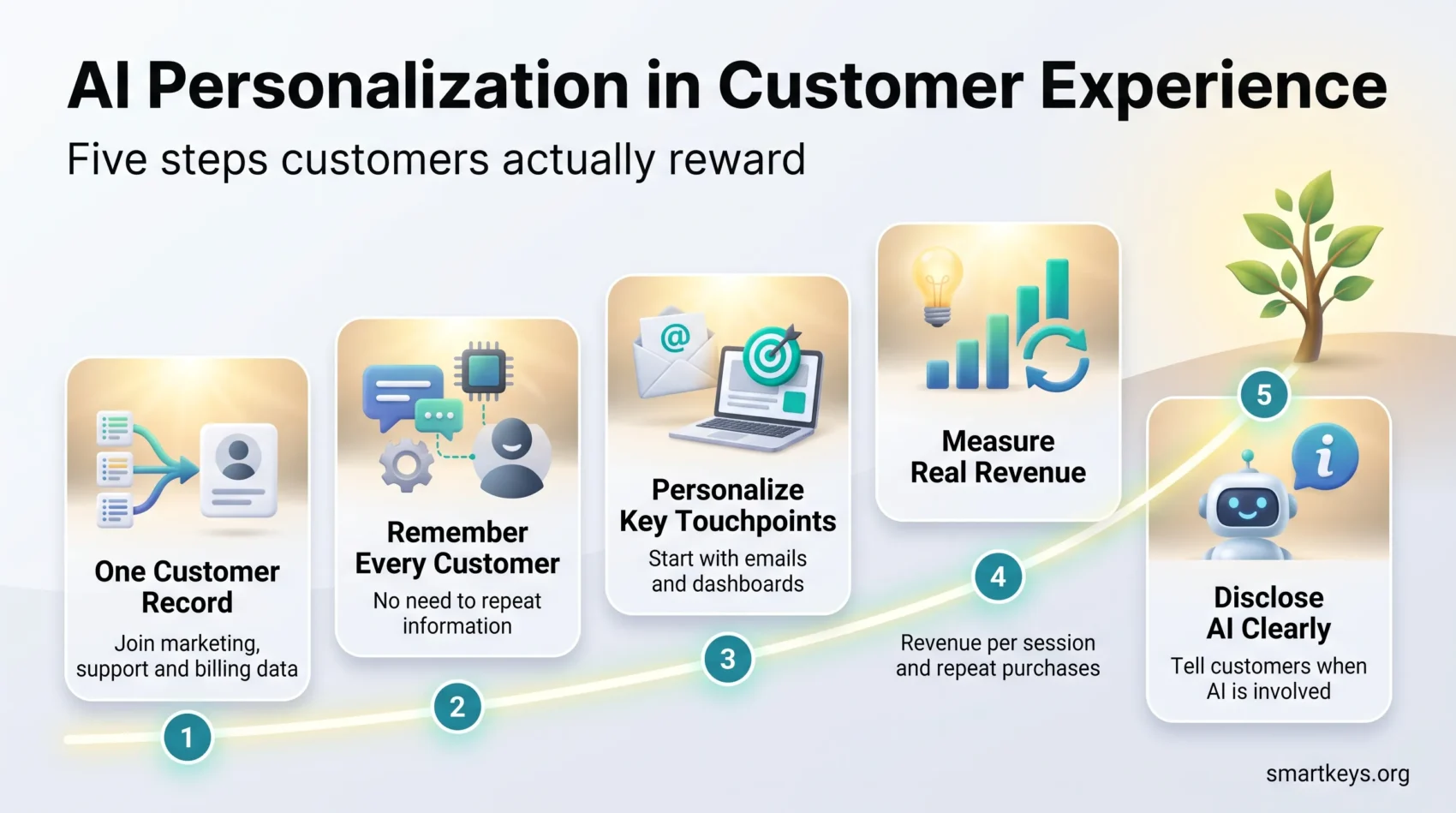
Once collected, the data has to be usable. In practice that means one customer record rather than five disconnected ones. Marketing sees the purchase history, support sees the marketing emails, billing sees the open ticket. Assembling that view is an engineering problem more than an AI problem, and it is where most of the work sits. Our overviews of data lakes and business intelligence and business intelligence tools cover how companies structure that layer.
Machine learning then looks for patterns in the assembled record: which sequences of behavior precede a purchase, a complaint or a cancellation. Those patterns are what the personalization layer acts on. If you want the wider picture of how firms turn behavior into insight, see behavioral analytics.
Predictive Analytics: Anticipating Customer Behavior
Predictive analytics uses historical data to estimate the probability of a future event. In a customer context, the useful predictions are narrow and specific: how likely is this customer to cancel in the next 60 days, to buy again this quarter, or to need support after this purchase.

The value is in acting earlier. If a model flags that a customer’s usage has dropped in a pattern that usually precedes cancellation, you can reach out while the relationship can still be saved. That is more useful than a discount offered after they have already left.
Three caveats are worth stating plainly. Predictions are probabilities, not facts, so treat a churn score as a prompt to look, not a verdict. Models trained on last year’s customers can be wrong about this year’s, especially after a pricing or product change. And a prediction is only as good as the data behind it, which is why data quality work usually pays back faster than a better algorithm.
For a broader treatment of the method, see our guide to predictive analytics in business decisions.
Machine Learning and Its Impact on Personalization
Machine learning is what lets personalization improve without someone rewriting rules every week. A rules engine says: if the customer bought running shoes, show socks. A machine learning model works out which follow-up products actually get bought together, including combinations nobody would have guessed, and updates as behavior shifts.
Three model types do most of the work in personalization:
- Collaborative filtering recommends items based on what similar customers chose. It works well with a large user base and struggles with new customers who have no history.
- Content-based filtering recommends items similar to what this customer already liked. It handles new customers better but tends to narrow, showing more of the same.
- Hybrid models combine both, which is what most commercial systems use.
The practical limitation is the cold start problem: a system knows nothing useful about a first-time visitor. Sensible defaults matter here. Bestsellers, seasonal picks and clear category navigation serve a new visitor better than a poor guess dressed up as a recommendation.
Personalization also has to respect the boundary between helpful and creepy. A model can often infer more than a customer expects, and acting on every inference erodes the trust that makes personalization work in the first place. The judgment calls involved are the same ones we discuss in the ethical questions AI raises at work and in our piece on digital trust.
Personalizing Every Touchpoint With AI Algorithms
Personalization is most visible on a website, but it works across every channel a customer uses: email, app notifications, support chat, even the invoice.

The hard part is consistency. If your email says one thing and your support chat contradicts it, personalization has made the experience worse, not better. This is the real argument for joined-up systems, and it is why personalization projects so often turn into integration projects. Our guide to omnichannel marketing covers how companies keep those channels aligned, and the piece on how CRM systems have changed explains where the customer record usually lives.
A short list of touchpoints worth personalizing first, in rough order of effort to payoff:
- Post-purchase emails, which have high open rates and obvious relevance.
- The logged-in homepage or dashboard, where returning customers land.
- Support routing, so repeat issues reach someone who has the context.
- Renewal and reorder prompts, timed to actual usage rather than the calendar.
Notice that none of these require a recommendation engine on day one. They require knowing who the customer is and what they last did. For the marketing side of this, see AI in marketing and our wider look at how digital marketing has evolved.
AI in Customer Service
Customer service is where personalization is most obvious to the customer and most measurable for the business. An AI assistant that knows the order number, the delivery date and the last conversation can resolve a routine question in seconds. One that does not simply adds a step before a human.
Gartner predicted in March 2025 that agentic AI, meaning AI that can take actions rather than only answer questions, will autonomously resolve 80% of common customer service issues by 2029, with an associated 30% reduction in operational costs. That is a forecast rather than a measurement, and the word “common” is doing a lot of work in it. Routine, well-documented, low-risk requests are the realistic scope.
Two practical rules keep these deployments honest. First, make the handover to a human fast and obvious. A customer who cannot escape a bot will remember that, not the successful automations. Second, disclose that the customer is dealing with AI. Since 2 August 2026, Article 50 of the EU AI Act requires providers of systems that interact directly with people to inform them that they are interacting with an AI, clearly and at the latest at the first interaction. Systems already in service have until 2 December 2026 to comply.
If you are evaluating tools, our reviews of Chatbase and Cassidy AI cover two common entry points, and AI chatbots in customer service looks at what the technology does and does not solve. The chat-first buying journeys these tools enable are covered in conversational commerce.
Personalization Trends in 2026
Four shifts define personalization this year.
Memory replaces novelty. The Zendesk data above makes this the clearest trend: customers rate being remembered above being surprised. Systems that carry context between channels beat systems with cleverer recommendations.
Disclosure becomes a design requirement. The EU transparency rules that took effect in August 2026 turn “tell people it is AI” from good manners into a compliance item. Article 50 also requires generative outputs to be marked in a machine-readable format so they remain detectable as AI-generated.
Agents move from suggesting to doing. The direction in customer service is toward systems that complete a task, such as issuing a refund or rescheduling a delivery, rather than drafting a reply for a human. That raises the stakes on permissions and audit trails.
First-party data becomes the default. With third-party cookies still alive but politically fragile, and privacy regulation tightening in the EU and across US states, the durable strategy is the one that does not depend on either. That means giving customers a reason to log in, subscribe or create an account. Business models built around that relationship, including subscription business models, direct-to-consumer brands and community-driven growth, have a structural advantage here.
How Recommendation Engines Work
A recommendation engine is the most recognisable form of AI personalization, and it is worth understanding what it actually needs.

Three inputs feed every engine. Behavioral data tells it what this customer and similar customers did. Product data tells it what the items are, including category, price and attributes. Contextual data tells it about the moment: device, time, referral source, whether the visit follows a support ticket.
Missing product data is the quiet failure mode. If your catalogue has inconsistent categories, blank attributes and duplicate entries, no model can make good suggestions from it. Catalogue hygiene usually improves recommendations more than switching vendors does.
Measure recommendations on the right metric. Click-through rate on a recommendation widget is easy to inflate and tells you little. Revenue per session, repeat purchase rate and return rate are harder to game. A recommendation that drives a sale and then a return has cost you money. Our guide to using big data to improve customer experience covers how to build that measurement layer, and e-commerce trends puts recommendations in the wider retail context.
Where AI Personalization Goes Wrong
Most personalization disappointments have mundane causes. Knowing them in advance saves a lot of budget.

The data is fragmented. The website, the CRM and the support desk each hold part of the customer. Personalization built on one third of the picture contradicts the other two thirds.
The model is trained on stale behavior. Customer behavior shifts after a price change, a product launch or a seasonal peak. A model that is not retrained keeps optimising for a world that has moved on.
Personalization is applied where it adds nothing. Inserting a first name into a subject line is not personalization, and customers stopped being impressed by it years ago. Changing what is offered, and when, is the part that matters.
Nobody owns the outcome. Personalization sits between marketing, product, data and support. Without a single owner and a single success metric, it becomes four half-built projects.
Trust is spent faster than it is earned. One badly timed message, such as a promotion sent during an open complaint, undoes months of goodwill. Suppression rules matter as much as targeting rules.
Conclusion
AI personalization is no longer a differentiator on its own. Enough companies do it that customers now treat it as the baseline, and the McKinsey data suggests the cost of getting it wrong is rising faster than the reward for getting it right.
The practical path is unglamorous. Join up your customer data so you have one record instead of several. Start with the touchpoints where relevance is obvious, such as post-purchase email and the logged-in dashboard. Measure on revenue and repeat purchases rather than click-through rate. Disclose clearly when a customer is dealing with an AI system, because in the EU that is now the law.
Do those four things and the technology choice becomes much easier, because most tools work reasonably well on clean data and none work well on messy data.
Found this useful?
Make SmartKeys a preferred source on Google, and our articles will surface more often in your Top Stories, AI Overviews, and AI Mode.
Add as Preferred Source