Digital marketing changed more between 2024 and 2026 than in most of the decade before it. Search stopped sending the traffic it used to, AI moved from novelty to the layer campaigns actually run on, and the cookieless future everyone spent years preparing for never arrived.
This article traces how the discipline got here — from the first banner ad in 1994 to AI-generated answers that resolve a query without a single click — and what that history implies for the strategies worth funding in 2026. Where numbers appear, the source is named.
Key Takeaways
- Global ad spend passes $1 trillion for the first time in 2026, and digital takes 68.7% of it, according to Dentsu’s global forecast.
- Roughly 68% of US Google searches ended without a click in early 2026, up from about 60% in 2024 (SparkToro, using Similarweb clickstream data).
- Google reversed course on third-party cookies in April 2025, but consent-based first-party data is still the more durable asset.
- Retail media is the fastest-growing digital channel, ahead of online video and social.
- From 2 August 2026, EU rules require AI chatbots and AI-generated content to be disclosed to users.
What is Digital Marketing?
Digital marketing is the practice of reaching customers through connected channels — search, social platforms, email, websites, apps, connected TV and retail sites — and measuring what happens next. The channels change constantly; the underlying job of matching an offer to demand does not.
What separates it from traditional advertising is the feedback loop. A billboard tells you nothing about who looked at it. A campaign running through a platform like HubSpot Marketing Hub reports impressions, clicks, sign-ups and revenue against the same record, which is why budgets can be reallocated weekly rather than annually.
That loop only works if the data underneath it holds together. Teams that treat customer records as a shared asset — usually through a customer data platform — get reporting that describes the business. Teams that leave data scattered across tools get reporting that describes their tooling. It is one of the more mundane parts of digital transformation, and one of the most consequential.
Consumer behaviour moved online long before marketing budgets fully followed, and the gap is what created the opportunity for personalised messaging at scale.
History of Digital Marketing
The commercial internet learned to sell in stages, and each stage left something behind that marketers still use.
The first clickable banner ad ran on HotWired in October 1994. It was a novelty with an extraordinary click-through rate, and it established the idea that attention online could be bought and measured. Search engines followed: Yahoo! as a directory, then Google in 1998, which made relevance rather than placement the organising principle.
The 2000s belonged to paid search and then social. Google AdWords launched in 2000 and gave small advertisers access to demand that had previously required a media buyer. Facebook opened to the public in 2006, and brands discovered they could hold a conversation rather than run an interruption.
Mobile reset everything again after the iPhone launched in 2007. By the 2010s, video and creator partnerships had become mainstream channels, and brand storytelling became a practical requirement rather than an agency flourish. GDPR took effect in May 2018 and made consent a design constraint. ChatGPT’s public release in November 2022 started the current phase, and Google’s rollout of AI Overviews from 2024 brought it into the search results page itself.
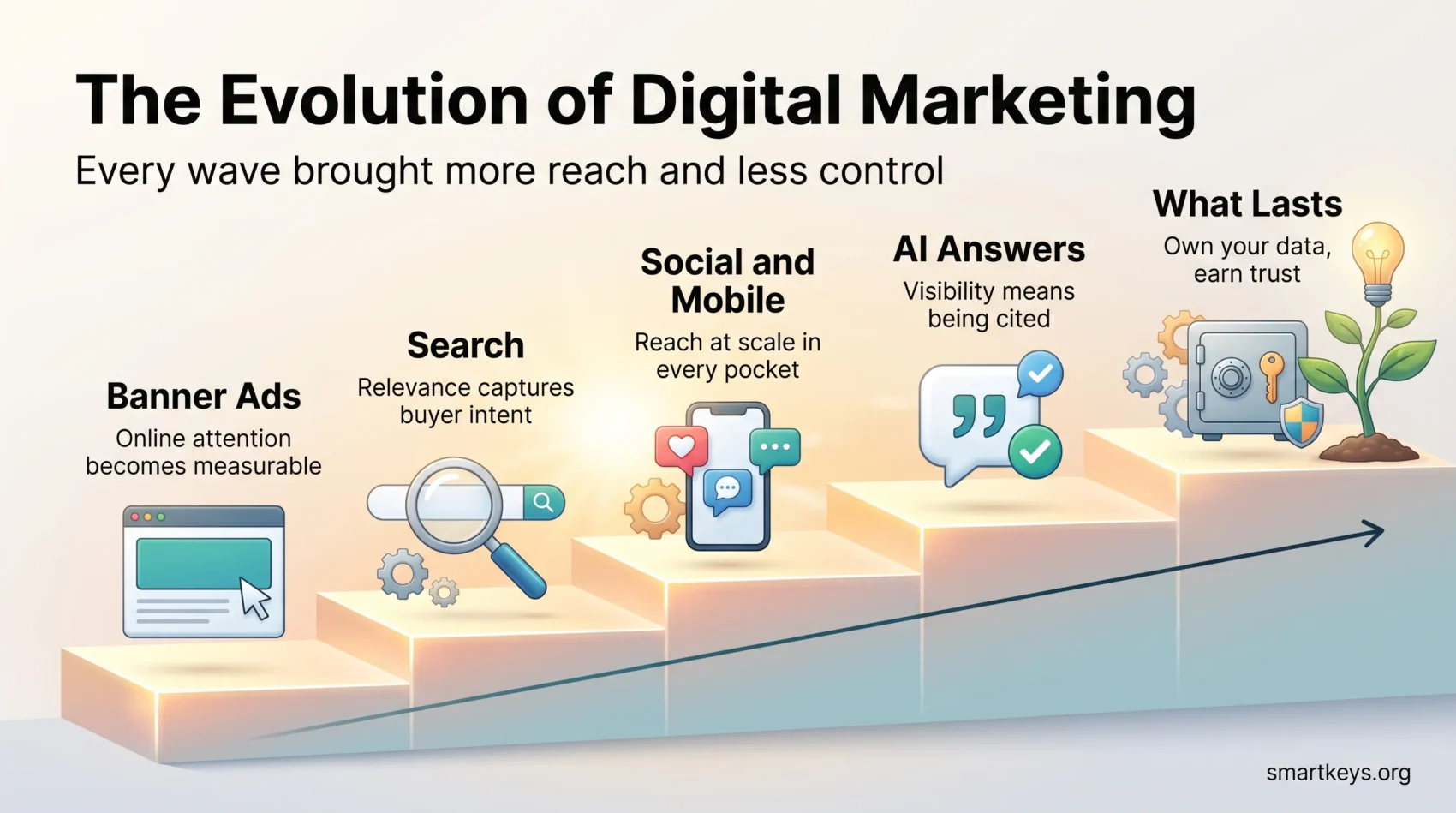
The through-line is worth noting, because it also shapes how the workplaces behind these campaigns are changing: each wave gave marketers more reach and less control.

Key Milestones in Digital Marketing Evolution
Compressed into a list, the shifts that still matter look like this:
- 1994 — the first banner ad. Online attention becomes a purchasable, countable inventory.
- 1998 — Google launches. Ranking by relevance creates the entire discipline of SEO.
- 2000 — AdWords. Auction-based pay-per-click makes performance marketing accessible to any budget.
- 2006 — Facebook opens to everyone. Audience targeting shifts from keywords to declared interests and behaviour.
- 2007 — the smartphone. Marketing becomes something people carry, which eventually produces mobile commerce as its own channel.
- 2018 — GDPR applies. Consent, purpose limitation and data minimisation become campaign design constraints, not legal footnotes.
- 2022 — generative AI goes mainstream. Production cost collapses; differentiation moves to judgement and distribution.
- 2024 onwards — AI answers in search. The results page starts satisfying queries instead of routing them.
Each milestone also pulled marketing closer to the rest of the commercial stack, which is why CRM decisions are now marketing decisions.
Digital Marketing Trends in 2026
The headline number for 2026 comes from Dentsu’s global forecast: worldwide advertising investment passes $1 trillion for the first time, growing 5.1% year on year, with digital accounting for 68.7% of the total. Growth is not evenly spread — retail media is expected to grow 14.1%, online video 11.5% and social 11.4%, while print declines.
Social Media and Short-Form Video
Short-form video remains the format with the widest reach and the shortest half-life. The practical change in 2026 is less about which platform is ascendant and more about how discovery works: recommendation feeds surface content to people who do not follow the account, so consistency of output matters more than audience size. Keeping up with shifts across social platforms is now a distribution question rather than a community-management one.
Creator partnerships have matured alongside it, including in B2B, where practitioner-led influencer programmes often outperform brand channels. Messaging and in-feed checkout have also blurred the line between content and transaction, which is the territory conversational commerce occupies.
Email Marketing
Email is the one channel marketers still own outright, and the rules for keeping it working got stricter. Gmail and Yahoo introduced bulk sender requirements in February 2024 — SPF, DKIM and DMARC authentication, one-click unsubscribe under RFC 8058, and low spam complaint rates. Microsoft applied comparable requirements to Outlook.com, Hotmail.com and Live.com from 5 May 2025 for senders of more than 5,000 messages a day, with non-compliant mail routed to junk and eventually rejected.
The practical consequence is that deliverability is now an infrastructure task before it is a creative one. Authentication records, list hygiene and honest sending volumes decide whether a campaign built in a tool like Mailchimp ever reaches an inbox.
Search: From Rankings to AI Visibility
This is where the sharpest change has landed. SparkToro’s analysis of Similarweb clickstream data found that 68.01% of US Google searches ended without a click during the first four months of 2026, up from 60.45% in 2024.
A randomised field experiment by Saharsh Agarwal (Indian School of Business) and Ananya Sen (Carnegie Mellon University), run with 1,065 US desktop Chrome users over two weeks in January and February 2026, isolated part of the cause: on queries where AI Overviews appeared, organic clicks fell 38%, and the share of searches ending without any click rose from 54% to 72%. Removing the summaries produced no measurable drop in user satisfaction.
The response is not to abandon SEO but to widen the goal. Ranking still matters for the queries that do generate clicks; being quotable — clear definitions, specific figures, named sources, structured markup — matters for the queries that do not. Rank tracking in a platform such as Semrush now sits alongside AI-visibility monitoring, and content workflows built around tools like Surfer SEO and Ahrefs increasingly optimise for citation as well as position.
Retail Media and Commerce
Retail media — advertising sold by retailers against their own shopper data — is the fastest-growing digital channel in Dentsu’s 2026 forecast. Its appeal is closed-loop measurement: the platform that shows the ad also records the purchase. The trade-off is dependence on someone else’s walled garden, which is a familiar pattern by now.
The Role of Technology in Digital Marketing
Two technology shifts do most of the work in a 2026 marketing stack: what AI can automate, and what mobile behaviour demands.
Artificial Intelligence in Marketing
Generative models collapsed the cost of producing variants — subject lines, ad copy, thumbnails, localisations. That has moved the bottleneck from production to judgement: deciding what is worth making, and whether the output is accurate enough to publish. AI-driven marketing programmes tend to succeed where a human owns the brief and the quality bar.
The more interesting development is agentic tooling — systems that carry out multi-step work such as briefing, drafting, scheduling and reporting rather than answering a single prompt. Agent workflows are useful where the process is well documented and the failure mode is cheap; they are risky where a mistake reaches a customer unreviewed.
All of this runs on infrastructure most marketing teams never see, which is why cloud and data platform decisions now shape what marketing can realistically do. And from 2 August 2026, EU transparency rules under the AI Act require that people be told when they are interacting with an AI system, that synthetic images, audio and video be labelled, and that AI-generated content carry machine-readable marks. Disclosure is now a compliance requirement in the EU, not a stylistic choice.
Mobile and On-Device Experience
Mobile is no longer a channel to optimise for; it is the default context. That makes page weight, load time and checkout friction commercial variables rather than technical ones. Location context, app notifications and in-feed purchase flows all extend reach, but each adds a consent and preference decision that has to be respected consistently across touchpoints — otherwise the personalisation that was supposed to build trust erodes it instead.
Types of Digital Marketing
Most programmes combine a handful of disciplines rather than betting on one. The useful distinction is what each is actually good at:
- Content marketing — builds durable demand and supplies the material AI systems cite. Slow to compound, hard to displace once it does.
- Search and AI visibility — captures existing intent. Increasingly split between clicks you win and answers you influence.
- Social and creator marketing — creates demand and reaches people who were not looking. Reach is rented, not owned.
- Email and owned messaging — the highest-control channel, and the one most dependent on technical hygiene.
- Paid media, including retail media — fastest to test, fastest to stop working when the budget stops.
- Partnerships and affiliates — borrows someone else’s credibility; works best when the incentive is aligned with retention, not just the first sale.
Which mix is right depends less on channel fashion than on where your buyers already are, which is the question a go-to-market strategy exists to answer before any budget is committed.

Challenges in Implementing Digital Marketing Strategies
The obstacles in 2026 are less about access to channels and more about attribution, consent and pace.
Measurement got harder, not easier. With most searches ending without a click and AI assistants summarising sources without linking them, a meaningful share of brand influence is now invisible to standard analytics. Teams that judge every channel by last-click attribution will systematically defund the work that creates demand.
The cookie question did not resolve the way it was planned. Google announced on 22 April 2025 that it would keep its existing approach to third-party cookies in Chrome and would not ship a standalone choice prompt, and has since wound down much of the Privacy Sandbox programme. Third-party cookies still function — but browser protections, regional privacy law and platform policy have all tightened around them, so consented first-party data remains the more defensible foundation.
Disclosure obligations arrived. The EU AI Act’s transparency rules apply from 2 August 2026, and they cover exactly the tools marketing teams adopted fastest: chat interfaces, synthetic imagery and AI-generated video.
Speed outpaces process. Cheap production makes it easy to publish more than a team can review. Working in short, reviewed cycles — the core idea behind agile marketing — is the practical defence against volume replacing quality.
Where Digital Marketing Goes Next
Three directions are already visible rather than speculative.
Budgets keep shifting toward channels with closed-loop measurement. Dentsu expects programmatic buying to account for more than four-fifths of digital investment in 2026, with retail media, online video and social growing fastest.
Visibility increasingly means being cited rather than ranked. As AI systems answer more queries directly, the asset that matters is content specific and credible enough to be quoted — with clear attribution, real data and a named point of view.
And the balance between reach and trust keeps tightening. Regulation, platform policy and audience scepticism all push in the same direction: disclose what is automated, collect only what you will use, and make the value exchange obvious. That is a slower way to grow than the last decade rewarded, but it is the one that survives the next platform change.
Conclusion
The evolution of digital marketing has been a steady trade: more reach, less control. Banner ads gave marketers measurement. Search gave them intent. Social gave them scale. AI has given them production capacity — and taken away the assumption that a good answer leads to a visit.
For 2026, that argues for a narrower set of bets. Own your audience relationships where you can, through email and community rather than rented reach alone. Publish content specific enough to be worth citing. Keep consented first-party data clean, because it now underpins both targeting and measurement. And treat AI as leverage on judgement you already have, rather than a substitute for it.
The channels will keep changing. The requirement to be genuinely useful to a specific audience has not changed since 1994.
Found this useful?
Make SmartKeys a preferred source on Google, and our articles will surface more often in your Top Stories, AI Overviews, and AI Mode.
Add as Preferred SourceFAQ
What is digital marketing?
Digital marketing is the practice of promoting products and services through connected channels and measuring the response. That includes search engines, social platforms, email, websites and apps, and increasingly connected TV and retailer-owned advertising networks. What distinguishes it from traditional advertising is the feedback loop: campaigns report impressions, clicks, sign-ups and revenue against the same customer record, so budgets can be adjusted weekly rather than annually. It applies to both consumer and business-to-business marketing, and in practice most organisations run several channels together rather than relying on one.
How has digital marketing evolved over time?
It has moved through four broad phases. The first clickable banner ad ran on HotWired in 1994, establishing online attention as purchasable inventory. Google’s launch in 1998 and AdWords in 2000 made relevance and auction-based pay-per-click the organising principles of the discipline. Social platforms and the smartphone reshaped it again through the 2000s and 2010s, shifting targeting toward behaviour and making mobile the default context. The current phase began with generative AI in 2022 and AI answers appearing directly in search results from 2024. The consistent pattern across all four: marketers gained reach and lost control.
What are the digital marketing trends in 2026?
Four dominate. Global ad spend passes $1 trillion for the first time, with digital taking 68.7% of it according to Dentsu’s forecast. Retail media is the fastest-growing digital channel at an expected 14.1%, ahead of online video and social. Search is shifting from clicks to citations as AI answers absorb more queries. And disclosure of AI use became a legal obligation in the EU from 2 August 2026. Underneath all of them sits the same requirement: consented first-party data that is clean enough to target and measure with.
How much traffic has AI search taken from websites?
Two 2026 studies give a sense of scale. SparkToro, analysing Similarweb clickstream data, found that 68.01% of US Google searches ended without a click in the first four months of 2026, compared with 60.45% in 2024. A randomised field experiment by researchers at the Indian School of Business and Carnegie Mellon University, covering 1,065 US desktop Chrome users over two weeks in early 2026, found that AI Overviews cut organic clicks by 38% on the queries where they appeared, with zero-click searches rising from 54% to 72%. Both measure US desktop and web behaviour, so treat them as directional for other markets.
Do third-party cookies still work in 2026?
Yes, in Chrome. Google announced on 22 April 2025 that it would maintain its existing approach to third-party cookies and would not roll out a standalone choice prompt, and it has since wound down much of the Privacy Sandbox programme. That reversal ended the deprecation timeline marketers had been planning around since 2020. It did not, however, undo the wider direction of travel: Safari and Firefox still block third-party cookies by default, privacy regulation continues to tighten, and consent requirements apply regardless of browser. Building on consented first-party data remains the more durable choice.
How do you get content cited in AI search results?
By making it easy to quote and hard to dispute. In practice that means answering a specific question directly in the opening sentence rather than building up to it, attributing figures to named sources with dates, keeping headings descriptive so a passage can be extracted cleanly, and using structured data such as FAQ or article markup where it genuinely reflects the visible page. Original material — first-hand testing, proprietary data, a clear point of view — is harder for a summary to replace than a restatement of what everyone else has published. Conventional SEO still applies for the queries that generate clicks.
What are the main challenges in digital marketing today?
Attribution, consent and pace. With most searches ending without a click and AI assistants summarising sources without always linking them, a growing share of brand influence never appears in standard analytics, which penalises demand-creation work under last-click models. Consent and disclosure obligations keep expanding, including the EU AI Act transparency rules that apply from 2 August 2026. And because generative tools make publishing cheap, teams can easily produce more than they can review. Short, reviewed working cycles and a clear quality bar matter more than raw output volume.