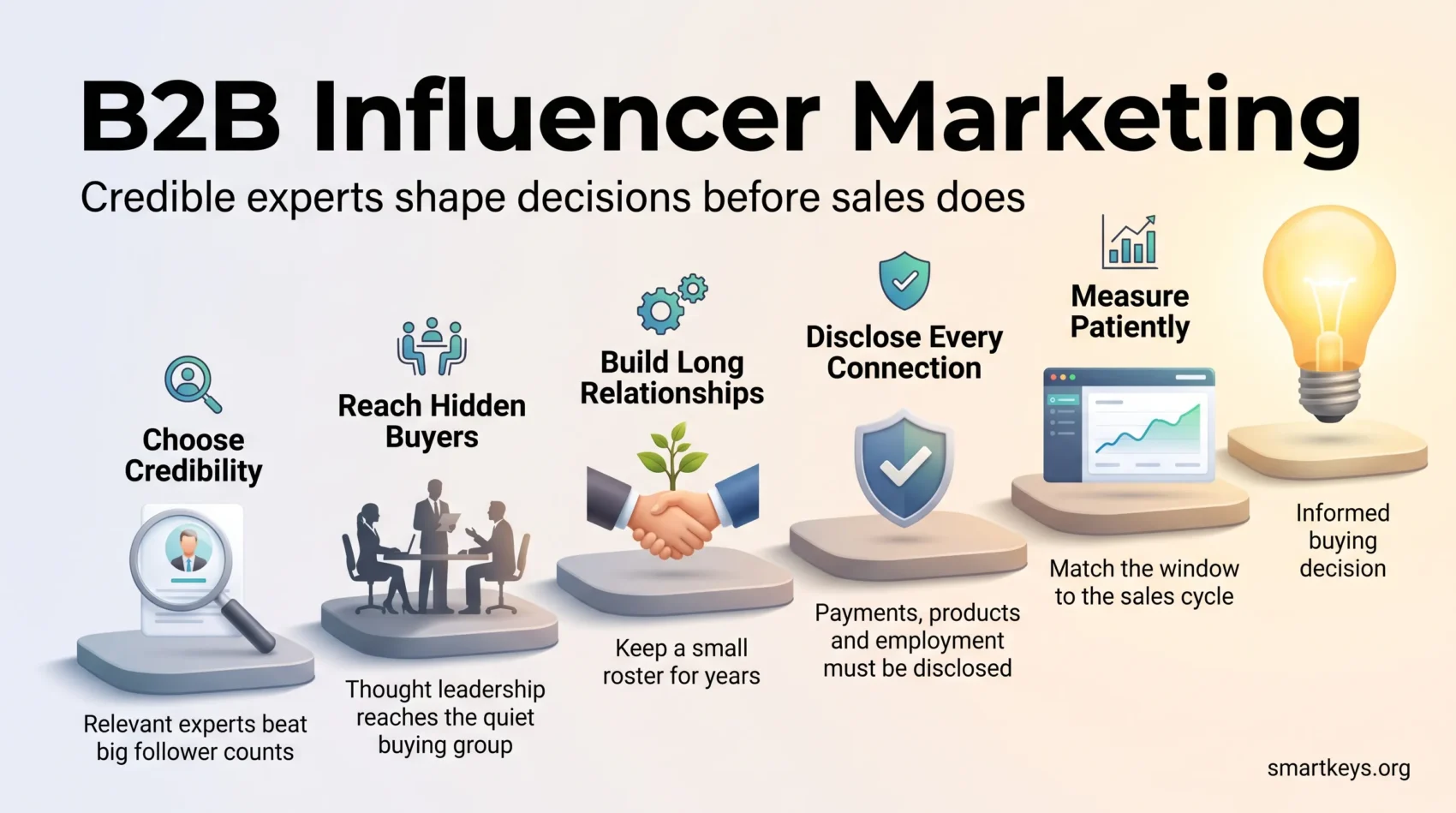
B2B influencer marketing means working with credible practitioners, analysts and industry experts whose audience overlaps with your buying group. It grew for a structural reason rather than a fashionable one: buyers now do most of their evaluation before a vendor hears from them, and someone else is shaping that evaluation.
Gartner surveyed 646 B2B buyers between August and September 2025 and found that 67% prefer a rep-free buying experience, 45% had used generative AI during a recent purchase, and buyers consulted an average of seven information sources. Influence is what occupies those sources while your sales team is not in the room.
This guide covers what B2B influencer marketing actually is, what the current evidence supports, where programmes fail, which platforms matter, how to measure results across a long sales cycle, and what disclosure rules apply in 2026.
Key Takeaways
- Most evaluation happens without a seller present. Two thirds of B2B buyers told Gartner they prefer a rep-free experience.
- Credibility beats reach. A respected practitioner with a small, relevant audience outperforms a large generic following.
- Thought leadership reaches the quieter members of the buying group who rarely speak to sales at all.
- Measurement has to survive a sales cycle measured in quarters, so pick indicators that hold up over months.
- Material connections between a brand and an endorser must be disclosed clearly, employees included.
- Collaboration with credible experts can also support your SEO efforts through citations and referral traffic.
Understanding B2B Influencer Marketing
B2B influencer marketing is a way of borrowing credibility that your brand has not yet earned on its own. It works through people whose judgement your buyers already trust: analysts, consultants, engineers, founders, community moderators and specialist journalists. The point is not audience size. It is whether the right twenty people in a buying committee take that person seriously.
Definition and Scope
A B2B influencer is anyone with an independent reputation in your category who can shape how buyers frame a problem. That includes paid partnerships, but also unpaid formats: joint research, podcast appearances, webinar panels, expert quotes and product advisory work. Programmes usually sit alongside wider digital marketing activity rather than replacing any of it.
The scope has widened in one important direction. Employees with genuine subject expertise now carry much of the load, which is why employee advocacy and influencer work increasingly run as one programme rather than two.
How B2B Differs From B2C Influencer Marketing
Three differences matter in practice. First, the audience is a committee, not a person, and different members care about different things. Second, the decision is justified rather than felt: buyers need arguments they can repeat internally, which is closer to brand storytelling than to a discount code. Third, the timeline is long, so a single post rarely produces a traceable outcome.
That last point reshapes everything else. Consumer campaigns can be judged in a week. A B2B programme is closer to account-based strategy: sustained presence with a defined set of accounts, judged over quarters.

The Benefits of B2B Influencer Marketing
The benefits are real, but they are concentrated in a narrower band than most vendor material suggests. They show up in trust, in reach into parts of the buying group you cannot address directly, in content quality and in retention.
Building Trust and Authority
Buyers discount vendor claims and apply less discount to independent voices. When a respected practitioner explains where your product fits and where it does not, the qualification itself is what makes the endorsement credible. This is the same mechanism that makes honest comparison content effective: readers reward the parts that are not flattering.
Authority built this way compounds. It also transfers to the sales conversation, since Gartner found that 69% of buyers still turn to sales reps to validate what they have learned elsewhere, including insights produced by AI tools.
Reaching the Hidden Buying Group
The 2025 Edelman-LinkedIn B2B Thought Leadership Impact Report surveyed close to 2,000 professionals and describes a group that rarely appears in a CRM. Among these less visible buyers, 71% have little or no interaction with sales teams, yet 63% spend more than an hour a week consuming thought leadership, and 81% say strong material helped them identify a challenge they had not previously recognised.
The same report found that more than 40% of B2B deals stall because of internal misalignment inside the buying group, and that 95% of these buyers became more receptive to sales and marketing outreach after encountering strong thought leadership. Influence, in other words, does its most useful work on the people your reps never meet. Aligning that content with what sellers say next is a sales and marketing alignment problem as much as a content one.
Strengthening Your Content Strategy
Working with practitioners changes what you are able to publish. Joint research, teardowns, benchmark studies and honest post-mortems are difficult to produce from marketing alone because they need operational detail. Expert input also improves data storytelling, since someone who works in the field can say which numbers actually change a decision.
Distribution improves as a side effect rather than as the goal. When a contributor shares work they helped shape, the audience treats it as their recommendation, not as an advertisement.
Driving Loyalty and Advocacy
Sustained expert relationships tend to support retention rather than acquisition alone. Customers who encountered your brand through a trusted third party arrive with more accurate expectations, which is one of the quieter drivers of customer loyalty. The Edelman-LinkedIn data points the same way: 79% of respondents said they would be more likely to advocate for a proposal internally when the vendor produces consistently strong content.
Challenges in B2B Influencer Marketing
Most programmes that disappoint fail for one of three reasons: the wrong people, misaligned content, or measurement that was never designed for a long cycle.
Identifying the Right People
Follower counts are the weakest available signal. Better indicators are whether the person is cited by others in the field, whether their audience contains actual practitioners, whether they have ever publicly disagreed with a vendor, and whether they can speak to your buyer’s specific problem rather than the category in general.
Run this check before you contact anyone. Selecting for reach and then hoping for relevance is the most common and most expensive mistake in the discipline.
Content Alignment and Messaging
Over-scripting destroys the credibility you are paying for. Under-briefing produces content that is pleasant and useless. The workable middle is a brief that fixes the audience, the problem and the boundaries of what you can claim, and leaves the argument to the expert.
Consistency across channels matters too, because a buyer who hears one story from a podcast guest and a different one from your website simply stops trusting both. That is a familiar problem in omnichannel marketing, and it applies here without modification.
Measuring ROI and Performance
Attribution is genuinely hard, and pretending otherwise leads to bad decisions. Last-click models will credit branded search and ignore the podcast episode that caused it. Practical alternatives include tracking branded search volume, monitoring self-reported attribution on inbound forms, watching whether target accounts appear in pipeline after a campaign period, and running holdout tests by account segment where your volume allows it.
Set the measurement window to match your sales cycle. Judging a six-month cycle on thirty-day data will always produce the same wrong answer. Feeding what you learn back into sales enablement is usually worth more than another attribution model.

Programmes that survive these three problems tend to look unglamorous: a small roster, long relationships and patient measurement. For wider context on how buying behaviour is shifting, see our overview of current commerce trends.
The Role of Social Media Platforms
Platform choice follows your buyers, not your preferences. In most B2B categories that means one primary platform and a small number of secondary ones.
LinkedIn as the Default
LinkedIn reports more than one billion members across more than 200 countries and territories, and it remains the default professional network for most B2B categories. Its advantage is not reach but context: a post appears next to the reader’s professional identity, and the commentary underneath is frequently more valuable than the post itself.
Two habits separate effective LinkedIn programmes from noisy ones. They favour a small number of recurring voices over a rotating cast, and they treat comments as the product rather than as an afterthought. Broader platform dynamics are covered in our guide to social media trends.
Other Platforms Worth Testing
YouTube carries the long-form technical content that engineers and operators actually watch before a purchase. Podcasts reach commuters and practitioners who will not read a whitepaper. Industry newsletters and specialist communities such as Slack groups and forums often deliver the highest concentration of qualified readers per impression, even at small absolute numbers.
Instagram and TikTok can work for design, hospitality, construction and other visually legible categories, and for recruitment in almost any category. They are a poor default for enterprise software. Where short video does fit, the mechanics overlap with social commerce more than with traditional B2B media.
Effective Influencer Outreach
Outreach is a relationship-building exercise with a slow payback, and it fails most often at the first message.
Building Long-Term Relationships
Read the person’s work before contacting them, reference something specific, and make an offer that is useful whether or not it turns into a paid arrangement: early access to research, a panel seat, an introduction, a data set. Expect several exchanges before anything commercial is discussed.
Keep the roster small. Five people you work with for two years will produce more than fifty one-off posts, and the compounding comes from the audience recognising a repeated association.
Using Influencer Management Tools
Tooling helps with discovery, scheduling, approvals and reporting, and it becomes necessary once you are running more than a handful of relationships. It does not help with judgement. Every platform in this category will rank people by audience metrics, because those are the metrics available, and audience metrics are exactly what you should not select on.
Treat tools as administration. The decisions that matter, who to work with and what to let them say, stay with a human who understands the category. The same caution applies to the broader wave of AI marketing tools.
Disclosure and Compliance
This is the part most B2B teams underestimate. The US Federal Trade Commission revised its Endorsement Guides in 2023, including a new definition of what counts as a clear and conspicuous disclosure. The requirement is straightforward: if there is a connection between an endorser and a marketer that a significant minority of the audience would not expect, and it would affect how they weigh the endorsement, it has to be disclosed.
Two points catch B2B programmes in particular. Employment counts as a material connection, so an employee posting about a company product needs to say so in the post itself; the FTC is explicit that listing your employer on a profile page is not enough. And free or discounted products, affiliate commissions and equity all count, not just cash payments.
Build disclosure into the brief rather than reviewing for it afterwards. A clear statement of the relationship also tends to improve credibility rather than damage it, which is consistent with what the trust research repeatedly shows about customer experience.
Boosting SEO and Online Visibility
Influencer work supports search visibility, though the mechanism is less direct than link-building pitches suggest.
Citations, Links and Referral Traffic
Genuine collaborations produce citations from sites that would never accept a guest post, and those citations are worth more than the ones you can buy. They also generate referral traffic that converts unusually well, because the reader arrived with a recommendation attached.
Visibility in AI Answers
The more significant change is upstream of the search results page. AI assistants and answer engines assemble responses from sources they treat as credible, and consistent expert association makes a brand more likely to appear in that set. Being described accurately by third parties has become part of search visibility, which is a shift that also affects voice search optimisation and any channel where a machine summarises you to a buyer.
What Is Changing in 2026
Three shifts are worth planning around.
Practitioners Over Personalities
The most effective B2B voices are increasingly people doing the job rather than people commenting on it: a head of RevOps, a security engineer, a plant manager. Their audiences are small and almost entirely qualified, which is the trade most programmes should want.
AI on Both Sides of the Table
AI now sits inside the buying process, not only inside your marketing stack. Gartner found that 45% of buyers used generative AI primarily to research vendors and products, while 51% worried about being misled by AI-generated information and 49% had the same worry about sales reps. That combination explains why independent human validation has become more valuable rather than less. On your side, AI is useful for discovery and reporting, and unreliable for judging credibility. The same pattern shows up in AI-driven personalisation.
Longer Formats Are Winning
Podcasts, recorded roundtables and long video are absorbing budget that used to go to short social posts, because they let an expert make a full argument. They also produce transcripts, which feed both search and AI answer systems. The counter-trend is real too: Edelman found that 57% of respondents prefer quick takeaways to dense reports, so the durable pattern is a long conversation plus a short, well-designed summary. How that summary is presented matters, a point explored further in our piece on how buyers process marketing messages.
Conclusion
B2B influencer marketing earns its place because of where B2B buying now happens. Two thirds of buyers prefer to progress without a rep, they consult around seven sources on the way, and a large share of the people who shape the decision never speak to your sales team at all. Credible third parties are what occupy that space.
The programmes that work share a shape. A small roster of genuine practitioners, relationships measured in years, briefs that leave room for honest opinion, disclosure handled properly, and measurement matched to the length of the sales cycle. The programmes that fail almost always chose reach over credibility, or judged a six-month cycle on thirty-day numbers.
Start narrow. Pick three people your buyers already read, work with them properly for a year, and measure whether target accounts start arriving better informed. That is a slower answer than a campaign, and it is the one the evidence supports. For a wider view of how buying behaviour keeps shifting, our overview of current sales trends is a useful companion.
Found this useful?
Make SmartKeys a preferred source on Google, and our articles will surface more often in your Top Stories, AI Overviews, and AI Mode.
Add as Preferred Source