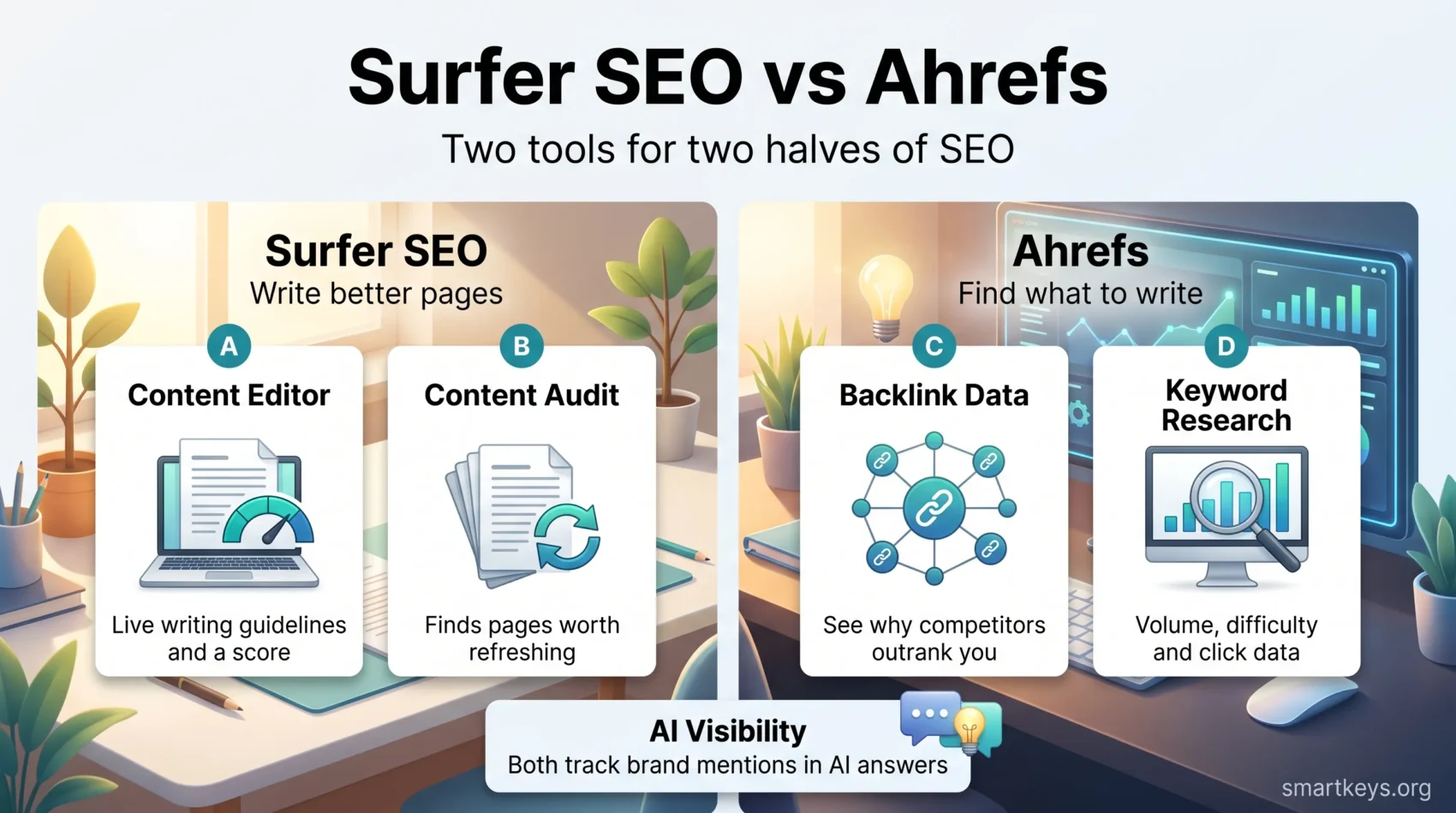
Surfer SEO and Ahrefs are usually framed as rivals, but they solve different halves of the same problem. Surfer helps you write and improve individual pages. Ahrefs tells you which pages are worth writing at all, and why competitors outrank you. Choosing starts with being honest about which job is costing you more traffic.
Both have changed a lot. Surfer moved from a pure on-page optimizer into a content workflow with topical maps, AI-assisted drafting and tracking of how brands appear inside AI assistants. Ahrefs kept its backlink index at the centre while adding AI-visibility reporting, a much cheaper entry tier and web analytics. All pricing below comes from the vendors’ own pricing pages in August 2026 and changes often. For wider context, see how digital marketing strategies have evolved.
Key Takeaways
- Surfer is an on-page and content workflow tool; Ahrefs is a research, backlink and rank-tracking platform.
- Surfer’s plans start at $49 per month billed yearly; Ahrefs starts at $29 per month on its Starter tier.
- Ahrefs owns the stronger backlink index and keyword database; Surfer owns the better writing interface.
- Both now report on brand visibility inside AI assistants, via Surfer’s AI Tracker and Ahrefs’ Brand Radar.
- Agencies often run both. Solo publishers usually do better picking one and covering the gap with free tools.
Surfer SEO in 2026
Surfer analyses the pages currently ranking for a query and turns that analysis into concrete editing instructions: which subtopics to cover, roughly how long the piece should be, which terms are missing. The result is a Content Score that updates as you write, easy to hand to a writer who is not an SEO specialist.
Content Editor and Content Audit
The Content Editor is still the core. It sits alongside your draft, either in Surfer or through the WordPress and Google Docs integrations, and gives live guidelines while you write. Content Audit works in the other direction, scanning published pages to find those losing ground and prioritising which to refresh.
That refresh workflow is arguably the more valuable half: reworking twenty pages that already carry some authority usually beats publishing twenty new ones.
Topical Map and Keyword Coverage
Topical Map replaces the older Content Planner. Instead of a flat keyword list it proposes a cluster around a subject, so you can see which supporting articles are missing before you fix a publishing calendar. It is built around topical authority, not single-keyword targeting.
Surfer’s keyword data is fine for planning a cluster but shallower than a dedicated research platform. If you need precise volume and difficulty figures across markets, you will still want Ahrefs or an alternative such as Semrush or SE Ranking beside it.
AI Tracker and Surfer AI
The newest part of the platform tracks how often your brand is mentioned or cited when people ask questions in ChatGPT, Gemini, Perplexity and Google’s AI results, and which competitors get named instead. Surfer sells this inside its main plans and as a standalone AI Search Analytics product.
Surfer AI generates full drafts against the same guidelines, and a free AI humanizer and detector are open to anyone. Drafts still need a knowledgeable editor: the tool optimises for coverage, not accuracy. The same caveat applies to every generator in this category, as our review of AI content generation for marketers shows.

Ahrefs in 2026
Ahrefs is a data platform first. Its value comes from the size and freshness of its own crawl, which feeds every report in the suite. You use it to answer questions, not to produce pages.
Keywords Explorer
Keywords Explorer returns search volume, difficulty, click metrics and parent topics across a very large number of countries and languages. Click data matters more than raw volume: many high-volume queries are answered on the results page and send almost nothing onward, and Ahrefs makes that visible before you write.
Site Explorer and Backlink Data
Site Explorer is what most people are really buying. Point it at any domain and you get its backlink profile, referring domains, top organic pages and the keywords driving traffic to each. For competitive research it is the most useful report in either product, and Surfer has no equivalent.
It also feeds digital PR: seeing which stories earned links for a competitor tells you what to pitch. That connects to work on brand storytelling and turning data into compelling narratives, which earn links more reliably than product pages.
Site Audit, Rank Tracker and Web Analytics
Site Audit crawls your site and flags technical problems that suppress rankings, from broken internal links to indexing conflicts. Rank Tracker follows positions over time against named competitors, and Web Analytics offers a lightweight, cookie-free traffic view. Read alongside behavioral analytics, these reports show not just where you rank but what visitors do next.
Brand Radar and AI Visibility
Brand Radar measures how often a brand surfaces in AI-generated answers. It is included in limited form on paid plans, with a larger standalone version and optional prompt packages for heavy tracking. If your audience increasingly asks assistants instead of typing queries, this matters as much as classic rank tracking, much as voice search changed digital marketing earlier.
Surfer SEO vs Ahrefs: Feature Comparison
Content Optimization
Surfer wins this outright. It converts competitor analysis into instructions a writer can follow without understanding the method, and the Content Score gives editors a shared reference point. Ahrefs has content tooling, but nothing that guides a draft line by line. Where Surfer needs supervision is in being taken literally: its guidelines describe what currently ranks, not your product or your customers. Treat the score as a floor, not a target.
Backlinks and Competitive Research
Ahrefs wins this just as clearly. The backlink index, referring-domain history and organic-keyword reports have no counterpart in Surfer. If you need to know why a competitor outranks you, or to build a link prospecting list, Surfer is not the tool. Ahrefs has been a reference point for backlink data since the early 2010s, and that longevity shows on higher plans, where you can look back years rather than months.
Tracking Visibility in AI Search
This is the newest battleground and neither has settled it. Surfer’s AI Tracker is priced into its main plans and scales from a handful of tracked prompts on the entry tier to a hundred daily at the top. Ahrefs’ Brand Radar starts small and expands through add-ons. For most publishers the practical difference is billing, not capability.
Pricing Comparison in 2026
Both vendors restructured their pricing since this article first appeared; the old tier names no longer exist.
Surfer Pricing
Surfer lists these tiers, billed yearly:
- Discovery: $49 per month, 120 documents, 10 tracked pages
- Standard: $99 per month, 360 documents, weekly AI prompt tracking, WordPress and Google Docs integrations
- Pro: $182 per month, daily prompt tracking across several assistants, five brand workspaces
- Peace of Mind: $299 per month, unlimited documents, API access, dedicated support
- Enterprise: custom pricing
A standalone AI Search Analytics plan is listed at $158 per month, for teams wanting the tracking without the writing tools.
Ahrefs Pricing
Ahrefs lists these monthly rates, with a discount for annual billing:
- Starter: $29 per month, a capped but genuine version of the main tools
- Lite: $129 per month, one user, five projects, 750 tracked keywords
- Standard: $249 per month, twenty projects, 2,000 tracked keywords, Content Explorer
- Advanced: $449 per month, fifty projects, 5,000 tracked keywords, longer history
- Enterprise: $1,499 per month on an annual commitment, uncapped API access and SSO
Extra seats, prompt packages and add-ons such as Report Builder are billed separately, which is where agency invoices outgrow the headline number.
Free and Low-Cost Entry Points
Ahrefs is the friendlier start on a tight budget. Its free tier gives limited Site Explorer and Site Audit access for a site you have verified, and the standalone free tools cover keyword generation, backlink checks and difficulty scores. The $29 Starter plan then adds real reporting without a four-figure commitment. Surfer has no permanent free plan, though its AI humanizer, AI detector and Chrome extension are free. Check current terms before assuming a trial or refund window exists.
Using Surfer SEO and Ahrefs Together
The handoff between them is clean. Find the opportunity in Keywords Explorer, sanity-check competitors in Site Explorer, build the cluster in Surfer’s Topical Map, write in Content Editor, publish, then watch Rank Tracker and Content Audit for pages needing a second pass. Teams that automate parts of this often connect the steps with tools like those in our Workato vs Zapier comparison.
The overlap to watch is keyword research and AI visibility tracking, where both now compete and you would pay twice. Pick one tool per job rather than the top tier of both. The same discipline applies across a stack, whether you are choosing between email marketing platforms, comparing website builders, or evaluating a suite like HubSpot Marketing Hub.
Which One Should You Choose?
Choose Surfer if you publish regularly, work with writers who are not SEO specialists, and your frustration is that good articles underperform. Content Editor and Content Audit pay for themselves fastest there.
Choose Ahrefs if you need to decide what to publish, understand a competitor’s link profile, diagnose a ranking drop, or report visibility to someone else. It is also the better first purchase for anyone still learning: the free tier and $29 Starter plan let you build the habit cheaply.
Choose both only when a real person is doing both jobs. A single operator will get more from Ahrefs plus disciplined editing than from two half-used subscriptions. Whichever you pick, the habit matters more than the licence. Teams that treat SEO the way they treat agile marketing — short cycles, fast feedback — get more from either tool than teams that buy both and check in quarterly.
Found this useful?
Make SmartKeys a preferred source on Google, and our articles will surface more often in your Top Stories, AI Overviews, and AI Mode.
Add as Preferred Source