Semrush is one of the few SEO platforms that has kept pace with how search itself changed. This Semrush review looks at what the platform actually does in 2026, what the reorganised plans cost, what the Adobe takeover means for you as a customer, and where a cheaper tool would serve you better.
Note on spelling: the company brands itself Semrush, although the older SEMrush styling is still widely used. Both refer to the same product.
Key Takeaways
- Semrush now sells four tiers: SEO, Starter, Pro+ and Advanced, from $139 to $549 per month.
- The three upper tiers bundle AI search visibility tracking alongside classic SEO reporting.
- Adobe completed its acquisition of Semrush on 28 April 2026; the product continues under its own name.
- Keyword research, site audits and position tracking remain the reasons most teams buy it.
- The platform is deep rather than simple; budget real time for onboarding.
Why Semrush Still Matters for SEO in 2026
Semrush earned its place by covering the whole reporting chain in one login: what people search for, who currently ranks for it, what is technically wrong with your own site, and whether your position is moving. That breadth is still the core argument for it.
What changed is the definition of visibility. Search results now sit alongside AI answers and assistant-generated summaries, and Semrush has moved to measure both. Its upper plans track a set number of AI prompts per day and report on how your brand shows up in those generated answers, not just in the ten blue links.

That shift matters for anyone whose traffic strategy is built on organic search. It sits alongside the broader changes in how digital marketing strategies have evolved and the way AI is reshaping marketing work more generally.
Semrush is not without friction. There are numerous alternatives worth comparing, such as Surfer SEO and Ahrefs, and new users routinely describe the first weeks as data overload. The dashboard hands you organic traffic, backlink counts, keyword positions and technical errors at once, with little guidance on which number to act on first.
What Is Semrush?
Semrush was founded in 2008 by Dmitry Melnikov and Oleg Shchegolev and grew from a keyword database into a full marketing suite. On 28 April 2026, Adobe completed its acquisition of the company. Adobe has said Semrush customers can expect continued investment and an expanded roadmap, and Semrush has told existing customers that contracts, billing, features and support remain unchanged for now. The product continues to be sold as Semrush.

In practice, Semrush is a research and monitoring platform. You point it at a domain, yours or a competitor’s, and it returns the keywords that domain ranks for, an estimate of the traffic those rankings produce, the backlinks pointing at it, and the technical issues holding it back. Everything else in the suite is built on that foundation.
Traffic Analytics estimates visits, unique visitors and bounce rates for sites you do not own. Those estimates are directional rather than exact, and they get shakier for low-traffic domains, so treat them as a way to rank competitors rather than as a measurement of them. The same caution applies to any modelled dataset, which is a recurring theme in behavioural analytics work.
Key Features of Semrush
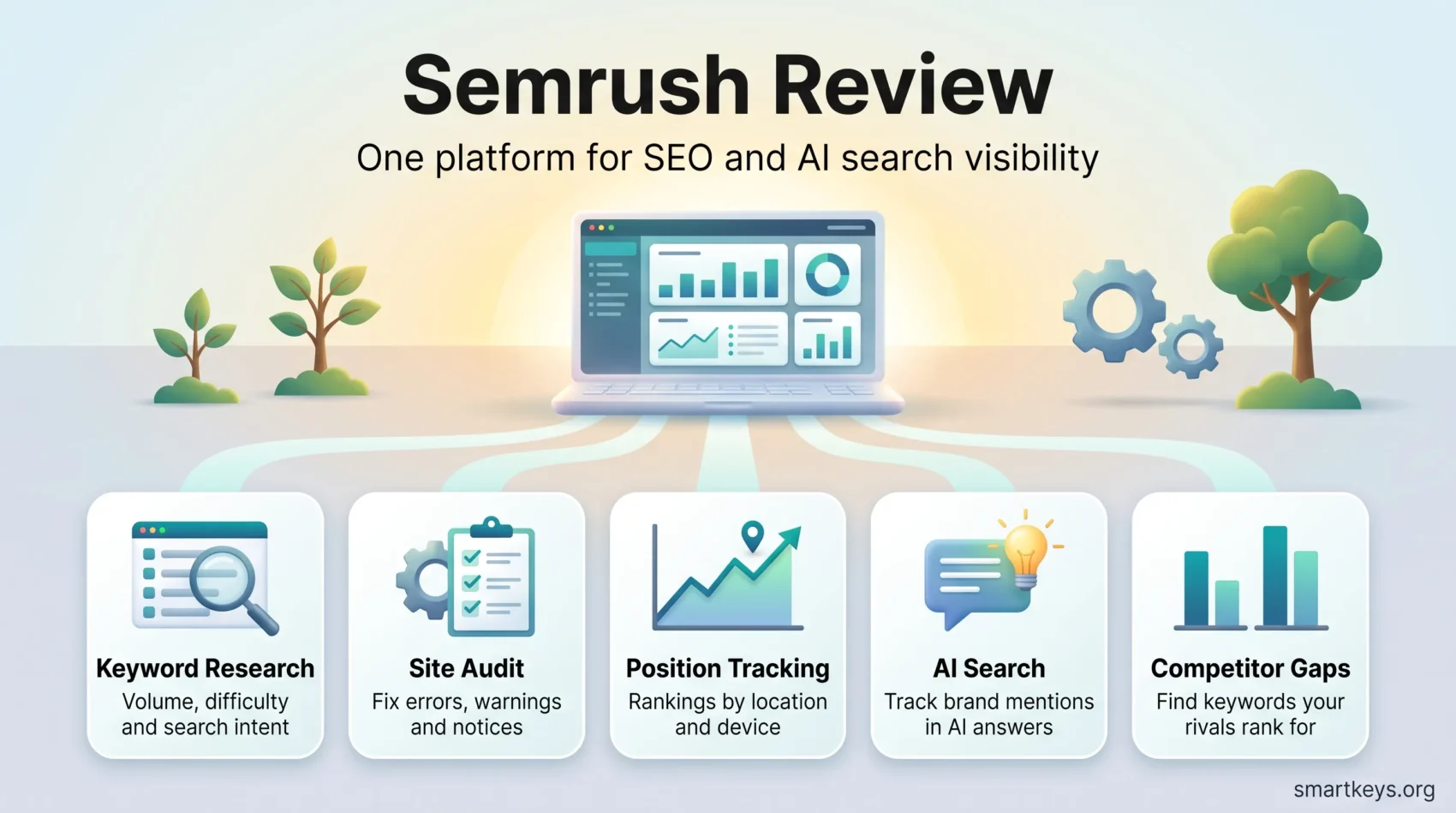
The suite is large, but four tools account for most of the day-to-day value: keyword research, site audits, position tracking and, newer, AI visibility reporting.
Keyword Research Tools
The Keyword Magic Tool takes a seed term and returns related queries with search volume, keyword difficulty and cost-per-click attached. The Keywords by Intent filter splits those results by what the searcher is trying to do: learn something, compare options, or buy. That single filter is the fastest way to stop writing informational articles for commercial queries, or the reverse.
Site Audit Features
Site Audit crawls your site and groups what it finds into errors, warnings and notices, with an explanation for each. Broken links, slow pages, missing tags, redirect chains and duplicate content all surface here. Run it on a schedule rather than once; most technical debt arrives quietly, through template changes and plugin updates.
Position Tracking and Rank Monitoring
Position Tracking follows your chosen keywords over time and can be segmented by location and device. It also reports which SERP features, such as featured snippets or local packs, are appearing for those queries, which often explains a traffic drop that raw rankings do not.
AI Visibility Tracking
The Starter, Pro+ and Advanced plans include a daily allowance of tracked AI prompts, from 50 to 200 depending on tier, plus AI visibility reporting. The idea is straightforward: watch whether AI assistants mention your brand when someone asks a question you should own. It is a young discipline and the metrics are still settling, but ignoring it is no longer a safe default.
Benefits of Using Semrush for Your SEO Strategy
Two capabilities justify the price for most teams: better keyword decisions and a clear read on competitors.
Improved Keyword Insights
Semrush’s keyword database is large enough that long-tail discovery stops being guesswork. Volume, difficulty and intent sit next to each other, so you can build a content plan around terms you can realistically win rather than the handful of head terms everyone chases. Pairing that with a clear narrative angle, as in brand storytelling, tends to produce better pages than keyword lists alone.
Comprehensive Competitor Analysis
Domain Overview and the gap-analysis reports show which keywords competitors rank for that you do not, and which pages earn their backlinks. That gap list is the single most actionable export in the product. Feeding it into a fast test-and-adjust cadence, the way agile marketing teams work, beats an annual content calendar.
Semrush Pricing in 2026
Semrush restructured its lineup around SEO and AI search. The plans, as listed on the company’s own pricing page, are:
- SEO — $139 per month, or $117.33 per month billed annually. 5 websites, 500 keywords tracked daily. SEO reporting only.
- Starter — $199 per month, or $165.17 billed annually. 5 websites, 500 keywords, plus 50 AI prompts tracked daily.
- Pro+ — $299 per month, or $248.17 billed annually. 15 websites, 1,500 keywords, 100 AI prompts daily.
- Advanced — $549 per month, or $455.67 billed annually. 40 websites, 5,000 keywords, 200 AI prompts daily, plus API access.
Annual billing saves roughly 17 percent. Add-ons are billed separately: additional user seats start at $45 per month, lead generation at $90 per month, and report packages at $10 or $20 per month. Semrush advertises a seven-day free trial on its pricing page.
The practical read: if you only need SEO reporting, the entry plan does that job. The step up to Starter buys AI visibility tracking, not more keywords. Pro+ is the first tier that meaningfully raises the limits. Compare that against how you would price your own product, since the tiering follows the familiar freemium-to-paid logic of most software businesses.
Semrush Review: User Experience and Interface
The interface is dense but consistent. Tools are grouped by job, projects carry your saved domains, and moving between keyword research and site audit takes a click rather than a hunt. Once you know where things live, it is fast.
The learning curve is the honest complaint. Semrush surfaces a lot at once, and beginners often mistake volume of data for clarity. The built-in guides and recommendation prompts help, and the reporting is genuinely good, but expect to spend a few sessions deciding which five numbers you will actually watch.
Report building deserves a mention. Semrush exports cleanly into scheduled PDFs, which matters when you have to justify spend to someone who does not live in the tool. If your reporting needs run beyond marketing, a dedicated BI platform such as those covered in Zoho Analytics vs Power BI is the better home for it, and the principles in data storytelling apply either way.

How to Use Semrush Effectively: A Beginner’s Guide
The fastest route to value is to ignore most of the platform for the first month and use three tools well.
Setting Up Your Account
- Start the seven-day trial, or pick the tier that matches the number of sites you manage.
- Create a project for your own domain first, before you look at anyone else’s.
- Connect Google Analytics and Search Console so estimated data sits next to measured data.
- Set your target location and device, since rankings differ sharply between them.
Conducting a Site Audit
- Open Site Audit and run a full crawl of your project.
- Fix errors before warnings, and warnings before notices.
- Re-crawl after each batch of fixes to confirm the change landed.
- Schedule the crawl weekly so regressions surface on their own.
Performing Keyword Research
- Open the Keyword Magic Tool and enter a seed term from your own business.
- Filter by intent first, then by difficulty, then by volume.
- Group the survivors into topics rather than treating each keyword as a page.
- Check the live results for your top candidates before committing to a brief.
Analysing Competitors with Semrush
Competitor research is where Semrush pays for itself fastest, because it turns guesswork about a market into a list.
Identifying Competitive Keywords
The Keyword Gap report compares up to several domains at once and marks the terms where rivals rank and you do not. Sorted by difficulty, that becomes a realistic backlog rather than a wish list. Pair it with a clear go-to-market strategy so the pages you commission serve a commercial goal.
Understanding Market Trends
Tracking a set of competitor domains over months shows where a market is heading before it is obvious: which topics are being invested in, which are being abandoned. Combining that signal with augmented analytics on your own data gives you an earlier read than either source alone.
Where Semrush Falls Short
Three limits are worth knowing before you buy. Traffic estimates for smaller sites are unreliable, so do not present them as fact. The pricing steps are steep for solo operators and small agencies, and the per-seat add-on cost compounds quickly. And the platform’s breadth invites tool sprawl: many teams pay for capability they never open, which is the same trap described in the wider shift toward AI-driven SaaS and AI in business operations.
Semrush also stops at the edge of your funnel. It will not send your emails or run your automations; that is the job of tools like Mailchimp, or of the platforms compared in Mailchimp vs Klaviyo and ActiveCampaign vs HubSpot. And if you are still choosing where your site will live, settle that first with a comparison such as Squarespace vs Wix.
Found this useful?
Make SmartKeys a preferred source on Google, and our articles will surface more often in your Top Stories, AI Overviews, and AI Mode.
Add as Preferred Source