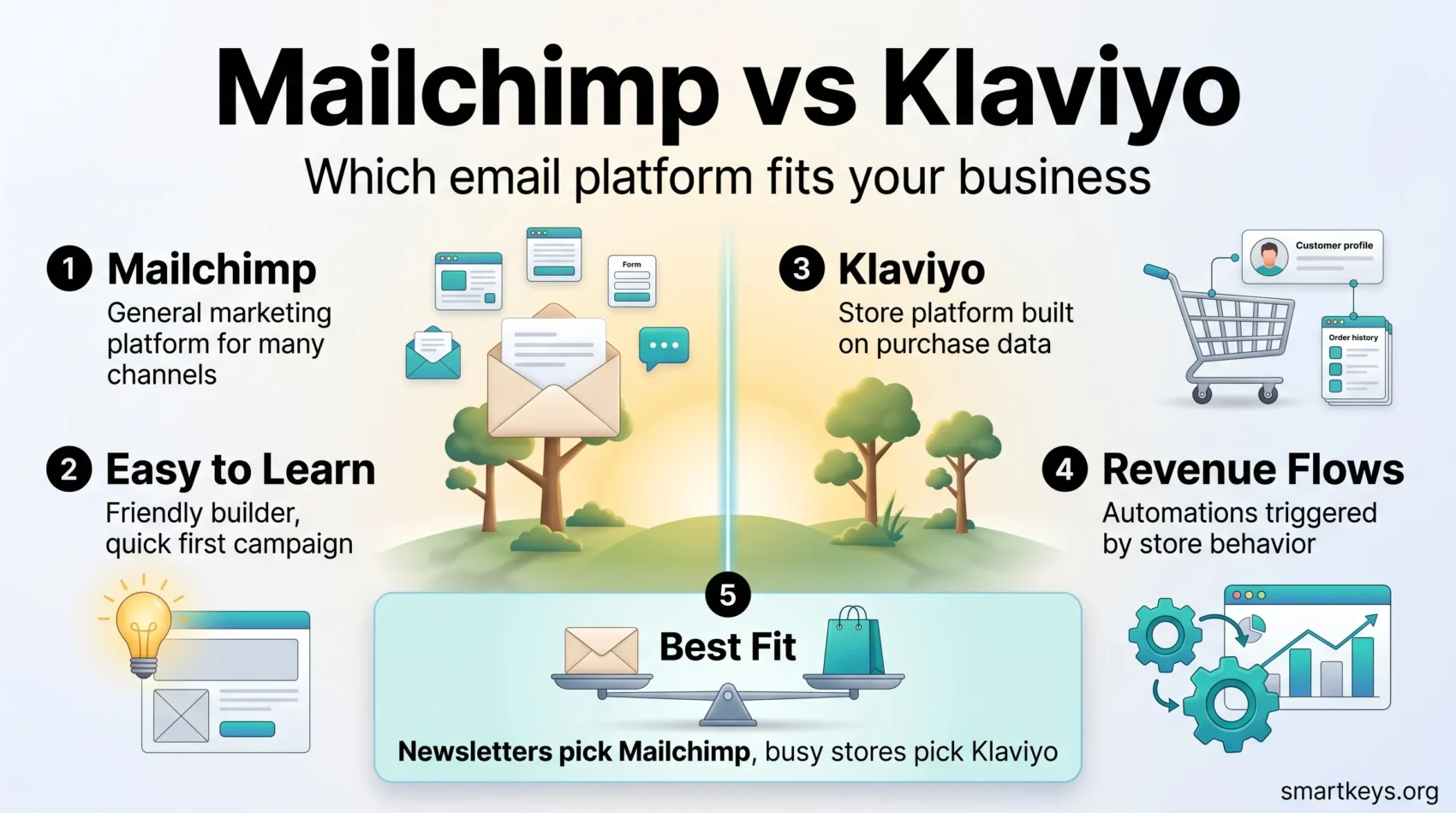
Mailchimp and Klaviyo both send marketing emails, but they were built for different jobs. Mailchimp is a general marketing platform that also works for online stores. Klaviyo is a store platform that also sends email. Almost every other difference follows from that: the pricing, the data model, the reporting, the learning curve.
This guide compares the two as they stand in 2026: what each plan costs, what the automation and analytics do, and which business each tool fits.
Key Takeaways
- Mailchimp is the easier starting point for small businesses, newsletters and teams without a marketing specialist.
- Klaviyo is built around order data, so its segmentation and revenue reporting are stronger for online stores.
- Both platforms bill by contact count, and both count people who never open an email.
- Klaviyo gets noticeably more expensive as the list grows: roughly $1,380 a month at 100,000 profiles against about $800 for Mailchimp Standard.
- Mailchimp’s free plan is now very small: 250 contacts and 500 emails a month.
- Both vendors expanded their AI tooling this year, from campaign drafting to customer-facing agents.
What These Platforms Actually Do
An email marketing platform stores your contact list, sends messages to parts of it, and reports on what happened. Two terms recur below. Segmentation means splitting your list into groups, for example everyone who bought in the last 90 days. Automation means a message that sends itself when something happens, such as a reminder to someone who left items in a cart.
Both do both. The real difference is how much they know about your customers. Mailchimp treats a contact as a person on a list with an email address and a few tags. Klaviyo treats a contact as a profile with purchase history attached. That is why Klaviyo can build a segment like “customers who bought twice and have not ordered in 60 days” with no setup work, and why it costs more.
Mailchimp in 2026
Mailchimp has been owned by Intuit since 2021 and sits alongside QuickBooks in Intuit’s small business stack. It remains the broader of the two tools, covering email, landing pages, forms, social posts, postcards and SMS.
What Mailchimp Offers
- Email campaigns with a drag-and-drop builder and branded templates
- Landing pages, signup forms and popups
- Customer Journey Builder for multi-step automations
- SMS, extended to 37 countries in the February 2026 release
- Around 300 app integrations
- Generative AI included at no extra cost on Standard and Premium
- Predictive segments that flag likely high-value and at-risk customers
That February 2026 release was the most store-focused update Mailchimp has shipped in years. It added a site tracking pixel, direct connections to review platforms such as Yotpo and Judge.me, one dashboard covering email, SMS and store events, migration tools for importing from another provider, and a ChatGPT integration for drafting campaigns. Our full Mailchimp review covers the builder and deliverability record in detail.
Who Mailchimp Suits
Mailchimp fits businesses where email is one channel among several and nobody’s full-time job: consultants, newsletters, membership sites and smaller stores. If your list is under a few thousand contacts and you mostly send a monthly campaign plus a welcome sequence, Mailchimp does the job for less money and less setup time.
Klaviyo in 2026
Klaviyo launched in 2012 and has always aimed at online retail. Over the past year it repositioned itself from an email tool to what it calls a B2C CRM: one customer database that also handles messaging, reviews and support. That framing explains both the product direction and the price.
What Klaviyo Offers
- Flows: sequences triggered by store behavior, such as abandoned cart, browse abandonment, post-purchase and winback
- Predictive analytics: estimates of lifetime value, next order date and churn risk
- Segmentation on order data: segments update themselves as purchase history changes
- Multi-channel messaging: email, SMS, push and WhatsApp from one profile
- Add-on products: Reviews, a customer data platform and a help desk
Klaviyo introduced two AI agents in September 2025. The Marketing Agent turns a store URL into a draft plan with campaigns, flows and forms. The Customer Agent answers questions across chat, SMS, email and WhatsApp, handing off to a person when it cannot resolve one. In March 2026 Klaviyo and Shopify added Locale Aware Catalogs, which syncs market-specific pricing, currency and translated product data so one store can send localised campaigns across countries. Treat the AI claims carefully: agents save time on a first draft, they do not replace someone checking what goes out.
Who Klaviyo Suits
Klaviyo suits stores on Shopify, BigCommerce, Magento or WooCommerce with enough order volume that behavior-based sequences pay for themselves. A store running abandoned cart, browse and post-purchase flows to thousands of customers usually recovers the price difference. One with 400 contacts will not.
Ease of Use and Learning Curve
Mailchimp is the friendlier of the two. The interface is clean, the builder is familiar to anyone who has used a website builder, and you can send a decent-looking email within an hour of signing up.
Klaviyo asks more upfront. The concepts are heavier: profiles, metrics, conditional splits and segment logic that nests several rules deep. Expect a few days of real work before your first flows behave as intended. The payoff is control.
A simple test: if nobody on your team enjoys building conditional logic, the extra power in Klaviyo will sit unused, and you will still be paying for it.
Pricing in 2026
Both platforms charge by list size rather than by emails sent. What counts as a contact is the detail that decides your bill.
Mailchimp Pricing
The free plan is now very limited: 250 contacts, 500 emails a month and a 250-per-day cap. It works as a trial, not as a starting plan.
Paid plans begin at $13 a month for Essentials and $20 for Standard, both at 500 contacts. At 2,500 contacts Essentials runs around $45 and Standard around $60; at 10,000 contacts, roughly $110 and $135. Premium starts at $350 a month and targets lists of 10,000 and up. Figures come from EmailToolTester’s tracked pricing tables and Mailchimp’s own plan comparison. Standard is where most businesses land: it is the cheapest tier with the generative AI features and the fuller automation set.
Klaviyo Pricing
Klaviyo’s free plan covers 250 active profiles, 500 email sends a month and 150 SMS credits, with email support for 60 days only.
Paid email pricing starts at $20 a month for 500 profiles and climbs steadily: about $100 at 5,000, $150 at 10,000, $400 at 25,000, $720 at 50,000 and roughly $1,380 at 100,000. SMS costs from about $15 a month on top. Several Klaviyo products are billed separately: Reviews from around $25 a month, marketing analytics from around $100, and the customer data platform from around $500 at 100,000 profiles. Those add-ons are easy to miss when comparing headline prices.
What Large Lists Really Cost
The gap widens as you grow. At 100,000 contacts, Klaviyo runs roughly $1,380 a month against about $800 for Mailchimp Standard. Whether that is worth paying depends on what your automated flows earn. For a store doing serious volume, one improved abandoned cart sequence can cover it. For a newsletter, it cannot.
Watch the contact definition on both sides. Mailchimp counts subscribed, unsubscribed and non-subscribed contacts toward your total, so only archived or deleted contacts stop costing money. Klaviyo moved in 2025 to billing on all subscribed contacts rather than only those you recently emailed. On both platforms, list hygiene is now a direct line item. If either price looks steep, compare MailerLite and ActiveCampaign or Brevo and Kit, which price differently for mid-sized lists.
Automation Compared
Automation is where the two separate most clearly. Test it before you commit.
Mailchimp Automations
The Customer Journey Builder handles the sequences most businesses need: welcome series, birthday emails, re-engagement, abandoned cart, and branching on opens and clicks. Standard allows up to 200 active journeys. Setup is visual and forgiving. Where it runs out of room is conditional depth: rules based on several purchase attributes at once are awkward to express.
Klaviyo Flows
Klaviyo’s flows react to store events rather than email behavior. A flow can branch on what someone bought, how much they spent, how many orders they have placed and how likely they are to buy again.
Here is the practical difference. In Mailchimp you typically build one abandoned cart email for everyone. In Klaviyo you can send first-time visitors a different message from repeat customers, with a discount only for the group that needs one. That kind of e-commerce personalization is the whole argument for the higher price.
Integrations
Neither tool is useful in isolation. What it connects to determines what it knows.
Mailchimp offers around 300 integrations across store platforms, content management systems, automation tools and CRMs. The most used are Shopify, WordPress, Zapier and Salesforce, plus review platforms such as Yotpo and Judge.me since February 2026.
Klaviyo concentrates on commerce. Its strongest connections are Shopify, BigCommerce, Magento and WooCommerce, and the Shopify link is close enough that catalog, order and browsing data flow in without custom work. Klaviyo also connects to help desks, loyalty tools and ad platforms, so audiences can be pushed into paid campaigns.
List the tools your business runs on and check both platforms against it. An integration you need and cannot get costs more than any price difference. On how customer data moves between systems, see our guides to the customer data platform and to behavioral analytics.
Analytics and Reporting
Mailchimp reports clearly on the standard metrics: opens, clicks, bounces, unsubscribes and revenue where a store is connected. The 2026 update added an omnichannel dashboard combining email, SMS and store events.
Klaviyo reports on money first. Its dashboards attribute revenue to individual flows and campaigns, its predictive metrics estimate what a segment is likely to be worth, and cohort analysis shows whether customers acquired in a given month keep buying.
The short version: Mailchimp tells you how your emails performed, Klaviyo tells you what they earned. If you cannot yet connect email activity to orders, the second is wasted on you. The same shift is visible across digital marketing and in customer relationship management generally.
Support and Resources
Mailchimp offers email and chat support depending on plan, plus a large knowledge base and onboarding on Standard. Premium adds phone support and a dedicated onboarding specialist. Klaviyo provides documentation, live training and a certification program through its academy, plus an agency partner network. Free-plan users get email support for the first 60 days only, so support is effectively a paid feature.
Which One Should You Choose?
Choose Mailchimp if email is one of several things you do, your list is small or moderate, and nobody wants to spend a week learning a new tool. It is also the better choice if your business is not a store, since Klaviyo’s advantages depend on order data you would not have.
Choose Klaviyo if you run an online store with steady orders and can point to the revenue your flows would produce. The price only makes sense against that number.
Still undecided? Build the same welcome sequence in both and see which one you finish. That tells you more than any feature table. If your business leans toward marketplaces and mobile buying, our overviews of mobile commerce, conversational commerce and current e-commerce trends may shape the choice. Teams weighing a full marketing suite can compare ActiveCampaign and HubSpot or read our HubSpot Marketing Hub review, and stores adding live chat can look at Tidio or Drift and LiveChat.
Found this useful?
Make SmartKeys a preferred source on Google, and our articles will surface more often in your Top Stories, AI Overviews, and AI Mode.
Add as Preferred Source