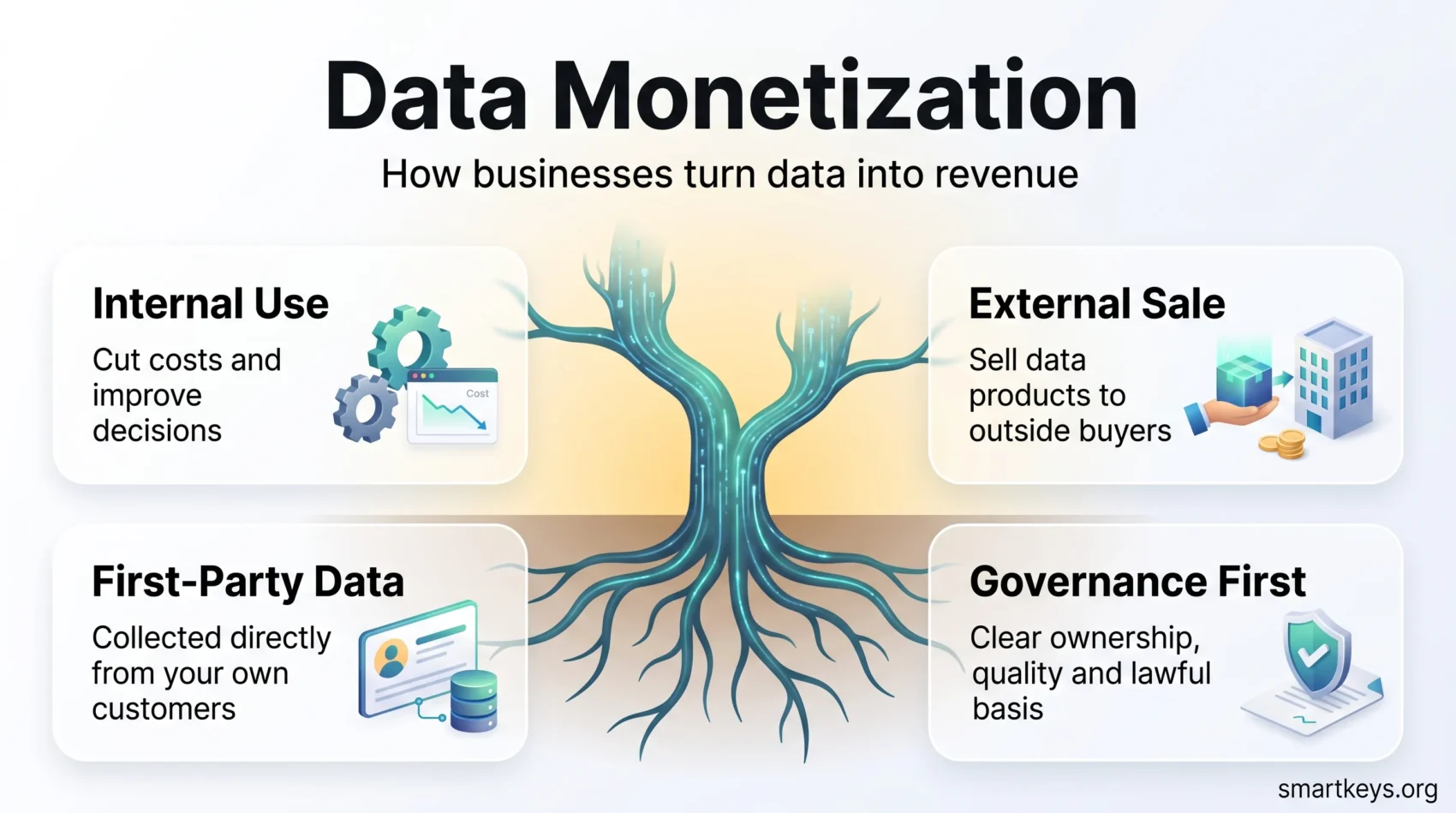
Data monetization means turning the data your company already collects into money. That happens in two ways: using the data internally to cut costs and work faster, or packaging it into something you can sell to other companies. Most businesses do the first without calling it monetization, and far fewer manage the second.
The idea has moved from experiment to line item. Grand View Research puts the global data monetization market at about $4.8 billion in 2026, growing at roughly 20% a year to $17.6 billion by 2033. That market covers the platforms and services companies buy to do this work, not the value of the data itself, which is far larger and much harder to measure.
This guide explains what data monetization actually involves, which models exist, what the rules now require in the EU and the US, and where these projects usually stall.
Key Takeaways
- Data monetization has two forms: internal use that improves operations, and external sale or sharing of data products.
- Grand View Research values the global data monetization market at about $4.8 billion in 2026, with roughly 20% annual growth forecast to 2033.
- McKinsey found that respondents at high-performing companies were three times more likely than others to say monetization contributes over 20% of revenue.
- First-party data, collected directly from your own customers, is the foundation. Third-party data is harder to get and harder to defend legally.
- The EU Data Act has applied since 12 September 2025 and changes who can demand access to connected product data.
- Twenty US states had comprehensive consumer privacy laws in effect during 2026, so a single national approach no longer works.
What Data Monetization Actually Means
Every company generates data as a by-product of operating: transactions, sensor readings, support tickets, website sessions, delivery times. Data monetization is the deliberate work of converting that exhaust into measurable financial value.
The distinction that matters is direct versus indirect. Indirect monetization uses data inside the business. A logistics company that analyses delivery times to reroute vans is monetizing data: the payoff shows up as lower fuel costs, not as an invoice. Direct monetization means someone outside your company pays for access, whether that is a raw data feed, an analytics report, or a benchmarking dashboard.
Most organizations start indirect because it is easier. You already own the data, you already have the legal basis to use it for running your business, and you do not need a customer for it. Direct monetization is a different discipline. It requires a product, pricing, support, contracts, and a clear answer to why your data is worth more to a buyer than the alternatives they could assemble themselves.
A useful test: if you cannot name who would pay and what decision your data helps them make, you have an internal efficiency project, not a data product. Both are legitimate. Confusing them is what wastes budgets.
Why It Matters for Your Business
The commercial case rests on two things. Data assets do not deplete when used, and the same dataset can serve several purposes at once. A retailer’s transaction log improves its own forecasting, informs its suppliers’ production plans, and supports its retail media business. Few other assets work that way.
McKinsey’s research on data monetization found that respondents at high-performing companies were three times more likely than others to say their monetization efforts contribute more than 20% of company revenues. The same survey found that 41% of companies had begun monetizing data, with more than half of respondents in basic materials and energy, financial services, and high tech reporting active efforts. Treat these as directional rather than current: the survey is several years old, and adoption has broadened since.
There is a defensive argument too. As third-party tracking has become harder and more restricted, companies that hold rich first-party data have an advantage over those that rented audience data from intermediaries. Zero-party data, meaning information customers hand over on purpose through preference centres and surveys, is even more durable because consent is explicit.
The Two Models: Internal and External
Almost every approach fits into one of two categories, and the operational demands are very different.
Internal Monetization
Here the data never leaves the company. You use it to reduce cost, raise throughput, or improve a decision. An airline that models booking curves to adjust schedules, a manufacturer that predicts machine failures before they happen, a support team that routes tickets by predicted complexity: all are monetizing data internally.
The advantages are speed and low legal risk. You are using your own data for your own purposes, which is usually the most straightforward position under privacy law. The discipline required is measurement. If you cannot show the saving in a budget line, the project will be judged on enthusiasm rather than results, and enthusiasm runs out.
External Monetization
Here data or insights derived from it leave the company. Three common shapes:
Selling information products. A packaged feed, report, or dashboard sold to customers, suppliers, or third parties. Financial market data businesses are the mature version of this.
Wrapping existing products. Adding data-driven features to something you already sell, then charging more for it. A machine manufacturer that includes a usage analytics portal with each unit is wrapping.
Ecosystem sharing. Pooling data with partners so all participants get a better picture than any could build alone. Supply chain visibility consortia work this way. The hard part is rarely the technology. It is agreeing who may see what, which is why shared ledgers and permissioned records keep being proposed for these arrangements. Our overview of blockchain adoption in business covers how far that has actually got.
Connected products have widened the raw material available for all three shapes. Machines, vehicles, and equipment that report their own usage produce readings nobody had to ask a customer to supply. That is why equipment makers increasingly sell performance benchmarking alongside the hardware, and why the EU Data Act, covered further below, now matters to anyone building on sensor data.
External monetization is slower to build and carries real legal exposure. You need contracts covering permitted use and resale, a way to prevent buyers from redistributing what they bought, and confidence that your data protection basis actually covers commercial sharing. That last point defeats many projects late, after money has been spent.
Strategies That Work
Build on First-Party Data
First-party data is the information you collect directly from your own customers and operations: purchases, account activity, service interactions, loyalty programme behaviour. It is the strongest foundation because you know its provenance, you can document consent, and competitors cannot buy the same thing.
The practical work is unglamorous. It means fixing identity resolution so the same customer is not four records, agreeing definitions so “active customer” means one thing across departments, and setting retention rules so you are not sitting on data you no longer have a reason to hold. A customer data platform can help consolidate this, though the tool solves less than the governance work around it.
Most of that work is really about silos. When sales, support, and finance each keep their own version of the customer, no single team can answer a question the whole business cares about. Nothing you could sell to an outsider is complete either. Joining those sources up does not mean building one giant database. It means agreed definitions, one place where the combined view lives, and a named person responsible for keeping it accurate.
Make the Data Usable by People Who Need It
Monetization stalls when only the analytics team can answer questions. Data democratization means giving other teams safe, self-service access with sensible guardrails. Pair it with data storytelling so findings reach the people who make decisions in a form they act on.
Assessing where you stand honestly helps. An analytics maturity model gives you a rough diagnosis: whether you are still reporting on what happened, or genuinely able to predict and act.
Fix Governance Before You Sell Anything
A data governance strategy sounds like paperwork, and it is the difference between a data product you can defend and one that becomes a liability. You need documented ownership, quality standards, lineage showing where each field came from, and a clear record of the lawful basis for each intended use.
Do this before you approach a buyer. Retrofitting governance onto a live commercial arrangement is expensive, and discovering afterwards that you cannot legally supply what you promised is worse.
What It Looks Like in Practice
Retail is the clearest example of a large company turning operational data into a business. Walmart Data Ventures sells first-party retail insights to the suppliers whose products it stocks. The platform, launched as Luminate and since rebranded to Scintilla, gives suppliers access to sales figures, inventory levels, shopping patterns, and customer perception surveys, and connects those insights to media planning through Walmart Connect.
In February 2026 Walmart extended the line with Scintilla In-Store, a mobile app for supplier field representatives that surfaces real-time data and assigned tasks, so a rep can spot low inventory and fix a stocking problem while standing in the aisle. The direction of travel is from describing what happened to recommending what to do next.
The pattern repeats in other sectors. Payment processors sell anonymised spending trend data. Telecoms sell aggregated movement data for transport planning. Industrial equipment makers sell performance benchmarking back to the customers who generated the readings. In each case the seller already held the data for operational reasons and found a second buyer for the same asset.
The pattern is not limited to the largest retailers. Dollar General sells advertisers access to its own shopper data through DG Media Network. The company describes that network as covering more than 18,000 stores in 47 states and more than four million monthly app users. Its pitch is not sheer volume. It is reach into rural areas that other retailers measure poorly, plus closed-loop reporting that ties an advert to an actual purchase. That is the useful lesson for mid-sized companies: a dataset wins by being the only reliable view of something, not by being the biggest.
Smaller companies rarely have data at that scale, but the indirect route is open to everyone. A regional distributor that uses its own order history to cut stockouts is capturing real value without needing a data product or a sales team to sell one.
Tools and Platforms
The tooling divides roughly into three layers, and buying at the wrong layer is a common mistake.
Storage and processing. Data lakes and warehouses hold raw and modelled data. This is where quality problems either get fixed or get baked in.
Analysis and delivery. Business intelligence tools turn stored data into dashboards and reports. Augmented analytics adds automated pattern detection so analysts spend less time hunting. Where decisions cannot wait, real-time data pipelines matter more than deeper historical analysis.
Distribution. Data marketplaces and exchange platforms handle listing, licensing, entitlement, and billing for data you sell externally. Cloud marketplaces are the usual starting point because the buyers are already there. Buyers increasingly expect delivery as a subscription rather than a file, which is the data-as-a-service model: continuous access to curated data through an interface you keep running.
Above all three sits the modelling layer. Predictive analytics turns historical records into forecasts, and behavioral analytics explains how customers actually move through your product rather than how you assumed they would. Both raise the value of a data product, and both depend entirely on the quality of what sits underneath.
The Rules You Have to Work Within
Data monetization is one of the most heavily regulated things a company can do with its own assets. Four bodies of law matter most.
GDPR in the EU and UK. Personal data needs a lawful basis for each purpose. A basis that covers running your service does not automatically cover selling derived insights, and consent obtained for one purpose does not stretch to another. Anonymisation can remove data from scope, but only if re-identification is genuinely not possible, which is a higher bar than removing names.
US state privacy laws. Twenty states had comprehensive consumer privacy laws in effect during 2026, according to MultiState’s tracker, with Indiana, Kentucky, and Rhode Island joining in January. Most give consumers a right to opt out of the sale or sharing of their personal information, and several define “sale” broadly enough to catch arrangements that do not involve money changing hands. Privacy rules keep shifting, so treat compliance as a standing programme rather than a project.
The EU Data Act. Applicable since 12 September 2025, it requires connected products sold in the EU to be designed so the data they generate can be shared, and gives users the right to access that data and direct it to third parties. It also bans unfair contract terms that block data sharing between parties of unequal bargaining power. For manufacturers this cuts both ways: data you assumed was exclusively yours may now have to be shared, while data held by others may become reachable.
The EU AI Act. Where monetization involves AI systems, obligations under the EU AI Act apply alongside privacy law. Broader AI regulation continues to develop in other jurisdictions.
If you operate across borders, data localization laws add another constraint by restricting where data can be stored and processed. A privacy compliance framework that maps obligations to specific systems is more useful than a policy document nobody reads.
Where These Projects Fail
The failure modes are consistent enough to be worth naming.
Data quality was worse than assumed. Internal reporting tolerates gaps and inconsistencies that paying customers will not. Many projects discover this after committing to a delivery date.
No buyer was identified first. Teams build a dataset they find interesting, then look for demand. The reverse order works better: find the decision someone is struggling to make, then check whether your data informs it.
It was never tied to a business objective. A data initiative that runs alongside the company strategy instead of serving it loses its budget at the first review. Name the outcome it supports, whether that is margin, retention, or a new revenue line, before you start.
The legal basis did not survive review. Commercial sharing gets scrutinised more closely than internal use. Involving legal and privacy people at the design stage costs less than rebuilding later.
Nobody owned it. Data monetization sits between IT, analytics, legal, and the commercial side. Without a named owner and a budget, it becomes everyone’s second priority.
Trust was treated as free. Customers who feel their data was sold behind their back do not read your privacy notice before reacting. Digital trust is slow to build and quick to lose, and the reputational cost can exceed the revenue.
How to Get Started
A realistic sequence for a company that has not done this before:
Inventory what you hold. List your significant datasets, who owns each, how good the quality is, and what you are permitted to do with them. This alone surfaces both opportunities and problems.
Start internal. Pick one operational decision that is currently made on instinct and improve it with data. Measure the result in money. This builds credibility and exposes quality gaps cheaply.
Use that result to win a sponsor. This work needs someone senior who owns the outcome and defends the budget when priorities shift. A documented saving is the argument that earns that backing. A strategy deck rarely is.
Test external demand before building. Talk to potential buyers with a description of what you could provide. If nobody is interested in a conversation, they will not be interested in an invoice.
Get the governance and legal review done early. Confirm you can lawfully supply what you intend to sell before you build the pipeline.
Price against the alternative. Buyers compare your data with what they could assemble themselves. Your price has to reflect the effort you save them, not the effort it cost you.
Companies that use data well tend to be better at the connected disciplines too, from customer relationship management to personalization. Monetization is usually a symptom of that wider capability rather than a shortcut to it.
Conclusion
Data monetization is not a single move. It is a capability built from ordinary parts: data you can trust, people who can use it, governance that holds up under scrutiny, and a clear view of who benefits and how.
The internal route is available to almost any company and pays back in costs avoided. The external route is a real business with real obligations, and it deserves to be treated as one rather than as a side effect of already having data.
The regulatory picture has tightened considerably. That is not a reason to avoid the subject. It is a reason to do the groundwork first, so that when an opportunity appears you can act on it rather than spend six months discovering you cannot.
Found this useful?
Make SmartKeys a preferred source on Google, and our articles will surface more often in your Top Stories, AI Overviews, and AI Mode.
Add as Preferred Source