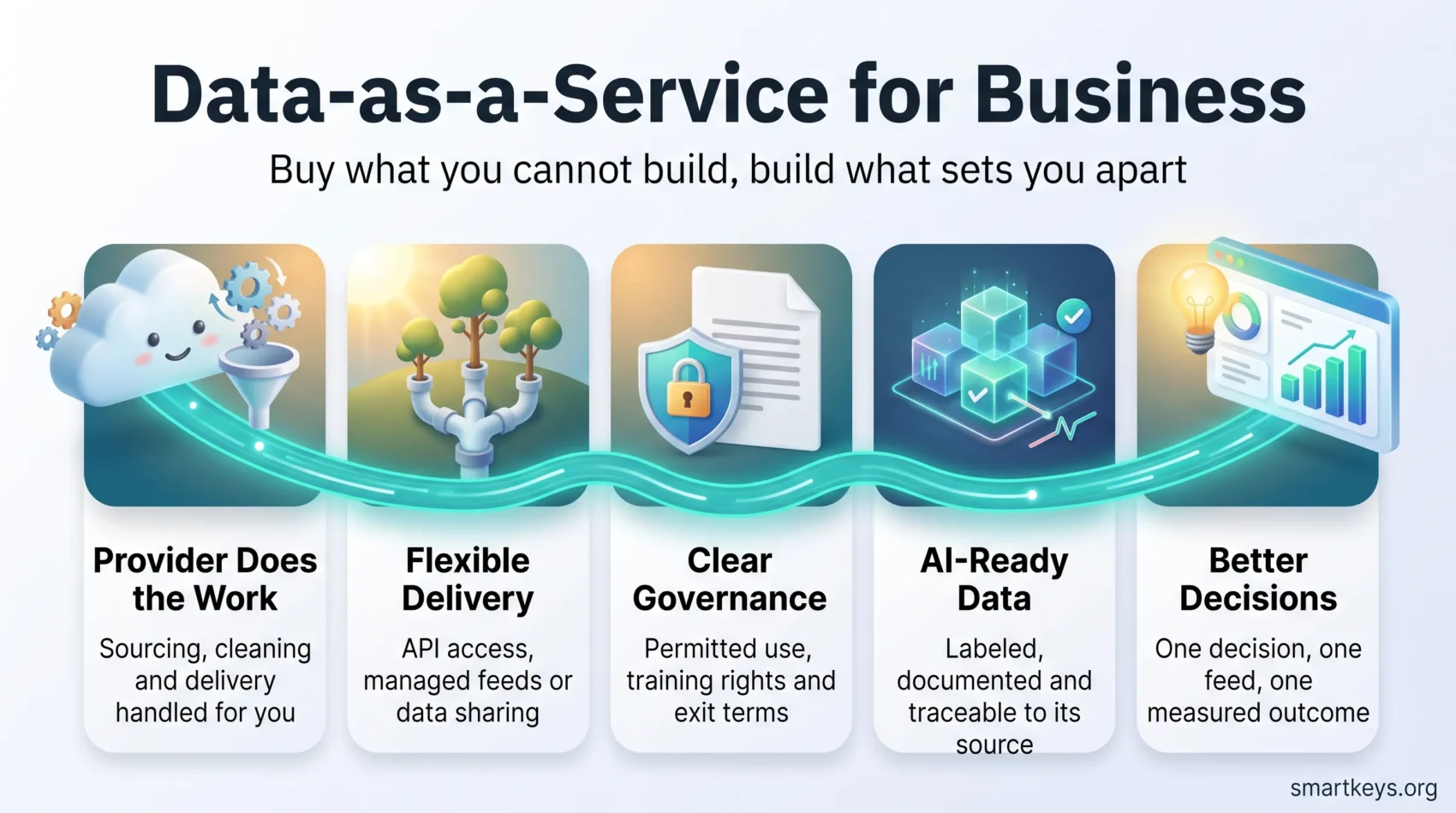
Data-as-a-Service (DaaS) means buying curated, ready-to-use data on demand instead of building and maintaining the pipelines yourself. The provider owns the sourcing, cleaning and delivery; you consume the result through an API, a shared table or a managed feed.
The business case is blunt. Gartner puts the average cost of poor data quality at at least $12.9 million a year per organization — and that was before AI systems began amplifying whatever they were fed.
The market has grown accordingly. Mordor Intelligence sizes DaaS at roughly $29.7 billion in 2026, rising toward $61 billion by 2031 at about 15.5% a year, as enterprises move from on-premises warehouses to consumption-based platforms.
This guide covers what DaaS delivers, where it pays off, and the 2026 rules now shaping every contract you sign.
Key Takeaways
- DaaS is a contract, not a technology. A provider owns sourcing, quality and delivery so your team works on decisions instead of pipelines.
- Gartner estimates poor data quality costs organizations at least $12.9 million a year.
- The DaaS market reaches roughly $29.7 billion in 2026 and is forecast to more than double by 2031 (Mordor Intelligence).
- AI readiness is the new selection criterion. Gartner found 63% of organizations lack AI-ready data practices or are unsure they have them.
- The EU Data Act has applied since 12 September 2025; switching charges disappear entirely on 12 January 2027.
- Start with one decision blocked by missing data, buy exactly that feed, and measure it for a quarter.
Understanding Data-as-a-Service (DaaS)
DaaS extends the SaaS idea to the data itself. Rather than licensing software and filling it with your own records, you subscribe to data that arrives already sourced, cleaned, joined and documented — alongside the data management services needed to keep it that way.
The practical effect is that you stop owning a category of work. Ingestion, deduplication, schema drift and refresh schedules become someone else’s problem, governed by a service level agreement rather than an internal backlog.

DaaS sits alongside, not instead of, the platforms you run. Most organizations keep data lakes and warehouses for internal records and buy external data — firmographics, market prices, weather, risk signals — where building the pipeline would never repay the effort.
Three delivery shapes dominate: API access for high-frequency lookups, managed feeds for bulk refreshes, and data sharing through clean rooms or cross-account warehouse shares — the fastest growing option, because it moves the query to the data rather than copying the data to the query.
Benefits of Data-as-a-Service for Businesses
The gains fall into two groups: what you stop paying for, and what you can now decide.
Cost Savings and Scalability
Buying data replaces a fixed cost with a variable one. You avoid the storage, compute and engineering headcount needed to acquire and maintain a source, and you pay by subscription, seat or consumption instead.
That model cuts both ways. Consumption pricing scales down in a quiet quarter, but it also scales up when a team starts querying a feed hourly, so cap it contractually — the same discipline you would apply to any cloud computing commitment.
Improved Data Access and Quality
The quality argument is the stronger one. A specialist maintains one dataset for thousands of customers, which justifies validation and source monitoring no single company would fund alone.
Access improves too. When finance and marketing pull from the same governed feed, arguments about whose number is right largely disappear and the meeting moves on to the decision.
How DaaS Solutions Impact Data Management Services
DaaS reshapes your internal data function rather than shrinking it. Less time goes on acquisition; more on modelling, governance and making results usable.
Enhancing Data Integration Tools
External feeds still have to land somewhere and join to your own records. That is integration work, and it is where DaaS projects most often stall. Entity resolution — deciding that the company in your CRM and the one in the purchased feed are the same — is rarely as easy as the demo suggests.
Most teams route this through an iPaaS integration layer so connectors, retries and schema handling live in one place. Where the data feeds marketing, a customer data platform usually becomes the resolution point.
Streamlining Data Processing
Automation is the point: scheduled refreshes, validation rules that reject a bad delivery before production, and alerts when a source changes shape all cut the manual checking that quietly consumes analyst time.
Where feeds arrive from connected equipment, the same logic extends to IoT in business operations: high-volume telemetry is far easier to buy as a managed stream than to collect and normalise yourself.
Data-as-a-Service Business: Transforming the Data Landscape
The bigger shift in 2026 is that data has become a product with an owner, a roadmap and consumers. That framing changes how it is funded and how success is judged.
Gartner’s April 2026 research makes the case plainly: organizations with successful AI initiatives invest up to four times more, as a share of revenue, in foundations such as data quality and governance. The most mature report up to 65% greater business outcomes.

The confidence gap is just as telling: in the same survey of 353 data, analytics and AI leaders, only 39% were confident their current AI investments would improve financial performance. Buying a clean external dataset is a cheaper way to test a hypothesis than funding a year of pipeline work.
Sector platforms absorb the same pattern. Industry cloud solutions increasingly ship with reference data included, and vertical AI solutions are sold on the domain data behind them rather than the model in front. Our overview of where business analytics is heading puts that shift in context.
Deployment questions follow quickly. If regulated records cannot leave your estate, a hybrid cloud strategy lets you keep them in place while consuming external feeds in the cloud.
Key Components of a Successful DaaS Offering
Two layers determine whether an offering is worth paying for.
Data Access Layer
This is how the data reaches you: API, feed, warehouse share or clean room. Judge it on latency, documented schemas, versioning and — the one buyers forget — what happens when a field is deprecated. A provider that changes a schema without notice costs you more in broken dashboards than the subscription saves. Look for stable identifiers, a sandbox you can test before signing, and rate limits stated in the contract rather than the marketing page.
Data Management Layer
This is the part you are really buying: cleansing, validation, deduplication, lineage and refresh discipline. Ask where each field originates, how often it is verified, and what the provider does when an upstream source disappears.
Lineage matters more than it used to. Gartner predicts that by 2030, half of organizations will use autonomous agents to translate governance policies into machine-verifiable data contracts — which only works if provenance is recorded in the first place.
Common Challenges in Implementing DaaS
DaaS moves work rather than eliminating it. These are the three places projects usually stumble.
Data Reliability Issues
An external feed is a dependency you do not control. Build for its failure: validate on arrival, keep the last known good snapshot, and define contractually what counts as an outage. Treat it like any other supplier risk in your risk management framework.
Integration Complexity
Formats, identifiers and update cadences rarely align across providers. Standardise on one internal identifier scheme early rather than letting each new feed bring its own. Retrofitting that decision is expensive.
Data Governance Solutions
Governance is where DaaS becomes a legal question, not just a technical one. Policies on permitted use, retention and onward sharing are essential — and for personal data, so is knowing which jurisdictions the provider touches, since rising data localization laws make the answer vary by country.
One clause deserves explicit attention in 2026: whether your data may be used to train the provider’s AI models, and which subprocessors handle it. Gartner expects half of organizations to adopt zero-trust data governance by 2028, precisely because unverified AI-generated content is spreading through supply chains.

What the EU Data Act Changes for DaaS Buyers
The EU Data Act has applied since 12 September 2025, and it rewrites the economics of switching.
Three dates matter. Since September 2025, customers have had a right to switch data processing services, with contractual and technical obstacles restricted. From 12 September 2026, interoperability requirements take effect alongside data-by-design obligations for newly placed connected products. From 12 January 2027, switching charges are banned outright.
So renegotiate egress and exit terms now rather than in 2027, and ask any provider serving EU customers how they intend to meet the September 2026 requirement. For anyone running a digital transformation programme across EU markets, this is a planning input, not a legal footnote.
Real-World Use Cases of DaaS
The pattern that works is narrow: one decision, one feed, one outcome.
Financial Services
Market prices, reference data, sanctions lists and credit signals are almost universally bought rather than built: the sources are external by definition and the cost of being wrong is immediate. Subscription pricing also lets a risk team trial a source for one quarter without a capital request.
Healthcare Applications
Healthcare is the strictest case. Clinical and claims data can be bought or shared, but only inside HIPAA and equivalent frameworks, and usually de-identified. The value sits in reference and population-level data no single provider could assemble alone; the constraint is that permitted use is narrower than anywhere else.
Retail and E-Commerce
Retailers buy demand signals, competitor pricing, foot traffic and weather to plan inventory and promotions — classic DaaS purchases, since they are perishable, expensive to collect and worthless a week late. Paired with first-party behavioural data, the forecast improves in a way neither source manages alone.

DaaS and AI-Ready Data
This is the pressure point in 2026. Gartner’s survey of 1,203 data management leaders found that 63% of organizations either lack AI-ready data management practices or are unsure whether they have them — and Gartner expects roughly 60% of AI projects unsupported by AI-ready data to be abandoned through 2026.

AI-ready is not the same as clean. It means labelled, documented, permissioned for model training or retrieval, and traceable to a source you can name in an audit. Many long-standing contracts are silent on training rights, which makes them unusable for the purpose your team now wants.
Add three questions to procurement: may this data be used for model training or retrieval, is provenance documented per field, and can the provider confirm the data is not itself AI-generated? The same discipline shows up in mature LLMOps practices and behind AI agent workflows, where an agent acting on unverified data fails silently rather than loudly.
Security belongs in the same conversation. External feeds widen your attack surface, which is part of why cybersecurity mesh architecture has gained ground — and why feeds bought on a team credit card show up in every shadow IT audit.
Developing an Effective Data Monetization Strategy
If you hold data others need, DaaS is a revenue model rather than a purchase. Grand View Research sizes the data monetization market at about $4.8 billion in 2026, growing toward $17.6 billion by 2033 at roughly 20% a year — small next to DaaS as a whole, but expanding faster.
Leveraging First-Party and Third-Party Data
First-party data is the asset you own outright: transactions, usage, service history. Its value comes from being unavailable elsewhere. Third-party data adds the context — market size, competitive position, macro signals — that makes your own records interpretable.
Before selling anything, confirm you have the right to. Consent, contractual terms and jurisdiction all constrain what can be shared, and retrofitting consent is usually impossible.
Identifying Revenue Streams
Four routes are worth considering:
- Insight products: benchmarks and indices derived from aggregated data, which avoid sharing raw records.
- Embedded data: enriching your existing product so customers pay more for the same subscription.
- Direct feeds: selling access to partners through a marketplace or clean room.
- Internal monetization: using the data to cut cost or churn — the most common outcome, and the easiest to defend.
Start with aggregation, not raw access: lower legal risk, harder to resell, and it gives you something to price. Our guide to big data analytics covers the modelling side.

Conclusion
Buy the data you cannot economically build, and build the data that differentiates you. That single rule settles most DaaS decisions.
The financial case rests on avoided engineering cost and better inputs, not on a cheap subscription. Weigh it against the $12.9 million Gartner attributes to poor data quality, and against projects that stall for want of one reliable feed.
Contract carefully. Permitted use, AI training rights, schema change notice, exit terms and provenance are the five clauses that decide whether the arrangement ages well — and the EU Data Act timeline through 2027 gives you leverage on the last of them.
Then start small: one blocked decision, one feed, one quarter, one metric. Whether you renew, switch or build matters less than having tested it with real numbers instead of a vendor deck. That is also how DaaS becomes ordinary AI augmentation work rather than a separate initiative competing for budget.
Found this useful?
Make SmartKeys a preferred source on Google, and our articles will surface more often in your Top Stories, AI Overviews, and AI Mode.
Add as Preferred Source