Zendesk and Freshdesk remain two of the most widely deployed help desk platforms, and in 2026 the gap between them is less about features than about what each one costs once AI is switched on. Freshdesk has just raised prices for the first time in years and quietly retired its public free plan; Zendesk has moved its AI billing to a resolution-based meter with no published rate. This comparison walks through the current plans, the AI pricing models, and which platform actually fits the way your team works.
Key Takeaways
- Freshdesk’s paid ladder runs $19, $55 and $89 per agent per month on annual billing; Zendesk Suite runs $55 and $115, with Enterprise quoted by sales.
- The old ten-agent Freshdesk free plan is gone. What remains is a two-agent programme with a six-month limit, and it is not listed publicly.
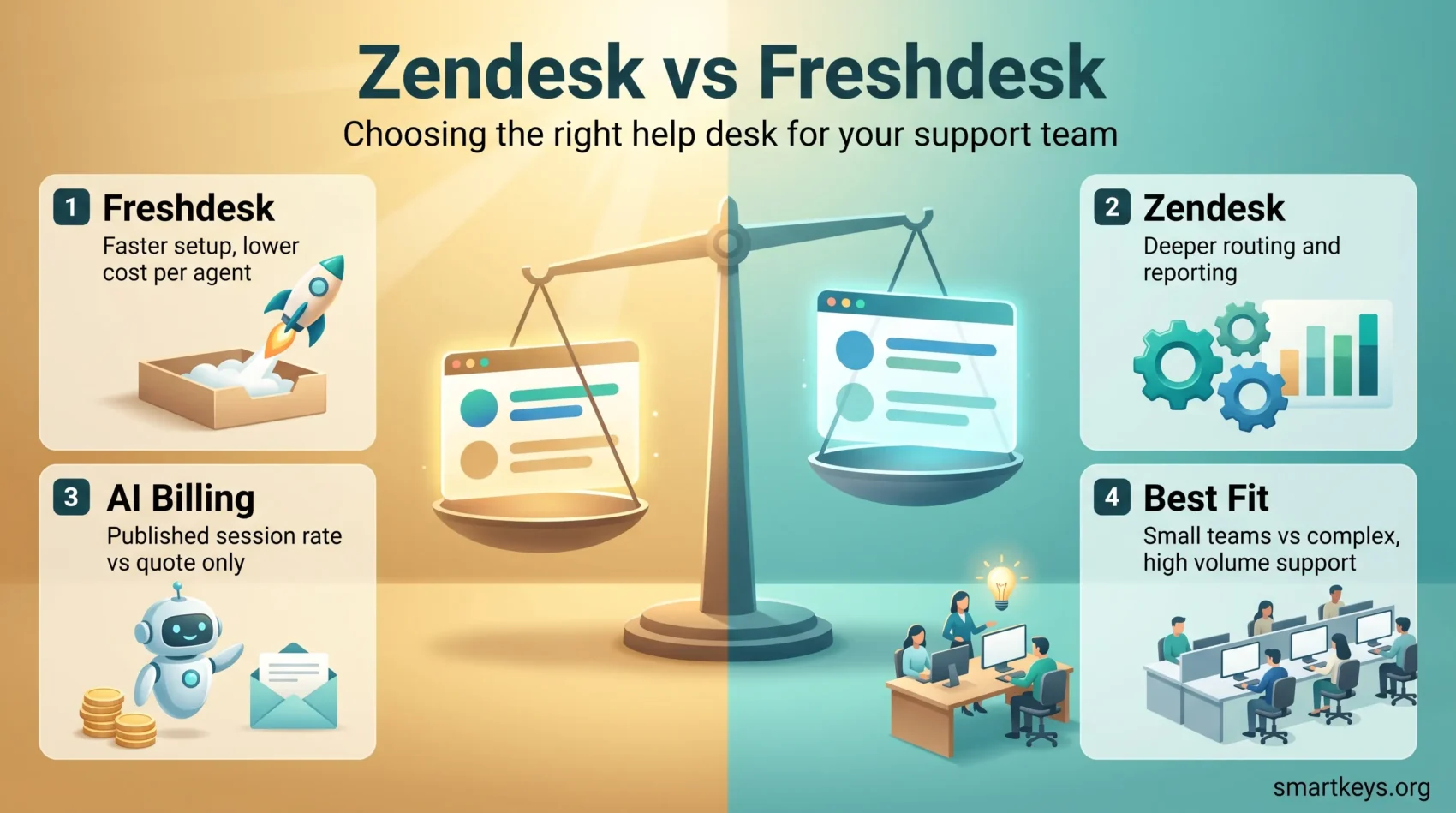
- Freshdesk meters AI in sessions at a published rate. Zendesk meters it in automated resolutions and does not publish a rate at all.
- Both vendors run large app marketplaces covering CRM, e-commerce, telephony and collaboration tools.
- Freshdesk is the faster, cheaper start for small teams; Zendesk earns its price on complex, high-volume operations.
Introduction to Customer Support Platforms
Customers expect fast, accurate answers on whichever channel they happen to be using. That expectation is what makes a dedicated support platform worth paying for: it pulls email, chat, phone and social messages into one queue, applies rules to them, and gives managers a view of what is actually happening.
Both Freshdesk and Zendesk do this well. The differences show up at the edges: how long setup takes, how much configuration a non-technical admin can handle, and how quickly the bill grows as you add channels, agents and AI.

Zendesk is the deeper product and the one large service organisations tend to standardise on, but it carries a real configuration burden. Freshdesk is quicker to get running and cheaper at the entry tier, which shortens onboarding for new agents. If you want the single-vendor view first, our Zendesk review goes through the platform on its own terms.
Overview of Freshdesk
Freshdesk is Freshworks’ help desk product, aimed at teams that want customer support software they can configure without a specialist. One thing to check before you compare prices: Freshworks now sells two separate products. Classic Freshdesk is the email-and-ticketing help desk. Freshdesk Omni is the broader omnichannel suite, and it sits on its own price ladder. Quotes and comparisons often mix the two up.
Features of Freshdesk
- Multi-channel support: email, chat, phone and social messages land in one ticket queue.
- Automation tools: rule-based ticket assignment, reminders and escalation paths.
- Self-service portals: a knowledge base customers can search before they open a ticket.
- SLA management: response and resolution targets with business-hours awareness.
- Reporting and analytics: queue, agent and satisfaction metrics with scheduled reports.
- Freddy AI: an AI agent for deflection plus a Copilot that drafts replies for human agents.
Pricing Plans for Freshdesk
Freshworks lists three paid Freshdesk plans, priced per agent per month on annual billing:
- Growth: $19
- Pro: $55
- Enterprise: $89
Signing up gives you the Enterprise plan free for 14 days. AI is billed on top: Freddy AI Copilot is $29 per agent per month on Pro and Enterprise, and extra AI agent sessions cost $49 per 100 sessions. Day passes for occasional agents run $2 to $12 depending on tier. All figures are from the Freshworks pricing page.
The free plan needs a caveat. Freshworks no longer advertises one. Reporting by eesel AI in 2026 describes a remaining Free Program limited to two agents and a six-month window, visible only inside an existing account and applicable to email-first Freshdesk rather than Freshdesk Omni. If you are planning around the old ten-agent free tier, plan around $19 per agent instead.
Integrations Supported by Freshdesk
Freshdesk connects to the tools most support teams already run: Salesforce, Google Workspace, Slack, Trello and Shopify among them, through the Freshworks Marketplace. If a connector does not exist, general-purpose automation platforms cover the gap. Our Zapier and Integromat comparison and the Workato vs Zapier review are useful if you expect to wire the help desk into a wider stack.
Overview of Zendesk
Zendesk is built for service organisations with volume and complexity: multiple brands, layered routing, workforce management and detailed reporting. That depth is the reason larger companies pick it, and also the reason implementations take longer.
Features of Zendesk
Zendesk Suite bundles ticketing, a knowledge base, live chat, messaging and voice into one licence. Around that sit prebuilt automation workflows, macros, triggers and side conversations, which let agents pull in colleagues without leaving the ticket. Reporting through Explore is the part reviewers most consistently rate above Freshdesk’s.
Zendesk’s AI layer includes AI agents that resolve tickets without a human, plus a Copilot add-on that handles triage, agent assistance and admin suggestions.
Pricing Plans for Zendesk
Zendesk publishes the following per-agent monthly prices on annual billing:
- Support Team (ticketing only): $19
- Suite Team: $55
- Suite Professional: $115
- Suite Enterprise + Copilot: quoted by sales
The trial is 14 days on Suite Professional. Copilot is a separate add-on at $50 per agent per month on Professional and above. AI agents are billed through what Zendesk calls automated resolutions, and the company publishes no per-resolution rate, so that line of the budget has to come from a quote. Figures are from the Zendesk pricing page.
Integrations Supported by Zendesk
The Zendesk Marketplace covers CRM, e-commerce, billing, telephony, survey and collaboration tools, including Salesforce, Microsoft Teams, Shopify and Mailchimp. If your support desk needs to sit alongside a sales CRM, our Salesforce CRM review and the Bitrix24 CRM review cover two of the more common pairings.
Zendesk vs Freshdesk: A Detailed Comparison
On list price the two platforms now converge more than they used to. Freshdesk Pro at $55 sits exactly where Zendesk Suite Team sits, and Freshdesk Enterprise at $89 undercuts Zendesk Suite Professional at $115. The entry point is where Freshdesk still wins clearly: $19 buys a full Freshdesk Growth plan, while $19 at Zendesk buys Support Team, a ticketing-only product with no AI agents.
Neither vendor offers a meaningful free tier any more. Both run 14-day trials, Freshdesk on Enterprise and Zendesk on Suite Professional.
AI is where the models genuinely differ. Freshdesk charges $49 per 100 AI agent sessions, which is a published number you can forecast against. Zendesk charges per automated resolution and publishes no rate, so the AI portion of a Zendesk bill is only knowable after a sales conversation. For a team trying to build a budget, that asymmetry matters more than any feature checklist.
Freddy AI Copilot at $29 per agent per month also undercuts Zendesk Copilot at $50. Both sit on top of an already-paid seat licence.
Feature Sets: Freshdesk vs Zendesk
Ticketing Systems Comparison
Both handle the fundamentals: queues, assignment rules, SLAs, collision detection and canned responses. Freshdesk’s interface is the one smaller teams get productive on faster, and its admin screens assume less prior knowledge. Zendesk offers deeper customisation of routing and ticket forms, which pays off when you support several brands or products from one instance and costs you time when you do not.
Automation Tools and AI Capabilities
Zendesk’s automation surface is broader, with triggers, automations, macros and skills-based routing that can be layered into fairly elaborate workflows. Freshdesk covers the same ground with fewer moving parts.
On AI, both ship a customer-facing agent and an agent-facing copilot. The practical constraint is the same for each: answer quality is capped by how good your knowledge base is. A thin or outdated help centre produces vague deflections on either platform, which is worth fixing before you pay for AI at all. If you are weighing a dedicated bot instead, the Chatbase review and our overview of AI-powered chatbots in customer service are a reasonable starting point.
Reporting and Analytics Features
Both platforms report on volume, response and resolution times, agent workload and satisfaction. Zendesk Explore goes further on custom metrics and cross-channel analysis, and it is the capability enterprise buyers most often cite as the reason they stay. Freshdesk’s reporting covers the core operational questions well; it is the deeper cohort and behaviour analysis where it stops short.
Pricing Comparison: Which Platform Is More Affordable?
For a ten-agent team on annual billing, before any AI usage, the arithmetic looks like this. Freshdesk Growth costs $190 per month. Freshdesk Pro costs $550. Freshdesk Enterprise costs $890. Zendesk Suite Team costs $550 and Suite Professional costs $1,150. Add Copilot and Zendesk Professional becomes $1,650, while Freshdesk Pro with Freddy AI Copilot becomes $840.

Two caveats apply to every figure above. First, these are annual-billing prices; monthly billing costs more at both vendors. Second, neither total includes metered AI, and at Zendesk that component cannot be estimated from public information.
Freshdesk is the cheaper platform at every comparable tier in 2026. Whether it is the better value depends on whether you need what the extra Zendesk spend buys.
What Reviewers Say
Public review scores put the two platforms close together. Summaries of G2 and Capterra data checked in mid-2026 place Zendesk at roughly 4.3 on G2 across about 6,800 reviews and 4.4 on Capterra across about 4,000, with Freshdesk marginally ahead on G2 at about 4.4 from roughly 3,750 reviews. Review counts move weekly, so treat these as indicative rather than precise.
The qualitative pattern is more useful than the decimals. Freshdesk reviewers consistently praise setup speed and value, and consistently flag that Freddy AI handles simple tickets well but misclassifies anything nuanced. Zendesk reviewers praise reporting depth and reliability, and consistently flag pricing complexity, with add-on configuration described as a job in itself.
If neither shortlist entry convinces you, the Zoho Desk review, the Intercom review and the Tidio review cover three common alternatives at different price points.
Suitability for Business Sizes
Freshdesk for Small to Medium-Sized Businesses
At $19 per agent per month, Freshdesk Growth gives a small team ticketing, automation and a knowledge base without a procurement process. Setup is measured in days rather than weeks, and the interface needs little training. For companies under roughly 25 agents with straightforward routing needs, this is usually the pragmatic choice.
The upgrade path is worth planning, though. Freddy AI Copilot requires Pro, which triples the seat cost before the AI add-on is counted.
Zendesk for Larger Enterprises
Zendesk suits organisations with multiple brands, high ticket volume, workforce management requirements or strict reporting obligations. The routing engine, Explore analytics and the breadth of the marketplace are what justify Suite Professional at $115 per agent.
Budget for implementation time as well as licences. The same configurability that makes Zendesk powerful is what makes the rollout longer. For a view of how support tooling fits alongside team communication, see our Slack review.
Common Integrations with Zendesk and Freshdesk
Popular Integrations with Freshdesk
- Google Workspace — connects Gmail and Drive so agents work from familiar tools.
- Salesforce — syncs customer records and support tickets between sales and service.
- Trello — tracks escalated issues alongside project work.
- Slack — pushes ticket updates and alerts into team channels.
Popular Integrations with Zendesk
- Salesforce — gives sales and support one shared customer view.
- Mailchimp — feeds support context into marketing segments.
- Zapier — links Zendesk to tools that have no native connector.
- Shopify — surfaces order and fulfilment data inside the ticket.
If your CRM decision is still open, the Freshworks CRM vs Salesforce and Freshworks CRM vs Pipedrive comparisons cover the sales-side counterpart to this decision, and the Pipedrive CRM review covers the lightweight option. For live chat specifically, see Drift vs LiveChat.
Conclusion
Freshdesk is cheaper at every comparable tier in 2026, faster to deploy, and clearer about what AI will cost. Zendesk is deeper on routing and reporting, better suited to multi-brand and high-volume operations, and considerably harder to budget for because its AI meter has no public rate.
The honest test is not which platform has more features. It is whether your support operation is complex enough to use Zendesk’s extra capability. If routing is straightforward and the queue is manageable, Freshdesk Growth or Pro will do the job for less. If you are running several brands, need workforce management, or answer to reporting requirements that Freshdesk’s analytics cannot meet, Zendesk Suite Professional is worth the difference.
Whichever way you lean, run both 14-day trials with your own tickets and your own knowledge base before signing anything annual.
Found this useful?
Make SmartKeys a preferred source on Google, and our articles will surface more often in your Top Stories, AI Overviews, and AI Mode.
Add as Preferred Source