Most teams do not fail because people lack skill. They fail because the same task gets done five different ways, and nobody can say which way is correct. A Standard Operating Procedure (SOP) removes that ambiguity: it writes down how a recurring task is performed, who performs it, and what “finished” looks like. Done well, it is one of the cheapest ways of improving team productivity without adding headcount or software.
This guide shows how to write standard operating procedures your team will actually follow: what the evidence supports, where documenting pays off, who should write each SOP, which tools are worth paying for in 2026, and where SOP programs usually go wrong.
Key Takeaways
- An SOP turns an undocumented habit into a repeatable step sequence with a named owner.
- The strongest published evidence for standardized procedures comes from safety-critical fields, where checklists cut errors measurably.
- Onboarding is the clearest payoff: new hires stop guessing and stop interrupting colleagues.
- SOPs written without the people who do the work get ignored. Involve them first.
- An out-of-date SOP is worse than none, because it teaches the wrong method with authority.
- AI assistants and agents need the same written context a new hire needs, which makes documentation more valuable in 2026, not less.
What a Standard Operating Procedure Actually Is
An SOP is a written instruction for a task that repeats. It names the trigger (when the task starts), the steps in order, the person or role responsible, the tools involved, and the definition of done. That is the whole idea. Everything else is formatting.
An SOP is also different from a template. The SOP tells you how to do the task; reusable templates for repetitive tasks give you the starting structure for what the task produces, such as the report, the email or the project plan. Most teams need both, and a good SOP simply points to the right template.
It helps to separate three things that often get lumped together. A policy says what the organization requires. A process describes how work moves between people. An SOP tells one person how to carry out one task. Confusing the three produces documents that are too abstract to follow, which is the most common reason SOP libraries go unread.
SOPs are not only an internal preference. Quality management standards make documentation an explicit requirement: ISO 9001:2015 devotes clause 7.5 to “documented information” and requires organizations to create, update and control the documents their quality system depends on. In regulated sectors such as pharmaceuticals, food production, aviation and healthcare, written procedures are a condition of operating, not an efficiency project.
What the Evidence Actually Supports
Claims that SOPs lift productivity by a specific percentage are usually vendor marketing with no study behind them. The honest picture is narrower and more useful.
The strongest published result comes from surgery. In a study of eight hospitals across eight cities, published in the New England Journal of Medicine in 2009, introducing the WHO Surgical Safety Checklist was associated with the inpatient death rate falling from 1.5 percent to 0.8 percent and major complications falling from 11 percent to 7 percent, across 7,688 patients. That is a standardized procedure, applied to a high-stakes task by expert professionals who already knew the work, producing a measurable reduction in error.
The lesson generalizes carefully rather than universally. Standardization reliably reduces variation and omission in tasks that have a correct sequence and a real cost of getting it wrong. It does much less for creative or judgment-heavy work, where a rigid script can actively hurt. Before you document a task, ask whether variation in it is a problem or a feature.
Onboarding is the other area where the gap is well measured. Gallup finds that only 12% of employees strongly agree that their organization does a great job onboarding new employees. Most of that gap is not budget. It is that nobody wrote down how the work is done, so every new hire reconstructs it by asking colleagues, which costs two people’s time instead of one.
Where SOPs Pay Off Most
Not every task deserves a document. These four situations reliably justify the effort.
Onboarding and role handover. A documented task survives the person who used to do it. When someone leaves, goes on holiday or changes role, the procedure stays behind. This is the practical face of organizational knowledge management, and it is the difference between a two-day handover and a two-month one. It also makes remote onboarding workable, since a new hire in another time zone cannot lean over and ask. Some teams layer gamified onboarding on top, but the written procedure has to exist first.
Tasks with a compliance or safety consequence. Payroll, data handling, client off-boarding, incident response. Here the SOP is evidence as much as instruction: it shows an auditor what the required method is and that staff were trained on it.
Tasks you are about to automate. You cannot automate a process you cannot describe. Writing the SOP is the specification step, and it usually exposes the exceptions that would have broken the automation. Teams that map the manual sequence first get far better results from task automation and from digital workflow tools.
Tasks you want to delegate. Most delegation fails at the transfer of context, not the transfer of responsibility, which is why documentation belongs in any serious time management system. A written procedure makes delegation a genuine handover instead of a series of interruptions.
What SOPs Realistically Deliver
Set expectations honestly with your team, because overselling is what makes people cynical about documentation.
- Fewer omissions: the steps people skip when they are busy are exactly the ones a checklist catches.
- Less interruption traffic: questions that have a written answer stop being asked in chat.
- Faster ramp-up: new joiners reach useful output sooner because they are not reverse engineering the job.
- Consistent output: customers get the same experience regardless of who handled the request.
- A baseline you can improve: you cannot improve a process that exists only in people’s heads.
What SOPs do not do: they do not fix an understaffed team, they do not make a bad process good, and they do not create motivation. If the underlying workflow is broken, documenting it just makes the breakage repeatable. Fix the process first, then write it down.

There is also a cost side that rarely gets mentioned. Every SOP is a maintenance commitment. A library of 200 documents that nobody reviews is a liability, because staff eventually learn that the documentation lies and stop consulting any of it. Write fewer procedures and keep them true.
How to Write an SOP People Will Actually Use
The format matters less than the discipline. A workable sequence:
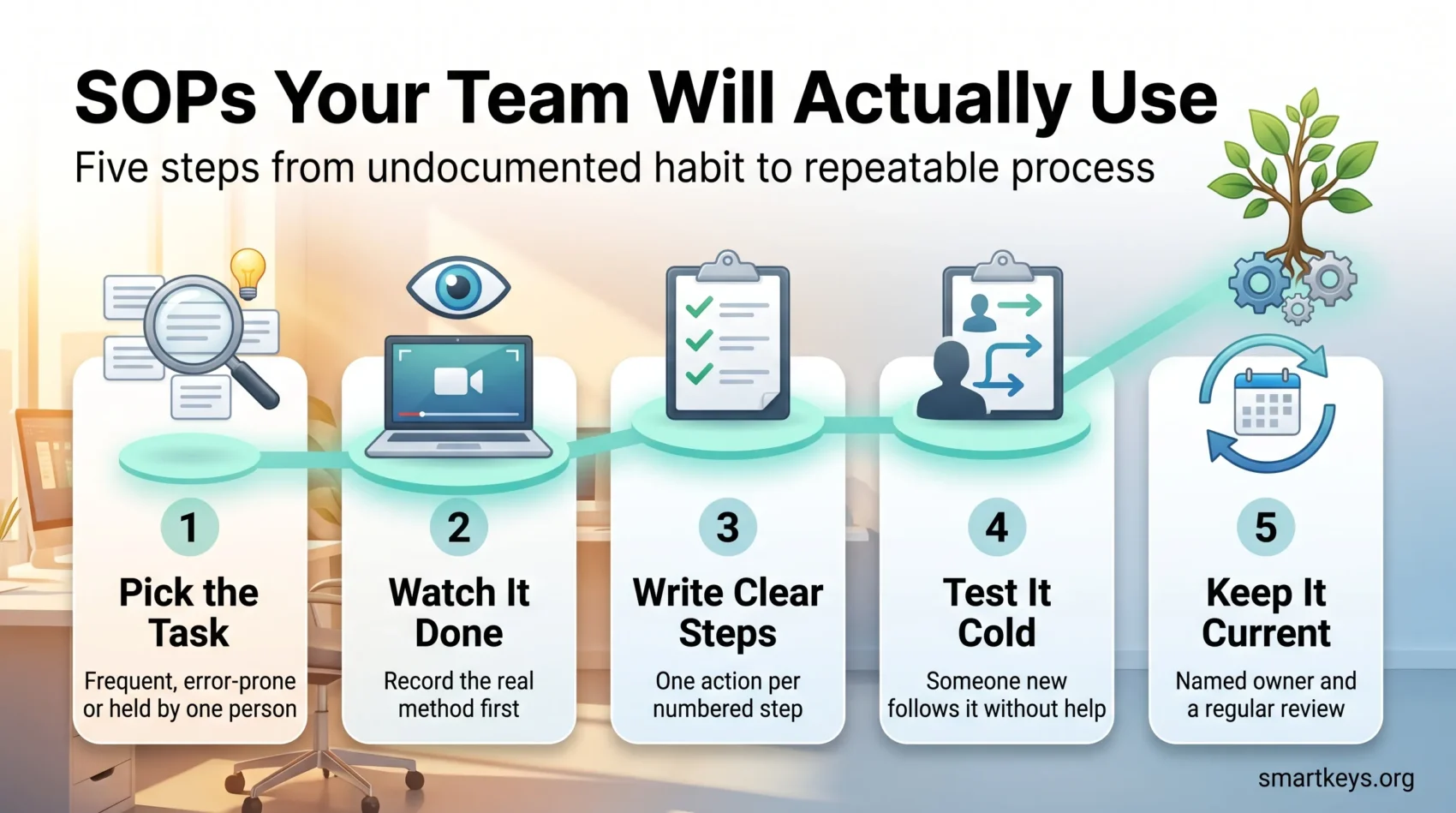
1. Pick a task worth documenting. Start with tasks that are frequent, error-prone, or currently held by one person. Ignore the rest for now.
2. Watch it being done. Do not write from memory or from how the task is supposed to work. Sit with the person who does it, or have them record their screen while narrating.
3. Write the steps in the imperative. “Open the billing dashboard. Filter by unpaid. Export as CSV.” Short numbered steps, one action each. Avoid background explanation inside the steps; put context in a short intro paragraph.
4. Name an owner and a review date. An SOP without a named owner is an orphan document. Put both at the top.
5. Add screenshots where words are slow. A labeled screenshot beats three sentences describing where a button is. Modern capture tools generate these automatically.
6. Test it on someone who has never done the task. This is the step teams skip, and it is the one that finds every hidden assumption. If they get stuck, the SOP is wrong, not the reader.
7. Store it where the work happens. A procedure in a shared drive nobody opens does not exist. Link it from the tool, the ticket template, or the project board where the task is triggered.
For recurring routine tasks, a short checklist often works better than a full procedure document. Match the format to the weight of the task.
Involve the People Who Do the Work
The fastest way to produce a library nobody follows is to have a manager write procedures for work they no longer perform. The people doing the task hold the exceptions, the workarounds and the tacit knowledge that make the difference between a document that works and one that reads well.
Practical approach: the person who performs the task drafts it, a second person tests it cold, and a manager reviews it for compliance and consistency. This splits the effort, produces a testable document, and gives the team ownership of the result. Teams that are involved in writing procedures tend to follow them, which is also one of the quieter drivers of employee engagement: people who shape how their work is done feel more control over it.
Build in a low-friction way to report that a procedure is wrong. A comment box on the document is enough, and most collaboration tools already provide one. If correcting an SOP requires a meeting, nobody will correct it.
Tools for Documenting SOPs in 2026
The tool market splits into three groups, and picking the wrong group wastes more money than picking the wrong vendor within a group.
Step capture tools record your screen while you perform a task and generate a written, screenshotted procedure from it. This is the fastest route from “she knows how to do it” to “it is written down”. Scribe is the best known: it offers a free Basic tier, and paid plans are priced per seat, with Pro Team at $13 per seat per month billed annually ($17 monthly, minimum five seats) and Pro Personal at $25 per seat per month annually. Tango and Supademo compete in the same category.
Knowledge bases and documentation platforms host the finished library, handle versioning, permissions and search. Document360 sits here and now quotes custom pricing rather than published tiers, with a 14 day trial. Notion, Confluence and Guru cover the same need for teams that already use them, and a general knowledge organization system can serve smaller teams perfectly well.
Process execution and training tools turn a procedure into a runnable, trackable instance. Process Street offers Startup, Pro and Enterprise tiers with a 14 day trial on Pro, and is built around recurring checklists with assignments and due dates. Trainual (Core, Pro, Premium and Enterprise plans) approaches the same problem from the training side, tracking who has read and acknowledged which procedure.
Published vendor pricing changes frequently and several of these companies have moved to quote-based models, so check the current rate before you budget. If you already run a project tool such as Trello or Jira or Asana, recurring task templates there may cover your needs without another subscription, and the same is true of several general productivity apps. Adding a dedicated SOP platform to an already crowded stack contributes to tool overload, which has its own productivity cost.
SOPs in the Age of AI Assistants and Agents
The 2026 argument for documentation is stronger than the 2020 one, for a reason that has nothing to do with headcount.
AI assistants and agents fail for the same reason new hires do: missing context. An agent asked to process refunds cannot infer your escalation threshold, your approval chain or your exception rules. Those live in the same undocumented space that makes onboarding slow. Teams building AI agent workflows consistently find that the hard part is not the model, it is writing down the procedure precisely enough to hand over. An SOP library is, in practice, the context layer those systems need.
This cuts both ways in the drafting process too. A language model is genuinely useful for turning a rambling screen recording transcript into clean numbered steps, or for spotting steps that reference a tool you no longer use. It is not useful for inventing the procedure, because it does not know how your team actually works. Use it to edit, not to author, and have a practitioner verify every generated step before it goes live.
The same logic applies to broader business automation: documented procedures are the input, not the output.
Keeping SOPs Current
Documentation decays quietly. The tool changes its interface, a step becomes unnecessary, an approval moves to another team, and the document keeps confidently describing the old world.
A review cadence that survives contact with real work looks like this:
- Set a review interval by risk, not by calendar habit. Compliance-critical procedures get reviewed quarterly; low-stakes ones annually is fine.
- Tie reviews to events, not just dates. A tool migration, a reorganization or a new regulation should trigger a review of anything that touches it.
- Let anyone flag an error in one click, and let the owner fix it without approval bureaucracy.
- Delete aggressively. A procedure for a task you no longer perform is noise.
Treat this as ordinary continuous improvement rather than a documentation project with an end date. The teams that keep libraries useful are the ones where updating a procedure is a five minute task, not a governance process.
Where SOP Programs Fail
Four failure patterns account for most abandoned SOP libraries.
Writing too many, too fast. A documentation sprint that produces 80 procedures in a month produces 80 documents nobody has tested and nobody will maintain. Ten procedures that are accurate beat eighty that are approximately right.
Documenting the ideal instead of the real. If the written procedure differs from what people actually do, staff follow reality and ignore the document. Capture the real method first, then improve it deliberately.
Storing them out of reach. If finding the right procedure takes longer than asking a colleague, people will ask the colleague. Search and placement matter more than formatting.
No owner. Shared responsibility for maintenance means no responsibility. Every document needs one name.
Resistance is the predictable fifth issue, and it is usually rational: experienced staff hear “we are documenting your job” as a prelude to being replaced or micromanaged. The counter is to be specific about the purpose, which is normally to stop them being interrupted and to let them take a holiday without their phone. Involving them in the writing does more to address this than any announcement.
Conclusion
SOPs are unglamorous infrastructure. They do not transform a team overnight, and any source promising a specific percentage lift is selling something. What they reliably do is remove ambiguity from repeatable work, so that quality no longer depends on who happens to be handling the task, and so that knowledge survives people leaving.
Start small. Pick the three tasks that generate the most questions, document them with the person who does them, test each on someone new, and put them where the work happens. If those three stay accurate for six months, you have a working system worth extending. If they rot, extending the library would only have multiplied the problem. The scale of your SOP effort should follow the evidence that you can maintain it, and that discipline is what separates a useful library from a graveyard of documents.
Found this useful?
Make SmartKeys a preferred source on Google, and our articles will surface more often in your Top Stories, AI Overviews, and AI Mode.
Add as Preferred Source