Delegation is the act of handing a piece of your work, together with the authority to decide how it gets done, to someone else. It sounds simple. In practice it is one of the hardest habits for a manager to build, because it means accepting that a task will be finished in a way you would not have chosen.
The business case is well documented. Gallup studied 143 chief executives from the Inc. 500 list and found that those with high Delegator talent generated 33% more revenue in 2013 than those with low or limited talent for it, $8 million against $6 million. Their companies also grew faster over three years and created 21 new jobs in that period, against 17 for the low delegators. Only about one in four employer entrepreneurs scored high on delegation at all.
This guide covers what delegation is, why capable managers avoid it, what the evidence supports, and a practical method for your next handover.
Key Takeaways
- Delegation transfers a decision, not just a task. Keeping every decision is assignment, not delegation.
- Gallup found CEOs strong at delegation generated 33% more revenue.
- DDI reports that teams whose leaders delegate well are 3.9 times more likely to produce innovative outcomes.
- Trust in leadership is low, and delegation is one of the few visible signals a manager can send.
- Agree on the outcome and the level of authority before work starts, not after the first mistake.
- Delegation is the leadership skill most closely tied to preventing manager burnout.
What Delegation Actually Means
Most managers think they delegate. What many of them do is distribute tasks and keep all the judgment calls for themselves. The team member does the work and comes back for approval at every fork in the road. That is task assignment. It moves effort off your desk but leaves every decision on it.
Real delegation moves three things at once: the work, the decision rights that go with it, and the accountability for the result. You still own the outcome to the rest of the organization. What you give up is control over the route.
The distinction matters because only the second version produces the benefits people expect from delegating. Skills grow when someone has to choose, not when they follow instructions. Your calendar frees up only when the follow-up questions stop coming back to you. If you are still approving each step, you have added a handover cost and gained nothing.
A useful test: after the handover, how many decisions still need your signature? If the answer is most of them, you have assigned the work. Good task management habits help, but the bottleneck is usually a decision you have not released.
Why Capable Managers Avoid It
Managers rarely refuse to delegate on principle. They avoid it for reasons that feel sensible at the time, and each reason has a specific fix.
It is faster to do it myself. Usually true, once. It stops being true around the third or fourth repetition, and it is never true for work that recurs weekly. If a task will come back, the time spent teaching it is an investment with a short payback period.
I will lose control of the quality. The first version is often worse than yours. The second is usually close. Quality is a training problem, not an argument against delegating. Writing the process down once, as a standard operating procedure, removes most of the gap.
My team is already stretched. Sometimes true, and then the answer is to stop doing something else rather than absorb the work yourself. A meeting audit often frees more capacity than expected.
Delegating makes me look replaceable. The opposite is closer to the truth. Managers who cannot leave for a week without work stalling are hard to promote, because promoting them creates a hole nobody can fill.
Only senior people can delegate. Anyone with work and a colleague can delegate. Individual contributors delegate to peers, to contractors, and increasingly to automation. The same principles apply when you are supervising contractors or automating repetitive work.
There is one more barrier that is harder to admit. Watching someone struggle with a task you find easy is uncomfortable. That discomfort is the actual cost of delegation, and it is temporary.
What the Evidence Supports
Delegation attracts a lot of vague claims. Three findings hold up well enough to plan around.
It Is a Visible Signal of Trust
Trust in leadership is scarce. Gallup’s leadership indicator put the share of US employees who strongly agree that they trust their organization’s leadership at 20% in May 2026, barely moved from 19% the previous August. Statements about trust do not shift that number. Handing someone a decision that matters does, because it is observable rather than declared.
Delegation belongs in the same category as open communication about how decisions get made. Both replace assurance with evidence. A manager who says “I trust you” and then reviews every draft has told the team which to believe.
It Raises What People Attempt
DDI’s leadership research found that teams whose leaders delegate effectively are 3.9 times more likely to produce innovative or creative outcomes, and 4.2 times more likely to go beyond their formal job description. The mechanism is not mysterious. People propose better ideas when they have the authority to act on them, and they stay inside their job description when everything outside it needs approval.
The same research found that only 19% of rising leaders demonstrate strong delegation skills, which suggests the gap is a training problem rather than a talent shortage. Structured practice, including regular coaching on specific behaviors, closes it faster than experience alone.
It Protects the Manager
DDI identifies delegation as the leadership skill most strongly associated with preventing burnout, and the pressure it relieves is real. In its research, 54% of leaders said they were concerned about burnout and only 30% felt they had enough time to do their responsibilities with the depth the job required.
Gallup’s May 2026 data points the same way: 30% of managers described themselves as engaged, and managers account for roughly 70% of the variance in their own team’s engagement. A depleted manager is not a private problem. It becomes the team’s problem within a quarter. Burnout prevention that ignores workload distribution is unlikely to work, and the broader picture on employee burnout shows the same pattern across roles.
What to Delegate and What to Keep
Not everything should move. A short filter saves a lot of second-guessing.
A simple way to sort your list is to separate strategic work from tactical work. Strategic work sets direction: choosing priorities, shaping a plan, deciding what the team stops doing. Tactical work keeps things running: preparing reports, coordinating schedules, handling routine requests. Most tactical work can move. Most strategic work should stay with you, at least until someone has the context to share it.
Delegate first: recurring work with a stable process, tasks where someone on the team already has stronger skills than you, work that is a natural stretch for someone building toward a bigger role, and anything you are doing only because you have always done it.
Keep: performance conversations and reviews, decisions about compensation or someone’s role, the parts of strategy where you hold context nobody else has, and any situation where you would be asking someone to carry responsibility without the authority to match. Handling a difficult conversation in a one-on-one is your job, not a task to pass on.
Think twice about: work that is genuinely urgent and high stakes at the same time. Urgency removes the room to learn. If it must be delegated anyway, pair it with closer support rather than pretending the pressure is not there.
Run this filter over your whole week rather than task by task. A prioritization framework makes the pattern visible: work that keeps landing in the low-value, high-frequency corner is almost always delegable.
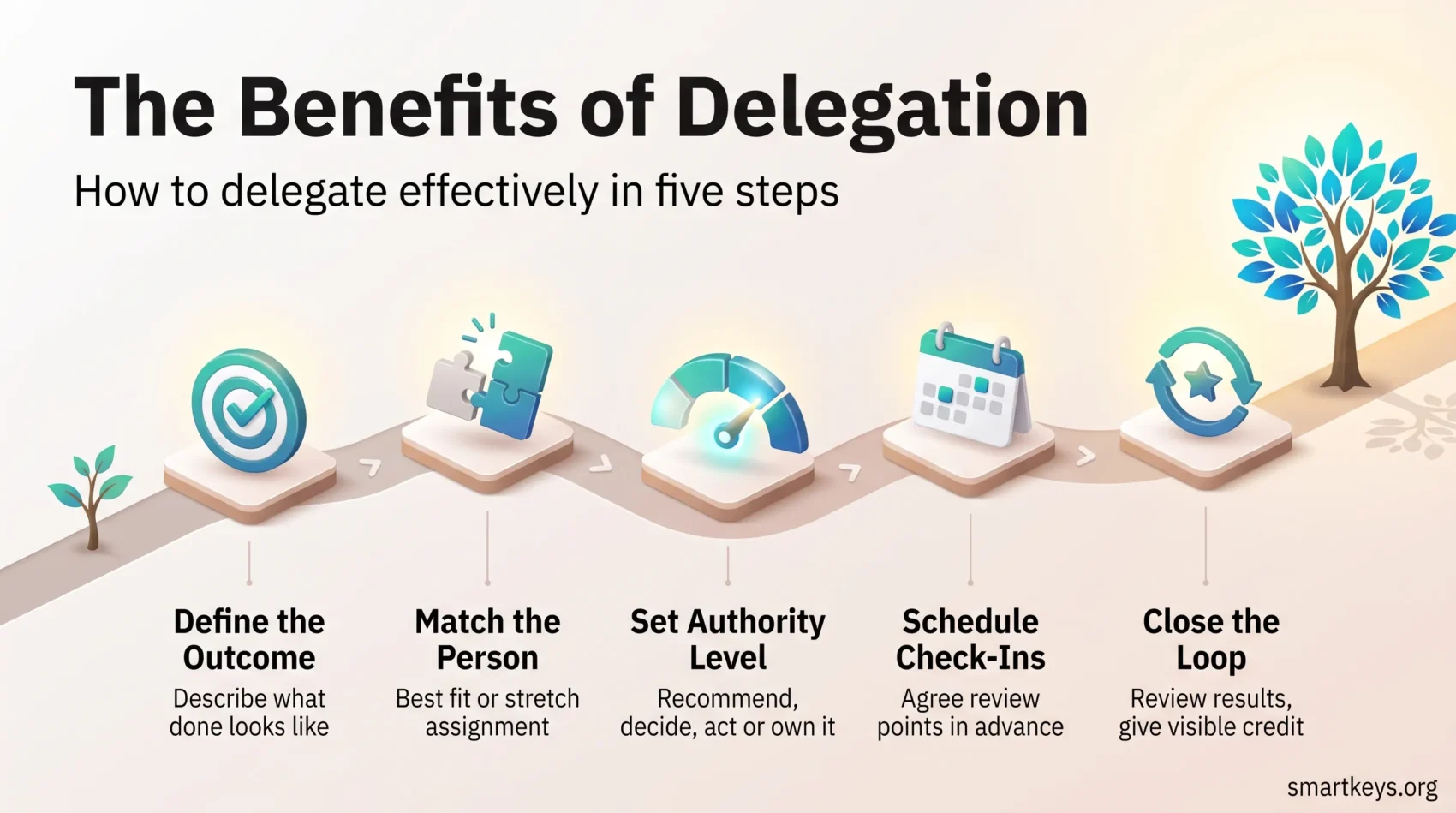
A Five-Step Method That Works
Most failed delegation fails at the handover, not during the work. These five steps take about fifteen minutes and prevent the majority of problems.
1. Describe the Outcome, Not the Steps
Say what “done” looks like, what it is for, and what the constraints are. “Produce a supplier comparison the finance team can decide from by Thursday, covering cost, delivery time and contract length” is an outcome. “Build a spreadsheet with these five columns” is an instruction, and instructions produce work that matches your method rather than the goal.
2. Match the Person to the Purpose
You are choosing for one of two reasons: this person is the best fit right now, or this task is the right stretch for them. Both are valid, but they need different support. A stretch assignment needs more check-ins and a clear statement that a rough first attempt is expected.
Consider interest as well as skill. Someone who wants to move toward a role usually invests more in the work that leads there, which is why delegation and retention are more closely linked than they look.
If you are not sure what someone is good at or wants to learn, ask. A ten-minute conversation about which parts of their job energize them tells you more than guessing from a job title. Past work helps too, and so do cross-functional projects, which often reveal skills that never show up in someone’s regular role.
3. Agree on the Level of Authority
This is the step most managers skip, and skipping it causes most of the friction. Be explicit about which of these applies:
- Recommend: gather the options, bring them to me, I decide.
- Decide and tell me first: you choose, but check in before acting.
- Decide and act: you choose and proceed, then keep me informed.
- Own it: you decide, act and report only by exception.
Saying “this one is decide and act, up to a budget of 2,000” takes ten seconds and removes an entire category of misunderstanding. It also gives you a visible way to increase autonomy over time, by moving the same person up a level on the next task.
4. Schedule Check-Ins Instead of Checking In
Unscheduled check-ins read as surveillance, whatever the intention. Agreed ones read as support. Fix the points in advance and tie them to the work: a short review after the outline, another before anything goes external.
This matters more in distributed teams, where a manager’s anxiety is easily mistaken for distrust. That dynamic, sometimes called productivity paranoia, does more damage remotely than in an office, and the same applies to teams spread across time zones.
5. Close the Loop
Review the outcome against what you agreed, not against how you would have done it. Separate two questions: did this meet the goal, and would I hand over more next time? Say both answers out loud. When the work turns out well, give the person visible credit, for example by naming them when the result is presented to others. Recognition costs nothing and makes the next handover easier to accept.
If the result missed, look at the handover before the person. An unclear outcome, missing context or an unstated authority level explains most misses. Teams that run continuous feedback instead of annual reviews catch these patterns earlier.
Mistakes That Undo Good Intentions
Taking the work back. Reclaiming a task at the first sign of trouble teaches the team that delegation is provisional. Coach through the problem instead, unless the deadline genuinely cannot absorb it.
Treating the first mistake as proof. A first attempt at unfamiliar work usually takes longer and contains errors. If that first miss is met with criticism or a quiet return to doing everything yourself, people stop taking risks. Teams learn fastest when mistakes can be discussed openly, which is the core idea behind psychological safety. Expect a learning curve and plan the deadline around it.
Delegating only the tedious work. If everything you hand over is dull and everything interesting stays with you, people notice quickly. Mix in work with visibility.
Delegating the task but not the information. Access to the data, the tools and the history is part of the handover. This is where a shared knowledge base earns its keep, and where new joiners struggle most during remote onboarding.
Using tools as a substitute for clarity. A project board shows who owns what. It does not communicate the outcome, the constraints or the authority level. Tracking software combined with an unclear brief just makes the confusion easier to monitor, which is the trap of managing by dashboard.
Conclusion
Delegation is not a way of doing less work. It is a way of changing which work you do, and it costs something up front: time to explain, patience while someone learns, and tolerance for a result that does not match your own.
The return is well evidenced. Companies led by strong delegators grow faster, their teams attempt more, and the managers themselves are less likely to burn out.
Start with one recurring task this week. Write down what “done” means, pick the person, name the authority level, agree two check-ins, then leave it alone. That loop, repeated, is most of what good delegation consists of. Applying the same discipline to your calendar through time blocking, and watching how leadership expectations are shifting, compounds the effect.
Found this useful?
Make SmartKeys a preferred source on Google, and our articles will surface more often in your Top Stories, AI Overviews, and AI Mode.
Add as Preferred Source