Productivity paranoia is the gap between what employees say they are doing and what their managers believe they are doing.
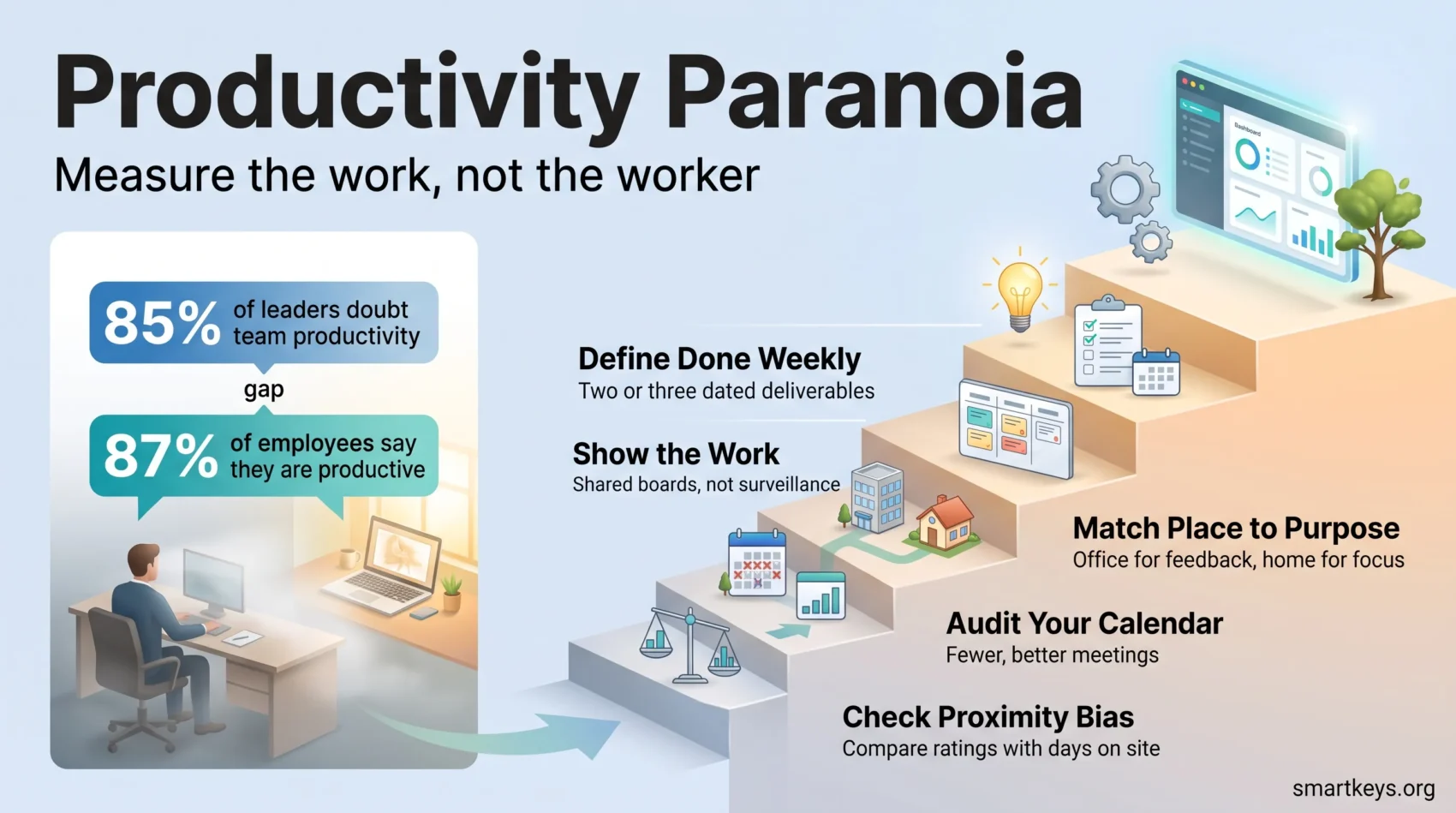
Microsoft coined the phrase in 2022, after a survey of more than 20,000 people found that 85% of leaders struggled to feel confident their teams were productive, while 87% of employees said they were. Only 12% of leaders had full confidence in their people.
Four years later the arrangement that triggered it has settled into normality. Gallup put 52% of remote-capable US employees in hybrid roles as of May 2026, and Stanford’s Survey of Working Arrangements and Attitudes found about a quarter of all paid days in the US were worked from home that same month. The doubt, however, did not settle with it.
This guide explains where that doubt comes from, what the evidence actually says about output in hybrid and remote teams, and how to replace surveillance with something that measures work instead of watching people.
Key Takeaways
- Productivity paranoia is a measurement problem, not a location problem.
- Managers fall back on visible hours when they have no clear definition of done.
- Proximity bias is real and documented, and it costs remote staff feedback and career growth.
- The largest controlled hybrid trial found lower attrition and no drop in performance.
- Monitoring software records activity. It cannot tell you whether the activity mattered.
What productivity paranoia actually means
Productivity paranoia describes a specific failure: an employer doubts an employee’s reported output because the employer cannot see the work being done. That is not the same as poor performance. It is the suspicion that poor performance might be happening, held without evidence either way.
The distinction matters because the two problems have opposite fixes. A real performance problem needs a conversation about the work. A visibility problem needs a better way to see the work, which is not the same as a better way to see the worker. Software that watches workers, and increasingly scores and directs them, belongs to the wider field of algorithmic management and workplace surveillance. This guide stays with the trust problem between managers and their remote teams.
Where the term came from
Microsoft published its Work Trend Index Pulse Report in September 2022, just as most companies were writing their first permanent hybrid policies. Citrix research in the UK that summer pointed the same way: around half of business leaders surveyed suspected that staff they could not see were working less hard, and close to half of their organisations had already added monitoring software.
Why it did not fade with the pandemic
You might expect the doubt to disappear once hybrid work became routine. It did not. Hybrid became the settled default rather than a temporary experiment, so the measurement question became permanent too. Many return-to-office mandates were justified with productivity claims their own companies could not substantiate, which kept the argument alive. And monitoring tools got cheaper, so the tempting shortcut stayed within reach.
Owl Labs found in its 2025 State of Hybrid Work report that only 19% of workers said their employer used no tracking software at all, and that 48% said their employer had added or increased monitoring. The suspicion did not go away. It got tooling.
For the wider picture of how these arrangements developed, see our overview of remote work trends and the current state of remote work productivity.
Why managers mistake visibility for work
Nobody sets out to manage by hallway sighting. It happens because presence is easy to observe and outcomes often are not.
Anchoring and confirmation bias
Anchoring means fixing on the first reference point you were given and judging everything against it. For managers who spent a career in an office, that anchor is a desk with somebody at it.
Confirmation bias does the rest. Once presence is the standard, a quiet chat channel reads as slacking rather than concentration, and a busy one reads as effort rather than noise. Both readings are guesses dressed up as observation.
Proximity bias is documented, not just felt
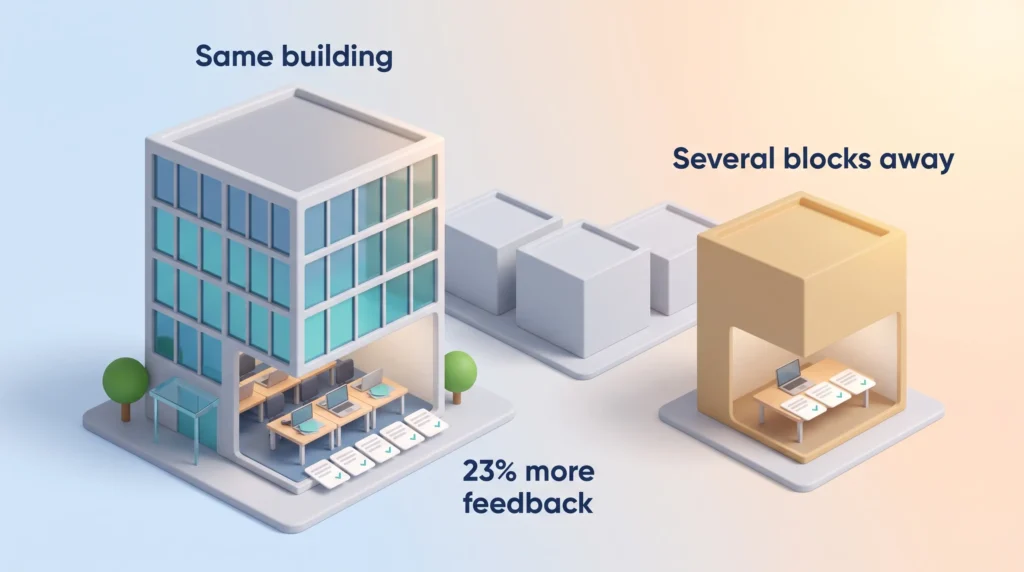
The strongest evidence here comes from a study of software engineers at a Fortune 500 firm by Natalia Emanuel, Emma Harrington and Amanda Pallais. Engineers who sat in the same building as their whole team received about 23% more written feedback on their code than engineers whose teammates sat several blocks away. When the offices closed, that advantage largely disappeared.
Two details matter. The effect was strongest for junior and female engineers, the people who most need feedback to progress. And the mechanism was not favouritism; proximity simply generated more small acts of coaching.
That is a real cost, and also a clue about the fix. If proximity mostly buys feedback, scheduled feedback can buy the same thing without requiring anyone to sit in a particular chair. Structured one-on-one check-ins and deliberate remote onboarding do the work that a shared corridor used to do by accident.
Vague goals invite suspicion
The quiet driver of productivity paranoia is unclear expectations. When neither party can state what “finished” looks like, the manager has nothing to check against, so they check the only thing available, which is whether the person appears to be working.
Write down what a good week produces. Two or three concrete deliverables with dates will do more for trust than any dashboard. Our guides to goal setting and personal productivity metrics cover how to make those definitions specific enough to be useful.
What the research says about remote and hybrid output
There is more controlled evidence here than the debate usually admits.
The call centre experiment
Nicholas Bloom and colleagues ran a randomised trial at the Chinese travel agency Ctrip in which call centre staff were assigned to work from home four days a week. Performance rose by 13%, most of it from taking more calls per shift in a quieter environment, and attrition fell by roughly half.
The caveat matters: call centre work is highly measurable and largely solitary, so the result travels poorly to collaborative or ambiguous work.
The largest hybrid trial to date
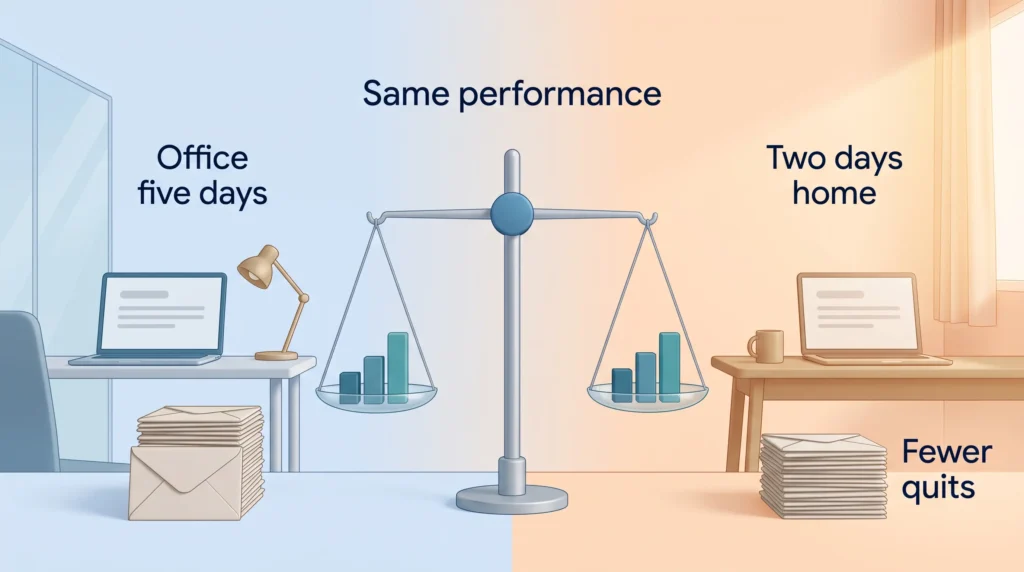
The better comparison for most knowledge teams is a randomised trial at Trip.com published in Nature in 2024, covering 1,612 graduate employees in engineering, marketing and finance. Half were assigned two work-from-home days a week; half stayed in the office five days.
Quit rates fell by about a third, from 7.2% to 4.8%, with the largest drops among non-managers and women. Performance reviews showed no difference between the two groups across four review periods, and promotion rates over the following two years showed no difference either. Self-reported work and life satisfaction were higher in the hybrid group.
That result cuts both ways. Hybrid did not make people more productive. It made them more likely to stay, at no measurable cost to output. That is a retention argument rather than a performance one, and a strong one given what replacing a trained employee costs. Our guide to talent retention strategies puts it in context.
The real productivity problem is fragmentation
While managers worried about whether people were working, a different problem grew underneath the argument. Microsoft’s June 2025 analysis of anonymised usage data found the average worker was interrupted every two minutes during the working day, roughly 275 times, by a meeting, an email or a chat message. Nearly half of employees described their work as chaotic and fragmented. Meetings after 8pm had risen 16% year on year.
None of that is caused by working from home, and none of it is fixed by watching people more closely. It is caused by how the working day is structured. A meeting audit, a protected focus time policy and a shift toward asynchronous work address more lost output than any monitoring tool will.
Monitoring software is not a management system
Activity tracking answers the wrong question. Keystroke counts, application time and screenshots tell you that something happened on a device. They cannot tell you whether the judgment behind it was sound, whether the work helped a customer, or whether a quiet afternoon was avoidance or hard thinking.
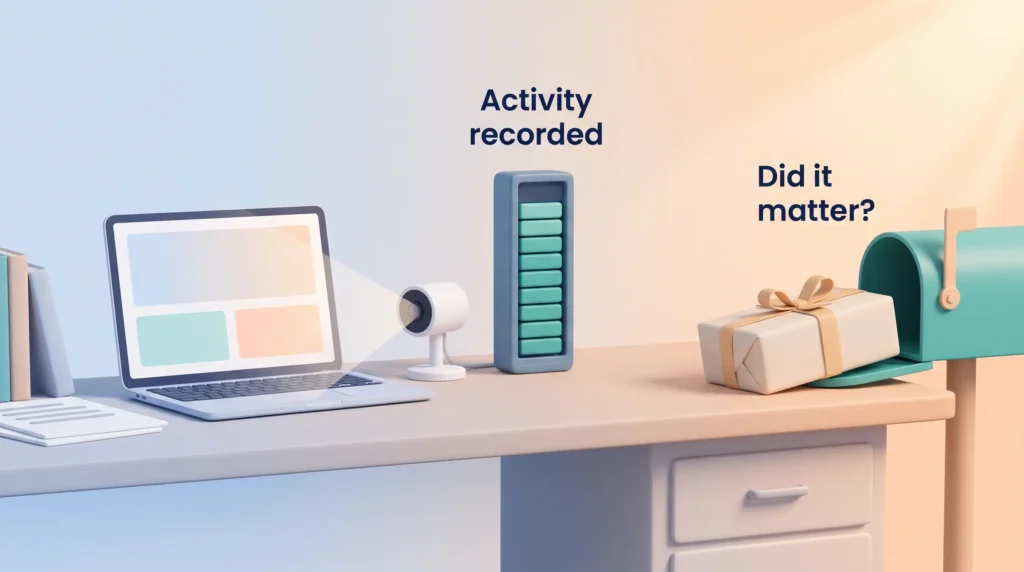
The costs, meanwhile, are concrete. Owl Labs found 85% of workers believe employers should disclose monitoring, and 40% would look for another job if flexible arrangements were withdrawn. Covert tracking risks the exact retention advantage the Nature trial identified.
Compliance has tightened too. Employee monitoring now touches data protection law in the EU and UK, biometric privacy statutes in several US states, and the EU AI Act where tools score or rank people. Our guides to AI employee monitoring software and algorithmic management cover the current obligations.
If you do monitor, the defensible version is narrow, disclosed, aggregated rather than individual, and tied to a stated purpose such as security. Anything broader is a trust cost you are paying for information you will not use.
Five practical steps to replace paranoia with measurement
- Define done, weekly. Agree two or three deliverables per person per week, each with a date and a description of what finished looks like. This single step removes most of the ambiguity that fear feeds on.
- Make the work visible, not the worker. A shared board, a short written update, a demo at the end of a sprint. Visibility of output solves the manager’s actual problem without surveillance.
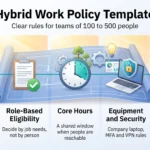
- Match place to purpose. Use office days for the things proximity genuinely helps: onboarding, feedback, messy problem-solving, relationship building. Protect home days for concentrated work. Our hybrid work policy template and notes on what the office is now for go into the detail.
- Audit your own calendar first. Managers who feel out of touch often respond by adding meetings, which fragments the very work they are worried about. Fewer and better meetings beat more check-ins.
- Check your ratings for proximity bias. Sort your last cycle of performance ratings and promotions by how many days each person spent on site. If the pattern is stark, the problem is in your process, not your people. A move toward continuous performance management makes that pattern easier to catch early.
Conclusion
Productivity paranoia persists because measuring knowledge work is hard and watching people is easy. The substitution feels like management. It is not.
The evidence points somewhere less dramatic than either side of the office argument claims. Well-run hybrid arrangements hold performance steady and improve retention. Poorly defined work damages output wherever it is done. The variable that matters is clarity, not location.
So define outcomes, review them on a rhythm, and give people the feedback that proximity used to deliver by accident. For structuring the wider system around that, see our guides to remote leadership skills, building digital trust in remote teams and decentralized teams.
Found this useful?
Make SmartKeys a preferred source on Google, and our articles will surface more often in your Top Stories, AI Overviews, and AI Mode.
Add as Preferred Source