A growth mindset is the belief that your abilities can improve through effort, practice and feedback. A fixed mindset is the opposite belief: that talent is something you either have or you do not. The terms come from psychologist Carol Dweck, whose 2006 book Mindset carried them far beyond academic psychology and into schools, sports and corporate training rooms.
The idea has since been oversold. Large reviews of the evidence show that simply believing you can improve does very little on its own. What survives the scrutiny is narrower and more useful: how you read a setback changes what you do next, and what you do next is where any productivity gain actually comes from. This guide gives you the honest state of the research, the habits that hold up regardless of the academic debate, and how to use the idea at work without turning it into a slogan.
Key Takeaways
- A growth mindset treats ability as something you build; a fixed mindset treats it as something you are issued at birth.
- Meta-analyses find the link between mindset and achievement is real but small, and mindset workshops rarely move results by themselves.
- The people who gain most are those who are struggling or under-resourced, not those already doing well.
- The practical value sits in behaviour: asking for feedback, breaking work down, and treating a setback as information rather than a verdict.
- At work, mindset language only helps if managers also change how they give feedback and judge progress.
What a Growth Mindset Actually Means
Dweck’s distinction is simple. With a fixed mindset, a hard task reads as a test of how capable you are. With a growth mindset, the same task reads as something you cannot do yet.
The difference shows up in behaviour, not in mood. Picture two analysts who both fail a certification exam. The first decides the subject is not for them and quietly avoids booking a retake. The second asks which sections they lost marks on, spends four evenings on those two topics, and sits the exam again. Same result, two very different next steps.

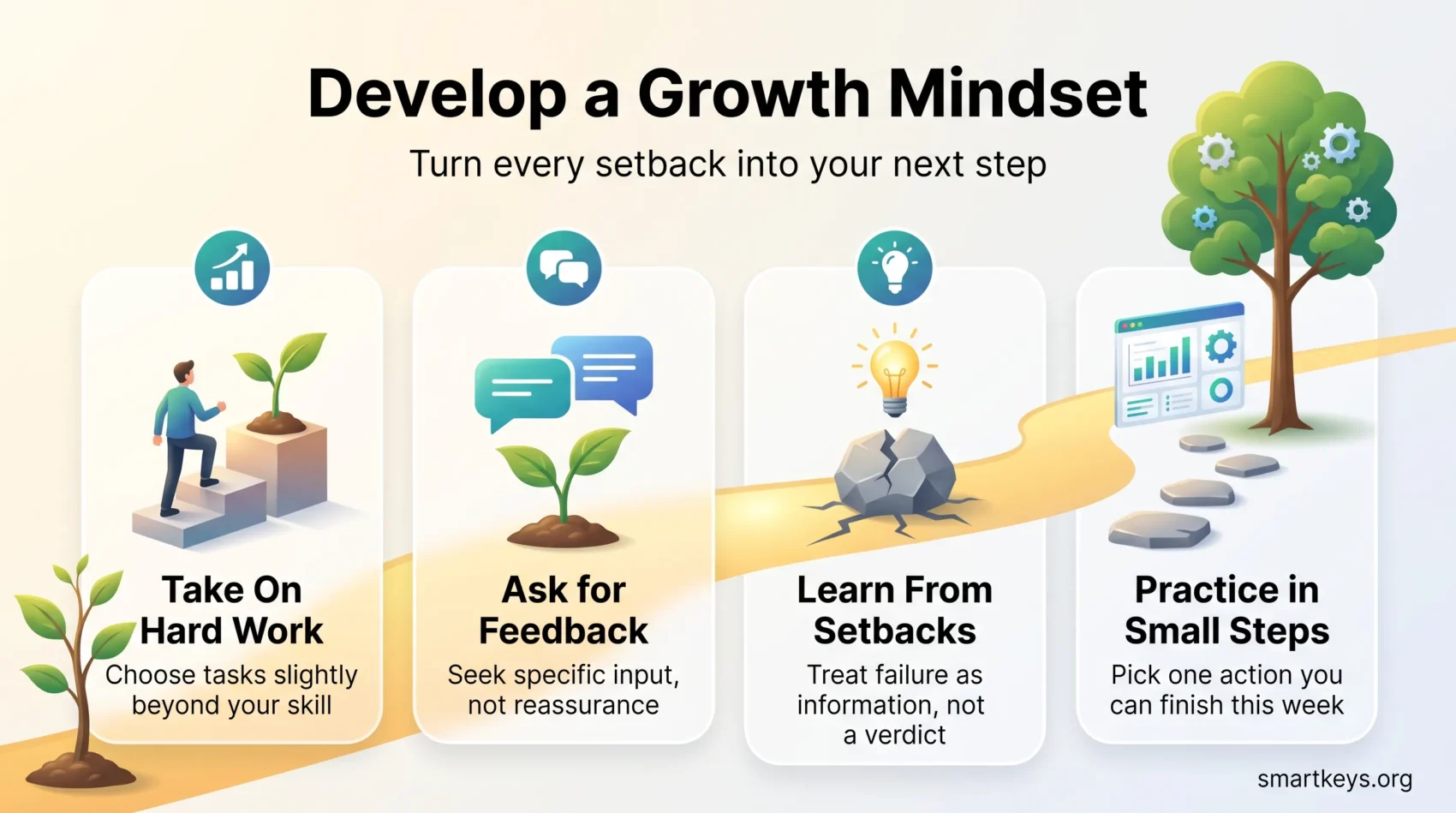
In practice, a growth mindset shows up as three observable habits:
- Taking on work slightly beyond your current skill rather than only work you already do well.
- Asking what a mistake tells you to change, instead of what it says about you.
- Seeking specific feedback rather than reassurance.
Note what is missing from that list: feeling good about yourself. A growth mindset is not optimism, and it is not self-esteem. It is a habit of turning difficulty into a next action.
What the Research Actually Shows
This is where careful reading matters, because the popular version of the story and the published evidence have drifted apart.
Two large meta-analyses, published in Psychological Science in 2018 by Sisk and colleagues, pulled the literature together. The first pooled 129 studies covering 365,915 students and found the correlation between growth mindset and academic achievement was very weak, at r = .10. Among adults the correlation was effectively zero. The second analysed 29 intervention studies with 57,155 students and found an average effect of d = 0.08, which is small.
A larger and stricter review followed. Macnamara and Burgoyne, writing in Psychological Bulletin in 2023, examined 63 studies covering 97,672 participants. Once they corrected for publication bias, the overall effect was not statistically significant, and in the six highest-quality studies it was close to zero. Their conclusion was blunt: the apparent effects were likely due to weak study design, reporting flaws and bias.
The most credible positive result is narrower. A national experiment published in Nature in 2019 by Yeager and colleagues delivered two online sessions of about 25 minutes each to United States ninth graders. Among 6,320 lower-achieving students across 65 schools, grades in core classes rose by 0.10 grade points. That is a real effect from under an hour of intervention, but it is small, and it appeared in students who were already struggling.
Read together, the picture is consistent. Mindset is not a lever that lifts everyone. It helps most where someone has stalled, and it helps least where things are already going fine. Treat any claim that a mindset workshop will transform your team’s output as marketing rather than evidence.
Why This Still Matters for Your Work
If the effect is small, why bother at all? Because the alternative belief is expensive.
The World Economic Forum’s Future of Jobs Report 2025 estimates that 39% of the key skills workers need will change by 2030, and 63% of employers named skills gaps as the biggest barrier to transforming their business. In a job where the required skills shift that fast, believing your ability is fixed is not a neutral position. It quietly rules out the retraining you will need. Anyone thinking about upskilling and reskilling or about which skills employers are actually paying for is making a bet on their own capacity to learn.
So the useful framing is not “believe harder and perform better”. It is “the belief that you can improve is what keeps you in the game long enough to actually improve”. The improvement itself still comes from practice, feedback and time.
Growth Mindset and Fixed Mindset in Everyday Situations
The contrast is easier to use when you can spot it in a normal working week:
- A hard task lands on your desk. Fixed: look for a reason to hand it on. Growth: take it, and name in advance what you will need help with.
- A project misses its target. Fixed: explain why it was never realistic. Growth: identify the two decisions you would make differently.
- A colleague criticises your draft. Fixed: defend the draft. Growth: ask which section confused them and why.
- Someone on your team is better than you at something. Fixed: avoid the comparison. Growth: ask them how they learned it.
Nobody sits permanently in one camp. Most people hold a growth mindset about skills they enjoy and a fixed one about skills they have failed at before. Naming the specific area where you have quietly given up is more useful than labelling yourself.
Treating Failure as Information
The most durable part of the growth mindset idea is what it does to failure. A setback is either a verdict on you or a piece of data about your approach. Only one of those two readings tells you what to do on Monday.
Turning a failure into data takes a deliberate step, because the instinct is to move on quickly. The step is small: write down what you expected, what happened, and the one thing you would change. That is the entire method. It works for a lost pitch, a bug that reached production and a badly run meeting alike.

There is a limit worth stating plainly. Not every failure teaches something. Some are caused by conditions outside your control, and forcing a lesson out of bad luck wastes time and invites unnecessary self-blame. The question to ask is whether a different decision on your part would plausibly have changed the outcome. If the answer is no, record it and move on.
Teams face the same choice at a larger scale. If admitting a mistake costs someone their reputation, people will hide mistakes, and the organisation loses the information. A culture where errors are examined rather than punished is not softness. It is how the expensive lessons get shared instead of repeated.
Habits That Build a Growth Mindset
Because the belief itself does so little, the practical work is in the habits it points to. These are worth doing on their own merits:
- Set goals you can act on. Vague ambitions leave nowhere to start. Clear goal setting and the SMART criteria both give you something concrete to check against.
- Break big goals down. A goal that cannot be started this week is not yet a plan. Splitting a large goal into steps and working in micro-goals turns intention into movement.
- Decide the next physical action. “Improve my presentation skills” stalls. Naming the next concrete action does not.
- Attach new practice to an existing routine. Habit stacking and micro-habits survive a busy week better than ambitious new schedules.
- Write things down. A short work journal gives you evidence of progress that memory will not supply on a bad day.
- Protect time for hard work. Skill grows in concentrated blocks, not in the gaps between messages. Deep work is where deliberate practice actually happens.
- Get a witness. An accountability partner makes quiet quitting on a goal harder.
Two warnings. First, effort alone is not the point. Repeating the same approach harder is not growth, and praising effort while ignoring results teaches the wrong lesson. Second, if you keep postponing the work, the problem is usually not belief. It is more often a task that is too vague or too unpleasant to start, which is a different problem with its own solutions.
Using Feedback Without Taking It Personally
Feedback is the mechanism that makes any of this work, and it is the part most workplaces handle badly.
Gallup’s research on feedback found that 80% of employees who say they received meaningful feedback in the past week are fully engaged, and that employees are 3.6 times more likely to say they are motivated to do outstanding work when their manager gives daily rather than annual feedback. The survey behind those figures ran in March 2021 with 13,490 full-time United States employees. The practical reading is not that feedback should be constant. It is that an annual review is far too slow to be useful for learning.
Three things make feedback usable:
- Be specific about the work. “This section lost me at the second paragraph” can be acted on. “This needs more polish” cannot.
- Say it close to the event. A comment three months later is a judgment. A comment the same week is a correction.
- Ask for it directly. Requesting feedback on one specific thing gets a far more useful answer than a general invitation to critique.
Receiving feedback well is a skill in itself. The move that helps most is separating the work from yourself: the draft was unclear, which is a fact about the draft. Managers can support this by shifting toward continuous performance management rather than one annual conversation, and by pairing criticism with specific positive reinforcement at work that names what went well.
Building a Growth Mindset Culture at Work
Organisations often announce a growth mindset and change nothing about how they operate. Employees notice the gap quickly. What actually changes behaviour is unglamorous:
- Make it safe to report problems early. If bad news travels slowly, it arrives too late to fix.
- Reward learning, not just outcomes. If only results count, people will pick the safe project every time.
- Give managers time to coach. Coaching is a scheduled activity, not something that happens spontaneously between meetings.
- Fund the training you talk about. A stated commitment to development that comes with no budget and no hours reads as a slogan.
- Review how decisions were made, not only how they turned out. Good decisions sometimes produce bad results, and vice versa.
This falls largely to managers, which is why leading a distributed team and current leadership practice matter more here than any workshop. Watch for one failure mode in particular: using growth mindset language to explain away structural problems. If someone is failing because of an unmanageable workload, telling them to see it as a chance to grow is not development. It is a route to burnout, and it is worth learning to recognise the difference.
Making Learning Part of the Working Week
Continuous learning fails when it depends on spare time, because there is never any. It works when it has a slot:
- Book it like a meeting. One protected hour a week beats an aspiration to read more.
- Keep sessions short. A microlearning approach fits real calendars better than a full-day course nobody attends.
- Learn something you will use this month. Skills applied immediately stick; skills stored for later usually do not.
- Teach it to someone. Explaining a concept exposes the parts you have not understood.
- Track what you finish. Simple progress tracking keeps learning from becoming an endless list of started courses.
Tracking Progress Honestly
Recognising progress matters, and it is easy to do badly. Celebrating everything drains the signal from real achievement; celebrating nothing means you never notice you are improving.
A workable middle: at the end of each week, write down one thing you did that you could not have done six months ago, and one thing that is still hard. The first gives you evidence against the fixed-mindset voice. The second keeps you honest. If you want to know how to stay motivated through a long workday, the answer is similar: motivation tends to come from visible progress rather than from pep talks, and the research on how positive thinking affects productivity is clear that imagining success is not the same as achieving it.
Conclusion
The growth mindset has been both overhyped and unfairly dismissed. The overhyped version promises that belief alone transforms performance, and the evidence does not support that. The version worth keeping is quieter: how you interpret difficulty determines whether you take the next step or stop, and taking the next step is what eventually produces skill.
Start with one area where you have decided you are simply not good at something. Name it, ask what specific feedback would tell you where you stand, and pick a first action small enough to complete this week. That is the whole method, and it works whether or not the label ever caught on.
Found this useful?
Make SmartKeys a preferred source on Google, and our articles will surface more often in your Top Stories, AI Overviews, and AI Mode.
Add as Preferred Source