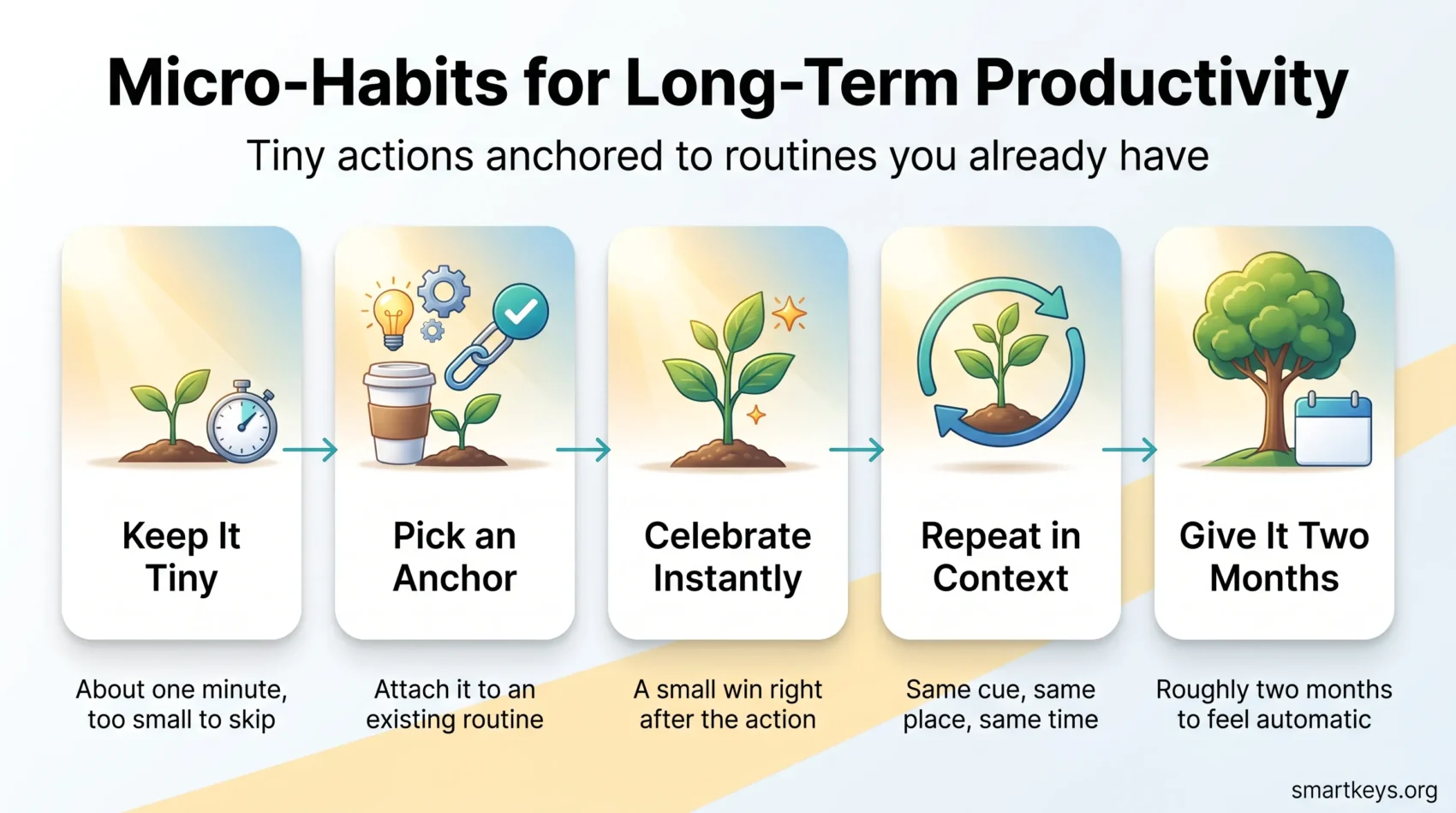
Lasting productivity improvement rarely comes from overhauling your day. It comes from behaviours small enough that you keep doing them when you are tired or busy. That is the case for micro-habits: actions that take a minute or less, anchored to something you already do.
The research behind this is firmer than most productivity advice. In a diary study by Wendy Wood, Jeffrey Quinn and Deborah Kashy, published in the Journal of Personality and Social Psychology in 2002, participants logged what they did hour by hour. Between 35 and 43 percent of the behaviours they recorded were habitual: performed almost every day, usually in the same place. A large share of your day already runs on autopilot, and micro-habits decide what that autopilot does.
Stanford behaviour researcher BJ Fogg built a method around this. His Tiny Habits approach shrinks a behaviour until it is almost trivial (two push-ups, one page, one glass of water), attaches it to an existing routine he calls an anchor, then celebrates immediately. His behaviour model, B = MAP, holds that a behaviour happens when motivation, ability and a prompt coincide. Motivation fluctuates; ability and prompts can be designed.
Key Takeaways
- Micro-habits are behaviours small enough to finish in about a minute, which is what makes them survive bad days.
- Anchoring a new action to an existing routine supplies the prompt most new habits are missing.
- Diary research found 35 to 43 percent of daily behaviours are already habitual, so the question is which ones.
- Meta-analytic evidence puts the median time to a reasonably automatic habit at roughly two months, not 21 days.
- Morning practice and habits you chose yourself tend to become stronger than assigned ones.
- The classic “willpower as a muscle” studies have not replicated well, so willpower is a weak foundation.
- Missing one day matters far less than the conclusion you draw from it.
Understanding Micro-Habits
Micro-habits sit at the opposite end of the scale from resolutions. A resolution asks for a large change starting Monday; a micro-habit asks for a small one now, and again tomorrow.
What Are Micro-Habits?
A micro-habit is a specific action, small enough that you cannot talk yourself out of it, tied to a fixed moment in your day. “Read more” is a goal. “Read one page after I put my phone on the charger” is a micro-habit: it names the behaviour, the size and the trigger.
The size is the point, not a motivational trick. When the behaviour costs almost nothing, you no longer need to feel motivated to start, so it keeps running on the days that would break a longer routine. It grows on its own afterwards, because starting was the hard part.
The Power of Small Changes
Small changes compound in two ways. The obvious one is volume: five minutes a day is roughly thirty hours a year. The more important one is structural. Every repetition in a stable context strengthens the link between cue and action, which turns a decision into a default.
That is why a five-minute habit you keep beats a forty-minute session you abandon in week three: you are building the mechanism that makes the minutes automatic. Our guide to breaking large goals into smaller steps covers how to shrink work to this scale.

Why Traditional Habit Formation Fails
Most new habits fail for one reason: they run on motivation, the one input you cannot schedule.
The Role of Willpower
For two decades the standard explanation was ego depletion, the idea that self-control works like a muscle that tires with use. The metaphor is on shakier ground than popular productivity writing suggests: a preregistered replication across 23 laboratories, published by Martin Hagger and colleagues in Perspectives on Psychological Science in 2016, found an effect close to zero.
The conclusion is not that self-control is unlimited. It is that betting your routine on it is a design flaw: a behaviour that only happens when you feel disciplined has a single point of failure. Micro-habits remove that dependency by making the action small enough that discipline is barely involved. They are one layer of a wider system, and our guide to building self-discipline and everyday consistency shows how habits, environment design and if-then plans fit together.
Decision Fatigue and Its Impact
Decision fatigue is the related claim that choice quality declines as you make more decisions. Its most cited evidence, the 2011 study of Israeli parole judges by Shai Danziger and colleagues, has been challenged: later analyses argued that case ordering and scheduling explain much of the pattern, and simulations suggested the effect was overstated.
What survives is more modest and more useful. Every choice is a point at which the behaviour can stall, so a habit that requires you to decide when, where and how much has three chances to fail. Fixing those details in advance removes the decision, which is why “after my morning coffee” beats “sometime today”. Decision fatigue at work goes deeper into reducing open decisions.
Benefits of Micro-Habits for Productivity
Micro-habits are easier to sustain, and they change how the rest of the day feels.
Improved Focus and Clarity
Many small behaviours worth automating are protective: closing the inbox tab before deep work, silencing notifications for the first block of the morning, writing down the one task that matters before opening anything else. Each is trivial alone; together they remove the interruptions that fragment attention. Our guide to managing work notifications covers the largest source.
Enhanced Time Management
Time management improves less through better planning than through fewer plans that need remaking. A two-minute habit of writing tomorrow’s first task removes a decision from your morning. These methods help prioritize tasks without a new system and pair naturally with time blocking.
Reduction of Overwhelm
Overwhelm usually comes from holding unfinished work in your head rather than from the work itself. Small fixed habits give that load somewhere to go: a capture habit for stray tasks, a short walk when the next step is unclear. Neither reduces the workload; both stop it feeling unmanageable.

Micro-Habits Productivity: The Key to Long-Term Success
The case for micro-habits is about time horizons: insignificant at a week, substantial at a year.
Accumulating 1% Improvements
The “1% better” framing is a mental model rather than a measured finding, and worth treating as one: nobody can quantify a one percent daily gain in your work. What is real is the direction. A small improvement repeated in a stable context tends to persist, while a large change made once tends to decay.
Ten minutes a day reading in your field, one deliberate question in every meeting, one process note after each recurring task. None will show up in a quarterly review, but over a year they change what you know and how fast you work. A consistent morning routine is where most people find the easiest slot.
Creating Automatic Behaviors
The goal of a micro-habit is to stop needing to think about it. That happens through repetition in a consistent context: same cue, same place, same rough time. Change the context and the habit weakens, which is why routines collapse during travel and are worth rebuilding deliberately afterwards.
Pairing the habit with an established structure speeds this up. A two-minute planning habit attached to the start of a Pomodoro session, or a stretch at the end of one, gets a prompt that already fires reliably.

Implementing Micro-Habits in Daily Routines
Building a micro-habit is design work, done once: choose the behaviour, choose the anchor, shrink both until the pairing is obvious.
Identifying Existing Routines
Your existing routine is the raw material. Before adding anything, find the moments that already happen without fail:
- Log your day in rough blocks for a week and mark what happens at the same time daily.
- Note the transitions: arriving at your desk, finishing a call, closing your laptop, making coffee.
- Mark the points where you consistently feel stuck, distracted or drained.
Transitions make the most reliable anchors, because they are already moments of change. A short time audit surfaces them faster than memory does.
Integrating New Micro-Habits
Once you have an anchor, add one habit to it. One, not five. Formulate it as “after [existing routine], I will [tiny behaviour]”:
- After I sit down at my desk, I will write the single most important task for today.
- After I finish lunch, I will walk for ten minutes.
- After I close my laptop, I will put my phone on the charger in another room.
This is habit stacking, and it works because you are not asking yourself to remember anything: the existing routine does that. Temptation bundling, pairing a habit you want with something you already enjoy, is a useful variant when the behaviour has little appeal of its own.
Keep the first version smaller than seems necessary. If it feels like a negotiation, it is too big. Scale up only after two or three weeks of effortless repetition.
Practical Examples of Micro-Habits
Each of these takes under two minutes and has an obvious anchor.
Morning Routine Enhancements
The morning is the most reliable slot most people have, and the 2024 meta-analysis discussed below gives a reason to prefer it: morning habits tended to become stronger than evening ones.
- Drink a glass of water before your first coffee.
- Make your bed. It takes a minute and closes one loop before the day starts.
- Do one stretch, not a routine. One.
- Delay your first look at social media until after the first work block.
- Take three slow breaths before opening your inbox.
Our morning routine guide sets out a fuller structure for these.
Effective Task Management
The same principle applied to work:
- Write the day’s single most important task before opening email.
- Handle anything under two minutes immediately rather than logging it. This is the two-minute rule.
- Start the task you have been avoiding first, for two minutes only. Starting is usually the whole problem, as our guide to overcoming procrastination explains.
- Take a screen break on the 20-20-20 pattern the American Optometric Association recommends: every 20 minutes, look at something about 20 feet away for 20 seconds.
- Stand up and move at the end of each focus block.

How Long Micro-Habits Actually Take
The 21-day figure circulating in productivity writing has no research behind it. It traces back to a plastic surgeon’s observation about patients adjusting to their appearance, not to any study of habit formation.
The measured answer is longer and more variable. Phillippa Lally and colleagues, writing in the European Journal of Social Psychology in 2010, tracked 96 people adopting a new eating, drinking or activity behaviour and found a median of 66 days before it felt automatic, with individuals ranging from 18 to 254 days.
A 2024 systematic review and meta-analysis published in Healthcare, covering 20 studies and 2,601 participants, put the median at roughly 59 to 66 days, with individual times spanning 4 to 335 days. It also found that habits practised in the morning, and habits people chose for themselves, tended to become stronger.
So judge a new micro-habit at two months, not two weeks. And the spread is wide enough that your own timeline says nothing about whether it will stick: consistency of context matters more than speed.
Overcoming Common Challenges with Micro-Habits
Even a one-minute habit meets resistance, but the failure modes are predictable.
Dealing with Resistance
Resistance usually signals that the behaviour is too large or the anchor is wrong. If you keep skipping a ten-minute habit, try the two-minute version rather than trying harder. If you forget it entirely, the anchor is not firing reliably and needs replacing.
Then there is the perfectionism trap: treating a missed day as evidence the attempt has failed. In the Lally data, a single missed day had no measurable effect on the habit’s eventual strength. What breaks habits is abandoning them, not interrupting them, as our piece on overcoming perfectionism explores.
Staying Motivated
Motivation is the wrong thing to rely on, but not irrelevant: it decides whether you start at all. The move is to need less of it. Fogg’s method builds in an immediate celebration, however small, because a positive feeling attached to the behaviour does work that a distant goal cannot. Beyond that, the usual supports apply: a visible streak, a reason you can state in one sentence, and accountability partners, which are unusually effective for habits that are easy to skip privately.

Tools and Techniques for Tracking Progress
Tracking exists to give a signal, not a second job. If the tracker takes longer than the habit, it is the problem.
Journaling for Reflection
A short written record does two things a mental note cannot: it shows the pattern over weeks, and it makes it obvious when a habit has quietly stopped. Two lines a day is enough. What did I do, and what got in the way.
Reviewing it weekly is where the value sits. That is when you notice the habit only fails on days with early meetings, or that your anchor is missing on Fridays. Our guides to productivity journaling and the weekly review cover both halves.
Using Productivity Apps
Habit apps do two useful things: remind you, and show you the streak. Habitica gamifies tracking with points and parties, Streaks focuses on unbroken chains, and most task managers now include a recurring-task view that does the same job without another subscription. A paper habit tracker works just as well and stays visible without unlocking anything. Pick one and keep it for two months before judging it, or see our overview of productivity apps if you would rather the tracker lived inside a tool you already use.

Creating a Reward System
A habit with no immediate payoff competes against everything that has one. Move some of the reward forward in time.
The Importance of Celebrating Small Wins
Immediate beats large. A moment of deliberate satisfaction right after the behaviour, which is what Fogg’s celebration step is for, attaches a positive feeling to the action itself. A reward promised at month end attaches nothing, because the connection is gone by then. Keep rewards proportionate and, where possible, related to the habit: rewarding a reading habit with an hour of uninterrupted reading reinforces it, rewarding it with something that undoes it does not. Reasonable options:
- A walk outside after a focus block
- Time set aside for a hobby at the end of a completed week
- Marking the streak somewhere you can see it
If a reward stops registering, change it. Once the habit runs on its own the external reward can fade out, because the behaviour has its own momentum by then.

Conclusion
Micro-habits work because they lower the cost of showing up. A behaviour that takes a minute survives the days a thirty-minute routine does not, and surviving those days is what turns an intention into a default.
The evidence supports a patient version of this. Expect roughly two months before a habit feels automatic, expect wide variation, and treat a missed day as an interruption rather than a verdict. Choose the behaviour yourself, anchor it to something that already happens, and keep it small. The compounding is slow and unglamorous, and that is the trade.
Found this useful?
Make SmartKeys a preferred source on Google, and our articles will surface more often in your Top Stories, AI Overviews, and AI Mode.
Add as Preferred Source