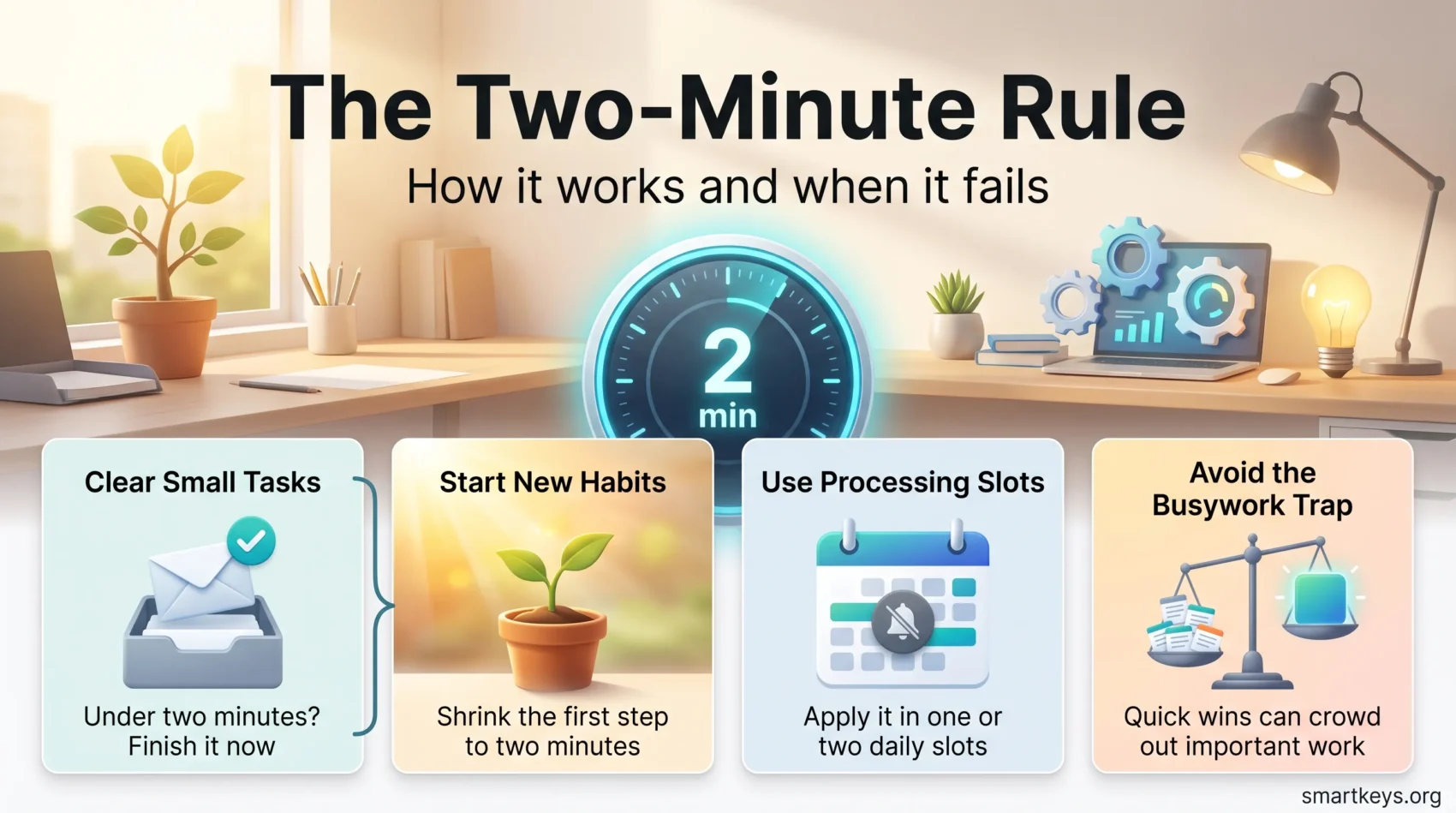
The Two-Minute Rule is one of the best known productivity ideas in circulation, and one of the most often misquoted. It exists in two versions, by two different authors, and each solves a different problem. David Allen, in “Getting Things Done” (first published in 2001), uses it to clear small jobs: if a task takes less than two minutes, do it now rather than write it down. James Clear, in “Atomic Habits”, uses it to start habits: shrink a habit until the first step takes under two minutes, then do only that step.
Mixing up the two is the main reason people try the rule and conclude it changed nothing. This guide separates them and is honest about where the idea falls apart.
Key Takeaways
- There are two Two-Minute Rules: Allen’s clears small tasks, Clear’s starts habits.
- Doing a quick task now is often faster than capturing and rescheduling it later.
- The rule belongs in a defined slot, not as a permission slip to answer every ping.
- On unfinished goals, a concrete plan calms the mind almost as well as finishing the task.
- It supports a prioritization method, it never replaces one.
Understanding the Two-Minute Rule
Allen’s version belongs to the part of task management where you process an inbox: email, notes, requests, anything that has landed since you last looked. For each item you decide what it is and what to do about it. Most get delegated, scheduled or filed. Some, though, are so small that the bookkeeping costs more than the work. Writing “reply to Anna about Thursday” into a list, tagging it, seeing it three times and finally answering takes longer than the reply itself. For those items, the answer is simply: do it now.
Clear’s version comes from habit formation and looks similar but works differently. The goal is not to finish the task, it is to start showing up. “Read before bed each night” becomes “read one page”. “Go to the gym” becomes “put on my running shoes”. You may stop after the two minutes, because the version you can manage on a bad day is the version that becomes automatic. Once the habit holds, you extend it. If you are building a routine rather than clearing a backlog, habit stacking follows the same logic.
Both are cheap to test: neither needs an app or a system change.
Why the Two-Minute Rule Works
Three mechanisms explain the effect, and it helps to know which one you are relying on.
It removes administrative overhead. Every task you postpone has to be written down, categorized, reviewed and picked up again later. For a two-minute job that overhead can exceed the task itself. Cutting it out is not a psychological trick, just arithmetic.
It closes open loops. An unfinished task keeps resurfacing in your thoughts, which makes concentrating on anything else harder. Masicampo and Baumeister showed this in a 2011 paper in the Journal of Personality and Social Psychology. Unfulfilled goals intrude on thinking, and making a specific plan for the goal largely removes that intrusion. That is a useful qualification: you do not always have to finish the task, but you do have to decide concretely when and how you will. Doing a two-minute job now is the fastest route to that quiet, though a written plan works too, which is why reliable task capture matters as much as the rule.
It builds momentum. Finishing something, even something trivial, makes the next step feel lighter. This is the least reliable of the three, because momentum from trivial tasks can just as easily carry you into more trivial tasks. None of the three makes your important work go faster: the rule protects your attention from small interruptions, and is no substitute for deep work on what actually matters.
How to Implement the Two-Minute Rule
The rule is easy to state and easy to misapply. The difference lies in when you allow yourself to use it.
Identify Quick Tasks
A two-minute task is one you can finish, not just start, in about two minutes. Typical examples:
- Answering an email that needs one or two sentences
- Confirming or declining a meeting invitation
- Approving a request or signing off a small expense
- Adding a date from an email to your calendar
- Filing a receipt or forwarding an invoice to whoever handles it
- Sending someone the link they asked for
Two minutes is a rough guide, not a stopwatch reading. What matters is that the threshold stays low enough that a “quick” task cannot swallow half an hour.
Act Immediately, but Only While Processing
Here is the part most summaries leave out. In Allen’s system the rule applies while you work through your inbox, not all day long. Apply it whenever anything appears and you have simply given yourself permission to be interrupted, which is the problem it was meant to solve.
The practical version: set one or two processing slots a day, apply the rule ruthlessly inside them, and leave notifications off in between. Grouping the work this way is the same principle behind email batching and inbox zero, and it pairs naturally with time blocking. For anything larger than two minutes, decide the very next physical step and write that down instead. That habit is what keeps a to-do list from turning into a wall of vague intentions.
Sometimes that next step is itself a two-minute task: creating the project folder, opening a blank draft and typing the headline, or sending the one question that blocks everything else. If you spot one inside a processing slot, do it on the spot. A project that has already been started is far easier to return to than one that still exists only as a line on a list.
Common Tasks You Can Tackle in Two Minutes
Once you start looking, the category is larger than expected. It falls into three groups.
Communication Tasks
Short replies, confirmations, acknowledgements and one-line status updates. These are the classic case, because a message sitting unanswered costs the sender time too. Answering now clears a task from your list and often from someone else’s. If most of your day disappears here, the fix is fewer threads, not a faster rule.
Household and Workspace Chores
Putting a cup in the dishwasher, clearing the pile on your desk, watering the plant, plugging in the charger. These barely register as work, yet a room full of them creates friction every time you sit down. A tidy desk is not a productivity system, but it removes decisions you would otherwise repeat all day.
Digital Decluttering
Deleting a useless email, renaming a file so you can find it, closing finished tabs, unsubscribing from a newsletter you never read. Each takes seconds and prevents a future search, which beats a quarterly clear-out.
The Two-Minute Rule Compared to Other Productivity Techniques
The rule handles one category of work: things too small to plan. It has to sit alongside a method that decides what your day is for.
The Pomodoro Technique
The Pomodoro Technique splits work into focused intervals, classically 25 minutes, each followed by a short break. The two methods fit together because they cover opposite ends of the scale. Two-minute tasks get cleared before or after a Pomodoro, never during one. If one occurs to you mid-interval, note it on paper and carry on. Cirillo’s original method treats that as part of the technique, not a failure of it.
The Eisenhower Matrix
The Eisenhower Matrix sorts tasks along two axes, urgent and important, giving four quadrants. It answers a question the Two-Minute Rule cannot: what deserves your attention at all. Use the matrix first to establish what matters this week, then the two-minute rule to stop small items cluttering the process. The other way round is how people end up with a spotless inbox and an untouched priority.
Challenges and Considerations of the Two-Minute Rule
The rule has two well-documented failure modes, both worth knowing before you adopt it.
Small Tasks Crowding Out Important Ones
Ticking off quick items feels productive, and that feeling is the trap. An afternoon of two-minute tasks produces a satisfying list of completed work and no progress on anything that mattered. This is productive procrastination, and the rule can fuel it. The defense is to schedule your important work first and let quick tasks fill the gaps around it. It also helps to ask whether a small task genuinely needs you, or could be dropped or handed on through delegation.
Context Switching
Every jump between tasks carries a cost, because you have to reload what you were doing. Gloria Mark, a professor at the University of California, Irvine, has tracked knowledge workers for two decades. In her book “Attention Span” she reports that average attention on a screen has fallen to roughly 47 seconds. Applied badly, the Two-Minute Rule adds to that fragmentation. Applied inside a processing slot, it prevents it, because the small jumps happen together and then stop. If your focus scatters anyway, stricter control over work notifications treats the cause rather than the symptom.
Integrating the Two-Minute Rule into Your Daily Routine
To make the Two-Minute Rule stick, give it a fixed place in your day rather than treating it as a mood. Grouping like tasks and clearing them together keeps the method from becoming a source of interruptions. 
Batch Similar Tasks
Batching means handling similar items in one pass: all the short replies, then all the approvals, then all the filing. Staying in one mode means you reload context once instead of six times. A simple daily shape:
- Morning: one block of focused work before you open your inbox at all.
- Late morning: a processing slot where the two-minute rule applies in full.
- Afternoon: a second focused block, then a short processing pass before you finish.
Anything that survives both slots without being urgent goes on a list for a weekly review. Many of those items turn out not to need doing at all.
Tools to Help Master the Two-Minute Rule
No tool is required. The rule works on paper, and adding software before the habit exists is a common way to stall. A capture tool you trust does make the “write down the next action” half easier.
Productivity Apps
The categories worth having, with common examples:
- A quick capture app: Google Keep, Apple Notes or a plain text file. It only has to open in a second, so noting a task never costs more than doing it.
- A task manager: Microsoft To Do, Todoist or Things, for items that failed the two-minute test and need a date or a next action.
- A board for larger work: Trello, Asana or Notion, so quick tasks and real projects stay visibly separate. Keeping two-minute tasks in the same view as multi-week projects is how small items start to look urgent.
- Text expansion or templates: useful if your quick tasks are mostly repeated replies, since it turns a two-minute task into a ten-second one.
Pick one of each at most. For a wider comparison, see our productivity apps overview.
Conclusion
The Two-Minute Rule is genuinely useful and routinely oversold. Inside a processing slot it stops small tasks accumulating into a backlog that drains attention all week. Applied all day, it turns you into a very responsive person who never finishes anything difficult.
So keep the two versions apart. Use Allen’s when you are clearing an inbox and the bookkeeping would cost more than the work. Use Clear’s when the full version of a habit is too intimidating to start. Either way the rule is a supporting move, not a strategy. If small tasks are not your real bottleneck, tackling procrastination directly or tightening your time management will do more.
Try it for a week inside one fixed slot a day. That is enough to see whether your backlog shrinks or your focus does.
Found this useful?
Make SmartKeys a preferred source on Google, and our articles will surface more often in your Top Stories, AI Overviews, and AI Mode.
Add as Preferred SourceFAQ
What is the Two-Minute Rule?
If a task takes less than two minutes, do it immediately instead of adding it to a list. David Allen introduced the rule in “Getting Things Done” as part of processing an inbox. The reasoning is practical rather than psychological: capturing a tiny task, categorizing it and returning to it later usually costs more than simply doing it. It applies only to items you can genuinely finish in that window, such as a one-line reply or a calendar entry. Anything larger gets a defined next action instead.
What is the difference between David Allen’s and James Clear’s two-minute rule?
They share a name and a number but solve different problems. Allen’s rule clears small tasks: finish anything under two minutes on the spot so it never enters your list. Clear’s rule, from “Atomic Habits”, starts new habits: shrink the habit until its first step takes under two minutes, so “read every night” becomes “read one page”. With Clear’s version you may stop after two minutes, because the aim is consistency rather than completion. Confusing the two is why many people try the rule and see nothing change.
Can the Two-Minute Rule help with procrastination?
It helps with one specific kind: the small task you keep postponing because deciding about it feels like more effort than it deserves. Clearing those items removes the mental noise they generate. Research by Masicampo and Baumeister found that unfinished goals keep intruding on thought, and that completing them or making a concrete plan stops the intrusion. What the rule will not fix is avoidance of large or unclear work. That needs a smaller first step, a clearer definition of done, or an honest look at why the task feels threatening.
What types of tasks fit the Two-Minute Rule?
Anything you can finish, not merely begin, in about two minutes: short email replies, accepting or declining a meeting, approving a small request, adding a date to your calendar, filing a document, sending a link, unsubscribing from a mailing list. Household equivalents include clearing a cup or tidying your desk. The test is completion. If a task only starts in two minutes and then needs thinking, research or someone else’s input, it is not a two-minute task. Write down its next action and schedule it instead.
When should I not use the Two-Minute Rule?
Do not apply it during focused work. If you act on every small task the moment it appears, you have given yourself a license to be interrupted, and each interruption costs time to recover from. Keep the rule inside one or two processing slots a day and leave notifications off in between. The other warning sign is a day that felt busy but moved nothing important forward. Schedule your important work first, then let two-minute tasks fill the gaps around it.
How does the Two-Minute Rule compare to other productivity techniques?
It complements them rather than competing, because it covers only the smallest tasks. The Pomodoro Technique structures long stretches of focus, and two-minute tasks belong before or after an interval, never inside one. The Eisenhower Matrix decides what deserves attention at all, a question the rule cannot answer. Time blocking reserves the hours; the rule cleans up what falls between them. Set direction with a prioritization method first. On its own, the Two-Minute Rule keeps you responsive but not effective.
Which apps help with the Two-Minute Rule?
No app is needed, and the rule works perfectly well on paper. If you want software, three categories cover it. A quick capture tool such as Google Keep, Apple Notes or a plain text file, chosen mainly for how fast it opens. A task manager such as Microsoft To Do, Todoist or Things for items that failed the two-minute test. A board such as Trello, Asana or Notion for larger projects, kept visibly separate so small items do not look urgent. Pick one of each at most.
Does the Two-Minute Rule work outside of work?
Yes, and at home it is often easier to apply, because there are fewer competing priorities. Putting the dishes straight into the dishwasher, hanging up your coat, replying to a family group chat or booking a routine appointment online all fit Allen’s version. Clear’s version suits personal habits: stretch for two minutes, write one sentence in a journal, lay out tomorrow’s clothes. The same limit applies as at work. If quick chores keep pulling you away from something you set time aside for, such as a hobby or time with friends, save them for a short tidy-up pass later.