Procrastination doesn’t just delay your to-do list. It chips away at your focus, your confidence, and your peace of mind. Whether you’re a student cramming before a deadline or a professional dodging that one email, the pattern feels familiar: something urgent always seems to matter more than what actually matters.
The good news is that procrastination isn’t a character flaw. It is a learned pattern, and one you can unlearn. This guide covers why we procrastinate, how to spot your triggers, and which strategies still hold up in a 2026 workday shaped by constant notifications, chat threads and AI assistants.
Psychologists Jane Burka and Lenora Yuen were among the first to argue that procrastination is rooted in emotion rather than laziness, and the research since has pointed the same way. Self-awareness is still the starting point; from there, clear goals and a distraction-free workspace put you back in control.
Key Takeaways
- Procrastination usually starts as an emotional response, not a scheduling problem.
- Naming your specific triggers is the fastest way to interrupt the pattern.
- Small, structured techniques like the Pomodoro Method beat relying on willpower alone.
- Realistic goals keep motivation alive; overly ambitious ones kill it fast.
- An accountability partner or app adds outside pressure that’s hard to ignore.
- Momentum matters more than motivation, so start with the easiest step rather than the hardest.
- Chronic procrastination is linked to worse mental and physical health, which makes it worth treating seriously.
Understanding Procrastination
Procrastination touches almost everyone, from first-year students to senior executives, and it carries a real cost: stress, guilt, and missed opportunities. Fixing it starts with understanding what is actually happening, and it is rarely about poor time management alone. Emotions usually run the show.
What Is Procrastination?
At its core, procrastination means putting off something important in favor of something easier or more comfortable. Researchers treat it as a failure of self-regulation rather than a shortage of time. In his widely cited review, psychologist Piers Steel concluded that the large majority of college students procrastinate, and that a much smaller share of adults, commonly put at 15 to 20 percent, do so chronically (Steel, Psychological Bulletin, 2007).
Many people who procrastinate believe, often correctly, that they can finish under pressure. That last-minute burst can feel like proof the strategy works, but it isn’t sustainable, and it usually costs you in stress and in quality. Seen this way, procrastination is a short-term coping mechanism for a task that feels overwhelming, boring, or threatening.
Common Myths About Procrastination
Several myths keep people stuck in the cycle:
- “Procrastinators are just lazy.” In reality, procrastination is more often linked to low self-confidence, perfectionism, or fear of judgment than to laziness.
- “Getting praised for last-minute work proves it’s fine.” Occasional success under pressure reinforces the habit, even though it raises stress and lowers consistency.
- “I’m busy, so I’m not procrastinating.” Reorganizing your files instead of writing the report is still avoidance. This pattern, sometimes called productive procrastination, feels useful precisely because it produces visible activity.
- “Better time management alone will fix it.” Calendars and to-do lists help, but they don’t address the emotional root, and over-focusing on scheduling can add pressure rather than relieve it.
Recognizing these myths is the first step toward addressing the real, emotional drivers behind the behavior.
What Procrastination Actually Costs
The habit is not only a productivity problem. A 2023 study in JAMA Network Open followed 3,525 Swedish university students and found that higher procrastination predicted worse symptoms of depression, anxiety and stress later on, alongside poorer sleep, physical inactivity and greater loneliness (Johansson et al., 2023). The individual effects were modest, but consistent. That makes chronic procrastination a habit worth changing rather than a quirk worth joking about.

The Psychology Behind Procrastination
Understanding the psychology of procrastination explains why willpower alone rarely solves the problem. Most procrastination traces back to a handful of recurring emotional and cognitive patterns.
Why We Procrastinate
- Fear of failure: Starting feels risky when the outcome might disappoint you.
- Perfectionism: Impossibly high standards make starting feel pointless.
- Lack of motivation: Tasks that feel meaningless get pushed aside.
- Low self-discipline: Difficulty resisting more appealing distractions.
- Negative emotions: Guilt, anxiety, or overwhelm trigger avoidance.
- Misjudged timing: The planning fallacy convinces you the task will take less time than it really does, so tomorrow always looks roomier than today.
The Procrastination Cycle
The cycle typically follows a pattern: avoiding a task brings short-term relief, but as the deadline closes in, that relief turns into anxiety, guilt, or shame. Without a clear plan to break the pattern, it repeats itself task after task.
Delayed tasks rarely stay quiet. They sit in the background as open loops, competing for attention while you concentrate on something else, which is part of why procrastination feels so tiring on days when you did very little.
Identifying Your Procrastination Triggers
Before you can address procrastination, you need to know what sets it off. Tasks that feel complex, ambiguous, or personally risky are far more likely to get pushed aside.
Recognizing Patterns of Avoidance
- The task feels difficult, boring, or unclear.
- Frustration builds and makes the task feel even less appealing.
- You’re not sure how or where to start.
- You’re afraid of criticism or a poor outcome.
- You lose track of how long things take, a pattern often described as time blindness.
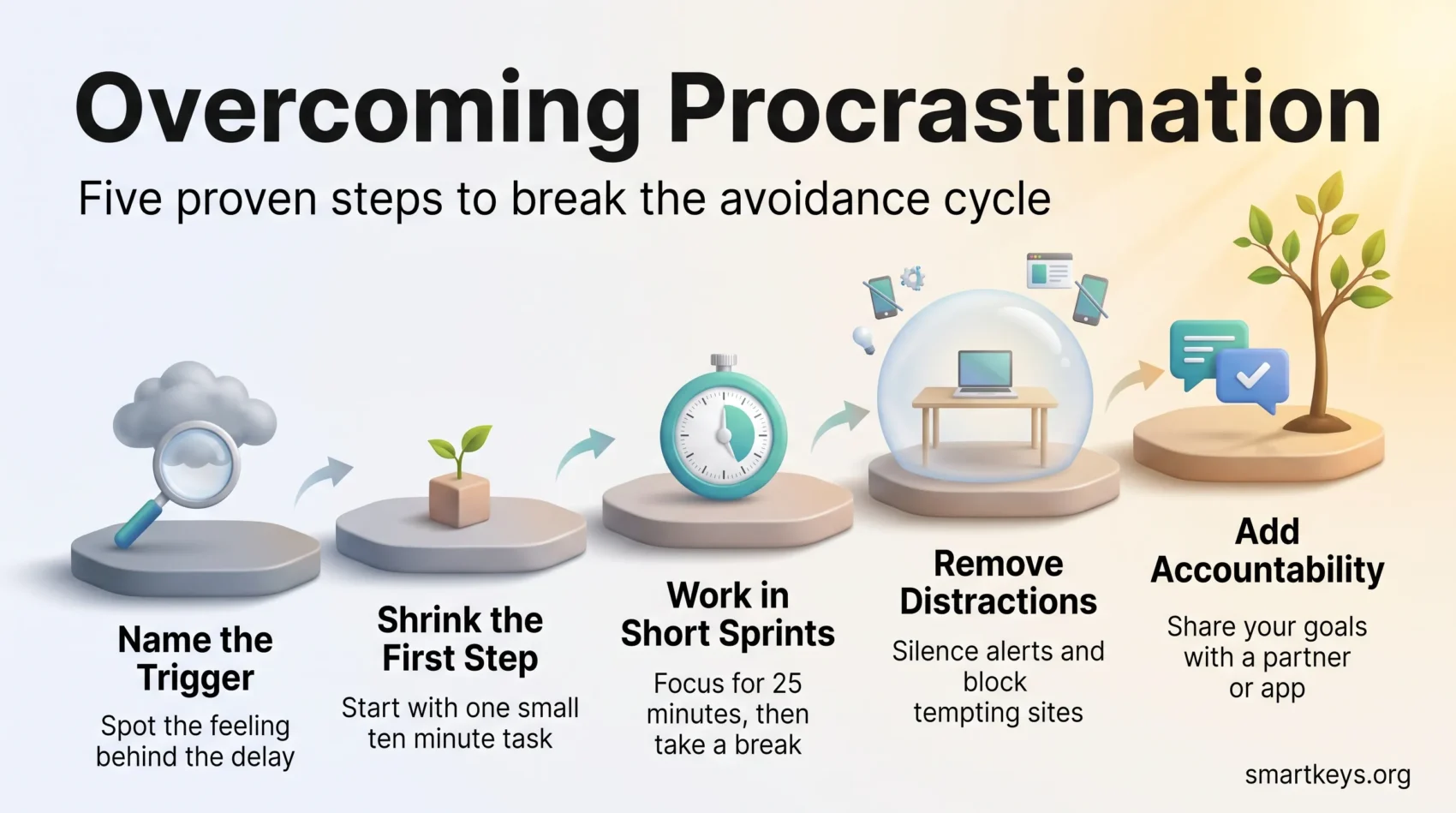
Underneath those patterns sit three recurring emotional signals: overwhelm or burnout that makes starting feel impossible, low motivation tied to self-doubt, and resentment toward goals that don’t feel like your own. Naming which one is driving today’s avoidance helps you pick a strategy that addresses the cause, not just the symptom.
Overcoming Procrastination: Effective Strategies
Change starts with acknowledgment. Admitting “I’m procrastinating right now” interrupts the autopilot and opens the door to a different response.
Admit You Are Procrastinating
Procrastination is common, and recognizing that you’re not alone eases the guilt that keeps the cycle going. From there, focus on the task in front of you rather than the behavior in general: what about this one is triggering avoidance?
Set Achievable Goals
Break large projects into smaller, well-defined steps. Smaller tasks feel less overwhelming and give you more chances to build momentum. Set a realistic deadline for each one, and keep the daily list short: the 1-3-5 rule, one big task, three medium and five small, stops a plan from collapsing under its own ambition.
When you have no idea where to begin, a brain dump helps: write down everything the project involves, then pick the smallest item you could finish in ten minutes. If avoidance always clusters around one dreaded task, try the opposite: Eat the Frog means doing that task first, before the day fills up with easier distractions.
For deeper reading, Whitworth University’s guide to overcoming procrastination outlines additional strategies, including setting specific deadlines and finding an accountability partner, both of which reinforce the habits below.
Time Management Techniques to Beat Procrastination
A structured day removes much of the decision fatigue that fuels procrastination. Three things help most: a reliable routine, short focused sessions, and an honest view of what your tools can and cannot do.
Creating a Daily Routine
Start by identifying your most important tasks for the day. Then:
- Sort tasks by urgency and importance; the Eisenhower Matrix is a quick way to do it.
- Assign realistic time blocks based on your energy peaks, not just your calendar.
- Build in flexibility so one disruption doesn’t derail your whole day.
- Schedule real breaks, because they protect your focus rather than undermine it.
If you would rather not start from scratch, a ready-made daily routine template gives you a structure to adapt. Tracking it for a week or two shows what is actually working, so you can adjust instead of guessing.
The Pomodoro Technique
This method breaks work into short, focused intervals, typically 25 minutes, followed by a 5-minute break:
- Pick one task to focus on.
- Set a timer for 25 minutes and work without interruption.
- Take a 5-minute break when the timer ends.
- After four rounds, take a longer break of 15 to 30 minutes.
Because each session is short, the technique makes intimidating tasks feel manageable: you’re only committing to 25 minutes. Some people find the countdown itself does the work, which is why visual timers suit anyone who loses track of time.
Where AI Tools Help, and Where They Don’t
AI assistants now sit inside most calendars, inboxes and project tools, and they are genuinely useful for the part of procrastination that is friction: drafting the email you have been avoiding, turning a vague project into a task list, or summarizing the document you keep postponing. Getting past a blank page is often the hardest step.
What they cannot do is want the outcome for you. If avoidance is driven by fear of judgment or an unclear goal, a smarter task list will not touch the cause. Use AI to lower the cost of starting, then rely on habits to keep going.
Creating a Distraction-Free Environment
Where you work matters as much as how you work. A well-chosen space reduces the friction that leads to procrastination in the first place.
Choosing the Ideal Work Space
- Quiet: Pick a spot away from foot traffic, loud appliances, or background conversation.
- Comfortable, not too comfortable: You want to focus, not doze off.
- Organized: Keep materials within reach and clutter out of sight.
Experiment with a few spaces to find what actually helps you concentrate.
Minimizing Digital Distractions
- Turn off notifications: Silence non-essential alerts on your phone and computer. A few deliberate rules for managing work notifications beat reacting to every ping.
- Limit social media: Set specific windows for checking it instead of doing so on impulse.
- Use focus apps: Website blockers help you stay put during dedicated work sessions.
Together these changes add up to a calmer workspace with fewer reasons to break your concentration.

Building Accountability to Combat Procrastination
Sharing your goals with someone else, or tracking them with a tool, makes it harder to quietly let a task slide.
Working with an Accountability Partner
Whether it’s a coworker, friend, or study partner, having someone to check in with adds a layer of commitment:
- They can remind you of deadlines and ask about your progress.
- Collaborating on shared goals keeps things interesting and breaks up isolation.
- Talking through obstacles together often surfaces solutions you wouldn’t find alone.
Using Accountability Apps
Digital tools fill the same role when a human partner isn’t available: goal-tracking apps let you visualize progress, task managers add daily structure, and some add a social layer so you can share goals with others.
Whatever method you choose, be willing to forgive past procrastination and focus on the plan going forward. Guilt rarely improves follow-through.
Rewarding Yourself for Progress
A well-designed reward system turns task completion into a positive feedback loop instead of a chore.
Understanding the Importance of Rewards
Rewards separate work time from personal time, which protects you from burnout, and they make it easier to break big projects into milestones, since each one comes with its own small win. Keep them occasional and meaningful, because over-rewarding dilutes the effect. Don’t overlook internal rewards either, like the satisfaction of finishing something well.
Examples of Effective Rewards
- Treat yourself: A favorite snack or small indulgence after finishing a task.
- Short breaks: A walk or a few minutes of reading to reset your focus.
- Social connection: Share your progress with friends or family.
- Personal growth: Spend time on a hobby you enjoy once a deadline is met.
Planning rewards in advance, rather than deciding in the moment, makes them more consistent and more motivating. Temptation bundling takes this one step further by pairing a task you avoid with something you genuinely enjoy, so the two arrive together.

Implementing Mindfulness Techniques
Mindfulness helps you manage the anxiety that often sits underneath procrastination, making it easier to stay present instead of avoiding the task at hand.
Mindfulness Practices to Reduce Anxiety
Meditation, deep breathing, and body scanning help you notice stress without judgment, which makes it easier to address the cause of avoidance rather than its symptoms.
Here are some mindfulness strategies worth trying:
- Meditation: Even a short session can reduce mind-wandering and improve focus.
- Deep breathing: A few slow breaths calm your nervous system before a difficult task.
- Body scanning: Noticing physical tension can reveal stress you hadn’t consciously registered.
The evidence is encouraging rather than magical. In a study published in Psychological Science, a two-week mindfulness course improved working memory and reading comprehension while reducing mind-wandering (Mrazek et al., 2013). Short daily practice is a reasonable place to start, especially if avoidance shows up alongside work stress.
Reflecting on Your Progress
Keeping track of what works, and what doesn’t, is one of the most underrated procrastination tools available.
Journaling Your Journey
A journal gives you space to notice patterns in your own behavior. Over time you’ll see which tasks trigger avoidance and why, whether it’s fear of failure on big projects or perfectionism on small details.
- Record what you accomplished each day, however small.
- Note specific challenges and how you handled them.
- Reflect on the emotions tied to your procrastination triggers.
- Review weekly to track real changes in your habits.
Setbacks become data instead of discouragement, and that shift alone keeps you moving. If a daily entry feels like one more chore, the lighter formats in our guide to journaling for productivity are easier to sustain.
The Importance of Self-Discipline
Self-discipline is what carries you through the moments when motivation runs out. It’s less about willpower in the abstract and more about specific, repeatable habits.
Developing Healthy Habits Over Time
Lasting change comes from small, consistent adjustments rather than one dramatic overhaul. The SMART framework, meaning goals that are specific, measurable, achievable, relevant, and time-bound, gives you the clarity self-discipline depends on. Breaking large tasks into well-defined steps reduces overwhelm and makes steady progress far more achievable.
Staying Committed to Your Goals
Staying on track gets harder when your schedule is genuinely full, and juggling work, family, and other commitments takes real accountability. The Two-Minute Rule helps here: if a task takes less than two minutes, do it immediately instead of letting it pile up. This alone prevents a long list of small tasks from quietly draining your focus.
When your workload is heavy, protecting time to rest matters as much as pushing forward. Checking in on your progress, and adjusting the plan when it isn’t working, keeps your commitment realistic instead of aspirational.
Conclusion
Overcoming procrastination isn’t about willpower alone. It’s about understanding your triggers and building a system that works with your habits, not against them. Set clear, achievable goals, break them into smaller steps, and celebrate the small wins. Techniques like the Pomodoro Method, a distraction-free workspace, and a reliable accountability partner all make consistency easier.
Most importantly: perfection was never the goal. Progress is. Start with one small step today, and let the momentum build from there.
Found this useful?
Make SmartKeys a preferred source on Google, and our articles will surface more often in your Top Stories, AI Overviews, and AI Mode.
Add as Preferred SourceFAQ
What is procrastination?
Procrastination is the voluntary delay of a task you intended to do, even though you expect to be worse off for the delay. Researchers treat it as a failure of self-regulation rather than a time management problem, and it is usually driven by how a task makes you feel: anxious, bored, or unsure where to start. That explains why a better planner rarely fixes it. Putting something off brings immediate relief, and that relief is what reinforces the habit each time.
Why do I procrastinate on tasks I actually care about?
Caring about a task can make it harder to start. When the outcome matters, the fear of doing it badly grows with it, and avoidance protects you from that judgment. Perfectionism works the same way: if only an excellent result counts, a rough first draft feels pointless. Ambiguity adds to it, because a task with no obvious first step gives your brain nowhere to go. The fix is to lower the stakes of starting: define one small concrete action, allow yourself to do it badly, and raise the standard on the second pass.
How do I stop procrastinating on a specific task right now?
Name what you are avoiding, then shrink it. Write down the smallest action that moves the task forward, something you could finish in ten minutes, and set a 25-minute timer to work on nothing else. Close the tabs and silence the notifications you know will pull you away. The goal of the first session is not to finish but to break the inertia, because starting is almost always the hardest part. When the timer ends, take a short break and decide whether to run another round.
Is procrastination bad for your health?
There is evidence that chronic procrastination is associated with worse health, not just missed deadlines. A 2023 study in JAMA Network Open followed 3,525 university students in Sweden and found that higher procrastination predicted worse symptoms of depression, anxiety and stress later on, along with poorer sleep, physical inactivity and greater loneliness. The effects were modest, and an association is not proof of cause, but the direction was consistent. That makes persistent avoidance worth treating as a habit to change.
How do I avoid procrastinating when I work from home?
Working from home removes the external structure that used to hold your day together, so you have to supply it yourself. Keep a consistent start time, work in a space you use only for work, and put a visible plan for the day somewhere you cannot ignore it. Household chores are the classic trap, because they feel productive while letting you avoid the real task, so give them their own slot. A scheduled check-in with a colleague adds the accountability an office provides for free.
Can I really change my procrastination habits over time?
Yes, though it works better as a gradual change than a sudden overhaul. Procrastination is a learned response to uncomfortable tasks, and like any habit it weakens when you repeatedly respond differently. Focus on one trigger at a time, use short structured sessions to build evidence that starting is survivable, and note what actually worked so you can repeat it. Self-forgiveness matters more than it sounds: research on students suggests those who forgive themselves for procrastinating are less likely to do it again next time.