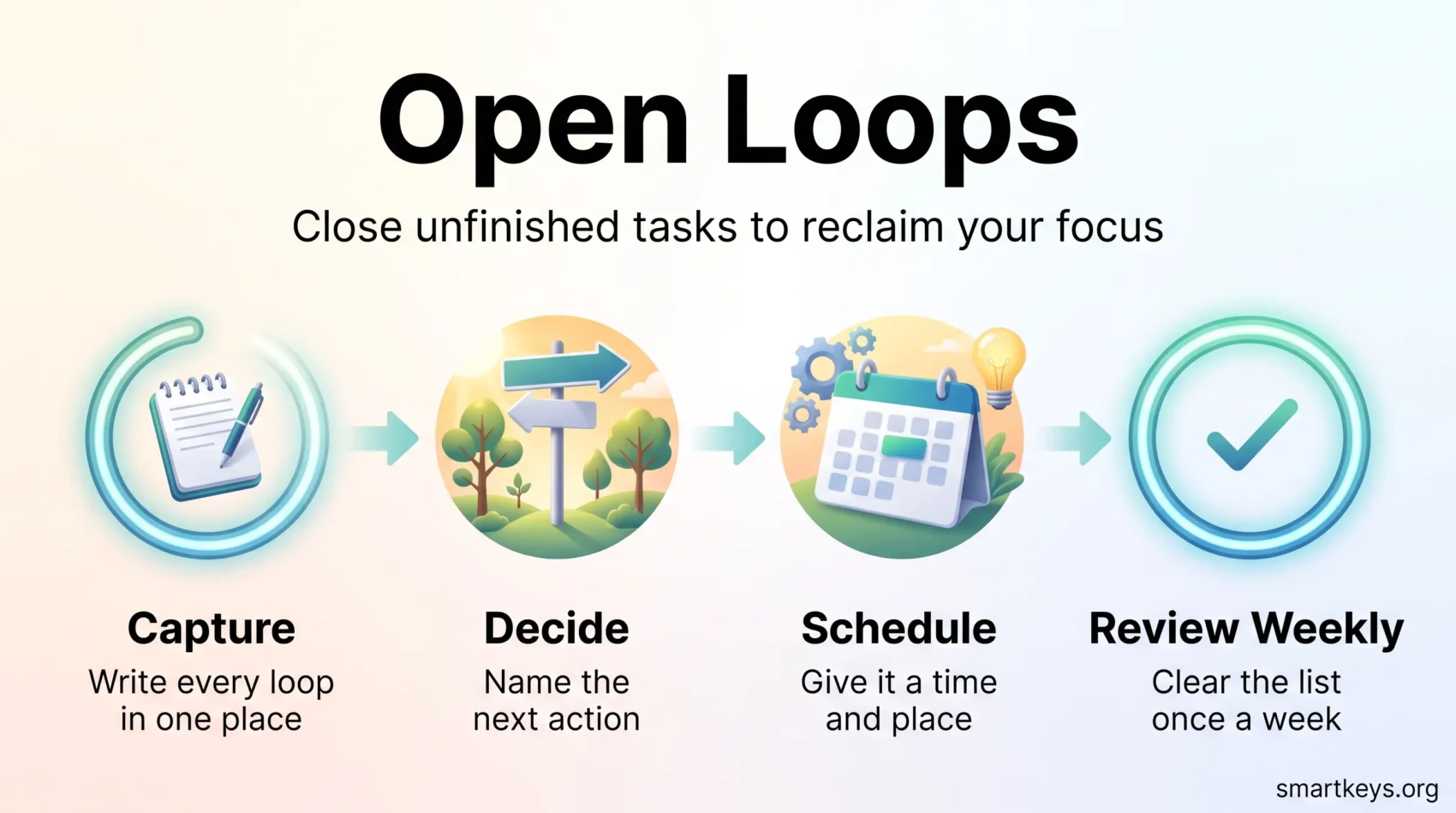
You notice a half-done task and your mind will not let it go. That nagging gap is an open loop: a question your brain has filed as unanswered. It pulls at your attention in small, draining bites while you are supposed to be doing something else.
An open loop is not the same as a long to-do list. A list is written down. A loop is the item you never wrote down, or wrote down without deciding what to actually do about it. The unpaid invoice. The reply you owe a colleague. The half-formed idea from Tuesday’s meeting.
This guide covers what the research really supports about unfinished tasks, why a plan works even when the task stays unfinished, and a three-step routine you can run today to clear the loops that are costing you focus.
Key Takeaways
- An open loop is any unfinished task or decision your brain keeps raising because it has no agreed next step.
- The classic claim that you remember interrupted tasks better does not hold up: a 2025 meta-analysis found no reliable memory advantage.
- What does hold up is the urge to return to interrupted work, and the finding that a specific plan stops the intrusive pull.
- You do not have to finish a task to quiet it. You have to decide when, where and how you will do it.
- A three-step loop routine (capture, decide, schedule) plus one weekly sweep keeps the backlog from rebuilding.
What an open loop actually is
An open loop is anything you have started, promised or noticed, but not resolved. The term comes from two places. In storytelling and copywriting, an open loop is a deliberate gap: a cliffhanger that makes you keep reading. In personal productivity, it is the accidental version of the same thing, and it works against you rather than for you.
The distinction that matters is not how big the task is. It is whether a decision has been made. “Sort out the client contract” is a loop, because your brain has to re-open the question every time it surfaces. “Email Sarah the revised contract on Thursday morning” is closed, even though nothing has been sent yet.
Most loops are small and unglamorous:
- Task loops: work you began and left half done, like a draft with three sections written and two missing.
- Decision loops: a choice you keep postponing, such as which supplier to use.
- Waiting loops: something you handed off and now quietly monitor, like an approval that has not come back.
- Idea loops: a thought worth keeping that has nowhere to live, so you rehearse it instead of filing it.
Waiting loops are the ones people miss. You cannot finish them yourself, so you assume they cost nothing. They still take up attention, because your brain has no way of knowing whether the ball is in your court until you check.
What the research really shows about unfinished tasks
This is the part where most articles reach for the Zeigarnik effect and overstate it. Here is the honest version.
Bluma Zeigarnik reported in 1927 that people recalled interrupted tasks better than completed ones. That claim has not aged well. A meta-analysis published in Humanities and Social Sciences Communications in July 2025 pooled the available studies and found no reliable memory advantage for interrupted tasks. Across 13 studies, interrupted tasks made up 49.16% of everything recalled, which is essentially a coin flip. So the popular line that your brain remembers unfinished work better than finished work is not well supported.
The same meta-analysis found something else that is strongly supported. When people are interrupted and then left alone, they tend to go back to the task. Across 21 studies, roughly 67% of interrupted tasks were spontaneously resumed, well above chance. That is the Ovsiankina effect, named after Maria Ovsiankina. The pull back to unfinished work is real, even if the memory boost is not.
Attention is a limited resource, and that pull is what makes open loops expensive. Your mind returns to the unfinished item at moments you did not choose, which is exactly when it is least useful.
The finding that actually gives you a fix
In 2011, E. J. Masicampo and Roy Baumeister published six experiments in the Journal of Personality and Social Psychology under the title “Consider It Done!”. They found that unfulfilled goals intruded on unrelated work. Participants thinking about unfinished tasks showed more mind-wandering and worse reading comprehension, and unfinished goals interfered with solving anagrams.
Then came the useful part. When participants made a specific plan for the unfinished goal, stating when, where and how they would act, the intrusions disappeared. The goals were still unfinished. The mental noise was not.
Two details are worth keeping. First, the benefit was linked to actually carrying the plan out, so a plan you never intend to follow will not hold up. Second, planning reduced intrusive thoughts without reducing anxiety, which suggests it works by handing the task over to a routine rather than by making you feel better about it.
You do not need to finish the task to quiet it. You need to decide when, where and how you will do it.
Close the loop in three steps
Every loop closes the same way: capture it, decide the next action, then put that action somewhere real. The steps are simple, which is why people skip them and then wonder why the noise comes back.
Step 1: Capture everything in one place
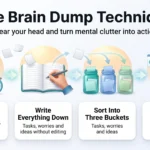
Loops multiply when they live in several places at once, some in your inbox, some on sticky notes, some only in your head. Pick one place and put all of them there. A brain dump is the fastest way to start: set a timer for ten minutes and write down every unfinished thing you can think of, without sorting or judging.
After the initial sweep, the habit that keeps it working is capturing tasks the moment they appear, in whatever tool you already open without thinking. That might be a notes app, a digital note-taking system, or a single running to-do list. The tool matters far less than having exactly one of them.
Step 2: Decide the next action, not the whole project
This is where most lists stall. “Website redesign” is not something you can start on a Tuesday afternoon. It is a project. What you need is the smallest concrete step: “list the five pages that must change”.
That is the next action mindset, and it is what turns a vague worry into something your brain can stop rehearsing. For anything large, break the goal into steps first, then take only the first one into your schedule.
Some loops should close by being dropped rather than done. If an item has sat unstarted for a month and nothing bad happened, it may belong on a not-to-do list. Deciding not to do something closes the loop just as well as doing it.
Step 3: Give the action a time and a place
A next action with no slot is still a loop. Put it on the calendar, or attach it to a recurring block you already hold. Time blocking works well for anything over thirty minutes. Shorter items can be batched into a single admin block, or handled inside a focus sprint with a fixed end time.
If your day is chopped up by other people, a standing focus time policy gives you somewhere reliable to put the work. For the one task you keep avoiding, the eat the frog approach is blunt but effective: schedule it first, before the day fills up.
Capture, decide, schedule. A loop is closed the moment all three are true, not when the work is finished.
Keep the backlog from rebuilding
Closing loops once feels great and lasts about a week. What keeps it going is a short recurring review and a few habits that stop loops from opening unnecessarily.
A weekly review is the workhorse here. Thirty minutes is usually enough to empty your inbox and capture list, check what you are waiting on from other people, and confirm that next week’s commitments have somewhere to sit. Keep a separate “waiting on” list so handed-off items stop nagging you. Reviewing that list once a week is cheaper than checking your inbox for it six times a day.
Three habits prevent loops rather than closing them:
- Finish small things immediately. If an item takes under two minutes, doing it now costs less than filing it.
- Stop opening loops you did not need. Every interruption you accept mid-task creates one. Turning off non-urgent alerts and managing work notifications deliberately cuts the supply at source.
- Work on one thing at a time. Switching between tasks leaves both half done, which is two loops instead of one.
If your capture list has grown past what a weekly review can handle, the problem is usually prioritization rather than volume. Running the list through a prioritization method tells you which loops deserve a slot and which can be dropped. A structured second brain helps if you are storing reference material as well as tasks, though it is overkill for a short list.
Using open loops on purpose in writing
The same mechanism that costs you focus is what writers use to hold attention. Understanding both sides is useful, because the ethical line is easy to cross.
An open loop in writing is a question raised early and answered later. A headline that poses a specific problem, a first line that makes a claim before proving it, a section that ends with a genuine “but”. Each one creates a small tension the reader wants resolved.
Three rules keep it honest:
- Match the payoff to the promise. If you tease a big reveal, deliver a substantial answer. A mismatch reads as clickbait and costs you the next visit.
- Close quickly. Most loops should resolve within one to three paragraphs, or inside the section that raised them. Save the longer arc for a series where you have said so.
- Track what you promised. When editing, list every question the piece raises and check that each one gets answered. Anything unanswered is a loop you left in the reader’s head.
Internal links work the same way when used well. Tease a question the current article will not answer in depth, then link to the piece that does. That is helpful. Linking to something that does not answer the teased question is the written equivalent of leaving a task half done.
Common mistakes
Most loop systems fail for one of four reasons.
Capturing without deciding
A list of 80 vague items is not a closed loop system. It is the same anxiety in a nicer font. If an entry does not name an action you could start, it has not been processed. Work through the list in batches and give each item a verb.
Treating planning as finishing
The 2011 research found that the benefit of planning was tied to people actually executing the plan. If you plan the same task every week and never do it, the loop stays open and you have added a ritual on top of it. Either schedule it properly or drop it.
Confusing busy with closed
Clearing twenty small loops can feel productive while the one that actually matters stays untouched. If your big project never moves, protect a block of deep work for it before you touch the small stuff.
Holding it all in your head
Trying to remember loops instead of writing them down is the most common failure and the easiest to fix. A written list is not an admission that your memory is poor. It is what frees your memory for the work in front of you. Good task management is mostly this one habit, repeated.
Conclusion
Open loops are cheap individually and expensive in bulk. Each one is a question your brain has not been given an answer to, so it keeps asking at inconvenient moments.
The research points to a specific fix rather than a vague one. Finishing everything is not realistic, and the evidence says you do not need to. Deciding when, where and how you will act removes the intrusive pull, provided you then do what you decided.
Pick one loop right now. Name the next action in a verb and a noun, give it a slot this week, and write both down. Then do the same for the next one. That is the whole method, and it works better than any amount of trying harder to concentrate.
Found this useful?
Make SmartKeys a preferred source on Google, and our articles will surface more often in your Top Stories, AI Overviews, and AI Mode.
Add as Preferred Source