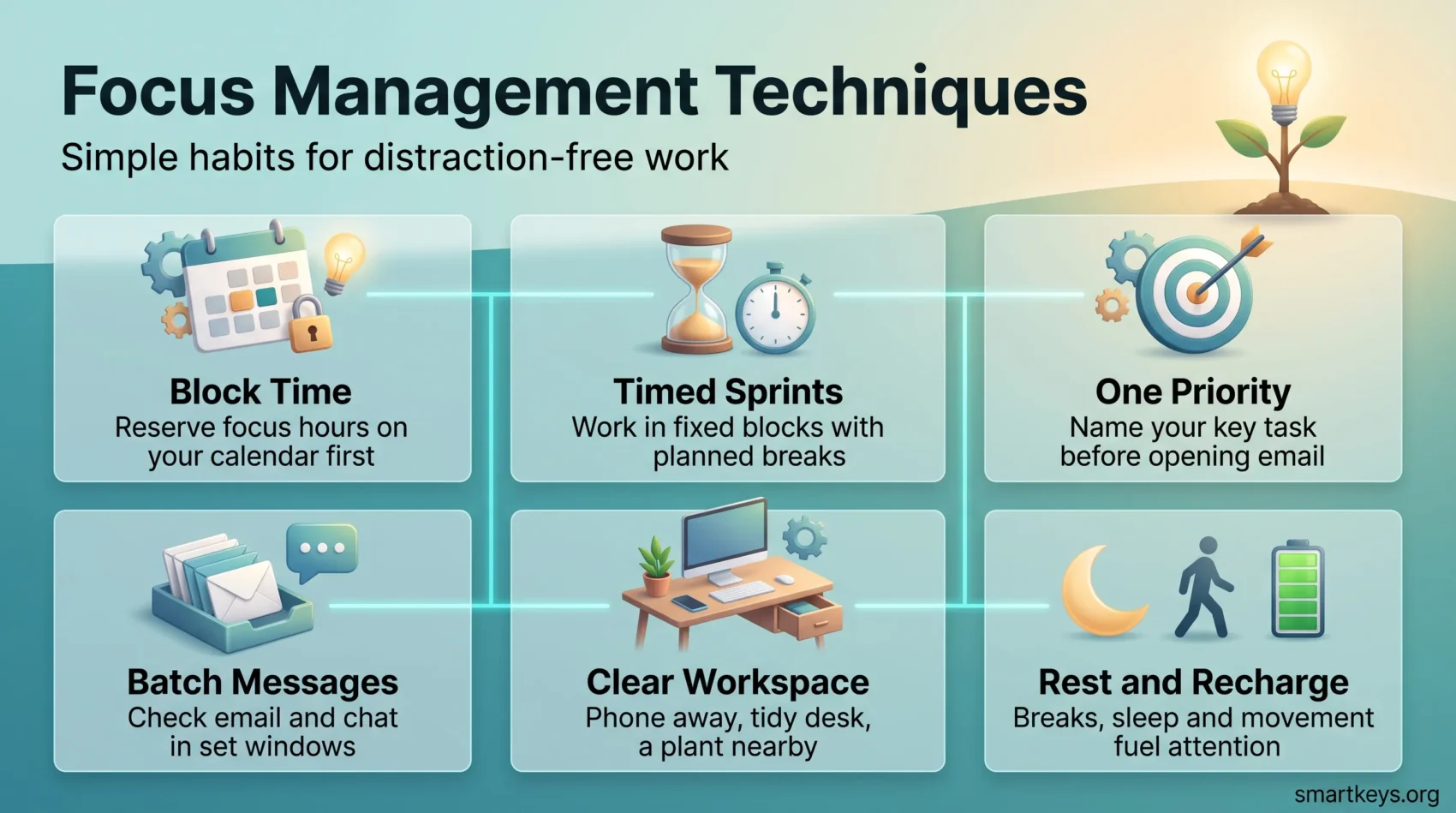
Focus is a skill you can build, not a personality trait you either have or lack. Focus management is the set of deliberate choices that make concentration easier: when you do demanding work, where you sit, what you let interrupt you, and how you recover between blocks.
This guide gives you seven techniques. Each one is small enough to test in a single week, and each targets a different reason attention breaks down. Some are about your calendar, some about your desk, and some about sleep and movement. Read the list, then pick one and run it for five working days before adding a second.
A short note on evidence first. Some claims about focus get repeated so often that they sound like settled science when they are not. Where a number below is solid, this guide names the study. Where it is not, it says so.
Key Takeaways
- Concentration is trainable. Treat it as a habit you build, not a mood you wait for.
- Reserve focus time on the calendar first; everything else fills the gaps.
- Batch email and messages into two or three windows instead of checking all day.
- Even very brief interruptions raise your error rate, so protecting a block matters more than working faster inside it.
- Sleep, movement and steady meals do more for attention than any app.
- Track one number, such as minutes of uninterrupted work, so you know whether a change helped.
What focus management actually means
Before the techniques, it helps to separate two words that get used interchangeably.
Attention is your mind’s gatekeeper. It decides, moment by moment, which signals get processed and which get ignored. Focus is narrower: it is sustained attention on one thing while everything else is filtered out. You can have plenty of attention and almost no focus, which is what a day of rapid task switching feels like.
Cognitive control is the term researchers use for the system that ties the two together. It holds your goal in mind, keeps the next step available in working memory, and lets you resume where you left off after a break. When cognitive control is under strain, you do not simply feel scattered. You start dropping steps.
Three kinds of distraction, and why the difference matters
Most focus advice fails because it fixes the wrong kind of distraction. There are three:
- Sensory: noise, movement in your peripheral vision, a cluttered desk. Fixed by changing the environment.
- Digital: notifications, open tabs, a phone within reach. Fixed by changing rules and settings.
- Internal: worry, an unfinished task circling in your head, a decision you keep postponing. Fixed by writing it down, not by trying harder.
Internal distraction is the one people underestimate. Unfinished work keeps intruding on your thinking until you have a concrete plan for it, which is why capturing open loops in a list frees up more attention than closing another browser tab.
“Name the kind of distraction first. The fix follows from that.”
The 7 focus management techniques
1. Block time on the calendar before someone else claims it
Time blocking means reserving named hours in your calendar for one kind of work, then treating that entry as a real commitment rather than a suggestion. If your calendar is visible to colleagues, an empty slot reads as availability. A blocked one does not.
Start with two blocks a week, 90 minutes each, for the work that actually moves a project forward. Put them where your energy is reliably good rather than wherever there happens to be a gap. During the block, close your email client and move your phone out of arm’s reach.
The practical version of this is set out in the timeboxing playbook, which covers how to size blocks and what to do when one gets hijacked. If you want to go further and defend long stretches for cognitively demanding work, see the guide to deep work.
2. Work in timed sprints with a defined end
A sprint is a fixed stretch of work followed by a fixed break. Knowing when you get to stop lowers the friction of starting, which is usually the hard part.
The best known version is the Pomodoro Technique, developed by Francesco Cirillo: 25 minutes of work, a 5 minute break, and a longer break after four rounds. Twenty five minutes suits shallow or dreaded tasks well. For analytical or creative work it is often too short, because you stop just as you have loaded the problem into your head.
If that describes your work, try 60 to 90 minute blocks instead. That length lines up with the body’s natural energy cycles and with the longer sessions described in the focus sprints guide. Pick one length, run it for a week, and adjust from what you observe rather than from what sounds disciplined.
3. Name one priority before you open your inbox
Most days go sideways in the first twenty minutes. You open email, absorb five other people’s priorities, and never get back to your own.
The fix is a single sentence written before you open anything: what is the one task that, if finished today, makes the day worthwhile? Everything else is a supporting list, and the list should be short enough to finish. Two techniques make this concrete. Eat the frog means doing the hardest or most avoided task first, while it still has your best attention. Parkinson’s Law is the observation that work expands to fill the time available, so giving a task a tighter deadline than it strictly needs often gets it finished.
If two tasks look equally important, pick the one with the nearest real consequence rather than the one that feels most urgent.
4. Batch communication into windows
Checking messages continuously is the single most expensive habit on this list, because it fragments every block you have protected.
Pick two or three windows a day for email and chat, and tell your team which ones they are. Expectations matter more than settings here: colleagues accept a slower reply if they know when it will come. Inside a window, process each item once by deciding to reply, delegate, defer or delete. Saved templates cut routine replies from minutes to seconds.
For the mechanics of setting this up, see email batching. And before any of that, turn off what you can: this guide to managing work notifications covers which alerts are worth keeping.
5. Design a workspace that makes focus the default
A good workspace removes decisions. You sit down and the only obvious thing to do is the work.
Three changes do most of the job. Put the phone in a drawer or another room during focus blocks. Clear the desk surface of anything unrelated to the current task. Fix the basics of chair height, screen distance and lighting, because low-grade physical discomfort drains attention slowly enough that you never attribute it correctly.
There is decent evidence for one addition: in field experiments run by researchers at the University of Exeter and published in the Journal of Experimental Psychology: Applied, adding plants to previously bare offices raised measured productivity by up to 15%. It is one of the cheaper changes available.
For the full setup, see workspace optimization. On the digital side, a site blocker removes the decision entirely during a block; the guide to website blockers compares the options.
One caveat on the phone. The well known finding that a phone sitting face down on the desk reduces your available thinking capacity has been tested repeatedly since. A 2023 meta-analysis found the effect is real but small, and clearest for memory rather than attention. Putting the phone away is still worth doing, mostly because it removes the temptation to pick it up.
6. Take breaks on purpose, before you need them
Attention decays over a long block whether you notice it or not. A scheduled pause resets it; pushing through does not.
Set the break before you start, so it is not a negotiation with yourself later. Two to ten minutes is enough. What you do with it matters: standing up, walking, stretching or stepping outside restores attention, while scrolling a feed keeps your mind in the same overloaded state it was already in.
Short outdoor breaks are especially effective, and a change of scenery signals to your brain that one block has ended and another can begin. The evidence on timing and length is summarised in short breaks and work focus.
On background sound: instrumental music or ambient noise generally works, lyrics generally do not. Research published in the Journal of Cognition found that music with lyrics interferes with cognitive tasks in a way instrumental music does not, because the words compete with the same language processing your work is using.
7. Protect sleep, movement and steady meals
This is the least exciting technique and the one with the largest effect. No calendar system compensates for six hours of sleep.
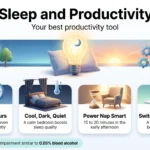
Sleep. Consistent timing matters more than any single night, and late caffeine costs more than most people assume. A screen curfew before bed is commonly recommended, though the evidence on blue light specifically is weaker than the advice suggests; the bigger problem is usually that screens keep you awake and engaged, not the wavelength. See sleep and productivity for what the research supports.
Movement. A brisk 20 to 30 minute walk lifts alertness for the hours afterwards, and it is a better use of a mid-afternoon slump than another coffee. The evidence is reviewed in exercise and productivity.
Food. Meals that keep blood sugar steady, built around protein, fibre and unsaturated fats rather than fast carbohydrates, avoid the crash that turns the hour after lunch into wasted time. See nutrition and productivity.
“Seven techniques, one rule: change one thing at a time and keep it long enough to judge.”
What interruptions actually cost
Two figures get quoted constantly in articles about focus. One holds up better than the other.
The claim that it takes 23 minutes and 15 seconds to return to a task after an interruption traces back to interviews with Gloria Mark, the University of California, Irvine researcher who has studied workplace interruption for two decades. It does not appear in her published papers, and the study most often cited for it measured something different. Treat it as a memorable illustration rather than a measurement.
What is documented is more useful anyway. Mark’s research on screen behaviour found that the average time office workers spend on one screen before switching fell from about two and a half minutes in 2004 to roughly 47 seconds by the late 2010s, with half of all attention periods lasting 40 seconds or less. That is the environment your focus techniques have to survive.
On errors, researchers at Michigan State University ran an experiment published in the Journal of Experimental Psychology: General in 2013. Interruptions of just 2.8 seconds, about the time it takes to type two letters, doubled the rate at which participants lost their place in a sequence. The lesson is not that interruptions are slow. It is that they are inaccurate, and the cost lands on quality before it lands on the clock.
This is also the strongest argument against working on several things at once. The research on why is collected in the science behind multitasking.
A two-minute reset for when attention slips
You will lose focus mid-block. The useful question is how quickly you get back.
Try this sequence. Stop and name what pulled you away in one word: planning, worrying, remembering. Naming it stops the loop without turning it into a debate. Then take four slow breaths, longer on the exhale than the inhale. Then look at your written next step and start with the smallest possible version of it.
The whole thing takes under two minutes and works because it gives your attention a defined place to return to. More options are in breathing techniques for work stress, and if the underlying problem is that your attention is fragmented across devices all day, a digital detox routine addresses the cause rather than the symptom.
How managers protect a team’s focus
Individual focus techniques fail inside a culture that rewards instant replies. If you lead a team, a few rules do more than any advice you can give people one at a time.
- Set shared no-meeting windows so heads-down time is a team norm rather than a personal quirk. The mechanics are in the guide to a focus time policy.
- Review the recurring meetings on the calendar once a quarter and cancel the ones nobody can justify. This alone often reclaims several hours a week per person.
- State response-time expectations explicitly. “Within four hours” removes more anxiety than any status indicator.
- Model it. If you send messages at 11pm, your policy says one thing and your behaviour says another.
- Measure output, not visible activity. Availability is easy to fake and expensive to reward.
Measure whether any of this worked
Pick one number and track it for two weeks. Three candidates work well: minutes of uninterrupted work per day, priority tasks finished, or a simple 1 to 5 energy rating at the end of the afternoon.
Log it in whatever you already use. The point is not precision, it is noticing a trend you would otherwise miss. Review once a week and ask three questions: what improved, what drifted, and what one change is worth trying next week.
If you want a fuller picture of where your hours actually go, log what you do in 30 minute slots for three days before changing anything. It often reveals that the problem is not focus at all, but commitments nobody has questioned in a year.
Conclusion
Seven techniques is more than anyone should attempt at once. The realistic version is this: choose the one that matches your biggest problem, run it for a week, and measure one number.
If your calendar is the problem, start with blocking. If your inbox is the problem, start with batching. If you are fine until three in the afternoon and useless afterwards, start with sleep and movement rather than any productivity system, because no amount of scheduling fixes a tired brain.
The compounding comes from keeping what works and dropping what does not. If you want a shortlist of aids that support the habits above, from timers to blockers, see the roundup of focus tools.
Found this useful?
Make SmartKeys a preferred source on Google, and our articles will surface more often in your Top Stories, AI Overviews, and AI Mode.
Add as Preferred Source