Parkinson’s Law says that work expands to fill the time available for its completion. Cyril Northcote Parkinson coined the idea in a 1955 essay for The Economist, and it still explains why a 20-minute decision reliably consumes a 60-minute meeting slot.
The fix is not working harder. It is giving the work less room. When you shorten a deadline, you force a choice about what actually matters — and the polishing, the second-guessing, and the late start disappear on their own.
This guide covers the practical version: how to set self-imposed deadlines, how far you can safely compress an estimate, which meeting defaults to change, and the specific situations where a tighter deadline makes the outcome worse rather than better.
Key Takeaways
- Work expands to match the time you allow, not the effort the task requires.
- Compressing an honest estimate to roughly 50–70% is the practical sweet spot.
- Timeboxing and 25/5 Pomodoro cycles put a hard cap on a task before you start.
- Change the default: 25- and 50-minute meeting slots instead of 30 and 60.
- Agree on a Definition of Done first, or scope will drift back in.
- Pressure follows an inverted-U curve — past a point, tighter deadlines cost quality.
- Never compress work that needs research depth, safety checks, or regulatory review.
What Is Parkinson’s Law?
Parkinson’s Law is the observation that a task will stretch to occupy however much time you set aside for it. Give an errand a full afternoon and it takes an afternoon. Give it 40 minutes and it usually still gets done.
The origin: a 1955 essay, not a scientific law
Cyril Northcote Parkinson was a British naval historian. Writing satirically in The Economist, he noted that Admiralty bureaucracy kept growing at a steady annual rate even as the fleet and its personnel shrank. He later expanded the idea in his book Parkinson’s Law: The Pursuit of Progress.
His illustration is the memorable part: an elderly woman whose only task for the day is mailing a postcard spends an hour finding the card, half an hour looking for her glasses, 90 minutes composing it — and fills the entire day with a five-minute errand.
“It is a commonplace observation that work expands so as to fill the time available for its completion.” — Cyril Northcote Parkinson, 1955
What the research actually shows
Parkinson wrote satire, but the underlying behaviour has been tested. A classic experiment published in Organizational Behavior and Human Performance asked participants to judge sets of photographs. One group was told partway through that the final set had been cancelled — and immediately slowed down on the set in front of them. The effect held up in replications.
The mechanism is simple: people estimate how much time is available, not how much time the work needs. A generous deadline reads as a signal that the task is large, so effort is paced to match.
Treat it as a reliable behavioural tendency rather than a physical law. That distinction matters, because it also means the effect has limits — which the compression section below covers.
What Parkinson’s Law Looks Like in 2026
The modern calendar is a near-perfect machine for letting work expand. The numbers from the past year make the pattern concrete:
- 15.4 hours vs. 12.1 hours. Microsoft’s Work Trend Index puts the average knowledge worker’s weekly meeting time above their weekly uninterrupted focus time — more time talking about work than doing it.
- ~20 minutes. The median uninterrupted work block in 2026, according to aggregated meeting-benchmark data. Most people now get two to three genuine focus hours per day.
- 71%. Share of employees in Atlassian’s State of Teams 2026 who describe at least some recurring meetings as unproductive; roughly half could be replaced with an async update or a document.
- +35%. Self-reported productivity increase associated with introducing two no-meeting days per week, in an MIT Sloan Management Review finding replicated in 2026 — the strongest argument for a team-wide focus time policy.
Read that against Parkinson’s Law and the diagnosis is obvious. The default 30- and 60-minute calendar slot is an allotment nobody chose deliberately — and the work reliably grows to fill it. If your calendar is the bottleneck, a structured meeting audit is usually a faster win than any personal productivity tweak, and deliberate time buffering stops small overruns from cascading through the rest of the day.
Why Work Expands: Four Root Causes
Hidden habits and clunky processes quietly stretch simple tasks into long projects. Four causes account for most of it.
1. Distant deadlines invite procrastination
When the due date sits far off, you delay starting and inflate how hard the task looks. A short job starts to feel complex, and the real work slides toward the end of the window anyway. This is often called student syndrome — and it is a separate problem from Parkinson’s Law, though the two usually appear together.
2. Supply of time drives demand for effort
The more room you give a task, the more work appears to fill it. Effort scales to the allotment, not to the need. Extra planning, extra revisions, and extra opinions arrive to occupy the space.
3. Perfectionism without a stopping rule
Without a defined “good enough” threshold, there is no signal to stop. Knowledge and creative work has no natural endpoint, so perfectionism continues until the calendar intervenes.
4. Bureaucracy and bike-shedding
Approvals, sign-offs, and status meetings pad every timeline. Teams also bike-shed — spending 40 minutes on the easy cosmetic choice while the hard decision waits.
When people have a lot of room, they polish small parts and delay the big decisions.
How to Use Shorter Deadlines: A 5-Step Framework
Short, clear deadlines turn vague chores into concrete steps you can actually finish. Work through these in order.
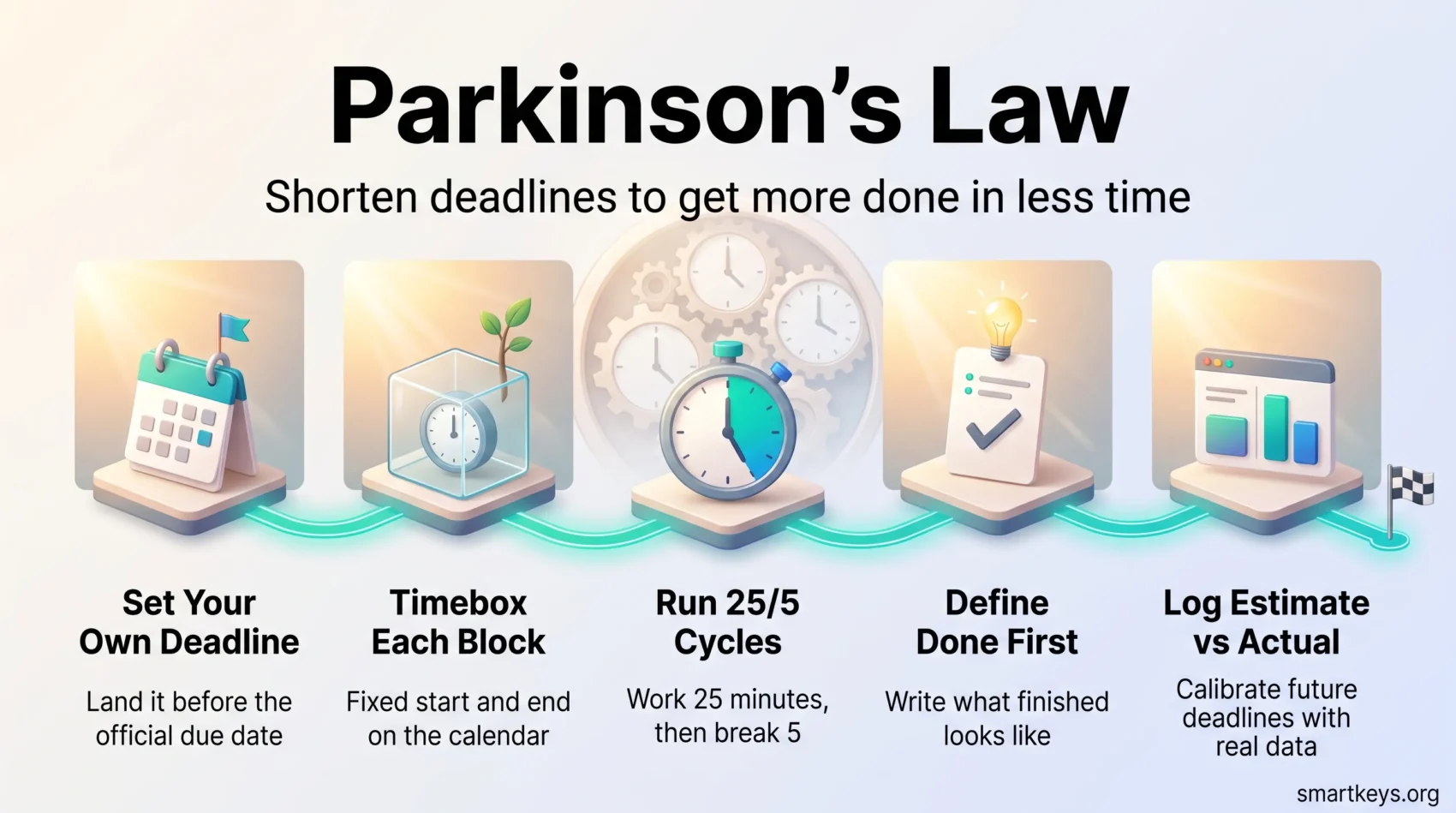
Step 1: Estimate honestly, then set your own deadline
Map the requirements and estimate the real effort — and account for the planning fallacy, which makes almost everyone underestimate. Then set a personal delivery date that lands before the official one — often a two-week window for a focused sprint. The self-imposed deadline is the one that creates urgency; the official one only creates a cliff.
Step 2: Timebox each block
Give every task a fixed slot on the calendar with a defined start and end. Timeboxing makes spillover visible instead of invisible. Reserve your longest blocks for deep work and batch admin into a single short slot — the timeboxing playbook walks through block sizing and hard vs. soft constraints in detail.
Step 3: Run 25/5 cycles inside the block
Work 25 minutes, break 5. After four rounds, take 15–30 minutes off. The Pomodoro Technique works here because each interval is a miniature deadline — too short for the work to expand into. Pair it with the two-minute rule so tiny actions never accumulate into a backlog.
Step 4: Split the work and define “done”
Break the project into subtasks you can tick off in a single sitting. Write down what finished looks like before you start. A concrete acceptance criterion is what stops perfection creep — vague goals always expand.
Step 5: Log estimate vs. actual
Keep a one-line record of what you planned and what it took. After two or three weeks you will have real calibration data, and your compressed deadlines stop being guesses.
Tip: The log is the highest-leverage step and the one most people skip. Without it, padded estimates quietly become self-fulfilling floors.
How Short Is Too Short? The 50–70% Rule
Compression works up to a point, and then it reverses. This is the part most Parkinson’s Law advice leaves out.
Performance under pressure follows an inverted-U curve, first described by Robert Yerkes and John Dodson in 1908. Too little pressure produces drift and phone-checking. Moderate pressure produces sharp focus and fast decisions. Past a threshold, more pressure produces anxiety, tunnel vision, and a spike in errors.
The practical translation: take your honest estimate and cut it to roughly 50–70%. A task you genuinely think needs four hours becomes a two-and-a-half-hour block. That is tight enough to force prioritisation and loose enough to preserve quality.
- Routine, well-understood tasks tolerate the aggressive end — 50% is often fine.
- Novel or creative work sits at the gentle end — 70–80%, with a review checkpoint.
- Anything below 50% of a calibrated estimate stops being a constraint and becomes a quality problem.
Compression also fails when nothing has started yet. If the pressure arrives on day nine of a ten-day task, it produces panic, not focus. Shorter deadlines only work when they are paired with an early start.
Plan and Prioritise to Beat the Clock, Not Fill It
A tight plan makes trade-offs obvious and keeps a team from drifting into low-value work.
Build a SMART plan with milestones
Turn the ambition into specific milestones with dates and acceptance criteria. Add short checkpoints — 15-minute reviews are enough — so problems surface while they are still cheap to fix.
Prioritise by impact, not by urgency
Use a simple board with three columns: blocked, next, done. Decide what belongs in “next” using impact, not whoever asked most recently. The 80/20 rule is the fastest filter here, and eating the frog puts the hardest item in your best hour rather than your last one.
Agree on a clear Definition of Done
A shared Definition of Done locks scope, cuts rework, and prevents the post-deadline polishing that adds almost nothing. Without it, a shortened deadline just moves the expansion to after delivery.
Clarify roles with DACI or RACI
Name a Driver, an Approver, Contributors, and who stays Informed. When decision rights are explicit, work stops queuing behind ambiguous approvals — one of the biggest sources of silent timeline padding.
Applying Parkinson’s Law Across a Team
Tightening the schedule turns vague plans into clear, testable steps.
Marketing: replace month-long drift with timeboxed sprints
Turn a month-long brief into two weeks of focused sprints with fixed review dates. Size the work together, agree the deadline as a group, and hold polishing until after the first review.
Design: get early feedback to avoid endless tweaks
Show rough drafts early and schedule short check-ins. Fast feedback prevents the ambiguous revision requests that stretch a project indefinitely.
Rethink the 40-hour week around outcomes
Shift the conversation from hours logged to deliverables due. One genuinely productive day beats a week of scattered attention — the case for a shorter workday rests almost entirely on Parkinson’s Law.
Respect maker and manager rhythms
A deadline that works for a manager’s day of 30-minute slots will wreck a maker’s morning. Match the constraint to the schedule type — the maker vs. manager schedule distinction explains why the same meeting costs one person 30 minutes and another an entire afternoon.
Advanced Techniques to Maintain Momentum
Change your meeting defaults
Set 25 and 50 minutes as the default instead of 30 and 60. Universities and large employers have made this switch org-wide, and it reclaims recovery time while giving every discussion a visible cap. Add an agenda and a hard end time, then close on the dot.
Limit work in progress
Fewer active items means faster completion and fewer errors. Every parallel task carries a switching cost, which is the core argument for monotasking — and a lean board makes bottlenecks visible instead of theoretical.
Protect the block itself
A timebox only works if it survives contact with your notifications. Silence them, clear the desk, and use website blockers during deep work. Schedule your hardest block against your natural peak — energy management beats willpower for deciding when the tight deadline should land.
Set micro-goals and close the loop
Before each block, write one sentence describing what done looks like. Afterwards, note start/stop/continue. Reward small wins — the habit sticks far better than the technique does.
When You Should Not Shorten a Deadline
Compression is a default, not a rule. Leave realistic timelines in place when:
- The work requires genuine research depth — where premature convergence produces a confidently wrong answer.
- Safety, legal, or regulatory review is involved and errors are expensive or irreversible.
- The task depends on external parties whose response times you do not control.
- The team is already at capacity — adding pressure to a saturated schedule produces burnout, not focus.
- You have no calibration data yet. Compress an estimate you trust, not one you invented.
Your 7-Day Starter Plan
- Day 1: Pick one recurring task and write down how long you think it takes.
- Day 2: Time it honestly. Do not change anything yet.
- Day 3: Cut the measured time by 30% and timebox it at that length.
- Day 4: Change your calendar default to 25 and 50 minutes.
- Day 5: Write a one-sentence Definition of Done before every block.
- Day 6: Cap your work in progress at three active items.
- Day 7: Review your estimate-vs-actual log and set next week’s compression ratio from real data.
Conclusion
Tighter deadlines sharpen decisions and remove the room where needless extras accumulate. An observation Parkinson made about naval bureaucracy in the 1950s still describes the average 2026 calendar with uncomfortable accuracy.
The takeaway is practical: reduce the time you allow, and the work contracts to fit. Use self-imposed deadlines, timebox each block, run short cycles, and agree on what “done” means before you start. Compress to 50–70% of an honest estimate, and leave the deep-research and high-stakes work alone.
Start with the smallest possible version. Pick one task tomorrow, cut its slot by a third, and see what turns out to have been optional all along.
Found this useful?
Make SmartKeys a preferred source on Google, and our articles will surface more often in your Top Stories, AI Overviews, and AI Mode.
Add as Preferred Source